Relationship banking at scale is the promise every community and regional bank makes, and most struggle to keep. Picture a relationship manager with 150 relationships. This quarter they will have time to proactively review a handful: the biggest deposit relationships, the most complex credits, the one a competitor is circling. The other 140 or so will hear from the bank when something breaks, a renewal comes due, an overdraft posts, or a complaint escalates.
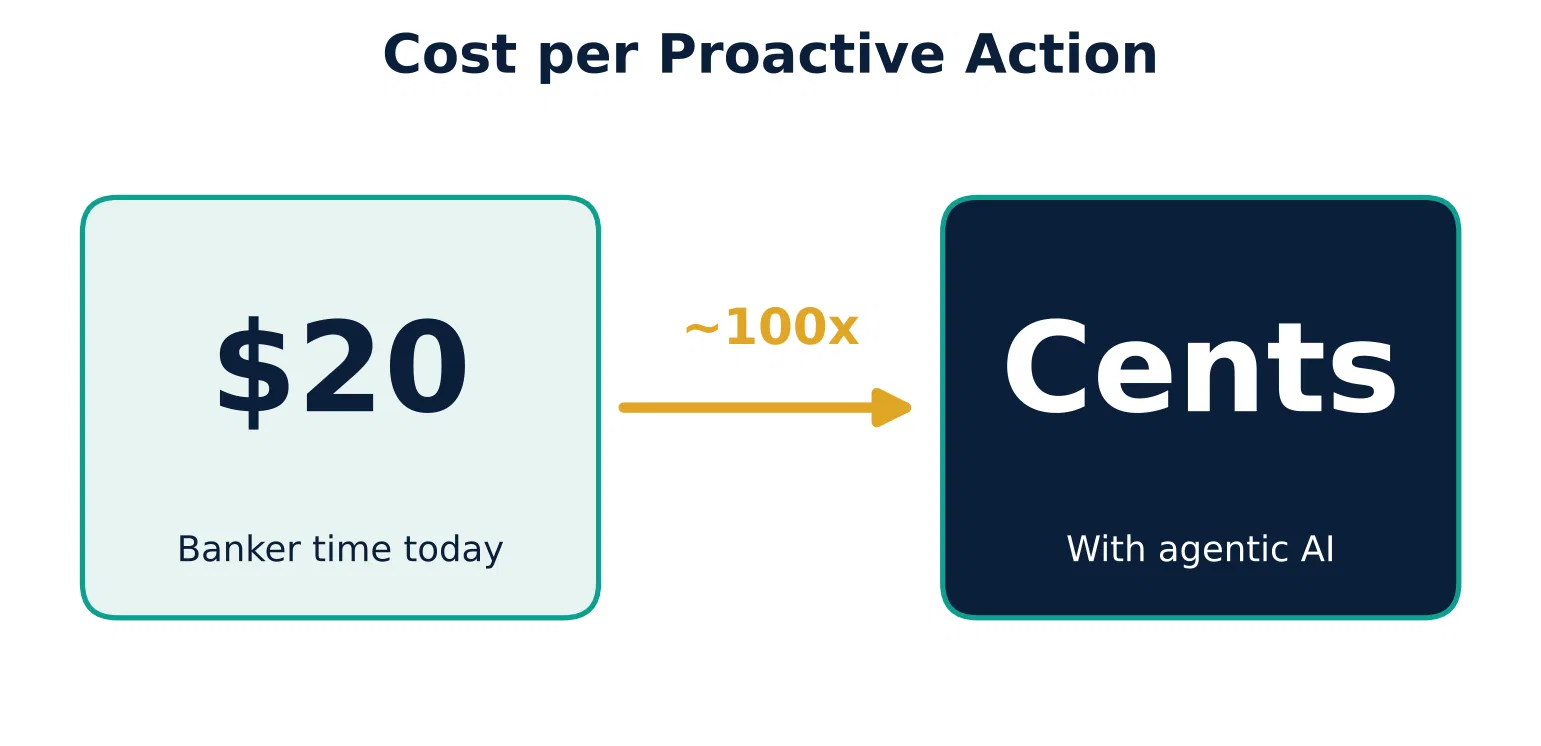
No one decided to run the portfolio this way. It is what arithmetic produces. Each high-touch action costs about $20 of banker time, and $20 multiplied across a whole book of business is more than any bank has ever budgeted for proactive service.
That makes this a cost problem, not a people problem. Cost problems have a different kind of solution: change the cost per action, and the whole coverage model changes with it.
The top-5% trap, quantified
The top-5% trap is when a bank's best clients get proactive, personal coverage and everyone else gets reactive service, because banker hours are finite and every proactive action costs real time. To see why it persists, price the unit of work.
What a "high-touch action" really costs
A high-touch action is one proactive, client-specific intervention: a portfolio review, a treasury check-in, a credit-line conversation, pre-renewal outreach, or a tailored advisory note. A campaign email does not count. The test is whether the client would recognize it as meant for them.
The cost is invisible because you pay for it in time rather than on invoices. Here is a transparent model. The inputs are illustrative; replace them with your own.
Ten minutes is a floor, not an average. A real portfolio review or treasury analysis takes far longer. Even at the floor, the numbers compound quickly.
Take a bank with 2,000 commercial and business relationships, roughly 13 bankers like the one above. Set a modest goal of four proactive touches per relationship per year. That is 8,000 actions, about $160,000 of banker time, and roughly 1,330 hours. The dollar figure is not what stops it. The hours are. Those 1,330 hours have to come out of a week that is already full of credit work, servicing, and internal reporting, and no bank has a budget line called "proactive outreach preparation.
Where the capacity goes
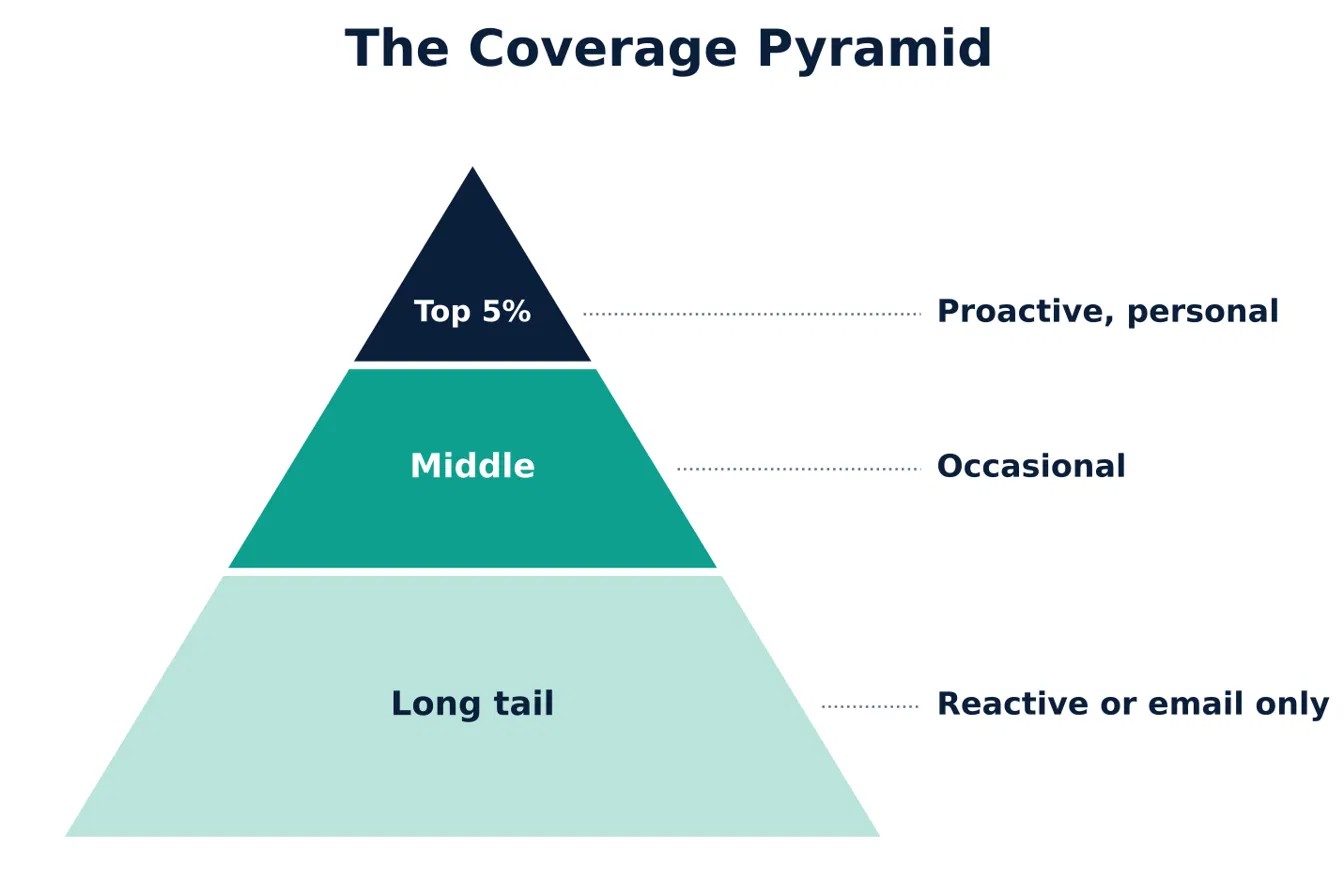
Finite hours get rationed, and rationing produces a predictable shape. The top 5% of relationships by revenue or deposits get concierge care: a named banker, scheduled reviews, proactive calls. The middle of the book gets occasional, event-driven attention. The long tail gets reactive service and whatever the marketing calendar sends.
What the other 95% actually receive
For most of the book, the client coverage model looks like this: unsegmented marketing emails, an annual statement, and contact at renewal or when a problem surfaces. Few would describe that as relationship banking.
It is not negligence. Under a $20 unit cost, concentrating attention on the highest-value relationships is the correct decision. The decision only looks wrong once the unit cost changes.
The hidden cost of neglect
Neglect costs a bank deposits, growth, and competitive position, and none of it shows up as a line item. The unattended 95% does not stay still. It erodes in three directions.
Quiet attrition
SMB banking relationships rarely end with a formal exit. Balances drift while the operating account stays open. Coalition Greenwich found that about one in ten small and mid-size businesses historically change banks each year, that roughly 15% had switched over the prior 12 months, and that 35% would consider switching or adding a new bank (August 2024). About one-third of those that moved cited weaker banker performance, including relationship managers' visit frequency, responsiveness, and lack of strategic guidance.
35% of small and mid-size businesses would consider switching banks or adding a new one. (Coalition Greenwich, 2024)
Missed growth
Treasury management needs, credit-line expansion, and deposit opportunities sit unnoticed in the unattended book. They are not lost to a competitor so much as never surfaced. McKinsey's Global Banking Annual Review 2025 found only 4% of new U.S. checking accounts now come from existing customers, down from 25% in 2018. Cross-selling to the existing book has nearly stopped.
Competitive exposure
Fintechs and larger banks target the mid-market and small business relationships that get the least attention. The FDIC's 2024 Small Business Lending Survey reports growing competition from credit unions and fintech lenders, while small banks still depend on people-driven, relationship-based lending. Competitors do not need to beat your service. They only need to beat silence.
Your unattended book is someone else's prospect list.
You may also read: Financial Insights Platforms in 2026: What You Can Actually See Across the Book
Why passive CRMs didn't fix it
CRMs did not fix relationship coverage because they record activity but do not act on it. Calls get logged, notes get typed, next steps get assigned. The banker still has to notice that something changed, research what it means, decide what to do, and do it.
That is the difference between a system of record and a system of action. A system of record tells you what happened. A system of action makes the next thing happen. Commercial relationship management has run on the first for two decades and asked bankers to supply the second by hand.
The result is predictable. CRM investment improved pipeline visibility, reporting, and management oversight, all of which matter. It did not touch the $20. The cost of producing one proactive action was the same the day after go-live as the day before, so the coverage pyramid kept its shape.
The ~100x shift: from $20 to cents
The shift that changes relationship banking at scale is a fall of roughly 100x in the cost of preparing a proactive action, from about $20 of banker time to under 25 cents of compute. That changes what the bank can afford to do, not just how fast it does it.
What changes when the cost per action collapses
Agentic AI takes on the research, preparation, and first draft of each action. It reviews the relationship's financial picture, detects a likely product need, assembles the history, and drafts outreach specific to that client. The banker reviews, adjusts, and decides, with oversight concentrated where judgment matters most.
Re-run the earlier math. The same 8,000-action program that needed about 1,330 banker hours of preparation now needs cents per action in compute, plus banker review on the actions that warrant a conversation. A program no one could fund becomes a rounding error.
Coverage becomes the default, not the exception
Once preparation is nearly free, proactive account management moves from 5% of the book to all of it. Annual reviews, next-best-product prompts, and pre-renewal check-ins happen for every relationship, because there is no longer a reason to choose.
This is not "more automation." A faster version of the old process still rations, only at a slightly higher volume. This is a change in the operating model: coverage stops being allocated and starts being assumed.
What this looks like in practice
- A treasury need spotted from deposit patterns: Balances have built up in a non-interest-bearing operating account for two quarters while payment volume rises. The system flags a sweep or liquidity conversation, drafts it, and routes it to the RM with the pattern attached.
- A credit-line conversation triggered by growth signals: Deposit inflows and transaction counts are climbing against a line that has not been reviewed in three years. The outreach proposes a review before the client starts shopping.
- A pre-renewal check-in 120 days out: Not a renewal notice, but a conversation about what the business needs next, early enough that renewal is a formality rather than a negotiation against a competitor's term sheet. Our guide to commercial loan annual review automation covers the credit side of this workflow.
- An attrition signal caught before the account empties: The operating balance is down 30% over 60 days, and part of payroll now runs through another bank. The system flags the drift, drafts a check-in that references what changed, and routes it to the RM while there is still a relationship to save.
- The meeting brief that writes itself: Before a 9 am client call, a digital banker assembles the relationship profile, recent activity, open items, and likely needs, so the RM walks in prepared without an hour of digging. The same layer can serve clients directly through digital banking, reaching relationships that rarely call their banker.
For the full workflow detail, see our practical guide to AI account management in banking.
Capacity creation, not cost cutting
The value of lower cost per action is capacity creation for growth: the same bankers serve more relationships and handle more applications on flat headcount. Read it as an efficiency story, and you miss where the return actually sits.
That framing matters because many banks still see technology mainly as a cost tool. Bank Director's 2026 Technology Survey found 76% of bank leaders view technology primarily as a way to improve efficiency, and only 24% as a way to generate growth. Coalition Greenwich made the growth case years ago, noting that analytics-driven processes can raise sales attempts per RM from a handful to several dozen each week.
For the CRO, this belongs on the revenue plan, not the operations budget. Retained deposits, expanded lines, and treasury wins in the middle of the book are measurable revenue that the current coverage model leaves on the table.
Where does the returned time go? Into work only a banker can do: strategic clients, complex deals that need structuring, new business development, and community presence, which is the whole competitive premise of a community bank and the first thing an overloaded calendar squeezes out. That is what relationship manager productivity should mean.
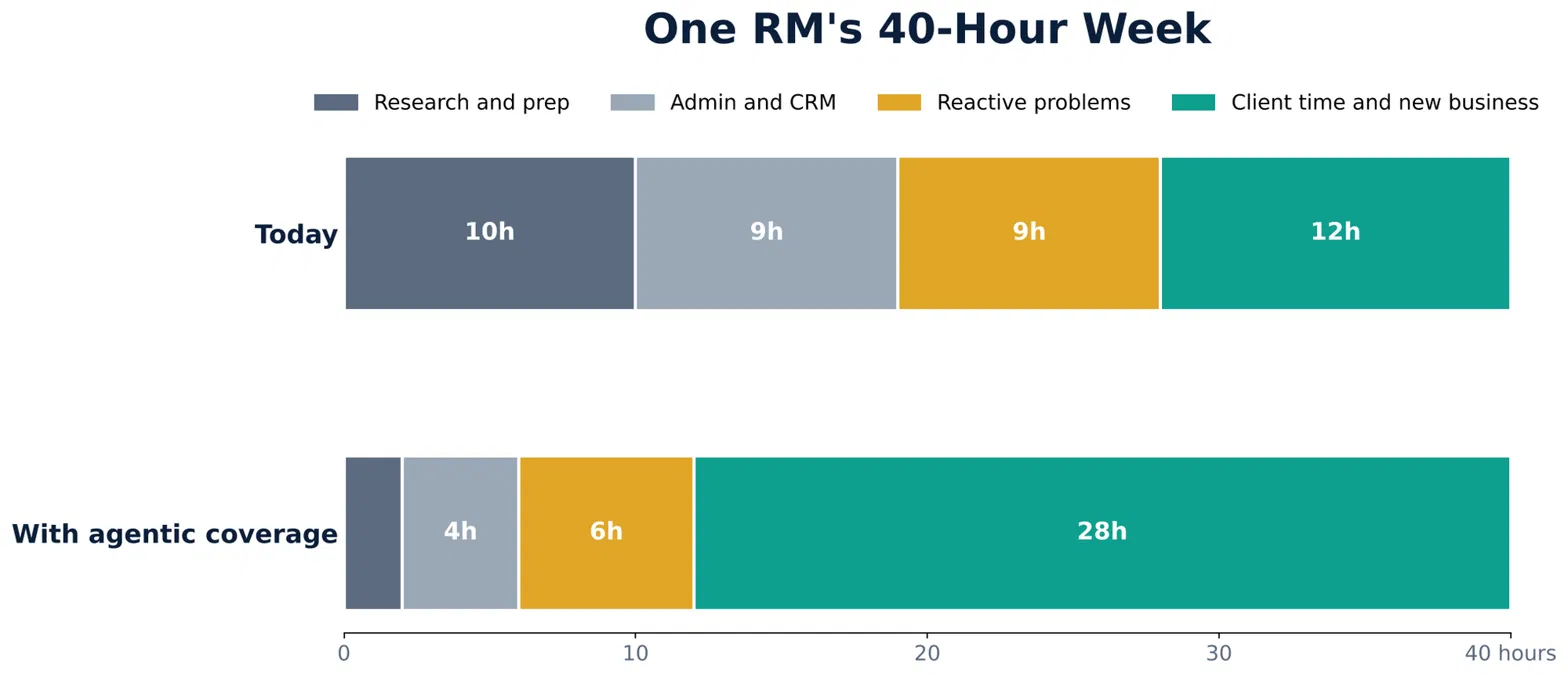
One RM's week, before and after (illustrative)
Same 40 hours, same banker, different job. Inputs are illustrative.
You may also read: Dynamic Credit Limits Tied to Cash Flow in Business Banking
Trust as the gate: the three-part examiner test
Executives will not let AI touch clients unless it is bank-grade by construction, and they are right. Bank-grade comes down to three properties, each of which an examiner can test.
- Grounded. Outreach and recommendations reason only over the institution's own rates, products, disclosures, and policies, held in a knowledge hub the bank signs off on. Never public web data or a general model's guess about what a bank product looks like. Every answer traces back to its source.
- Provable. Every action is produced by a defined chain of agents, skills, and handoffs that can be inspected step by step. Each one leaves a timestamped receipt showing which rule applied, which source informed it, which policy version was live, and who or what acted. Examiners can replay any outreach on demand.
- Governed. Policy checks run before execution and are designed to block a non-compliant offer or message before it reaches the client. Authority grids set what an agent may do alone and what needs banker approval. Role-based access, human-in-the-loop evaluators, PII masking, and a per-agent kill switch sit on top. The platform runs in the bank's private cloud with external calls blocked by default, and complete logs support near-real-time examiner reporting.
None of this is a new standard. The Federal Reserve's SR 11-7 guidance on model risk management already expects banks to understand, validate, and control the models that drive decisions. Applying that expectation to client-facing AI is continuity, not a new regime. It does mean compliance and risk teams belong in the design conversation, not only at final approval. In practice, the test turns into three questions for any vendor: show me the sources this message used, show me the policy check that would have stopped it, and show me the record an examiner would see. A system that cannot answer all three on demand is not ready for clients. For a deeper look, see our explainer on AI governance in lending.
What executives should do next
The fastest way to test this argument is against your own book. Three steps:
STEP 1: Measure your coverage gap - What share of relationships received a proactive, client-specific touch in the last 12 months? Count directed actions, not campaigns. The answer is usually lower than leaders expect.
STEP 2: Price a proactive action today - Multiply your fully loaded banker cost per hour by the real time one proactive touch takes, then by relationship count and target frequency. That is your coverage budget, whether or not anyone has written it down.
STEP 3: Pick one segment to pilot - Usually the middle tier, where relationships are large enough to matter and underserved enough to show impact. The top 5% is already covered, and the long tail rarely shows a clean signal.
A new software tier over your core, CRM, and digital banking
The top-5% trap was never about effort. It was about economics, and the economics have changed. Relationship banking at scale is now a choice about operating model, not a hiring plan.
Architecturally, the change is a new software tier over your existing core, CRM, and digital banking. Those systems remain the record, and nothing gets ripped out. The tier above them does the noticing, the research, and the first draft, so bankers can do the part that builds relationships. Because it connects into digital banking, the same layer can reach clients where they already bank, not only through the RM's calendar.
Two things separate a tier you can live with from one you outgrow. First, your own teams should be able to tune it: adjust triggers, outreach rules, and thresholds themselves, without waiting on a vendor release or a services engagement. Second, someone should own the outcome. A model or platform vendor sells capability; an accountable partner stands behind the coverage results, the training, and the measurement.
For a map of where AI fits across the lending lifecycle, see 15 AI in lending use cases.
Ready to reach the whole book?
Uptiq is the bank-grade AI platform for financial institutions. Its Account Management solution runs as a new tier over your existing core, CRM, and digital banking, with 100+ integrations, and a single agent is typically live in about five business days. More than 150 financial institutions use Uptiq.
Start with a book coverage assessment. We will measure your coverage gap, price a proactive action on your own book, and show where your first pilot segment should start.
Frequently Asked Questions
What is relationship banking at scale?

Why can't relationship managers cover their whole book?
Is it safe to let AI contact bank customers?
How much does a proactive relationship action cost a bank?
Why haven't CRMs solved relationship coverage?
How does AI help relationship managers without replacing them?
What should banks measure to track relationship coverage?
Does relationship banking at scale require replacing core systems?
About the Author