Small business loan application abandonment is one of the most expensive problems in community and regional lending, and one of the least visible. Plenty of owners start an application, too few finish, and many end up with an online lender that answered faster. If you run small business lending, digital banking or lending operations, this blog walks through your funnel like an operations review: the five places applicants drop off, the cause of each leak, the fix that closes it and how to measure progress.
The applications you never see
The applications that cost you the most never reach a banker. Take an illustrative example: the owner of a local landscaping company has banked with you for six years. On a Tuesday night, she opens your working capital application on her phone. Twenty minutes later, somewhere between the ownership questions and the document list, she closes the tab for good.
Your bank never learns why. There is no declined file and no note in the CRM. Pipeline reports start when a banker opens a file, so the leak happens upstream, in the digital loan application itself, where nobody is looking.
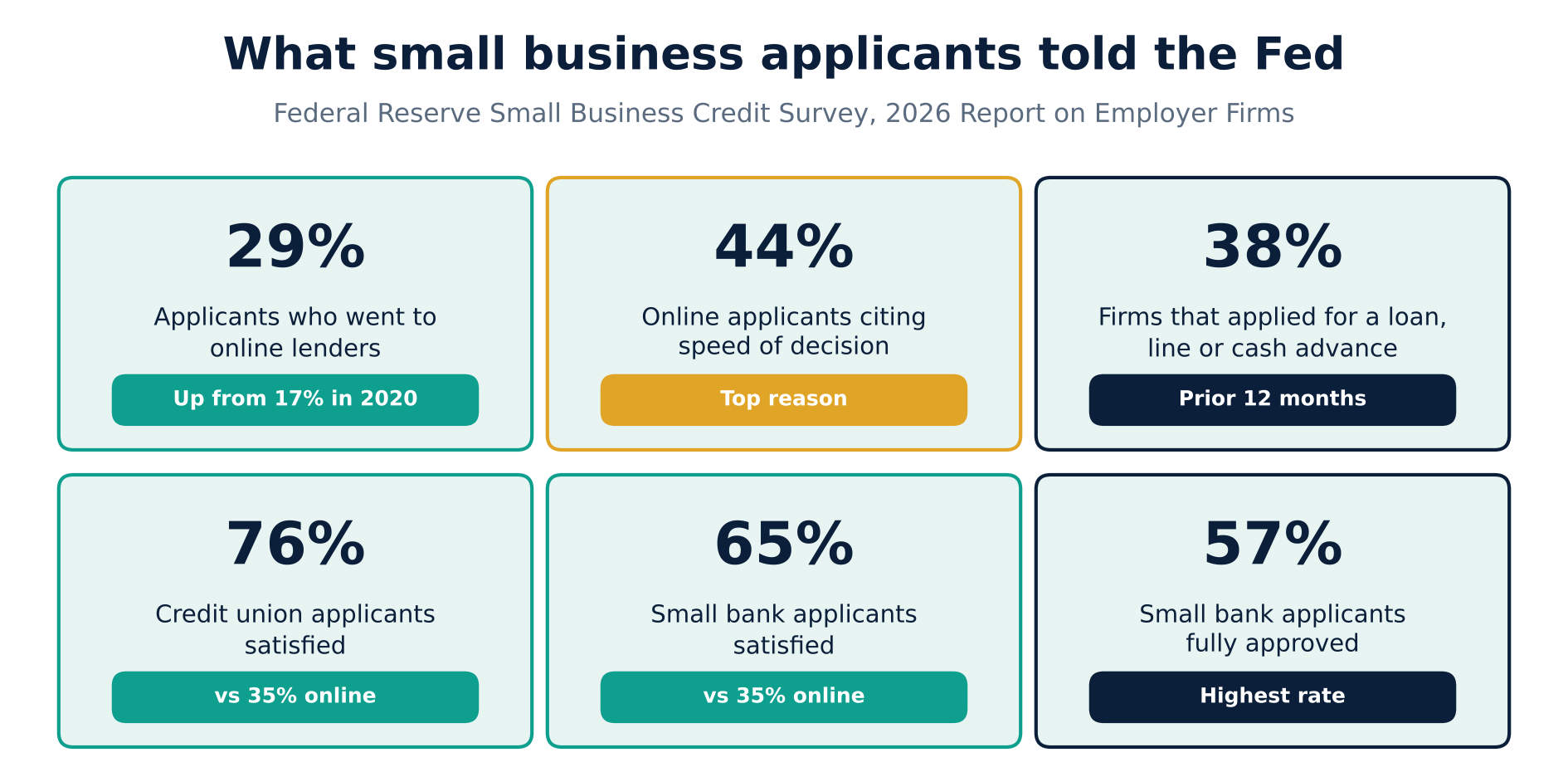
The Federal Reserve's data shows why that matters. In the 2026 Report on Employer Firms, based on the 2025 Small Business Credit Survey of 6,525 employer firms, 38% of firms applied for a loan, line of credit or merchant cash advance in the prior 12 months. The share of applicants that sought financing from online lenders rose from 17% in the 2020 survey to 29% in the 2025 survey. Among online lender applicants, 44% chose that lender for speed of decision or funding and 34% for their chance of being funded. At large banks (62%) and small banks (61%), the top reason was an existing relationship
Speed is not winning on experience, though. America's Credit Unions' summary of the same report shows 76% of credit union applicants and 65% of small bank applicants were satisfied with their lender, against 35% of online lender applicants. The survey also tracks long waits for a decision and difficult application processes as challenges applicants report. Many owners would rather stay with the institution they know. They leave when the small business loan application process makes staying harder than leaving.
The rest of this blog follows the funnel from first screen to closing: five leaks, a fix for each and the metrics that show whether the fixes work.
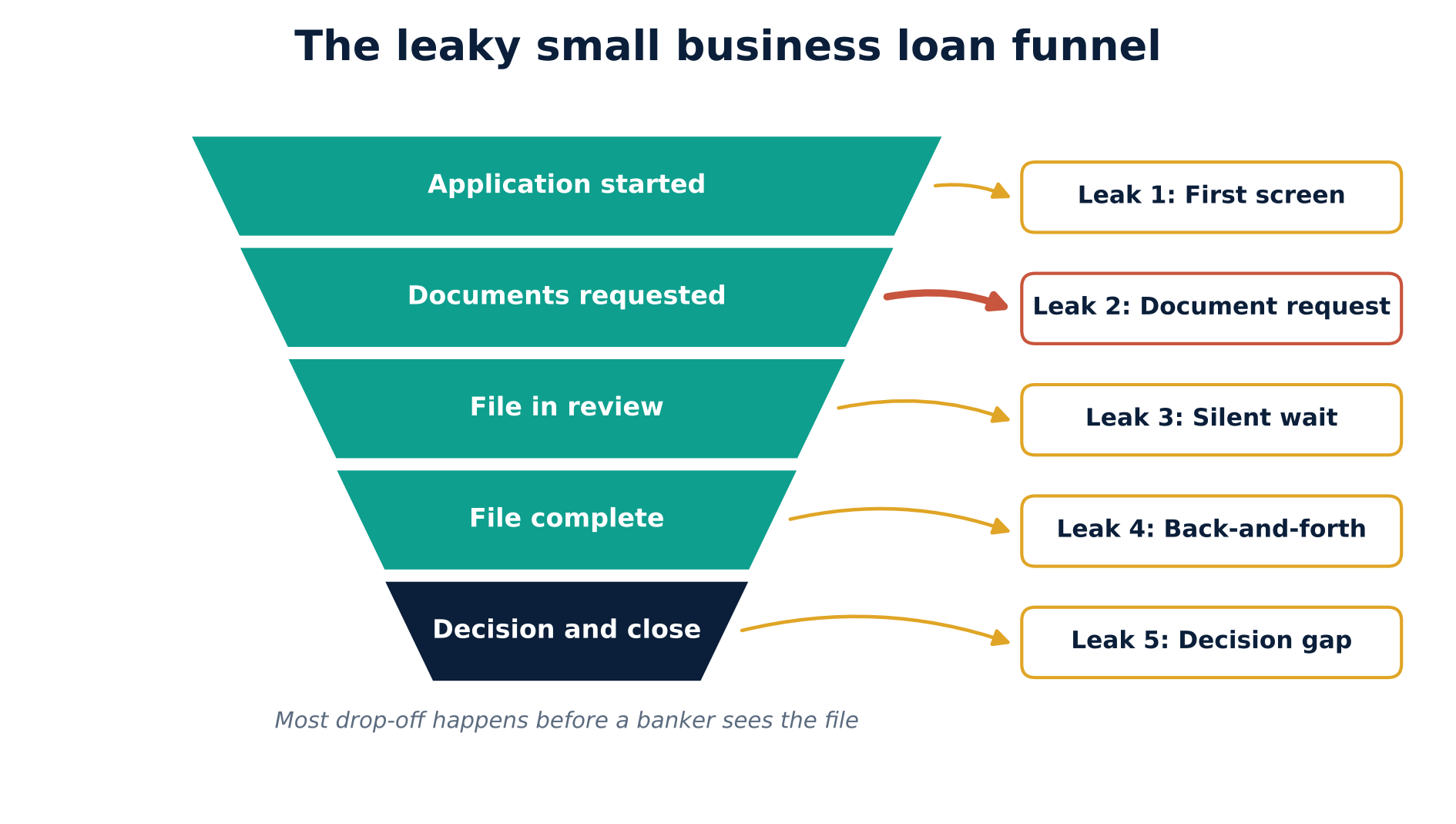
Leak 1: The first screen
The first leak opens when the first screen tells the applicant this will take too long. Long forms, unclear eligibility, no time estimate and questions the bank can already answer push owners out within minutes.
Small business owners apply between jobs, often on a phone. If the opening screen looks like an hour of work, they plan to come back later, and many never do. An owner who cannot tell whether a line of credit or an SBA loan is even possible for a two-year-old business will not spend the time to find out.
Existing customers feel this most. Asking a six-year deposit customer to retype her tax ID and ownership tells her the bank does not know her, which undercuts the advantage banks hold: the relationship.
Signs of this leak:
- High drop-off between starting the application and finishing step two.
- Short session times on the first screen, especially on mobile.
- Many started applications from existing customers that never progress.
Leak 2: The document request
The document request is the biggest leak in most small business funnels, because it is where the application stops being a form and becomes a project. Tax returns, bank statements, entity documents and a personal financial statement are often requested all at once, sometimes as an emailed PDF checklist.
For the owner, that list means files in different places: returns with the accountant, entity documents in a drawer, statements in a portal. Some need scanning or a signature. Each one is a reason to stop for the night, and every night away lowers the odds of a return.
A generic checklist adds friction of its own. It asks every applicant for every document, rarely explains what each is for, and so owners send the wrong thing or nothing.
Signs of this leak:
- Applications that sit at "documents pending" for days or weeks.
- Partial uploads: two of six documents received, then nothing.
- Bankers spending their time chasing paperwork instead of structuring deals.
You may also read: AI in Lending Use Cases
Leak 3: The silent wait
The third leak happens after the applicant has done the hard part: the file sits in a queue and they hear nothing.
Silence reads as rejection or indifference. An owner who submitted on Monday and has heard nothing by Thursday assumes the answer is no, and an online lender's same-day answer starts to look better, even at a higher price. The Fed's data shows that trade: 60% of online lender borrowers said their actual borrowing costs were higher than expected, yet the share applying online keeps rising.
Signs of this leak:
- Inbound "any update?" calls and emails to bankers and branches.
- Applicants who withdraw or go quiet mid-review.
- Applicants who tell you they accepted an offer elsewhere while you were still reviewing.
Leak 4: The back-and-forth
The fourth leak is the slow drip of follow-ups: missing items requested one at a time, days apart, often by different people. A processor asks for a missing page, an analyst later asks for a year-to-date profit and loss, then a credit officer wants a debt schedule.
The cost compounds. Each request restarts the clock, tests the applicant's patience and signals disorganization. By the third request, many applicants are comparing offers.
Signs of this leak:
- Multiple outbound document requests per file.
- A long gap between first submission and a complete file.
- Requests coming from several people with no single point of contact.
Leak 5: The decision gap
The final leak sits at the end of the funnel: a slow or unclear decision, followed by a slow path to closing. Even complete, approved files leak here.
A decision that takes weeks invites the applicant to keep shopping. An approval without clear next steps leaves the owner unsure the deal is done, and a long gap before closing opens a second window for a competitor. For a working capital need tied to payroll or seasonal inventory, any gap can decide the deal.
Signs of this leak:
- Approved applications that never close (low pull-through).
- Long, variable time from complete file to decision.
- Applicants asking what happens next after they have been approved.
Fixing each leak
Each leak has a matching fix, and most of the fixes sit in the intake layer rather than the core or the loan origination system. Every fix below follows the same pattern: the outcome first, then how it works, then the leak it closes.
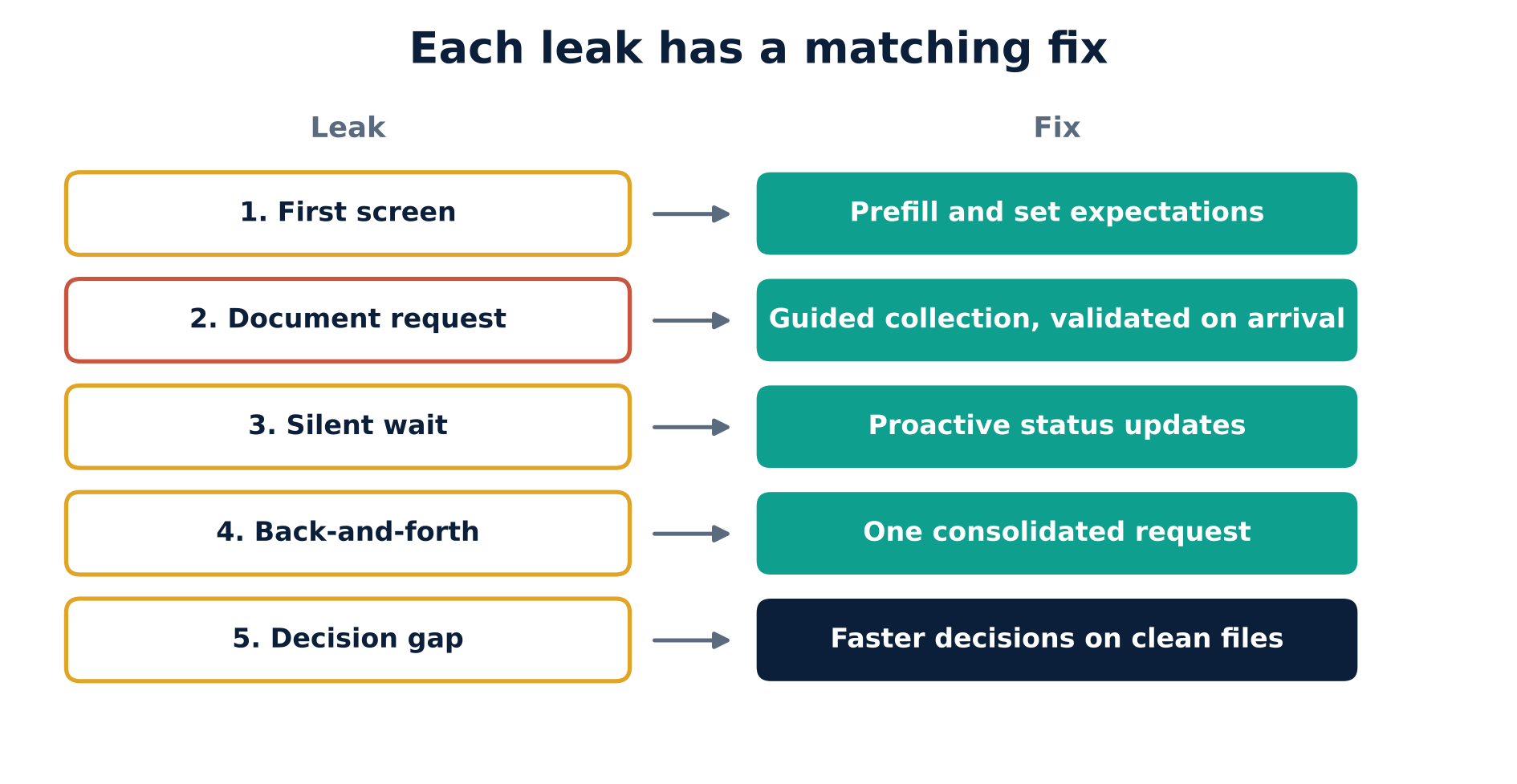
Fix the first screen: Prefill and set expectations
The outcome is more owners getting past the first two steps. Prefill existing customers' applications from data the bank already holds: business name, tax ID, address and ownership. Show eligibility up front, give an honest time estimate and say which documents come later. Offer save and resume and mobile-friendly upload, so an owner who starts on a phone at night can finish the next morning. This closes Leak 1.
Fix the document request: Guided collection and validation on arrival
The outcome is complete files in hours instead of weeks. Ask only for what this applicant needs for this loan type and size, explain each item in plain language and let owners upload by snapping a photo. The Intake Agent classifies and extracts each document as it arrives, validates it against what the file requires and checks completeness on the spot. A wrong year, a missing page or an unsigned form gets caught in minutes, while the applicant is still engaged. This closes Leak 2.
Fix the silent wait: Proactive status updates
The outcome is fewer applicants shopping while they wait. Send automatic updates at each stage: received, in review, additional item needed and decision, each saying what happens next. A simple note that the file is complete and in review often stops an owner from filling out a competitor's form that evening. This closes Leak 3.
Fix the back-and-forth: One consolidated request
The outcome is one follow-up per file instead of four. Because completeness checks run at intake, anything missing is known early and requested once, together, with a clear explanation of why each item is needed. One request from one point of contact replaces a week of scattered emails. This closes Leak 4.
Fix the decision gap: Faster decisions on clean files
The outcome is decisions while the applicant is still interested. Clean, complete files move straight to underwriting. The Underwriting Agent prepares spreads, cash flow analysis and a draft credit memo, so credit officers spend their time on judgment rather than data entry. Uptiq customers have seen 41% faster underwriting cycle time. Credit officers still make every decision: AI prepares, checks and documents, and people decide wherever your institution sets the gate. Pair the faster decision with a clear closing checklist so approved deals actually fund. This closes Leak 5.
Don't forget the operating account
A small business loan rarely travels alone, and the operating account becomes a leak of its own when it runs on a separate path. Opened separately, it makes the applicant repeat identity checks, re-upload entity documents and sign a second set of forms, often days after approval.
Opening the loan and the account in one flow removes that repetition: identity, ownership and entity documents are collected and validated once and reused for both, and the relationship is deeper from day one. The Digital Business Banking Agent is built for business account opening alongside lending. For the full single-flow story, see our take to loan origination system consolidation.
You may also read: Relationship Banking at Scale
Measuring small business loan application abandonment by stage
You measure small business loan application abandonment by tracking completion at each stage of the funnel, not just total applications in and loans closed. A total application completion rate tells you that you have a problem. Stage-level metrics tell you where it is.
Baseline before you change anything. Pull at least a quarter of history for each metric, split by channel, loan type and existing versus new customers, then review the funnel monthly with the owner of each stage.
One compliance note for planning. The CFPB's Section 1071 small business lending data rule has a revised compliance date of January 1, 2028, under a final rule published May 1, 2026. See the CFPB's small business lending requirements page and confirm your own coverage with counsel.
Where to start
Start with measurement, then fix the biggest leak first. Three steps get most lending teams moving:
- Measure your funnel by stage this month - Even rough numbers will show where applicants leave.
- Fix the biggest leak first - For most lenders, that is the document request. Guided collection and validation on arrival also shrink the back-and-forth, so one fix closes two leaks.
- Add intake as a new tier, not a new core - The Intake Agent sits over your existing loan origination system and core, with no migration project in the way. Plug it into the LOS you have or replace the LOS, your call.
Credit unions can find the member-side version of this funnel in our article to the credit union loan origination system.
Conclusion: Five small leaks, not one big problem
Small business application drop-off is not one big problem. It is five small ones: the first screen, the document request, the silent wait, the back-and-forth and the decision gap. Each has a cause you can see in your own data and a fix you can put in place without replacing your core. Measure by stage, fix the document request first and keep applicants informed at every step.
The payoff is capacity creation for growth. When intake prefills, guides, validates and updates on its own, bankers spend their time on relationships and credit judgment instead of chasing paperwork. The Uptiq platform adds that intake and underwriting tier over the systems you already run, with credit officers making every decision.
See your small business funnel without the leaks
Book a demo to see the Intake Agent collect and validate a small business file, and the Underwriting Agent prepare it for your credit officers.
Frequently Asked Questions
What is small business loan application abandonment?

Why do small business owners abandon loan applications?
Which stage of the application has the highest drop-off?
How can lenders reduce document-related drop-off?
How fast do small business applicants expect a decision?
How should lenders measure application drop-off?
Can existing customers' data be used to prefill applications?
Do lenders need a new LOS to reduce drop-off?
About the Author