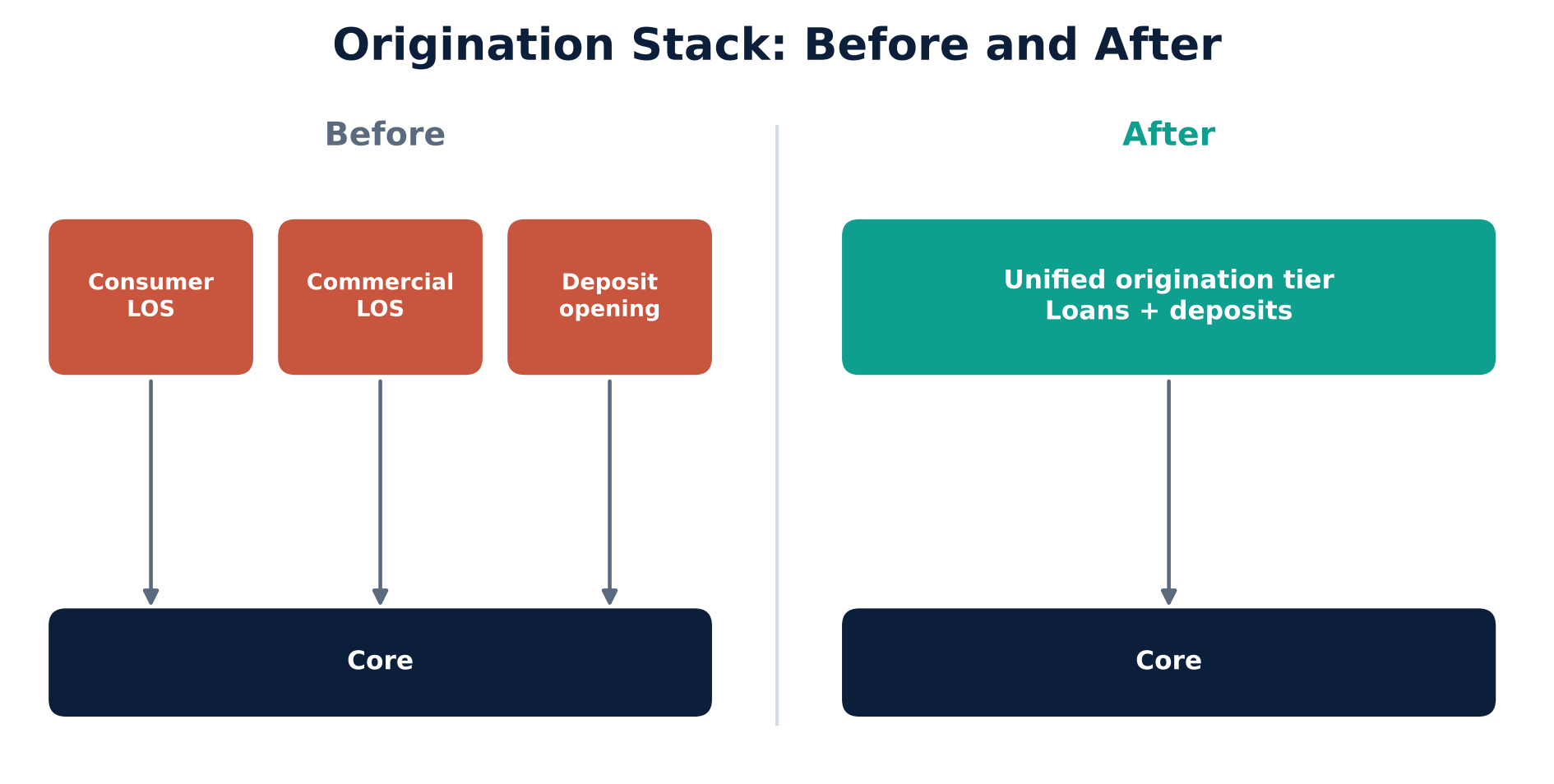
Loan origination system consolidation starts with a simple observation about the customer. A business owner applies for a term loan and opens an operating account in the same week. To her, that is one relationship with one bank. Inside the bank, it is three vendor contracts, three customer records, three document requests, and three sets of exceptions to reconcile.
Call it the point-solution tax: the cost of running point solutions in parallel, each doing part of the origination job. Most community and regional banks pay it without ever seeing it on one line, because it is spread across IT, lending operations, deposit operations, vendor management, and compliance.
The argument of this piece is narrow and practical. Consolidating the origination layer, not the core, can cut software spend, give the customer one experience, and free budget to fund the AI roadmap. Below is the stack, the math, the options, the risks, and where to start.
Anatomy of the point LOS stack
The typical point LOS stack is a set of separate systems for each product line, each with its own data model and its own integrations into a shared core. It grew one sensible purchase at a time, which is why no one owns its total cost.
The typical stack
A representative regional bank runs a consumer LOS, a commercial LOS, and a separate platform for deposit account opening. Many add a mortgage platform. Banks that have grown through acquisition often run two instances of the same category, one inherited from each side of a merger. Each system holds its own version of the customer, and each connects to the core separately.
The true cost: four line items
The real origination software costs fall into four line items, and only the first appears clearly in the budget.
- Contracts. License and subscription fees, contractual minimums, and per-application charges for each system.
- Integrations. Connections to the core, CRM, document management, credit bureaus, and identity verification, each built and maintained once per system.
- Maintenance. Vendor management, upgrade cycles, regression testing, and internal IT support for every platform.
- Duplicated operations. Re-keying data between systems, collecting the same documents twice, working separate exception queues, and reconciling records that disagree.
The costs nobody budgets for
Mismatched data between systems produces inconsistent customer records and a single customer view that never quite exists. Customers notice when they are asked for the same documents twice. The Financial Brand, citing FICO research with more than 14,000 consumers, reports that more than half of consumers who start a digital account application never finish it, and names siloed systems as one of the causes (August 2025).
Every vendor also carries third-party risk overhead. The interagency guidance on third-party relationships (June 2023) expects due diligence, contract negotiation, ongoing monitoring, and termination planning for each relationship, scaled to its risk. Three origination vendors means that the lifecycle runs three times.
The consolidation math: where ~25% comes from
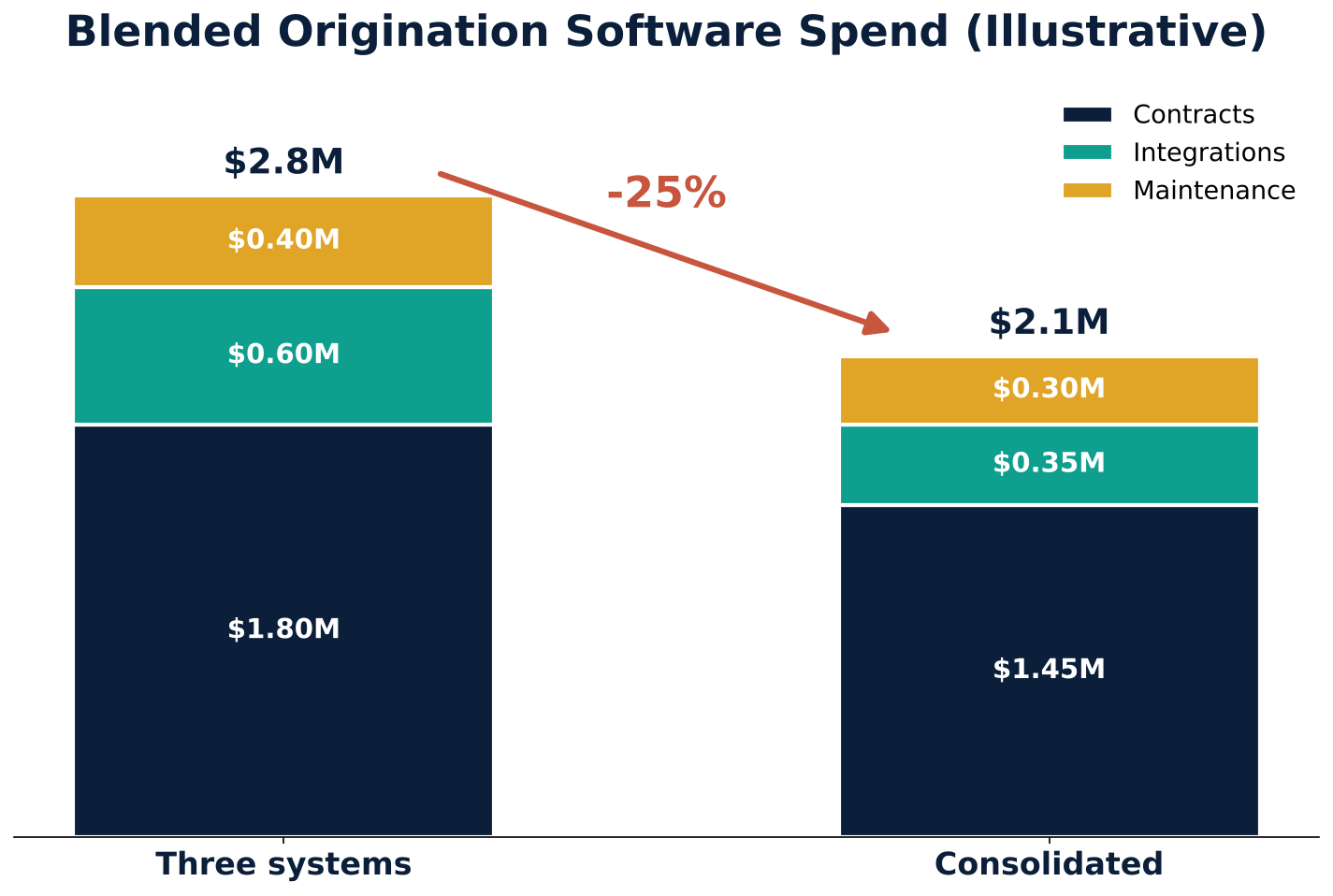
LOS consolidation saves money by retiring duplicated contracts, integrations, and maintenance. Uptiq's estimate is that retiring up to three point instances reduces blended origination software spend by at least 25%. Institutions running multiple instances of the same system after mergers can see savings well above that, because they pay for the same capability more than once.
The logic is mechanical. A contract you no longer hold has no fee. An integration you no longer maintain has no upkeep. A platform you no longer upgrade needs no regression testing. The remaining tier carries the combined volume, so some costs move rather than disappear, which is why the blended saving is a quarter rather than two-thirds.
Worked example: a hypothetical $8 billion regional bank (all figures illustrative)
Illustrative figures for a hypothetical institution. Replace every input with your own.
Multi-instance institutions save more because duplication multiplies. A post-merger regional with two commercial LOS instances pays two subscriptions, maintains two core integrations, runs two upgrade calendars, and trains staff on two interfaces for the same product. Consolidating removes a whole copy, not just overlap at the edges.
Timing matters as much as size. Incumbent LOS implementations typically run 8 to 16 months, which pushes savings into the next budget cycle or the one after. A platform tier that goes live in weeks starts retiring costs in the same fiscal year the decision is made.
A simple formula readers can use
Run this on your own stack:
Annual savings = current blended origination spend (contracts + integrations + maintenance) - consolidated spend.
Capacity recovered = duplicated operational hours today - duplicated hours after consolidation.
Keep the two lines separate. The first is budget. The second is time your loan officers and deposit operations teams get back, which belongs in a growth plan, not a cost plan.
You may also read: AI Budget for Banks in 2027: Benchmarks, Priorities and a Spend Plan for Community Banks and CUs
Self-funding AI: Turning savings into the roadmap
Consolidation savings can help fund the AI roadmap, so AI programs do not have to compete for new money. That changes the budget conversation from "what do we cut to pay for AI" to "what do we stop paying for twice."
Most AI proposals reach the CFO as incremental spend with uncertain payback. A consolidation plan arrives with its own source of funds. In the worked example, $700,000 of recurring savings is enough to offset a meaningful share of a first AI program, before counting any operational gains.
The sequencing that tends to work:
- Year 1: Consolidate the origination layer for the product with the nearest contract renewal, and bank the savings.
- Year 1 to 2: Point the savings at the next AI use cases in the same flow: intake, document intelligence, and decisioning support.
- Year 2 and beyond: Extend into account management and portfolio work, where AI expands coverage of the existing book.
Treat this as an offset, not a guarantee. The size of the savings depends on your contracts, and the cost of the AI program depends on scope. The point is that the funding source and the use case live in the same workflow.
Two commercial terms make the case easier to sign. Value-based pricing ties what the bank pays to quantified economic value, with agreed boundary conditions, so the payback assumption is shared rather than assumed. And an accountable vendor owns the outcome: the migration plan, the training, and the measurement of savings, not just the software license.
Plug in or replace: A decision framework
Consolidation does not require ripping out every system at once. There are two paths, and most institutions use both over time. Plug in or replace: the institution decides, product by product.
Option 1: Plug in
Plugging in means layering AI components such as intake, document AI, and decisioning support onto the LOS and deposit tools you already run. The existing systems stay in place, and the new tier handles the shared work across them.
It fits best when contracts have time left, when a system works well for its product line, or when the institution's appetite for change is low. The customer still gets one intake experience, even while two systems sit behind it.
Option 2: Replace
Replacing means retiring point systems as their contracts expire and moving those products onto unified loan origination, with deposits in the same flow. It captures the full contract and integration savings.
It fits best for multi-instance regionals, post-merger stacks, and systems approaching end of life, where the bank would otherwise renew something it already plans to leave.
Decision table by institution profile
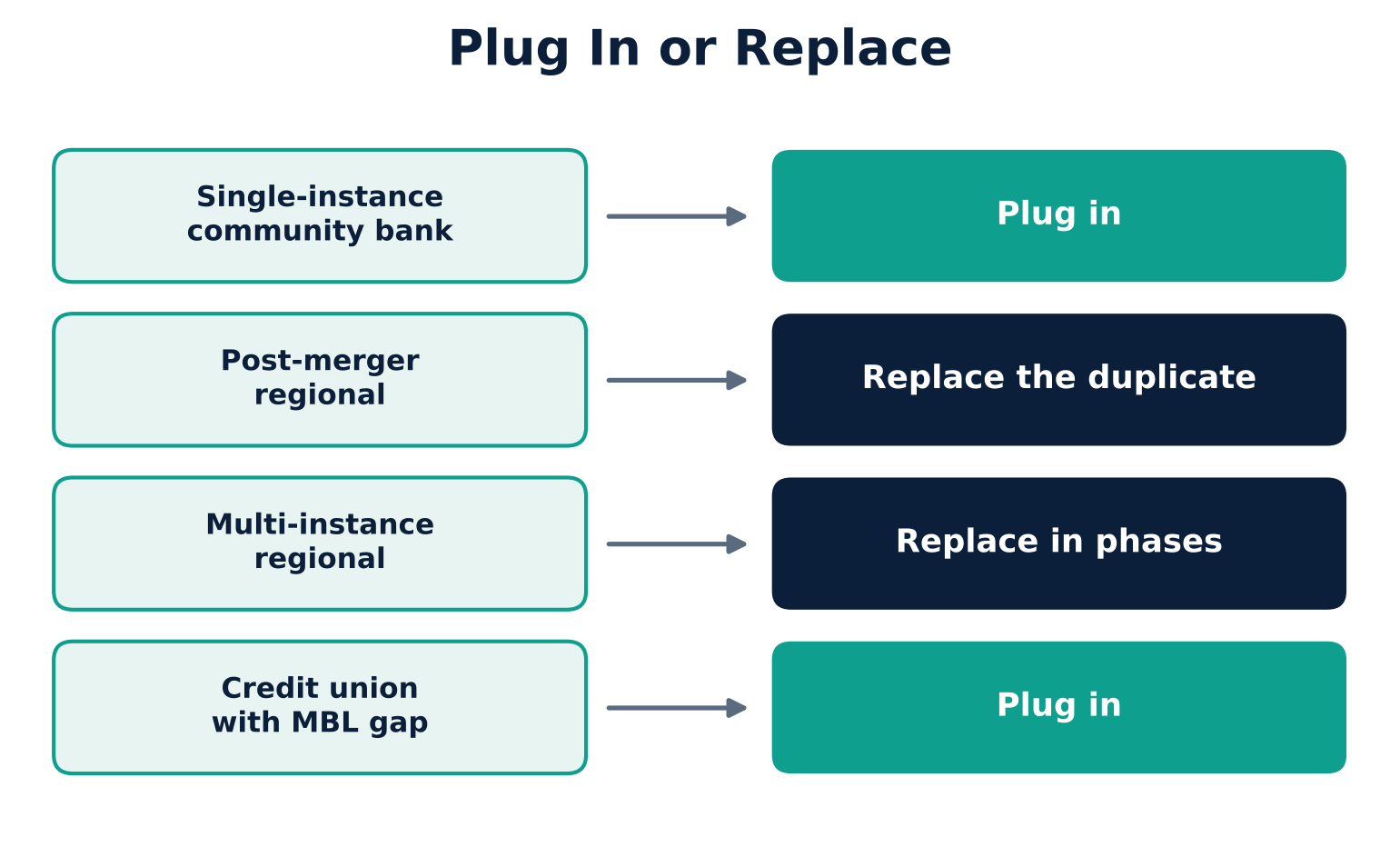
Credit unions face the same choice with a member lens. Our guide to AI loan origination for credit unions walks through the plug-in path stage by stage.
Managing migration risk
- Follow contract timing, don't fight it. Map every renewal date first. Paying to exit early usually erases the first year's savings.
- Move product by product. A phased migration limits the blast radius of any one cutover.
- Run in parallel during cutover. Keep the outgoing system live for a defined window and compare outcomes.
- Plan data migration early. Decide which historical records move, which stay archived, and how the single customer view gets built.
- Train before go-live. Staff should learn one flow before they are asked to work in it.
Capacity, not cuts
The operational gain from consolidation is capacity creation for growth: loan officers and deposit operations teams spend less time keying data and chasing duplicate documents, and more time closing deals and growing deposits.
The biggest commercial effect is cross-sell. When loans and deposits share one flow, the operating account, treasury management services, and online banking setup can go into the same closing package as the loan. The customer signs once. PCBB, citing Guidehouse research, notes that smoothly onboarded customers are two to three times more likely to adopt additional products in their first year (June 2026).
That is the case for one holistic flow: turning the hours the point stack consumes into relationships the bank actually grows. For the account management side of that story, see relationship banking at scale.
Governance as a consolidation benefit
Consolidation improves governance because one governed flow applies one rule set, produces one audit trail, and reduces the number of vendors to oversee. In a point stack, the same compliance requirement gets implemented three times, three slightly different ways.
- One rule set. Lending and deposit checks such as FCRA, CIP/KYC and beneficial ownership, Reg B, Reg DD, and UDAAP review can be applied consistently in one flow rather than configured separately in each system. The FFIEC BSA/AML Examination Manual sets the CIP and beneficial ownership expectations examiners test against.
- One audit trail. A timestamped receipt per action that examiners can replay, rather than evidence scattered across three vendors' logs.
- Fewer vendors. Less third-party risk management work across planning, due diligence, monitoring, and termination.
The same three-part test applies to any AI in the flow:
- Grounded in the institution's own products, rates, and policies, with every output traceable to its source.
- Provable through a defined chain of agents, skills, and handoffs, with a timestamped record of each action that examiners can replay on demand.
- Governed by policy checks designed to block non-compliant actions before they execute, plus authority grids, human approval, and role-based access.
You may also read: AI Agents for Financial Services: What They Do and How to Govern Them
Where to start
- Inventory your stack. List every origination system and instance, its contract value, renewal date, and integrations.
- Run the formula. Estimate blended origination spend and the duplicated operational hours behind it.
- Pick the first move. Either plug into the highest-pain workflow, often commercial intake and documents, or replace the system with the nearest renewal date.
For a full map of where AI fits after consolidation, see 15 AI in lending use cases.
A new software tier over your existing core
Loan origination system consolidation is not a core conversion. Consolidate the origination layer, keep the core, and both the savings and the customer experience improve: one application, one document request, one closing package, one record.
Architecturally, it is a new software tier over your existing core that reads from and writes to the core, CRM, and LOS. Some systems stay and get plugged into. Others retire at renewal. The institution sets the sequence.
Ready to price your origination stack?
Uptiq is the bank-grade AI platform for financial institutions. Its Originations Management solution brings consumer, small business, commercial, and deposit origination into one governed tier over your existing core, with 100+ integrations and a single agent typically live in about five business days. Institutions using Uptiq have reported 41% faster underwriting and 36% less financial spreading time.
Start with an origination stack and savings assessment. We will inventory your systems, run the formula, and map the first move to your renewal dates.
Frequently Asked Questions
What is loan origination system consolidation?

How much can banks save by consolidating origination systems?
Can one system handle both loan and deposit origination?
Do we have to replace our existing LOS to consolidate?
How do banks fund AI programs without new budget?
What are the risks of consolidating loan origination systems?
How does consolidation affect compliance and audit readiness?
Does consolidating origination require replacing the core banking system?
About the Author