.png)
AI in lending use cases now reach every stage of the loan lifecycle, from finding the right borrower to collecting the last payment. The hard part is no longer finding a use case. It is knowing which ones are proven, which are still maturing, which carry real regulatory weight, and where your institution should start.
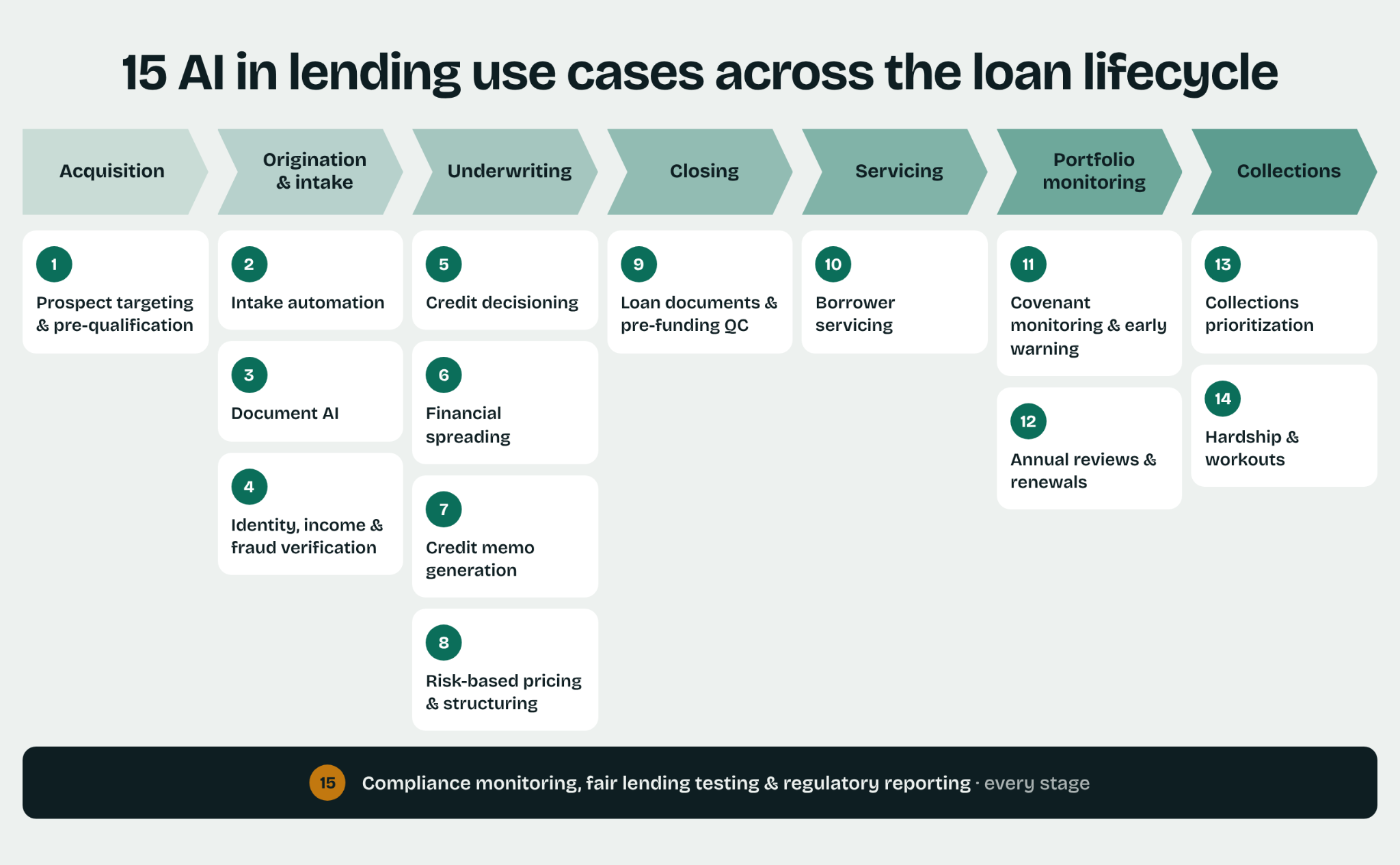
This guide maps 15 AI lending use cases across eight lifecycle stages, for banks, credit unions, and non-bank lenders. Each one follows the same template so you can compare them quickly: what it does, who uses it, how mature it is, what data it needs, the KPI that proves it, the regulatory watch-out, and where a person stays in control. A scorecard sums them up, and a prioritization matrix shows where to begin.
AI in Lending Use Cases at a Glance: The Scorecard
The scorecard below rates each of the 15 AI in lending use cases on maturity and regulatory sensitivity. Maturity means how widely the use case runs in production today: Proven (in production at many institutions), Scaling (in production at some, growing fast), or Emerging (early deployments and pilots).
Maturity and sensitivity ratings are Uptiq's editorial assessment as of [publish date], not survey results.
How to Read This List: The Loan Lifecycle
Loan lifecycle automation is easiest to plan when you see where each use case sits. The 15 use cases follow the loan from acquisition through origination and intake, underwriting, closing, servicing, portfolio monitoring, and collections, with compliance running across all of them.
Every use case below follows the same template:
- What it does and who uses it
- Maturity: Proven, Scaling, or Emerging
- Data needed to make it work
- KPI that proves it
- Watch-out: the regulatory or operational risk
- Human checkpoint: what stays with a person
One more idea matters before the list. Agentic AI means software agents that complete multi-step tasks under human oversight. Modern agents chain several use cases into one workflow. For example, intake (#2), document AI (#3), spreading (#6), and memo drafting (#7) can run as one flow, and the analyst reviews a finished first draft instead of four separate outputs. That chaining is where the largest gains come from.
Stage 1: Acquisition and Pre-Qualification
1. Prospect Targeting and Pre-Qualification
AI predicts which existing customers, members, or prospects are likely to need credit and qualify for it, then supports pre-qualified offers and next-best-product recommendations. A deposit customer whose business balances are growing, for example, may be a good candidate for a working capital line.
In practice, the strongest results come from the existing book rather than cold prospects. A model that notices a member's auto loan is nearly paid off, or that a business customer's receivables are growing faster than its line, gives the lender a reason to call that is about the borrower's situation, not a generic campaign. Offers still need clear terms, and every pre-qualification should lead to a real underwriting decision.
- Who uses it: Marketing and lending teams.
- Maturity: Scaling.
- Data needed: Relationship, deposit, and credit bureau data, within permissible-purpose rules.
- KPI: Application rate and cost per funded loan.
- Watch-out: Targeting can create fair lending exposure, including redlining risk if models steer offers away from certain neighborhoods or groups. Prescreened offers must follow the Fair Credit Reporting Act firm-offer rules, and digital marketing that targets by protected characteristics carries real risk.
- Human checkpoint: Compliance reviews targeting criteria and test outcomes across geographies and groups.
Stage 2: Origination and Intake
2. Conversational Applications and Intake Automation
AI guides applicants through the application, pre-fills fields from data the lender already holds, and checks completeness before the file reaches a processor. For commercial loans, it can also request and track the document checklist for each deal type.
In practice, the biggest win is ending the back-and-forth. Instead of a processor discovering three days later that the second year of tax returns is missing, the applicant sees the gap while still in the application. For commercial deals, the checklist adapts to the deal type, so a CRE investor loan asks for rent rolls and leases while an equipment loan asks for invoices and titles.
- Who uses it: Loan officers, processors, and applicants.
- Maturity: Proven.
- Data needed: Existing relationship data and document requirements by loan type.
- KPI: Application abandonment rate and time to complete an application.
- Watch-out: Conversational help must not steer applicants toward or away from products in ways that create fair lending issues.
- Human checkpoint: Staff can step in at any point, and applicants can always reach a person.
For the credit union view of this stage, see AI loan origination for credit unions.
3. Document AI: Extraction and Classification
Document AI classifies and extracts data from the documents behind every loan: tax returns, bank statements, pay stubs, financial statements, rent rolls, and entity documents such as operating agreements. It covers both consumer and commercial files.
In practice, document AI is the foundation most other use cases depend on. Spreading, verification, covenant testing, and annual reviews all need clean, structured data from documents first. That is why many lenders start here: it shortens every downstream step, and the results are easy to measure in minutes per file.
Legacy OCR captured characters from clean, fixed forms. Document AI understands unstructured documents, handles messy scans and multi-entity returns, and gives each extracted field a confidence score, so staff review only what is uncertain.
- Who uses it: Processors and credit analysts.
- Maturity: Proven.
- Data needed: The documents themselves, plus your field definitions and templates.
- KPI: Manual touch time per file.
- Watch-out: Test accuracy on your own documents, not vendor samples.
- Human checkpoint: Staff reviews low-confidence fields and exceptions.
4. Identity, Income and Fraud Verification
AI verifies identity, income, and employment, flags document tampering such as edited pay stubs or bank statements, detects synthetic identities, and spots loan stacking, where one applicant seeks several loans at once from different lenders. Generative AI has made fake documents cheaper to produce, which makes this use case more urgent every year.
In practice, the strongest fraud programs layer several checks instead of relying on one score. A pay stub whose fonts and metadata do not match, an employer phone number that leads nowhere, and deposits that do not match stated income are each weak signals alone. Together they justify a closer look by a trained analyst before funds go out.
- Who uses it: Fraud and BSA teams, underwriters.
- Maturity: Proven.
- Data needed: Application data, documents, device and identity signals, bank data.
- KPI: Fraud losses and false-positive rate.
- Watch-out: BSA and Customer Identification Program requirements still apply, and false positives hurt legitimate applicants.
- Human checkpoint: Fraud flags route to trained staff rather than triggering automatic declines.
Stage 3: Underwriting and Decisioning
AI in underwriting is where the use cases split most clearly between consumer and commercial lending. Consumer underwriting leans on decisioning models; commercial underwriting leans on analysis and documentation.
5. Credit Decisioning with Alternative and Cash-Flow Data
AI auto-decisions clean applications within policy and brings in cash-flow underwriting from bank transaction data, which helps thin-file and credit-invisible applicants whom a bureau score alone would miss.
In practice, the safest path is to expand auto-decisioning gradually within existing policy. Start by automating decisions on files that already clearly pass, then use cash-flow data as a second look for applicants just below the line. Track loss rates on auto-decisioned loans separately from manual ones, so you can show the model is not trading credit quality for speed.
- Who uses it: Underwriters and credit policy teams.
- Maturity: Scaling.
- Data needed: Bureau data, application data, and permissioned bank transaction data.
- KPI: Auto-decision rate and loss rate on auto-decisioned loans.
- Watch-out: Regulatory sensitivity is high. Under Regulation B, declined applicants must receive specific, accurate reasons, and the CFPB has said complex algorithms do not change that, in Circular 2022-03.
- Models also need disparate impact testing.
- Human checkpoint: Credit policy stays human-owned, AI decides only within policy, and every override is logged.
6. Financial Spreading and Global Cash Flow Analysis
This is the commercial lending use case most lists miss. Automated financial spreading maps business tax returns and financial statements into your spreading template, calculates ratios such as DSCR and leverage, and builds global cash flow across the borrower, related entities, and guarantors. Every value links back to its source page.
In practice, the time saved per deal is large because spreading repeats work: the same chart of accounts, the same adjustments, the same ratio checks, year after year. Once the first year is spread and reviewed, later years are mostly mapped automatically, and the analyst focuses on what changed and why.
For many commercial teams, spreading is where an analyst's week disappears. A single multi-entity relationship can take a day or more to spread by hand.
- Who uses it: Credit analysts.
- Maturity: Proven.
- Data needed: Financial documents and your spreading template.
- KPI: Analyst hours per deal.
- Watch-out: Entity relationships and adjustments, such as one-time items, still need analyst judgment.
- Human checkpoint: The analyst reviews and approves the spread.
7. Credit Memo Generation
AI drafts the credit memo from the spreads, collateral information, borrower history, and policy checks: the narrative, the ratio analysis, the risks and mitigants, and any policy exceptions. The credit officer edits, adds judgment, and signs.
In practice, the value is not just speed. A first draft that pulls every figure from the spread and cites its source makes memos more consistent across analysts, which helps credit committees compare deals and helps loan review test them. Analysts spend their time on the parts that need judgment: the story behind the numbers, the risks, and the mitigants.
- Who uses it: Credit analysts and credit officers.
- Maturity: Scaling.
- Data needed: Spreads, collateral data, borrower and relationship history, and your memo template.
- KPI: Memo turnaround time.
- Watch-out: Drafts must be traceable to source data so reviewers can check every figure.
- Human checkpoint: The credit officer owns the recommendation. AI drafts; people decide.
8. Risk-Based Pricing and Deal Structuring
AI prices loans within approved matrices, suggests counteroffers instead of declines, and recommends structure: term, amortization, collateral, and covenants. For commercial deals, it can compare a proposed structure with similar loans in the portfolio.
In practice, the easiest win is replacing flat declines with workable alternatives. A borrower who does not qualify for a five-year term at the requested amount may qualify for a shorter term, a lower amount, or added collateral. For commercial lending, comparing a proposed structure with similar deals in the portfolio helps lenders avoid pricing outliers in either direction.
- Who uses it: Lenders and pricing committees.
- Maturity: Scaling.
- Data needed: Pricing matrices, cost of funds, portfolio performance, and relationship data.
- KPI: Margin and pull-through rate.
- Watch-out: Pricing disparities across groups create fair lending exposure, even when no protected characteristic is used directly.
- Human checkpoint: Pricing exceptions and structure changes outside policy need approval.
Stage 4: Closing and Funding
9. Loan Document Generation and Pre-Funding QC
AI assembles the closing package, checks disclosures under the Truth in Lending Act and TRID where they apply, checks data consistency across the approval, documents, and system records, and verifies the loan boards to the core correctly.
In practice, most closing defects come from inconsistency, not complexity: a rate that differs between the commitment letter and the note, a borrower name spelled two ways, or collateral details that changed after approval. Automated cross-checks catch these before signing, when they are cheap to fix, instead of after boarding, when they become servicing problems.
- Who uses it: Closers, loan operations, and QC teams.
- Maturity: Proven.
- Data needed: Approval terms, document templates, and core and LOS data.
- KPI: Closing defects and time from approval to funding.
- Watch-out: A wrong rate, payment date, or lien detail becomes a servicing problem and an exam finding.
- Human checkpoint: Funding approval stays with authorized staff.
Stage 5: Loan Servicing
10. Borrower Servicing and Payment Support
AI in loan servicing handles routine requests through self-service, such as payment changes, payoff quotes, and balance questions, and supports staff with agent assist and call summaries on everything else.
In practice, the best servicing deployments start with the questions borrowers ask most and that have clear answers, such as payoff amounts, payment due dates, and how to change a payment method. Agent assist then shortens the harder calls by putting account history in front of staff and writing the call notes automatically.
- Who uses it: Servicing and contact-center teams.
- Maturity: Scaling.
- Data needed: Loan servicing records, payment history, and knowledge content.
- KPI: First-contact resolution, average handle time, and complaint rate.
- Watch-out: Chatbot deflection that keeps borrowers from reaching a person drives complaints. Measure resolution, not just containment.
- Human checkpoint: Borrowers can always reach a person, and staff handles disputes and sensitive requests.
For a parallel example in card programs, see AI credit card operations.
Stage 6: Portfolio Monitoring
11. Covenant Monitoring and Early-Warning Signals
AI tests covenant compliance as soon as new financials are spread, flags breaches and near-breaches, and watches early-warning signals between reviews, such as falling deposit balances or rising line utilization.
In practice, the shift is from annual checking to continuous monitoring. Instead of discovering a debt service coverage breach at the next annual review, the portfolio manager sees it the week the quarterly financials arrive. Early-warning signals between financial statements, such as a sharp drop in operating account balances, can prompt a call months before a covenant test would.
- Who uses it: Portfolio managers and credit administration.
- Maturity: Proven.
- Data needed: A covenant library, spreads, and deposit and utilization data.
- KPI: Covenant exceptions caught on time.
- Watch-out: Results are only as good as the covenant library, so clean up definitions first.
- Human checkpoint: Waivers, amendments, and workout actions are banker decisions.
For the relationship-management view, see AI account management in banking.
12. Annual Reviews and Renewals
AI collects updated financials, spreads them, tests covenants, checks collateral, recommends risk-rating changes with evidence, drafts the review memo, and triggers renewals 90 to 180 days before maturity, with prior-year analysis already in place.
In practice, annual reviews combine several earlier use cases, including document AI, spreading, covenant monitoring, and memo drafting, into one workflow with a deadline. That makes it a natural place to see the value of agentic AI. Risk-based tiering helps further: low-risk credits get exception-only reviews, and analysts focus on watch-list and large exposures.
- Who uses it: Credit administration, portfolio managers, and analysts.
- Maturity: Scaling.
- Data needed: Financial statements, covenant history, collateral records, and maturity data.
- KPI: Percentage of reviews past due and renewal lead time.
- Watch-out: Stale reviews mean stale risk ratings, which examiners look for.
- Human checkpoint: An authorized officer approves every rating change and review.
For the full step-by-step workflow, see commercial loan annual review automation.
Stage 7: Collections and Loss Mitigation
AI in collections shifts the work from calling down a list to reaching the right borrower, at the right time, with the right offer.
13. Collections Prioritization and Personalized Outreach
AI scores propensity to pay, so collectors focus on accounts where contact will make a difference. It picks the best channel and timing for each borrower and drafts compliant messages.
In practice, better targeting often matters more than more contact. Calling every delinquent account at the same time with the same script wastes effort on borrowers who would self-cure and misses the ones who need help early. Scoring lets collectors spend time on accounts where a conversation, a reminder, or a payment plan will actually change the outcome.
- Who uses it: Collections teams.
- Maturity: Scaling.
- Data needed: Payment history, contact history, and channel preferences.
- KPI: Roll rates, cure rate, and cost per dollar collected.
- Watch-out: The Fair Debt Collection Practices Act and Regulation F apply directly to third-party debt collectors, and many lenders follow them as best practice. That includes the presumption limits on call frequency. UDAAP applies to every lender's collection messages.
- Human checkpoint: Compliance reviews message templates, and staff handle disputes and sensitive situations.
14. Hardship, Modifications and Workouts
AI assesses hardship eligibility, models modification options for consumer loans, and supports commercial workout analysis by projecting cash flow under different terms. For commercial real estate, the interagency policy statement on prudent CRE loan accommodations and workouts sets expectations for documentation and risk ratings.
In practice, AI's role is preparing the analysis, not choosing the outcome. For a consumer loan, it can show which hardship programs a borrower qualifies for and what each option means for the payment. For a commercial workout, it can project cash flow under several modified terms so the special assets team negotiates from evidence.
- Who uses it: Loss mitigation and special assets teams.
- Maturity: Emerging.
- Data needed: Borrower financials, payment history, and program rules.
- KPI: Re-default rate and time to resolution.
- Watch-out: Modification decisions affect borrowers directly, so consistency and fair treatment matter.
- Human checkpoint: Modification and workout decisions stay with authorized staff.
Stage 8: Compliance Across the Lifecycle
15. Compliance Monitoring, Fair Lending Testing and Regulatory Reporting
AI is usually discussed as a compliance risk. It can also strengthen compliance. It can run fair lending analysis more often, classify complaints and spot patterns early, check HMDA data quality before submission, structure Section 1071 small business data at intake, and track policy exceptions across the portfolio.
In practice, AI makes continuous compliance possible where periodic sampling was the norm. Instead of a fair lending review once a year on a sample, monitoring can flag a pricing or approval pattern within weeks. Complaint classification can surface ten similar complaints about one letter template before they become a systemic issue in an exam.
- Who uses it: Compliance and fair lending teams.
- Maturity: Scaling.
- Data needed: Application, decision, and pricing data; complaint data; reporting fields.
- KPI: Exam findings and reporting data error rate.
- Watch-out: Monitoring models need validation like any other model.
- Human checkpoint: Compliance officers interpret results and decide on remediation.
Which AI Lending Use Cases Should You Start With?
Plot each use case by value (hours, dollars, or revenue it touches) and feasibility (data readiness, integration, time to production), then use regulatory risk as a filter.
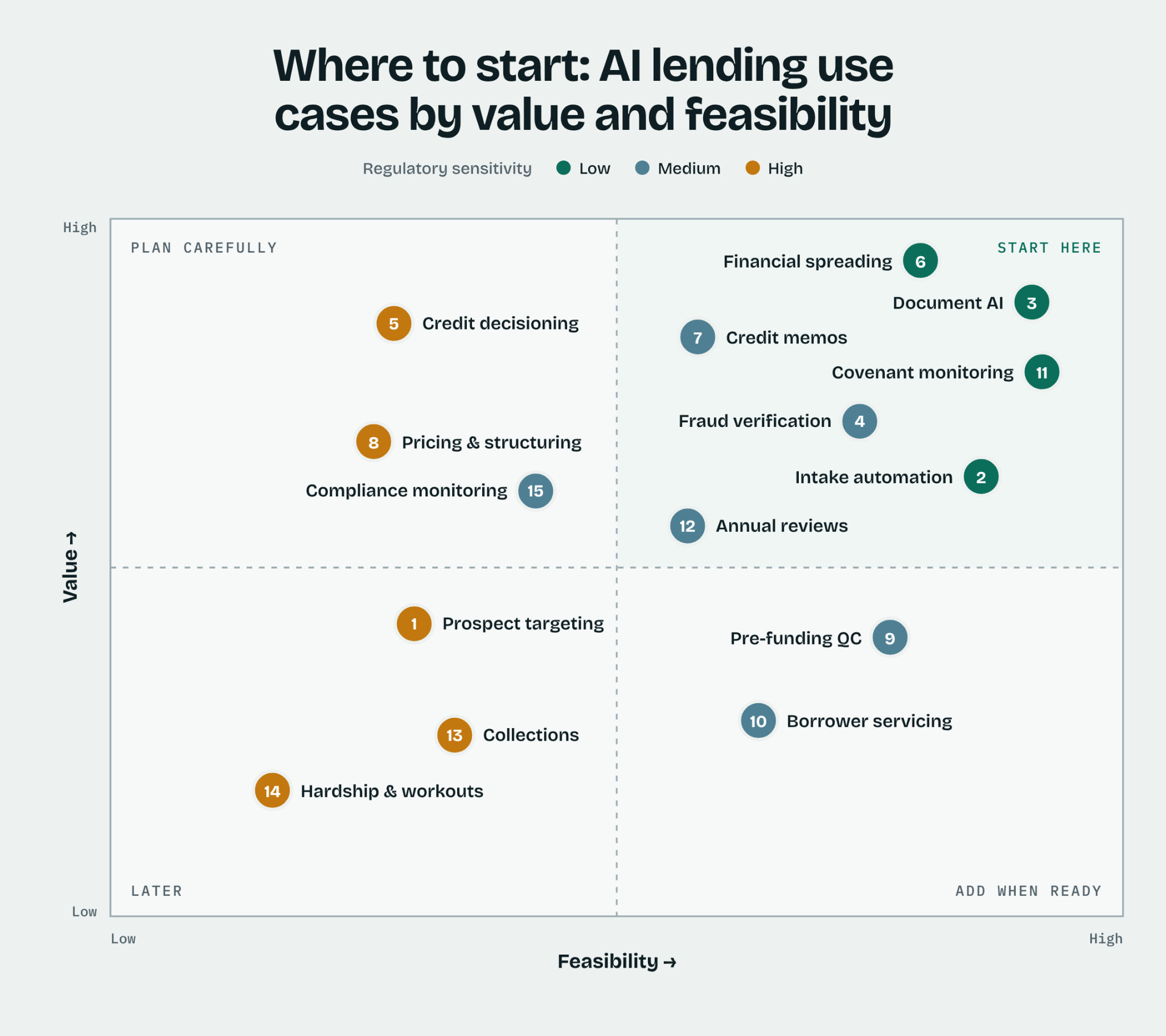
The usual starting points are document AI, spreading, and covenant monitoring. They combine high volume, measurable results, and lower decision risk, because AI prepares the work and people still decide.
Approach fully automated credit decisions (#5) carefully. Without mature governance, including validation, adverse action explainability, and disparate impact testing, the regulatory risk outweighs the speed gain.
Priorities by Institution Type
Typical priorities; your loan mix and data readiness should decide.
Build, Buy or Partner?
Most banks and credit unions do not have the machine learning engineers or model risk staff to build and maintain lending AI themselves, and that is fine. Buying or partnering lets them spend their scarce expertise on governance and credit judgment instead of model infrastructure.
You may also read: AI Budget for Banks in 2027: Benchmarks, Priorities and a Spend Plan
Risks and How to Manage Them
The familiar AI risks are bias, poor data quality, unexplainable outputs, and weak integration. In US lending, each maps to existing guidance:
- Model risk: The Federal Reserve's SR 11-7 and the OCC's Bulletin 2011-12 cover validation, monitoring, and governance, including for vendor models.
- Vendor risk: The interagency guidance on third-party relationships covers vendor oversight.
- Explainability and bias: CFPB adverse action guidance requires specific reasons, and fair lending laws require testing for disparate impact.
- Credit unions: NCUA's AI resources are the starting point, and credit unions carry more vendor oversight themselves.
Governance checklist:
- Model inventory that includes vendor AI
- Validation before use, proportionate to risk
- Ongoing performance monitoring with thresholds
- Human overrides with logged reasons
- An audit trail of AI outputs and human changes
- Vendor due diligence, including data use and security
See also our overview of AI governance.
You may also read: Lending Trends 2027: 10 Shifts Banks and Credit Unions Must Prepare For Now
AI in Lending Use Cases: Sequence Them and Connect Them
The lenders that win with AI will not adopt all 15 AI in lending use cases at once. They will sequence them stage by stage, starting where volume is high and decision risk is low, then connect them into end-to-end loan lifecycle automation, from the first document to the annual review. Each use case on its own saves hours. Connected, they change how lending works.
Ready to Map AI Across Your Loan Lifecycle?
Uptiq's Qore platform gives banks, credit unions, and lenders domain-trained agents for intake automation, Document AI, financial spreading, credit memo generation, covenant monitoring, and annual reviews. They work over your existing core and LOS, and a single agent typically goes live in about five business days. Institutions using Qore have reported 41% faster underwriting, 36% less financial spreading time, and 63% less credit memo prep time. Start with a lifecycle AI assessment. See also AI agents for banks and AI agents for credit unions.
Frequently Asked Questions
What are the most common AI use cases in lending?

How is AI used in loan underwriting?
How is AI used in loan servicing and collections?
Which AI lending use cases deliver the fastest ROI?
How is AI used in commercial lending specifically?
Is AI in lending regulated in the US?
Should banks build or buy AI lending tools?
What is agentic AI in lending?
About the Author