
TLDR
- Commercial loan underwriting automation speeds up the paperwork stage: document collection, spreading, memo drafting, not the credit decision itself.
- Roughly 60–70% of underwriting cycle time is administrative work, and that mechanical layer is exactly what AI agents remove first.
- New interagency guidance (SR 26-2 / OCC Bulletin 2026-13) means every automated step still needs a human-reviewable, source-cited trail examiners can follow.
Commercial Loan Underwriting Automation: What Changes, What Doesn't
Commercial loan underwriting automation gets pitched as a binary more often than it should: either AI takes over the credit decision, or nothing really changes. Neither is true. For a chief credit officer or head of commercial banking running a lean credit team, the real question isn't whether automation belongs in the process; it's exactly where the line sits between what a machine should touch and what stays with a person. Most institutions get this wrong in one of two directions: they bolt automation onto document intake and stop there, or they chase decisioning automation before the underlying workflow can support it.
This blog breaks commercial underwriting into its component steps, shows which ones genuinely speed up, which ones don't, and what current regulatory guidance expects from institutions running either.
What Is Commercial Loan Underwriting Automation?
Commercial loan underwriting automation is the use of AI agents and workflow software to handle the repeatable, document-heavy steps of evaluating a commercial borrower: collecting and classifying financial documents, spreading statements into structured ratios, drafting the credit memo narrative, and checking outputs against policy, while a credit officer keeps the actual approve, decline, or approve-with-conditions decision. It is not the same thing as algorithmic credit scoring, and it is not a loan origination system (LOS), which manages workflow and data storage but doesn't itself analyze a borrower's financials. In practice, this kind of AI underwriting layer sits alongside an existing LOS rather than replacing it, reading in application data and documents and returning structured output that an underwriter reviews before it moves forward, not a decision that skips them.
The distinction matters because it changes what "automation" is actually promising. Automate commercial loan underwriting in the narrow, accurate sense, and you're compressing the distance between a document landing in the file and an underwriter having something usable to work from. You are not removing the underwriter from the loop, and any vendor pitching commercial credit underwriting software as a decision-replacement tool is selling a different, much riskier product than what most banks and credit unions are actually buying in 2026.
What Slows Down Commercial Underwriting Today?
Most of the time a commercial loan spends in underwriting has nothing to do with credit judgment; it's spent moving information between systems. Ask a commercial underwriter to account for an honest day, and the pattern repeats across institutions of every size: 60–70% of cycle time goes to document collection, financial spreading, bank statement review, and credit memo writing, the mechanical work that happens before and after the actual risk assessment. A single commercial deal can arrive as a stack of tax returns, interim financials, rent rolls, and entity documents running hundreds of pages, and an analyst re-keys much of it into spreadsheets by hand before any analysis starts.
The effect shows up directly in cycle time. Institutions without automation routinely report commercial deals taking three weeks or more from first contact to funded loan, largely because the analyst layer is doing clerical work instead of analysis, and because every hand-off between intake, spreading, and memo drafting introduces its own delay. It also shows up in headcount economics: growing loan volume without growing the credit team means the same people absorbing more of exactly the work that isn't judgment.
Picture a mid-sized C&I renewal for a manufacturing borrower with two related entities: the borrower's own tax returns, a guarantor's personal financials, three years of CPA-prepared statements, and a rent roll for a property held in a separate holding company. An analyst working that file by hand is not making a credit call for most of the week it takes to assemble; they're matching entity structures across documents, keying numbers from PDFs into a spreading template, chasing a missing K-1, and then writing up what they found in a memo format the credit committee expects. None of that is underwriting judgment in the sense a chief credit officer means it. It's clerical work wearing a credit analyst's job title, and it's the layer that commercial loan underwriting automation is actually built to remove.
You may also read: Where Lending Teams Lose Capacity (and How to Recover It)
Where Does Commercial Lending Automation Actually Get Faster?
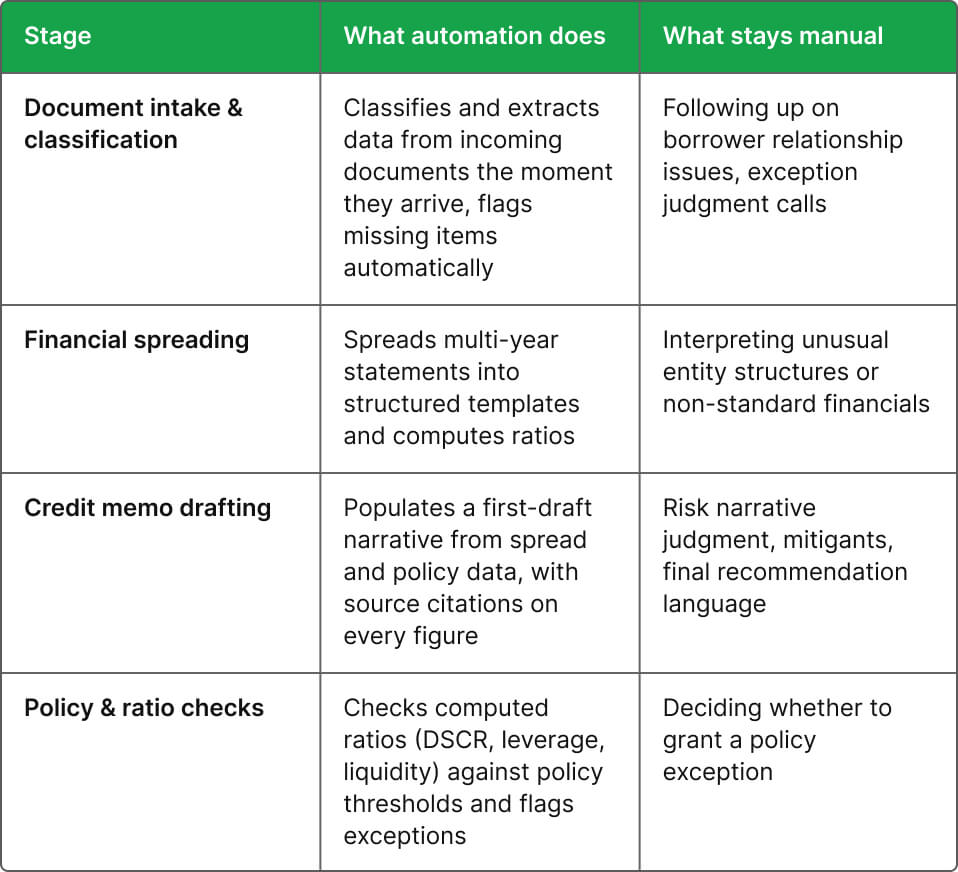
Four stages of commercial underwriting consistently get faster under automation: document intake and classification, financial spreading, credit memo drafting, and policy or ratio checks, the stages that are mechanical rather than judgment-based.
The aggregate effect of automating those four stages is what shows up in reported cycle-time numbers: institutions running Uptiq's commercial underwriting agents see underwriting cycle times fall by around 41%, with throughput reaching roughly 3x per analyst at the same headcount, and financial spreading time specifically down about 36%. That pattern isn't unique to one vendor. McKinsey's 2025 research on multiagent credit-memo pilots found a similar shape at a U.S. bank that automated its credit memo process, a 30% improvement in credit turnaround alongside 20–60% productivity gains for credit analysts, evidence that the biggest early automation wins cluster in exactly this mechanical layer, not the decision itself.
It's worth being specific about why each of these four stages is a good automation candidate, because the reason is the same in each case: the work is repeatable, and the correct output is checkable. Document classification has a right answer: this page is a tax return, that one is a rent roll, that doesn't depend on judgment. Spreading has a right answer too, once the source figures are extracted correctly, which is why AI underwriting commercial loans workflows lean so heavily on citation: every spread figure links back to the page it came from, so an analyst is verifying rather than re-deriving.
Credit memo drafting is checkable against the underlying spread and policy data, and ratio and covenant checks are pure arithmetic against a threshold. None of that changes when the borrower is complicated; it just means the automation is doing more classification and reconciliation work up front, not less.
What Stays Manual: Why Human-in-the-Loop Underwriting Wins
The actual credit decision, ie, the approve, decline, or approve-with-conditions call, along with judgment on exceptions, deal structure, and relationship context, stays with a human underwriter, and that division isn't a limitation of the technology. It's the correct design. Human-in-the-loop underwriting means every automated output- a spread, a computed ratio, a memo draft- is something a credit officer reviews and can override, not something that executes on its own.
There are practical reasons this split holds, beyond regulatory caution. Complex commercial deals, multi-entity borrowers, unusual collateral structures, first-time relationships, carry exactly the kind of ambiguity that a rules-based or model-driven system handles poorly and an experienced underwriter handles well. Relationship context that never makes it into a document how a borrower behaved through a prior downturn, whether a guarantor's other obligations are actually as stated- belongs to the people who know the account, not to a system reading a PDF.
Commercial credit decisioning also draws real regulatory scrutiny around bias and explainability in a way that document classification and spreading simply don't. Fair-lending enforcement has increasingly targeted the models banks use to score or approve credit, not the tools they use to prepare a file, which is exactly why the institutions furthest along with commercial lending automation tend to be the ones that were disciplined about scope from the start. They automated the prep work aggressively and left the scoring and approval logic untouched, rather than trying to automate both at once and inviting a much harder governance conversation than the efficiency gain was worth.
You may also read: Risks of Using AI in Lending (Compliance, Bias & Auditability)
What Do Regulators Expect From Automated Commercial Underwriting?
Since April 17, 2026, banks running AI-assisted commercial underwriting operate under new interagency model risk management guidance: SR 26-2 and OCC Bulletin 2026-13, which replaced the 15-year-old SR 11-7 framework and expects automated outputs to remain reviewable, source-cited, and explainable to examiners. The new guidance is principles-based and voluntary rather than prescriptive, and it notably does not yet contain generative-AI-specific rules; a dedicated AI request for information is still pending from the agencies. In practice, that means the operating bar for a commercial underwriting automation program right now is less "follow this checklist" and more "can you show your work", every extracted figure traceable to its source document, every policy exception logged, every memo reviewable by a human before it reaches a credit committee.
That bar is rising, not falling, at the same time. The Federal Reserve's April 2026 Senior Loan Officer Opinion Survey found banks reporting tighter lending standards for commercial and industrial loans across firms of all sizes in the first quarter of 2026, a reminder that examiner attention on commercial credit files, whether the analysis behind them was manual or automated, is not easing up. An automated workflow that can't produce a clean audit trail is a liability regardless of how fast it runs.
How Should a Bank or Credit Union Start?
The institutions getting this right start with a single high-friction stage. Usually financial spreading or credit memo drafting, prove the workflow on real deals, then expand, rather than trying to automate the full commercial underwriting cycle in one project. That sequencing matters more than which vendor gets picked first: a narrow deployment that works alongside the existing LOS, keeps the credit officer's sign-off intact, and produces a source-cited output an examiner can follow is far easier to expand later than a broad rollout that has to be unwound.
In practice, that means picking the one stage where the credit team already agrees the pain is worst; most institutions land on spreading, because it's the most hours per deal for the least judgment, and running it alongside the existing manual process for a handful of real files before cutting over. That side-by-side period is what actually builds the examiner-ready track record: a credit officer signing off on both the manual spread and the automated one for the same file, confirming they match, and only then trusting the automated version to run without a full parallel check. Institutions that skip that step tend to stall later, not because the technology fails, but because nobody can point to evidence the outputs were validated before they went into production.
Uptiq's Commercial Lending suite is built around that sequencing: a Credit Intake Superagent, Credit Underwriting Superagent, and Credit Monitoring and Covenant Superagent that each run independently or as one connected workflow, sitting on top of whatever LOS, core, and CRM an institution already runs. Every decision the agents make is logged with rationale, source citation, and policy reference, which is the same audit trail an examiner or auditor would otherwise have to reconstruct by hand. Institutions running the suite in production report underwriting cycle times down 41%, throughput up roughly 3x per analyst, and extraction accuracy above 95%, numbers that hold because the agents handle the mechanical layer end to end while the credit team keeps every decision. That's what makes commercial loan underwriting automation stick: not a bigger promise, a narrower and more honest one.
You may also read: 7 AI Agent Use Cases in Commercial Lending Banks Should Deploy First
Ready to see what gets faster in your credit shop?
Uptiq's Credit Underwriting Superagent runs alongside your existing LOS, no rip-and-replace, automating document intake, financial spreading, credit memo drafting, and policy checks while your team keeps every credit decision. Institutions running it report underwriting cycle times down 41% and throughput up roughly 3x per analyst.
About the Author