

Most conversations about AI in commercial lending arrive at the same question sooner or later: when do we get an AI underwriter?
It's a fair question. It points to real operational pain. Commercial credit is document-heavy, slow to move, and expensive to staff. Your best analysts spend 30% of their day on administrative work, chasing documents, manually spreading financial statements, reconstructing cash flows, instead of making credit decisions. Every deal that takes weeks instead of days is a deal lost to a fintech competitor who moved faster. The question, on the surface, makes perfect sense.
But here's the problem: it carries an assumption worth testing. It treats underwriting as one job performed in one step. A commercial loan does not work that way.
A commercial loan moves through intake, document processing, financial spreading, credit analysis, credit memo preparation, policy checks, approval preparation, and portfolio monitoring. Each stage has different inputs, different rules, different skills, and different outputs. If the work is that specialized, why would the answer be a single model that tries to do all of it?
That's the wrong question. Here's the better one: How should commercial credit be supported by a coordinated set of AI agents that handle the operational work while humans focus on judgment?
Commercial Lending isn't One Workflow. It's a System of Workflows.
A commercial loan is not underwritten in one motion. It moves through eight distinct kinds of work. The boundaries between them are where most of the delay lives.
- Intake. Collecting and organizing borrower information, application materials, and establishing what the request actually is.
- Document processing. Identifying what has been submitted, extracting relevant information, and determining whether anything required is missing.
- Financial spreading. Turning bank statements, tax returns, and schedules into structured financial data that can be analyzed consistently.
- Credit analysis. Evaluating financial performance, cash flow, leverage, liquidity, repayment capacity, and the factors that actually carry the credit.
- Credit memo. Turning analysis into a structured credit package a reviewer can act on.
- Policy checks. Testing the request and analysis against defined credit policy, concentration limits, and program requirements.
- Approval preparation. Assembling the information, exceptions, and rationale the appropriate approval authority needs.
- Portfolio monitoring. Continuously evaluating borrower performance, covenant compliance, and emerging risk after the loan closes.
Read that list with a staffing lens. These are not eight features on a vendor roadmap. They are eight different kinds of work. Intake is a coordination problem. Spreading is a normalization problem. Analysis is interpretive. Policy checking is a rules problem. Monitoring is a signals problem that never ends.
Your credit team already knows this. It already divides the work along roughly these lines. Analysts do one thing. Underwriters do another. Portfolio managers own monitoring. Operations staff chase documents. That organizational structure exists because the work is genuinely different, and because trying to collapse it into one role produces mediocrity.
You may also read: AI Agents for Commercial Lending Workflows: A Practical Guide
Why One AI Underwriter is the Wrong Mental Model
One AI underwriter is the wrong mental model because it asks a single system to be good at tasks that have almost nothing in common- reading a scanned rent roll. Tracing a K-1 across related entities. Forming a view on repayment capacity. Applying a concentration limit. Drafting narrative. Watching a covenant over three years. Those are different problems. A system built to be adequate at all of them is rarely excellent at any of them. And it is considerably harder to govern.
Specialization does the opposite. When an agent has a narrow, defined job, you can state what it is allowed to do, test it against the work it actually performs, and audit its output against a known standard. Scope is what makes AI in lending reviewable. A general-purpose assistant that touches every stage of the file gives you one large surface to validate. Eight bounded agents give you eight small ones.
That matters because it's what allows a second line of defense- risk, compliance, audit- actually to sign off on deployment. Federal Reserve guidance (SR 11-7) on model risk management didn't relax because the models got better at drafting. If anything, the regulatory scrutiny got tighter. You need to be able to reconstruct what happened and why.
The organizational analogy is already sitting in your org chart. A commercial credit team does not employ one person who does everything. It has analysts, underwriters, credit officers, operations staff, portfolio managers, and relationship managers. Those roles exist because the work is different, the skills are different, and the accountability is different. Nobody argues the bank would run better if all six were collapsed into one generalist.
So the answer answers itself. If commercial lending has always benefited from specialized human roles, why would its AI workforce need to look like one general-purpose worker?
What an AI Credit Team Could Actually Look Like
An AI credit team is a set of defined jobs, not a set of products. The useful way to picture it is to ask which parts of the workflow could be delegated to an agent with a clear brief, and what that agent would be accountable for producing.
Each agent is a job description, not a feature. That distinction matters when you evaluate this in practice. A feature list invites the question "what can it do?" A job description invites better questions: What is this agent accountable for? What does it hand over? What is it not allowed to decide? And who checks its work?
The Value isn't the Individual Agent. It's the Team Working Together.
The value of commercial lending automation is not in any single agent. It is in what happens between them. An agent that spreads financials flawlessly and then drops the file back into someone's inbox has moved the bottleneck, not removed it.
Most of the time a commercial file spends in process is not spent being worked on. It is spent waiting to be picked up by the next person. That waiting is operational drag. It compresses decision velocity. It costs deals.
Consider a borrower who submits an application, three years of tax returns, financial statements, and a debt schedule. In a coordinated workflow, the file moves like this:
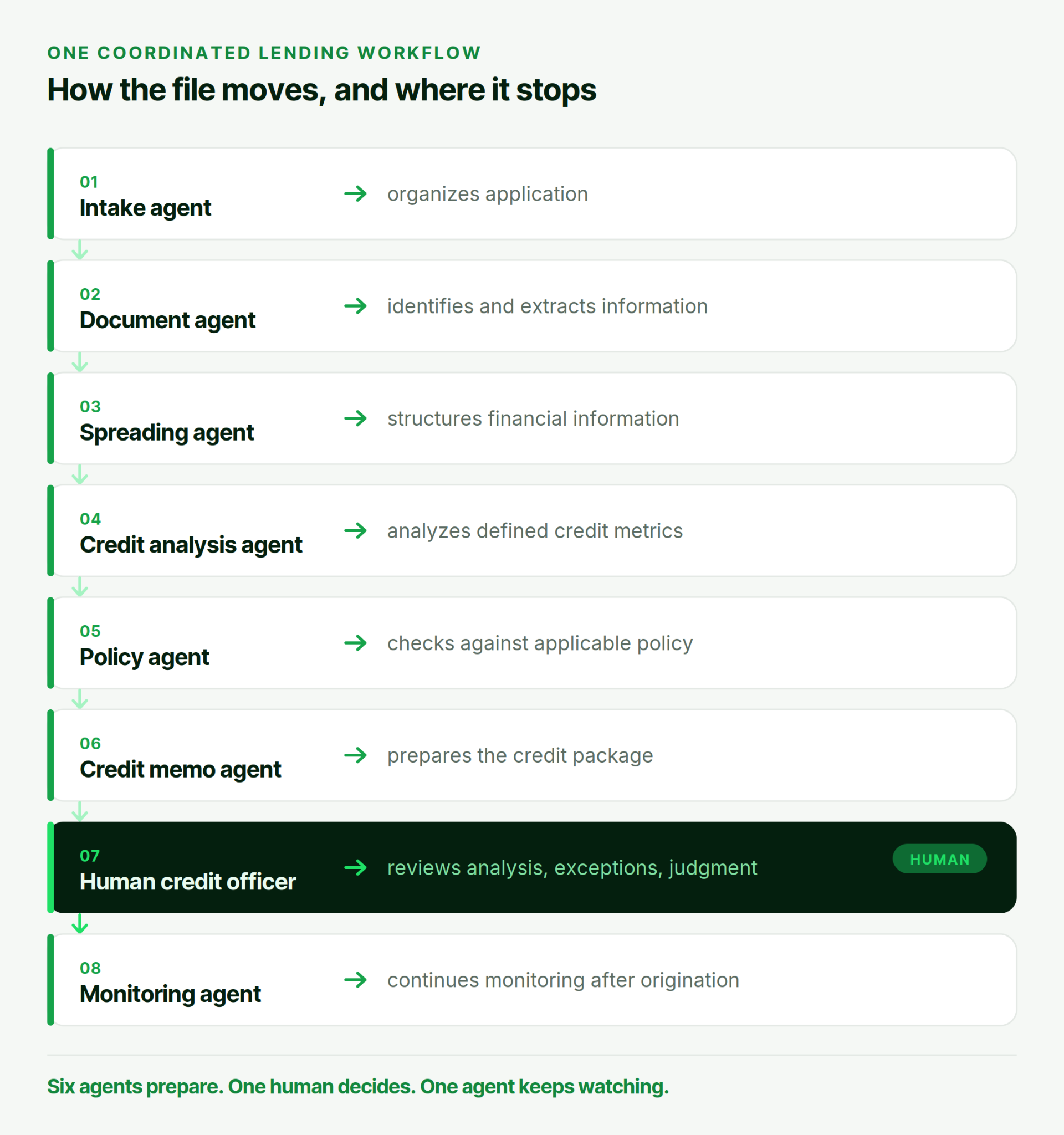
Nothing in that sequence removes the credit officer. What it removes is the queue between each step. The re-keying. The chasing. The status meeting that exists only because nobody can see where the file is.
The opportunity is not to automate eight tasks independently. It is to connect eight capabilities into one coordinated lending workflow.
You may also read: How to Standardize Credit Memo Preparation Across Analysts
Coordination is the Difference Between AI Tools and an AI Workforce
A tool performs an isolated task: input, task, output. Buy eight of them, and you have eight islands, a new integration problem, and eight audit trails that do not reconcile.
A workforce performs interconnected work:
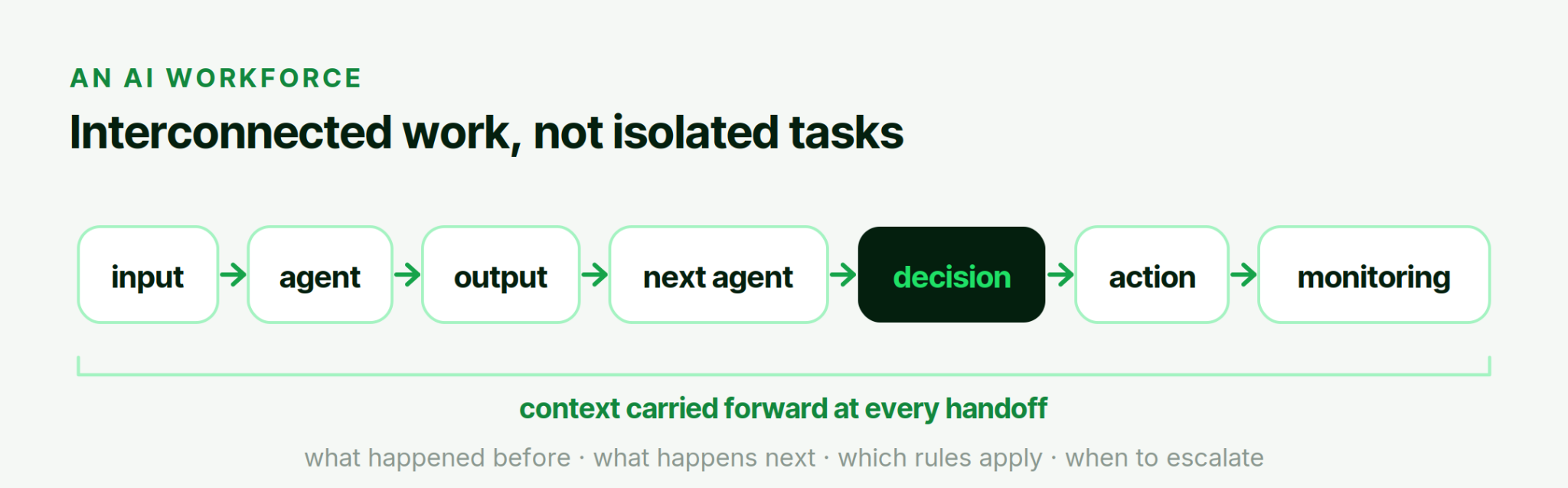
To do that, the system has to hold context no individual tool holds. It needs to know what happened before, what needs to happen next, which rules apply, when to stop, when to escalate, and what information to pass forward.
That last one, passing information forward, is the item banks underestimate. It's not a file transfer. It means carrying the provenance of every number, the exceptions already identified, the policy tests already run, and the questions still open. Without that, the next agent starts cold. The human at the end reconstructs the trail by hand. Which is the work you were trying to remove.
Tools automate tasks. An AI workforce coordinates work.
Humans Don't Leave the Workflow. Their Role Changes.
Humans do not leave the commercial credit workflow. Their role changes.
Commercial credit involves judgment that does not reduce to extraction and rules: management quality, the history behind a relationship, unusual circumstances, industry conditions, complex structures, non-standard risk, and the strategic considerations sitting behind a decision to stretch or decline.
This is not a hedge. It is what the data already shows. When the FDIC released its 2024 Small Business Lending Survey, it reported that although most banks are adopting new technology, those innovations have not displaced the relationship-oriented and staff-intensive character of business lending, which is still generally underwritten and approved by people at institutions of every size.
The sensible division of labor is clear.
AI handles: repetitive work, data preparation, calculations, first-pass analysis, policy checks, documentation, and monitoring.
Humans handle: judgment, exceptions, relationships, context, approval, and accountability.
The goal isn't to remove the credit team. It's to remove the work that keeps the credit team from doing credit work.
How an AI Workforce Could Change Commercial Lending Capacity
An AI workforce could change commercial lending capacity because it moves where the constraint sits. Today, capacity in most credit shops is bounded by analyst hours. A large share of those hours goes to preparation rather than assessment. Move the preparation and the boundary moves with it.
- Throughput. More applications processed by the same team.
- Turnaround time. Less waiting between workflow stages, where most elapsed time accumulates.
- Analyst capacity. More time available for deals that are genuinely complex.
- Portfolio coverage. More borrowers monitored continuously rather than at annual review.
- Consistency. More repeatable application of defined workflows and policies across analysts and offices.
- Scalability. Growth that does not require every increase in loan volume to be matched by a proportional increase in operational headcount.
That last point is the one that matters most to a chief lending officer. Loan demand and credit standards both move. The Federal Reserve tracks the swing quarterly in its Senior Loan Officer Opinion Survey. The operational question underneath every upswing is whether the credit shop can absorb it without loosening standards or hiring at the same rate volume grows.
These are possibilities, not guarantees. They depend on the workflow, the institution, and the discipline of the deployment. The reason to be careful with the claim is the same reason the model works: the gains come from removing coordination cost, and coordination cost varies enormously between banks.
What Changes When AI Works Across the Entire Credit Lifecycle?
AI in commercial lending gets more interesting when it stops being a point in the process. Origination attracts attention because friction is visible there. But the credit lifecycle does not end at funding.
ORIGINATION: intake → documents → spreading → analysis → approval
PORTFOLIO: monitoring → covenant checks → financial updates → risk signals → annual review preparation
The portfolio management layer is where most institutions carry the largest quiet exposure. Covenant compliance is tracked in spreadsheets and email. Borrower financials arrive late and are filed rather than analyzed. Annual reviews are prepared under time pressure on information nobody has revalidated.
An agent that already understands the file at origination is the natural candidate to keep watching it afterward. An AI layer across the lending lifecycle, not just at origination, is where the real compounding happens.
You may also read: How to Implement Continuous Credit Monitoring on an Existing Loan Portfolio
What This Means for the Commercial Credit Team
For the credit team itself, the implication is a change in what analysts spend their day doing. A traditional team spends a large share of its capacity finding information, preparing information, moving information, checking information, and formatting information. None of that is credit work. All of it has to happen before credit work can start.
If an AI workforce absorbs most of that preparation, the team's time redistributes toward complex deals, borrower conversations, exceptions, risk judgment, structuring, and portfolio strategy.
Stated as an organizational shift: analysts stop being information processors and become decision-makers and risk professionals. That is a real change in what a credit job is, what you hire for, and how the role should be measured.
What Banks Should Look for in an AI Workforce
Banks evaluating AI agents for lending should test the coordination, not the demo. Seven questions separate an AI workforce from a set of tools wearing the same label.
- Can agents operate within defined workflows?
An agent that only responds to prompts is an assistant. An agent that executes a defined step in a defined sequence is a worker.
- Can policies be configured into the workflow?
The AI should operate inside your credit policy, not approximate it. Policy should be configuration, not retraining.
- Can agents hand work to other agents?
If not, you are buying disconnected tools and rebuilding every handoff yourself.
- Can humans intervene?
There should be explicit escalation points and a clear answer to where judgment re-enters the file.
- Can the workflow be audited?
You should be able to reconstruct what happened and why, with source citations.
- Can it work with existing systems?
Your core, LOS, CRM, document repositories, and data providers should not have to be replaced to make this work.
- Can the bank start with one workflow?
If the deployment requires redesigning the entire lending operation on day one, the risk profile is wrong for a first project.
Ask them in that order. The first four decide whether the thing is a workforce. The last three decide whether you can actually deploy it.
Start with One AI Role. Build Toward an AI Credit Team.
The AI credit team does not have to arrive all at once. Deploying eight agents simultaneously is not ambition; it is an unmanaged change program. Build it one role at a time.
- Choose one high-friction workflow.
Document processing is usually the honest answer, because the pain is measurable and the output is checkable.
- Measure the current process.
How much human time does it consume today, and where does the file sit waiting?
- Define the agent's boundaries.
What can it do, what can it not do, and what does it escalate?
- Establish the human handoff.
Name the point where judgment stays with the credit team, and make it explicit rather than implied.
- Connect the next workflow.
Document processing to financial spreading. Then spreading to analysis. Then analysis to credit memo. Then origination to monitoring.
Each connection is a smaller project than the one before it, because the hard part is the first handoff. Once one agent's output is trusted as another agent's input, adding the next link is incremental rather than architectural.
The AI workforce doesn't have to arrive all at once. It can be built one role at a time.
Where Uptiq Fits
Uptiq is an AI operating layer for commercial lending. Financial institutions use it to deploy specialized AI agents across connected credit workflows rather than buying a single system that claims to do everything.
In practice, that means agents for document intelligence, financial spreading, credit analysis, credit memo generation, and continuous monitoring, running inside policy-driven workflows with defined human review points, and integrated with the core, LOS, CRM, and document systems a bank already runs. More than 150 financial institutions are running agents on the platform today. No rip-and-replace. No migration. Agents layer over the systems you already own.
The distinction worth holding onto is not "we have an AI underwriter." It is that the broader credit workflow can be supported by specialized agents that work together, and that a bank can start with one of them.
See the Commercial Lending AI suite →
The Credit Team of the Future May Have More Than Human Members
We started with a question: does your bank need an AI underwriter?
Maybe that is the wrong question. The more useful one is harder and more specific. Which parts of your credit team's workflow should be performed by AI? Which parts should stay with humans? And how should those two work together?
Answering it requires knowing your own process well enough to say where judgment actually lives. Which is worth doing even if you never buy anything.
The future of AI in commercial lending may not be one model replacing one underwriter. It may be a coordinated AI workforce handling the operational work across the credit lifecycle while human credit professionals focus on judgment, relationships, and risk. That is a smaller claim than "AI underwrites your loans." It is also a far more useful one.
Ready to Build Your AI Credit Team One Workflow at a Time?
Uptiq Qore deploys specialized AI agents across commercial credit workflows, from intake and document processing through spreading, credit memo preparation, and continuous monitoring, with human review points where your policy requires them. Start with the workflow that has the most drag. Then connect the next one once the first is trusted.
Frequently Asked Questions
Does a bank need an AI underwriter?

What is an AI credit team?
What is the difference between AI tools and an AI workforce in lending?
Does AI replace commercial underwriters?
What should banks look for in AI agents for commercial lending?
How should a bank start deploying AI in commercial lending?
About the Author