Commercial loan annual review automation is the use of software, increasingly AI, to assemble the evidence behind each annual credit review and renewal so credit officers can spend their time on judgment instead of on data entry. If your team carries a list of past-due reviews, analysts who spend their weeks spreading statements, and renewals that start a few weeks before maturity, this guide is for you.
We walk through the review step by step, show exactly where AI fits and where a person must stay in control, cover what examiners expect, and finish with a practical way to start. The principle throughout: automate the assembly, keep the judgment.
Annual Review, Loan Review and Renewal: What's the Difference?
These terms get used interchangeably, but they are different processes with different owners. Loan review automation can support all four below, and it helps to be precise about which one you are fixing.
This article focuses on annual reviews and renewals. Automation also helps independent loan review: when every review follows the same structured process and logs its rationale, reviewers can sample faster and spot inconsistencies more easily. For the broader relationship view, see our guide to AI account management in banking.
Why Annual Reviews and Renewals Break Down
Most review backlogs come from the same five places:
- Chasing borrower financials. Statements arrive late, partial, or in a format nobody expected, and someone has to follow up again and again.
- Manual spreading. Analysts retype tax returns and CPA statements into the spreading template line by line.
- Covenants in spreadsheets. Tests happen only when someone remembers to update the file.
- Memos written from scratch. Each review narrative starts from a blank page, even when little has changed since last year.
- Renewals started late. The maturity report surfaces a loan weeks before it matures, not months.
The pressure is rising. A large volume of commercial real estate loans is scheduled to mature in 2026 and 2027, and many will refinance at higher rates than they were originated at. [EDITOR: add a sourced, dated CRE maturity figure from MBA, Trepp, or MSCI, with link.] Rate resets will strain debt service coverage for some borrowers. Examiners are paying close attention to whether risk ratings keep up with those changes.
Illustrative example: a portfolio of 400 commercial relationships reviewed annually means roughly 33 reviews due each month, before counting watch-list credits reviewed more often. If each review takes an analyst most of a day, one sick week or one departure puts the team behind for the quarter. The backlog is not a sign of a weak team. It is the arithmetic of manual work.
Anatomy of a Commercial Loan Annual Credit Review
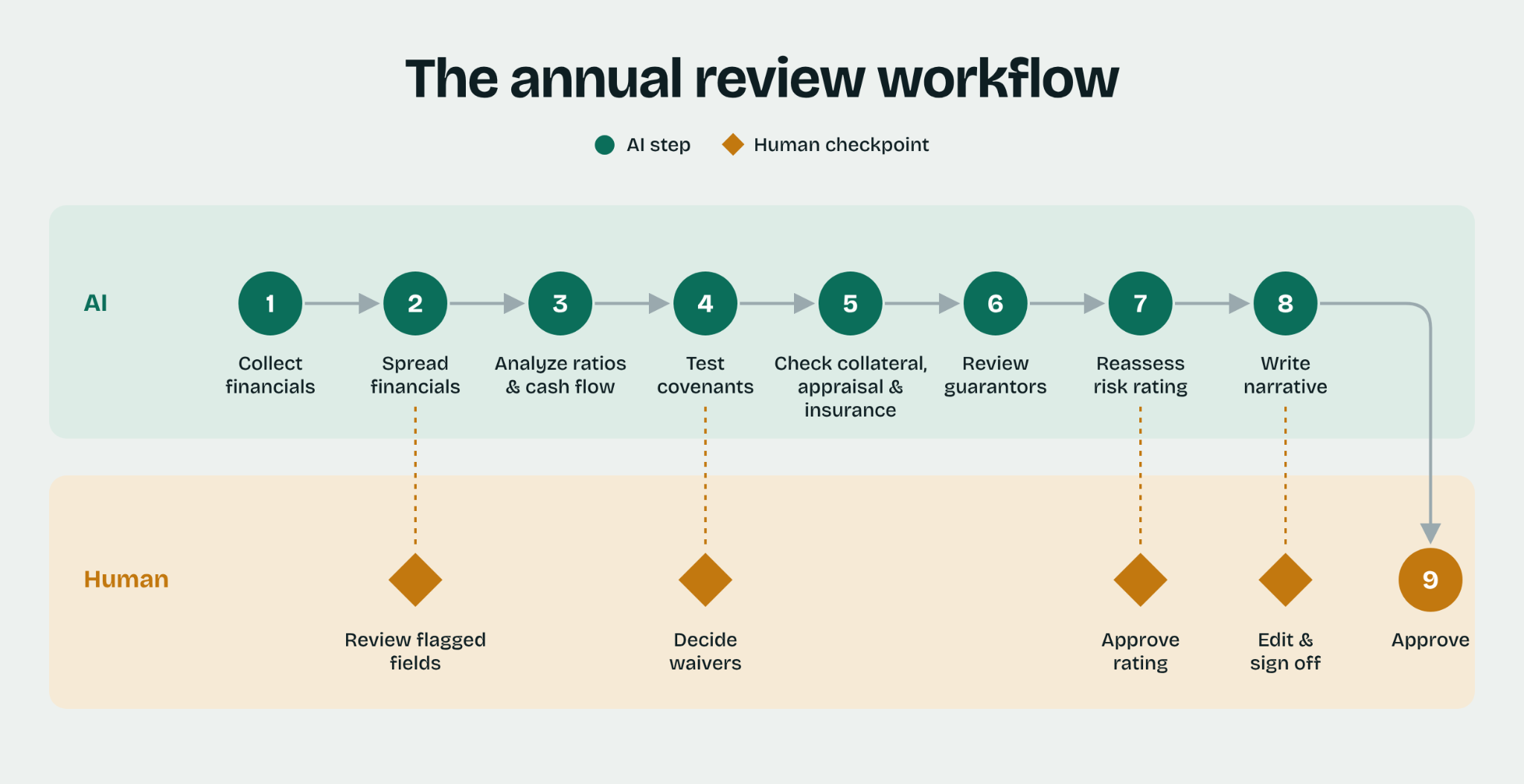
A commercial loan annual credit review follows nine steps, whether the work is manual or automated:
- Collect borrower and guarantor financial statements, tax returns, rent rolls, and compliance certificates.
- Spread the financials into the institution's template.
- Analyze debt service coverage ratio (DSCR), leverage, liquidity, trends, and global cash flow.
- Test covenants against the loan agreement.
- Check collateral, including appraisal age, insurance, and loan-to-value.
- Review guarantors, including personal financial statements and contingent liabilities.
- Reassess the risk rating against policy definitions.
- Write the narrative that explains the credit's condition and the rating.
- Approve through the appropriate credit authority.
How AI Automates Each Step of the Annual Review
Each step below follows the same pattern: how it works manually today, what AI does, and where the human checkpoint sits.
Financial Statement Collection and Tickler Follow-Up
Manual today: Credit administration runs a tickler report, emails borrowers, and tracks responses in a spreadsheet or the core.
What AI does: It sends borrower requests and reminders on schedule, receives incoming documents, classifies them, and checks completeness against the review requirements for that credit. A missing schedule or an unsigned statement gets flagged right away, not two weeks later.
Human checkpoint: Credit administration handles exceptions, such as a borrower who needs an extension.
Document Extraction and Spreading
Manual today: An analyst opens each PDF and retypes figures into the spreading template.
What AI does: Document AI extracts figures from tax returns, CPA-prepared statements, rent rolls, and personal financial statements. Automated financial spreading maps them into your template, with each value linked back to its source page.
Human checkpoint: The analyst reviews flagged items and low-confidence fields instead of retyping everything.
Financial Analysis and Global Cash Flow
Manual today: Ratios are calculated in the template, and global cash flow is built by hand across related entities and guarantors.
What AI does: It calculates ratios, compares them with prior years, highlights material changes, and assembles global cash flow across the borrowing entity, related businesses, and guarantors.
Human checkpoint: The analyst checks entity relationships and any adjustments, such as one-time items or owner compensation.
Covenant Testing and Exception Flags
Manual today: Covenants live in a spreadsheet and get tested when someone gets to them.
What AI does: It tests covenant compliance against your covenant library as soon as the spread is ready, flags breaches and near-breaches, and tracks open waivers. This is post-close loan monitoring that actually happens on time.
Human checkpoint: Waivers and amendments are banker decisions, made by people with the authority to make them.
Collateral, Insurance and Appraisal Checks
Manual today: Someone checks insurance certificates and appraisal dates against policy, often after an exception is already late.
What AI does: It flags insurance that is expiring, appraisals older than your policy allows, and changes in value or loan balance that should trigger an LTV recalculation.
Human checkpoint: The credit officer decides whether a new appraisal or evaluation is needed.
Risk Rating Reassessment
Manual today: The analyst proposes a rating based on judgment and the policy definitions, and the reasoning often lives in a sentence or two of the memo.
What AI does: It recommends a rating and lays out the supporting evidence, such as DSCR trend, covenant status, and liquidity, mapped to your policy definitions.
Human checkpoint: An authorized officer approves or changes the rating. The system records what the AI recommended, what the officer decided, and why. That audit trail is exactly what examiners and loan reviewers want to see when they test whether ratings are timely and accurate.
Drafting the Annual Review Memo
Manual today: The analyst opens last year's memo or a blank template and writes.
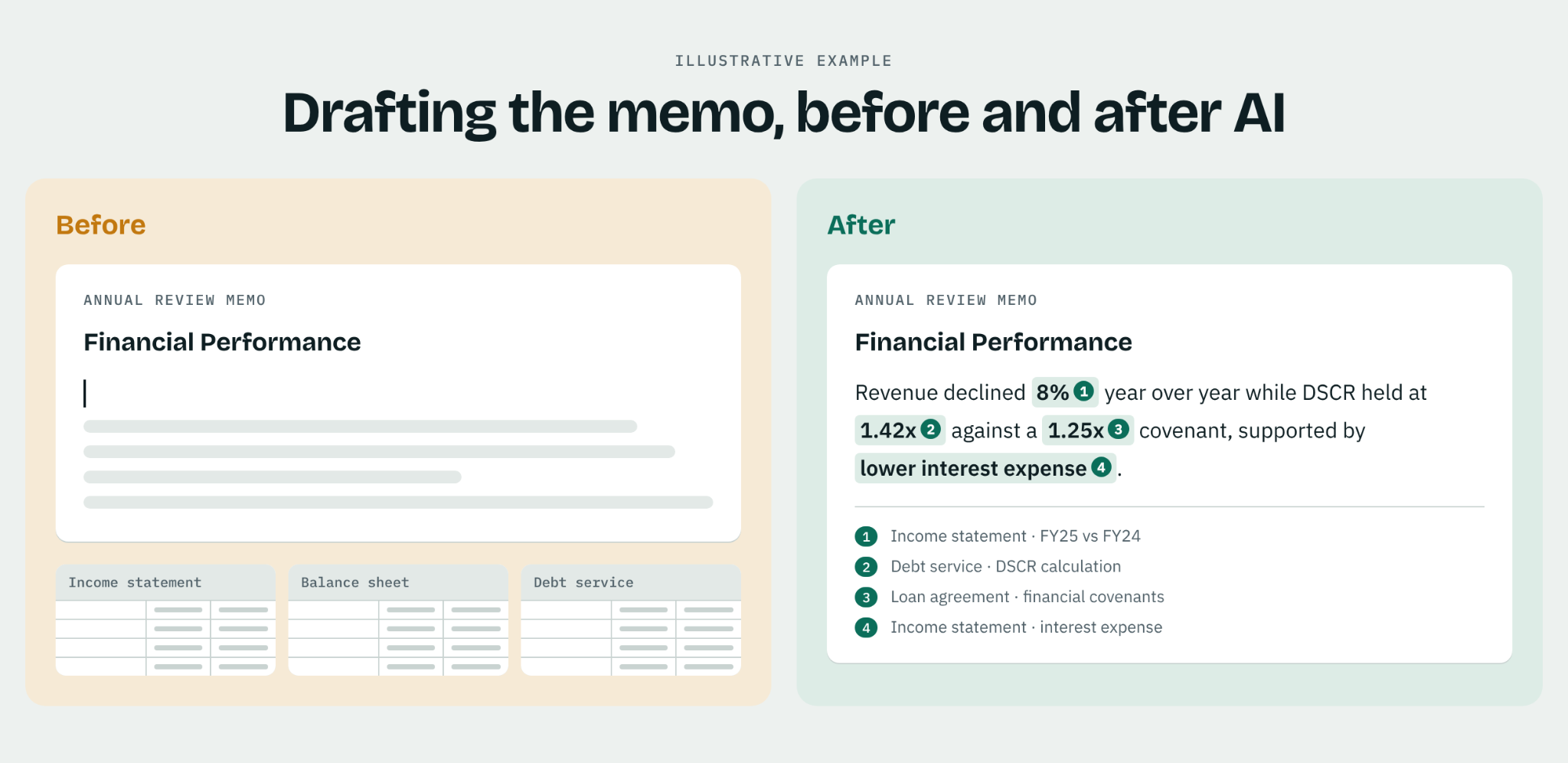
What AI does: It produces a first-draft credit memo narrative from the spreads, covenant results, collateral checks, and rating rationale.
Human checkpoint: The credit officer edits, adds judgment, and signs off.
You may also read: How to Implement Continuous Credit Monitoring on an Existing Loan Portfolio
How AI Automates the Commercial Loan Renewal Process
The commercial loan renewal process is mostly a re-underwrite on a deadline. AI loan renewal workflows help by starting earlier and reusing work you have already done.
The Renewal Runway: Start 90 to 180 Days Out
AI runs the maturity report continuously and triggers a renewal workflow at a set point, often 90 to 180 days before maturity depending on size and complexity. It assigns an owner, opens the document request, and puts the renewal on the portfolio manager's queue. Nobody discovers a maturing loan three weeks before the date.
Re-Underwriting with Prior-Year Data Already in Place
When annual reviews are automated, the renewal starts with current spreads, covenant history, collateral status, and the rating trend already assembled. An AI loan renewal workflow pulls those outputs into the renewal package, so the analyst updates rather than rebuilds.
Renewal Credit Package and Approval
AI drafts the renewal memo, summarizes proposed term changes such as rate, amortization, covenants, and guarantees, and routes the package to the right approval authority based on exposure and policy.
Handling CRE Renewals and Accommodations
CRE renewals need extra care right now. The 2023 interagency policy statement on prudent commercial real estate loan accommodations and workouts sets expectations for how lenders handle renewals and modifications for stressed borrowers. It covers documentation of the borrower's condition, how accommodations affect risk ratings, and the accounting and reporting considerations for modifications. Automation helps by keeping the evidence complete and consistent, but the decision to accommodate stays with credit.
Risk-Based Tiering: Not Every Review Needs the Same Depth
Not every credit needs a full annual review. Many institutions already tier reviews by exposure size and risk grade: a small, well-performing credit gets an abbreviated review, while large exposures and watch-list credits get a full review, often more than once a year.
Automation makes tiering practical. When spreading, covenant testing, and collateral checks run automatically, a low-risk review can become exception-only: if nothing breaches a threshold, the analyst confirms the result and moves on. That frees analysts to spend real time on watch-list and large credits, which is where the risk sits. Your credit policy should define the tiers and the thresholds, not the software.
What Examiners Expect from Automated Reviews
Examiners do not ask whether a review was done by hand. They ask whether it was timely, accurate, independent where required, and documented. The 2020 interagency guidance on credit risk review systems sets out those expectations, including timely and accurate risk ratings and appropriate independence of the review function.
When AI is part of the process, two more bodies of guidance apply. Model risk management expectations in the Federal Reserve's SR 11-7 and the OCC's Bulletin 2011-12 cover AI tools, including vendor models. Third-party risk management guidance covers how you oversee the vendor.
Controls checklist:
- Defined human approval points for ratings, waivers, and renewals
- An audit trail of AI outputs and human changes
- Version history for spreads and memos
- Exception logs for low-confidence extractions and overrides
- Periodic validation of AI outputs against manual samples
The Metrics That Prove It's Working
Baseline these before you change anything, then track them monthly.
Annual Review Automation for Community Banks and Credit Unions
Community banks and credit unions often feel the review backlog most. Lean credit teams carry large books, and one departure can set the schedule back months. Automation works here as capacity without new hires: the same team keeps reviews current.
For credit unions, member business lending carries its own rules. NCUA's Part 723 member business loan rule sets expectations for credit risk management, including policies that address ongoing monitoring of commercial loans. Portfolios are smaller, but staff are thinner, and shared CUSO arrangements can spread the cost of tools and expertise.
See also AI agents for credit unions.
How to Get Started
Step 1: Measure Your Backlog
Count past-due reviews, average cycle time, and analyst hours per review. Split by tier if you can. This is your baseline and your business case.
Step 2: Start with Spreading and Covenant Testing
These are the highest-volume steps and the easiest to measure. Pilot on one portfolio segment, such as CRE investor loans or C&I credits under a set exposure.
Step 3: Add Memo Drafting and Renewal Triggers
Once controls, approval points, and audit trails are working, expand to first-draft memos and automated renewal runways.
Questions to Ask Vendors
- How accurate is spreading on messy, scanned, or multi-entity documents, and can we test it on our own files?
- How do we set up and maintain our covenant library?
- How does the system explain a risk-rating recommendation?
- Can results write back to our core and LOS, or only display them?
- What audit logs and version history do you keep?
- How long does implementation take with our systems?
You may also read: Lending Trends 2027: 10 Shifts Banks and Credit Unions Must Prepare For Now
Loan Annual Review Automation: Automate the Assembly, Keep the Judgment
Loan annual review automation does not take credit decisions away from credit officers. It takes away the collecting, retyping, and blank-page writing that keeps reviews late and ratings stale. Automate the assembly, keep the judgment, and your team can stay current on every review and start every renewal on time.
Ready to Clear Your Review Backlog?
Uptiq's Qore platform gives banks and credit unions domain-trained agents for Document AI, financial spreading, covenant monitoring, and credit memo generation- the same steps that make up the annual review. They work over your existing core and LOS, and a single agent typically goes live in about five business days. Customers have reported 36% less financial spreading time and 63% less credit memo prep time. Start with a review-backlog assessment.
Frequently Asked Questions
What is a commercial loan annual review?

What's the difference between an annual review and a loan review?
How long does a commercial loan annual review take?
Can AI assign or change a loan's risk rating?
How far in advance should a commercial loan renewal start?
Do regulators accept AI-assisted annual reviews?
Which annual review steps should be automated first?
How does annual review automation help with CRE maturities?
About the Author


.png)