
How Banks Deploy AI Agents: From Prototype To Production
AI agent implementation is where most banking AI programs stall. The demo worked, the pilot impressed a steering committee, and then nothing went live. If you are a COO, head of lending or operations leader, you have probably seen both ends of the story: the multi-year program that never ships and the demo that claims to be ready this afternoon.
This blog shows how banks deploy AI agents from prototype to production, day by day. It covers who needs to be in the room, how an agent is grounded, connected, tested and supervised, what tends to slow things down, and what leadership should be able to see by day 30.
What "fast" actually looks like
Fast, done properly, means one agent live in about five business days, under supervision, with every action evidenced. That sits between two stories executives hear often. One is the 18-month AI program: a data lake first, a platform selection second, a use case somewhere in year two. The other is the demo that is "live this afternoon," which usually means it runs on sample data, reads the public web and has never met your credit policy.
Neither is real for a regulated institution. The long program loses sponsors before it ships, which is why so many banks end up in what we have called the pilot graveyard. The instant demo skips the parts a bank cannot skip: grounding in policy, connection to systems of record, controls, testing and an audit trail. The realistic middle is shorter than the first story and more careful than the second.
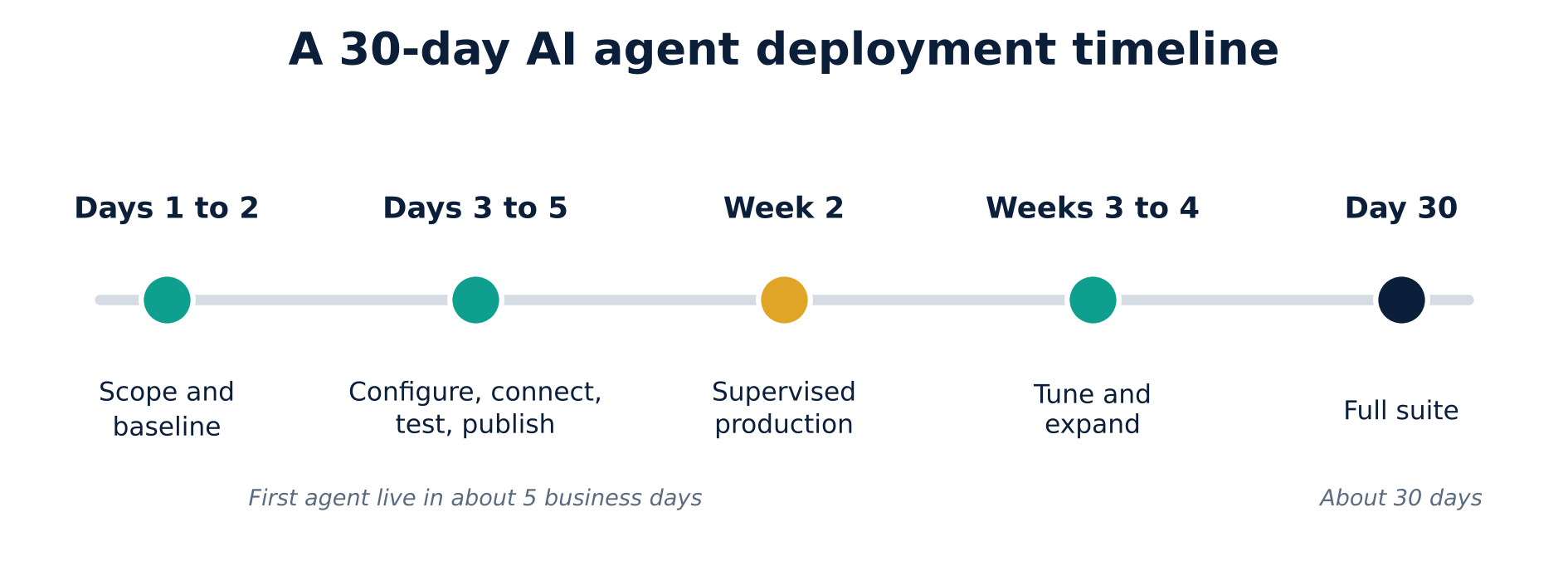
The rest of this blog follows an illustrative example: a commercial lending team at a regional bank deploying the Intake Agent first, then adding underwriting and monitoring. The AI agent deployment timeline below is representative. Real deployments vary with data access, policy readiness and the institution's own approval steps.
Who's in the room
AI in banking implementation needs six groups from the start, each with a clear job. The table below shows what each one owns during the first 30 days.
The key point: risk joins on day 1, not at the end. When model risk and compliance help write the test criteria up front, the review at go-live is a confirmation, not a first look. That is what keeps the timeline intact. Pilots tend to stall when risk sees them too late to shape them.
Days 1 to 2: Scope and baseline
The first two days decide what the agent will do and how you will know it worked. Pick one bounded workflow with high volume and a clear owner. Commercial loan intake is a good first candidate: the documents are familiar, the rules are written down and the pain is easy to measure.
Then measure today. Without a baseline, there is no result to show at day 30. For intake, capture:
- Hours per file spent collecting, classifying and re-keying documents.
- Error and rework rates on extracted data.
- Time from application to a complete file.
- Follow-up requests per file for missing items.
Finally, agree the human decision points. Where must a person review? Where must a person approve? Which actions is the agent never allowed to take? Writing these down now becomes the starting point for the authority grid in the next phase. For the intake funnel itself, our piece on small business loan application abandonment shows where files typically stall.
Days 3 to 5: Configure and connect
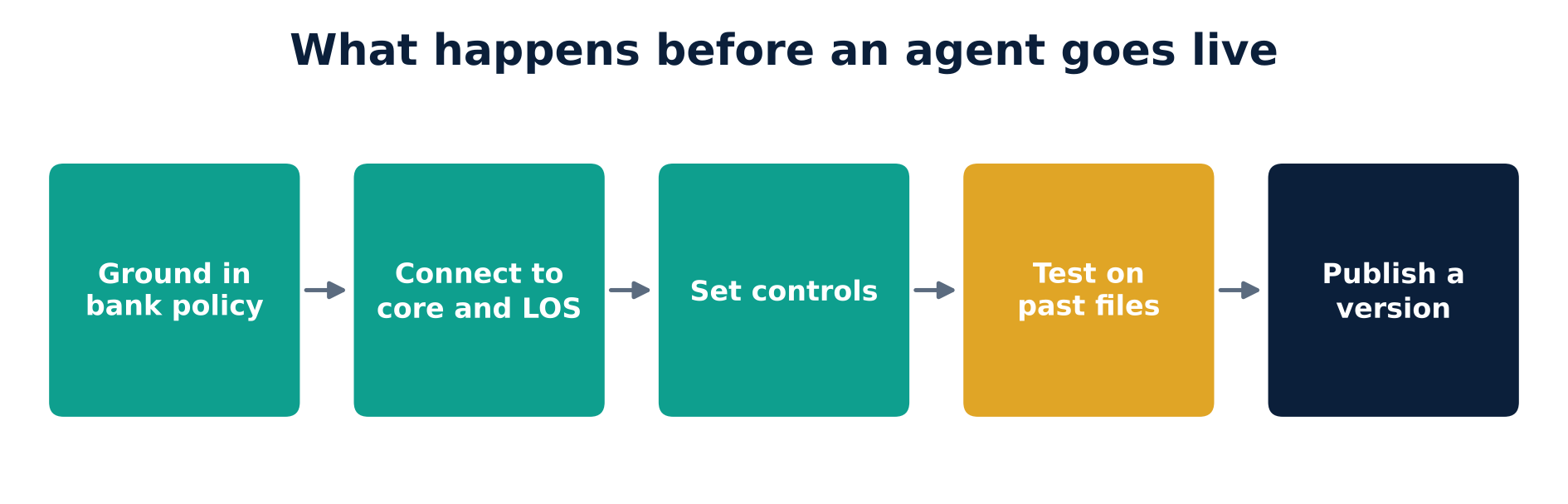
Days 3 to 5 are where the agent becomes bank-grade: grounded, governed and provable. Five things happen, in this order.
Ground it in the bank's own rules
Load the institution's credit policy, product rules, and authority grid into the Knowledge Hub so the agent works from the bank's rules, not the public web. The team can test knowledge before any agent relies on it: they ask the questions an analyst would and check that the answers come from the right policy, in the right version.
Connect it to existing systems
The agent connects to the existing core, LOS and CRM through the Data Gateway. This is a new tier, not a new core. Nothing is migrated. The platform has 150+ connectors mapped and 30 live in production, so most connections start from a known pattern. External calls are blocked by default, PII is masked before any external model sees it, and there is no retention and no training on the bank's data.
Set the controls
The Validation Hub checks every action against the authority grid before it runs, so actions outside policy are designed to be blocked rather than caught later. Access is set with team roles, and usage limits keep costs predictable from the first day.
Test it before it's live
In plain language: the agent has to pass the bank's own test before anyone relies on it. The team runs it against a set of past files with known correct answers, which the platform calls golden data, using regression evaluations and checklists. Risk sees the pass rate, the misses and the reasons. If the agent fails, it does not go live.
Publish through review
The agent goes live through a publish and review step, as a saved version that can be rolled back. The Console walkthrough shows what that looks like on screen. At this point, one agent is live in about five business days.
Week 2: supervised production
In week 2 the agent works on live files, but a person reviews every output before it is used. That is supervised mode, and it is where trust gets earned with evidence rather than asserted in a slide.
Three things make supervision useful rather than ceremonial:
- Exceptions are tracked. Every correction a reviewer makes is logged, so the team can see which documents or fields the agent gets wrong and why.
- Every action carries an evidence receipt. It records the rule invoked, the source and its version, the model and its version, the actor and the timestamp.
- Quality is scored live. Online evaluations score live work as it happens, so quality is measured, not assumed.
This is also the answer to the questions supervisors are now asking. Reuters reported in October 2026 that US regulators are questioning banks on what limits are placed on AI agents, whether their decisions can be tracked and audited, what stops them from exceeding their authority, whether humans stay involved and how they can be shut down. Supervised mode, the authority grid and evidence receipts answer each of those directly.
You may also read: AI in Lending Use Cases
Weeks 3 to 4: Tune and expand
Weeks 3 and 4 turn supervision data into a narrower, sharper review. Confidence thresholds are adjusted based on what the reviews showed. Fields the agent extracts reliably stop needing a second look. Document types it struggles with stay under review. Over these two weeks, review narrows from every output to exceptions only.
If a change makes things worse, the team runs the earlier saved version while they fix it. Versioning means a bad configuration change costs an afternoon, not a quarter.
This is where capacity appears. Analysts move from re-keying tax returns and bank statements to reviewing the items the agent flags. The same team handles more files with more attention on the ones that need judgment. That is capacity creation for growth: more deals reviewed, faster, by the people you already have.
What can slow AI agent implementation down
Four things slow AI agent implementation down more than any technology issue, and each can be avoided:
- Outdated or conflicting policy documents. An agent grounded in last year's credit policy is wrong on day one. Ask compliance to confirm the current version of each policy before grounding begins.
- Slow data access approvals. A connection request that waits three weeks in a queue stalls everything. Start access requests on day 1, in parallel with scoping.
- No single business owner. When three people share the workflow, decisions about review points stall. Name one owner who can say yes.
- Risk brought in late. A first look at go-live becomes a restart. Bring model risk and compliance in on day 1 to shape the tests.
None of these are unusual. They are the normal friction of a regulated institution, and planning for them is the difference between a 30-day deployment and a 30-week one.
Day 30: The full suite
By day 30, adjacent agents are added on the same foundation. For commercial lending, the natural sequence is the Intake Agent first, then the Underwriting Agent for spreading and analysis, then the Continuous Monitoring Agent after close.
The second agent is faster than the first. Grounding, connections and controls are already in place, and the test sets and review habits carry over. Each new agent still goes through testing, publishing, review, and a supervised period, but the foundation work is done once. That is how the full suite arrives in about 30 days. The seeded library holds 51 agents, so later workflows usually start from a pre-built agent rather than a blank page.
What leadership sees at day 30
At day 30, leadership should see three things: results against the baseline, a single view of every live agent and an audit trail an examiner can replay.
- Baseline versus live metrics for the first workflow: hours per file, rework, time to a complete file and time to decision.
- A single view in the Control Center of every live agent, its version, its evaluation scores and its cost.
- An audit trail an examiner can replay on demand, built from the evidence receipts on every action.
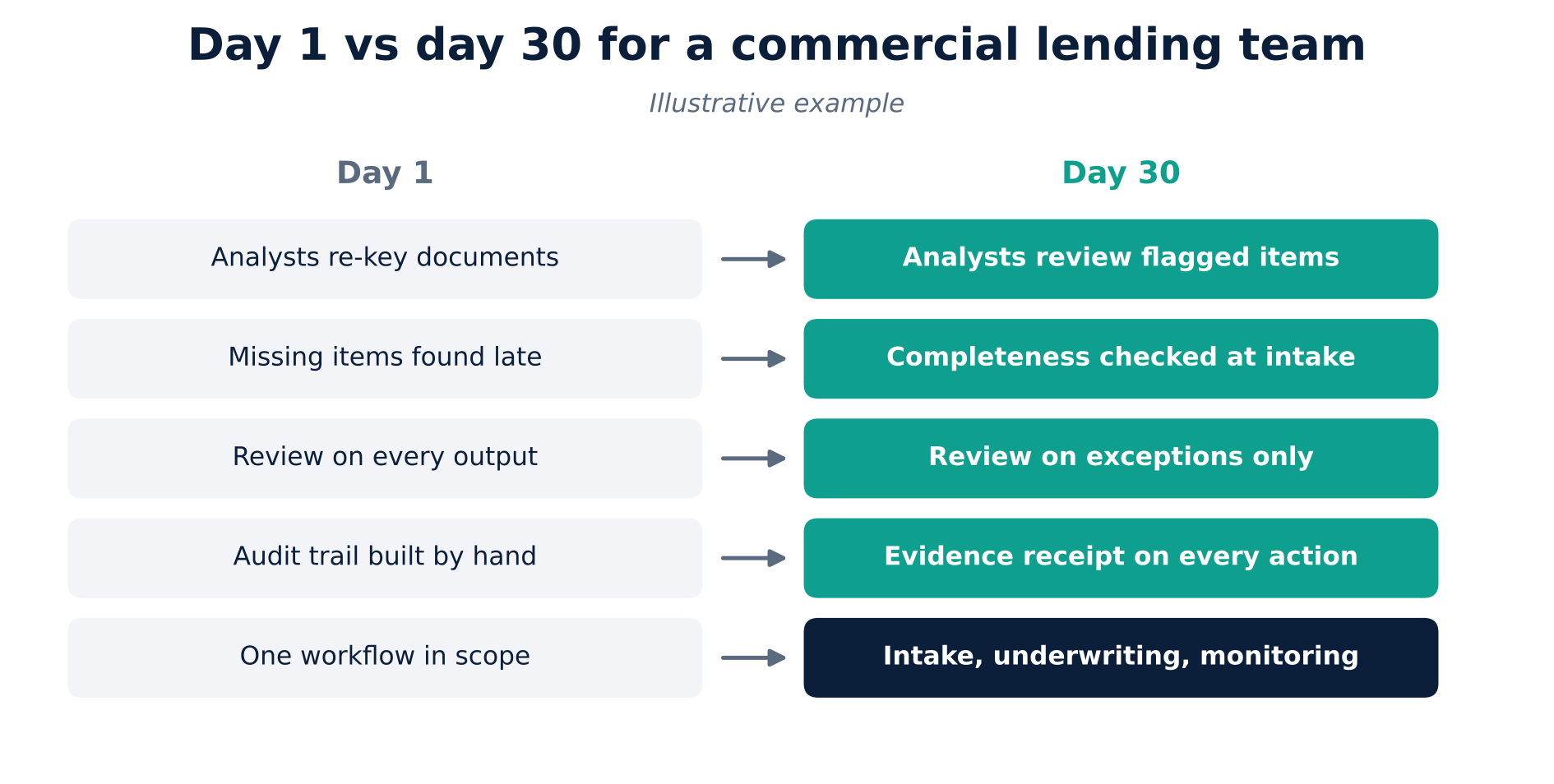
For the example team, the shift is from analysts re-keying documents to analysts reviewing flagged items, with completeness checked at intake and review limited to exceptions. Those day-30 outcomes are illustrative. Across deployments, Uptiq customers have seen 41% faster underwriting cycle time, 36% less financial spreading time and 63% less credit memo prep time once underwriting agents are in use.
The governance picture matters as much as the speed. The interagency model risk guidance banks worked under for 15 years, SR 11-7, was replaced in April 2026 by SR 26-2 (OCC Bulletin 2026-13 for national banks), which says generative and agentic AI models are not within its scope while the agencies gather information. Vendor relationships still fall under the interagency third-party risk management guidance. Until AI-specific expectations are written, inventory, testing evidence, human review and a replayable trail are what a careful examiner will expect to see.
Conclusion: start with one workflow
Fast AI agent implementation is possible when grounding, controls and evidence are built in from day one rather than added at the end. The first agent proves the foundation: policies loaded and tested, systems connected, controls set, tests passed and every action evidenced. Every agent after it is quicker because that work is already done.
So start with one workflow, one owner and one baseline. Bring risk in on day 1. Supervise the first weeks and let measured results narrow the review. The Uptiq platform is built to run that sequence, so your teams gain capacity for growth while your credit officers keep every decision.
See a 30-day deployment plan for your first workflow
Book a demo to walk through grounding, testing and supervised production for one of your own lending workflows.
Frequently Asked Questions
How long does it take to deploy an AI agent at a bank?

What is the best first workflow for an AI agent in banking?
Who needs to be involved in an AI agent implementation?
What is supervised production for AI agents?
Do banks need to replace their core to deploy AI agents?
How do banks control AI agent costs?
What do examiners need to see from an AI agent deployment?
About the Author