AI in banking just got a planning number. In October 2026, Boston Consulting Group estimated that AI could free up to 40% of current middle and back-office capacity by 2030. Most headlines read that as a jobs story. For the operations leaders who will actually do the work, it is a design story: which loan operations, document processing, spreading, covenant tracking, KYC and reconciliation workflows get rebuilt first, who does what once they are rebuilt, and where the freed hours go. This article walks through what the BCG figure does and does not say, which workflows to redesign first, a five-step redesign playbook, and how to measure capacity created so it shows up as growth rather than as a slide in a cost review.
What the BCG 40% figure actually says
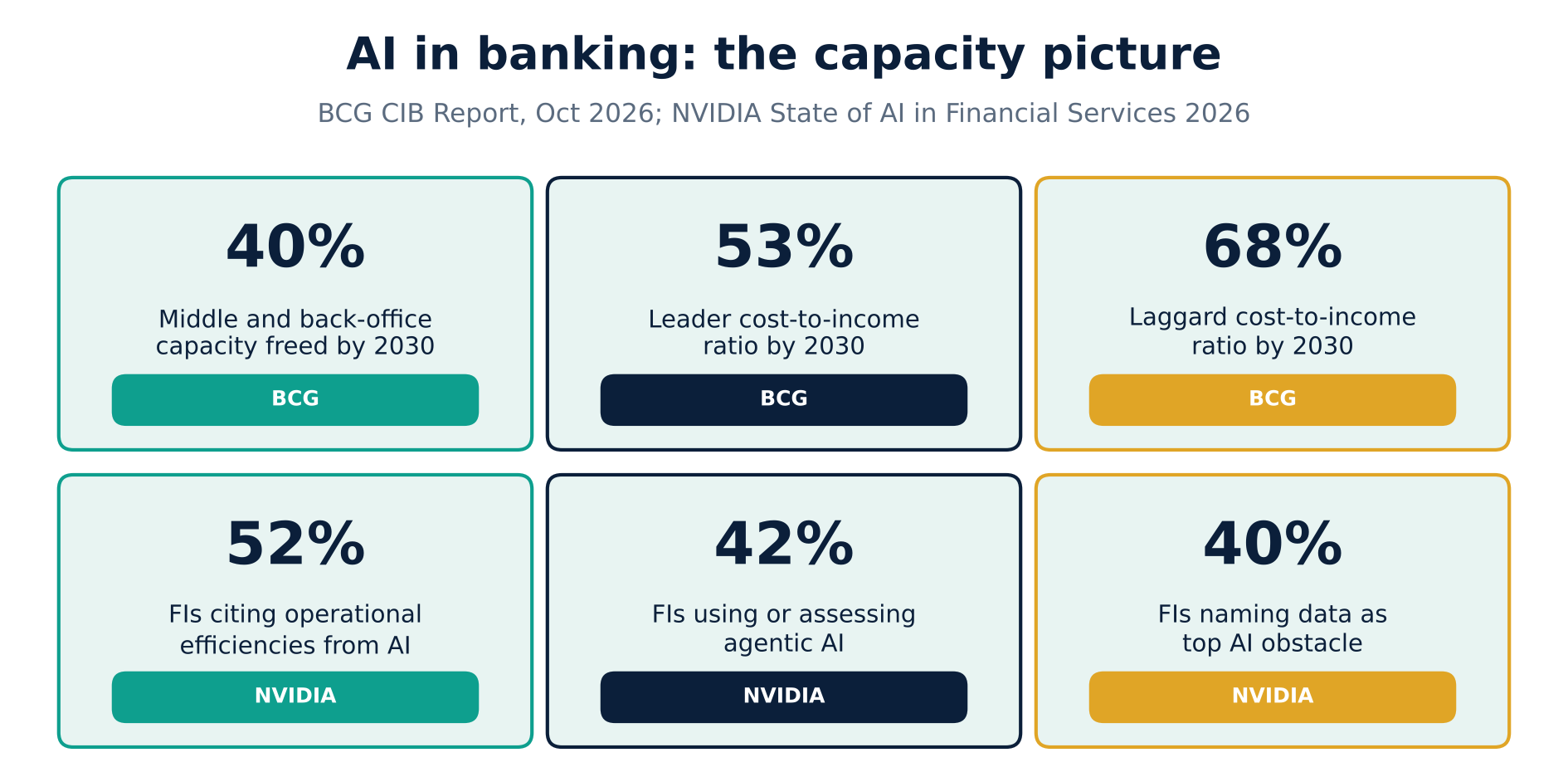
The figure says that by 2030, AI could free "up to 40% of current full-time-equivalent capacity in middle- and back-office functions," measured against today's job profiles. It comes from BCG's 2026 Corporate and Investment Banking Report, "A Golden Window for Growth," released on October 14, 2026. The same release adds a sentence most coverage skipped: "Freed capacity is not the same as a net head count reduction."
Three details matter before anyone builds a business case on it. First, the report is about corporate and investment banking, so the number is a directional benchmark for community banks, credit unions and lenders, not a forecast for them. Second, "up to" is a ceiling, and it is tied to today's job profiles, which will change as the work changes. Third, the report frames AI as part of a broader pivot "from a product-led model to a client- and platform-led one," noting that most operating models today "are led by humans" with AI supporting individual workflows.
The economic gap BCG describes is wide. It projects leading banks reaching a cost-to-income ratio of roughly 53% and a return on tangible equity of roughly 21% by 2030, against roughly 68% and 10% for laggards. The difference is not who buys AI. It is who redesigns the work around it.
Why AI in banking is a capacity story, not a cuts story
AI in banking is a capacity story because the binding constraint in most institutions is skilled hours, not demand. Credit analysts, loan operations specialists and KYC teams spend a large share of their week moving data between documents and systems. When AI takes the preparation and checking load, those same people can carry more deals, review more exceptions and spend more time with borrowers and members.
The industry data points the same way. In The Financial Brand's coverage of NVIDIA's 2026 State of AI in Financial Services report, 52% of institutions said AI created operational efficiencies, and 42% said they were already using or assessing agentic AI. The same survey found data challenges were the most cited obstacle, named by 40% of respondents. BCG and OpenAI's March 2026 piece on how retail banks can put AI agents to work makes the operational point directly, calling the back office the place AI will deliver "the most immediate and substantial impact."
Framing matters for delivery, too. Operations teams that believe redesign is a prelude to cuts tend to protect the old process, hide exceptions and slow adoption. Teams that see a path to bigger portfolios, better work and new roles tend to surface the edge cases that make the AI better. If you want the 40%, you need the people who know where the real exceptions live in every workflow.
Which middle and back-office workflows to redesign first
Redesign first the workflows that are document-heavy, rules-rich, high volume and easy to check. Those four traits let AI do meaningful preparation while humans can verify output quickly, which is where capacity shows up fastest. Workflows that depend on judgment, negotiation or relationship context come later, and the final call in credit always stays with credit officers.
Start with AI loan document processing if you are unsure. Almost every other workflow in the table depends on clean, extracted data, so fixing intake and extraction compounds downstream. Our explainer on OCR vs IDP vs Document AI covers why template-based extraction tends to stall on the variety of documents lenders actually receive.
Spreading and covenant tracking are usually the next best targets. Both are repetitive, both have clear right answers, and both are areas where analysts say the work crowds out actual analysis. Generative AI in banking is most useful here as a drafting and reconciliation layer, with every figure traceable to its source page.
You may also read: AI budget for banks 2027
A five-step playbook for redesigning operations around AI
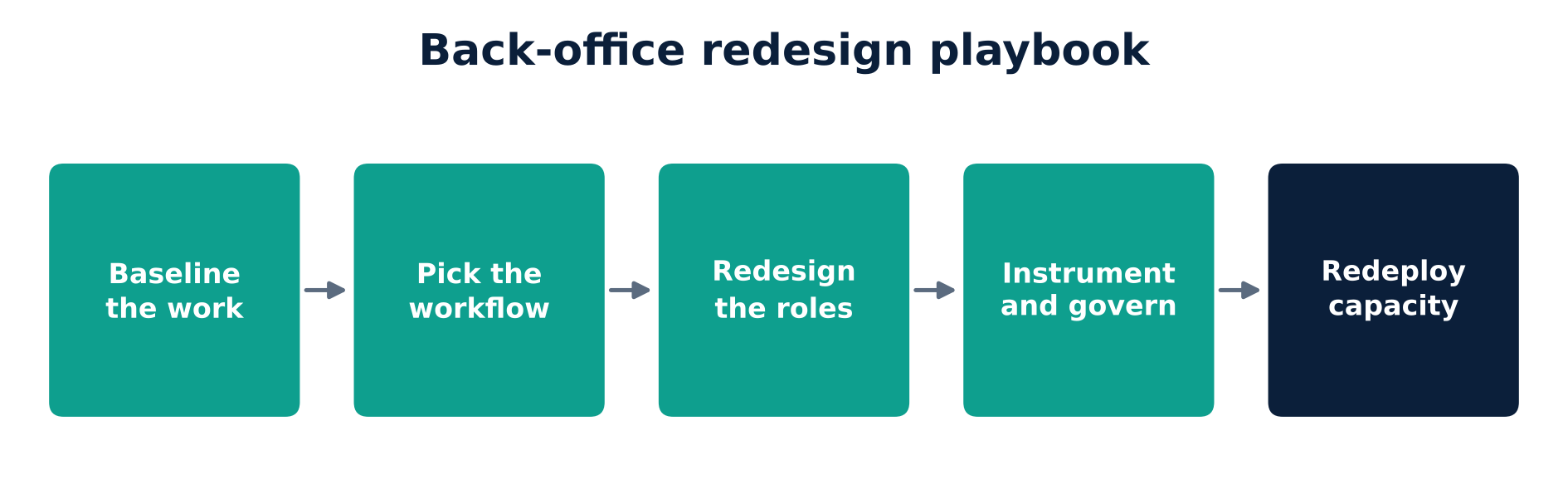
A workable playbook has five steps: baseline the work, pick the workflow, redesign the roles, instrument and govern, then redeploy the capacity. The order matters, because skipping the baseline makes the result impossible to prove, and skipping redeployment lets freed hours quietly disappear.
1. Baseline the work
Time how long each step of the target workflow takes today, how often it loops back and where exceptions come from. Use system timestamps where you can and short time studies where you cannot. Two to four weeks of data is usually enough to set a credible baseline.
2. Pick the workflow, not the use case
Choose an end-to-end workflow with a clear start and finish, such as "complete file to approved spread." A narrow use case like "extract one field" frees minutes; a workflow frees days. Prefer workflows where a single team owns the outcome so decisions move quickly.
3. Redesign the roles alongside the process
Write down what the AI prepares, what a person reviews, and what a person decides. In credit, agents prepare and check; credit officers decide. Define confidence thresholds that route low-confidence items to people, and design new roles such as exception reviewer or portfolio analyst before go-live, not after.
4. Instrument and govern from day one
Log every agent action, the source data it used and who approved the output. That audit trail is what lets you prove capacity gains and answer examiners. Reuters reported in October 2026 that US regulators are questioning banks on AI agent limits, audit trails and human involvement, so build those controls in rather than adding them later. Governance across pilots is a topic of its own, covered in the post linked below.
You may also read: Banking AI Governance: Why Most Pilots Die and How to Ship Them
5. Redeploy the capacity on purpose
Decide before launch where the freed hours go: more deals per analyst, faster turnaround for small business borrowers, deeper portfolio monitoring or member service. Put the redeployment target in the business case alongside the efficiency target. Capacity that is not assigned tends to be absorbed by meetings and rework.
How to measure the capacity you create
Measure capacity in four layers: hours returned, flow, quality and redeployment. Hours alone are easy to overstate, while redeployment is the layer that turns an efficiency project into a growth result. This is also how you answer the ROI question with evidence rather than estimates.
The measurement gap is real across industries. In IT Brief's March 2026 report on NVIDIA's cross-industry State of AI survey, 30% of respondents cited a lack of clarity on AI's return on investment as a top challenge. A baseline and a redeployment metric close most of that gap.
One practical rule: report capacity created as a range with the assumptions shown, and update it monthly. Finance teams trust numbers they can trace, and operations teams trust numbers they helped produce.
Where the Uptiq platform fits: A new tier, not a new core
The Uptiq platform fits as a new tier, not a new core: it sits on top of your core, loan origination system and document stores and runs agents across the middle and back-office workflows above. Nothing in the redesign playbook requires replacing systems of record. The platform reads from and writes back to what you already run.
Each priority workflow maps to a specific capability. Document AI classifies, extracts, validates and generates documents, with confidence thresholds that route uncertain fields to people. The Intake Agent assembles complete files and chases gaps. The Underwriting Agent prepares financial spreads and credit memo drafts for credit officers to review and decide. The Continuous Monitoring Agent supports covenant monitoring and portfolio checks after booking.
The governance is built in. The platform is bank-grade, meaning grounded, governed and provable: Validation Hub checks every action before it runs, and every output is traceable to its source. Uptiq customers have seen 41% faster underwriting, 63% less credit memo prep time, 36% less financial spreading time and up to 3x deals per analyst, with a single agent live in about 5 business days.
Conclusion: The 40% is an allocation decision
BCG's estimate gives operations leaders a ceiling, not a plan. The institutions that capture it will be the ones that baseline their workflows, redesign roles alongside processes, govern every agent action and decide in advance where freed capacity goes. That is how the 40% turns into more deals, faster borrower answers and stronger portfolio oversight.
The Uptiq platform is designed to make that redesign practical as a new tier on top of your existing systems, with agents that prepare and check the work while your people review and decide.
See how much back-office capacity you could create
Bring one workflow, such as intake, spreading or covenant tracking, and we will walk through a capacity assessment and a live demo of the agents that would run it.
Frequently Asked Questions
What is agentic AI in banking?

What is the ROI of AI in lending?
Does the BCG 40% figure mean banks will cut 40% of back-office jobs?
Which back-office workflow should a bank automate first?
How is generative AI in banking different from agentic AI?
How do you measure capacity created by AI in financial services?
Do banks need to replace their core to use AI in back-office operations?
About the Author