Most conversations about agentic AI in banking start inside the bank: agents that spread financials, draft memos, or triage alerts. The bigger shift may come from the other side of the counter. Consumers and business owners are starting to use their own AI agents to shop rates, move idle cash and compare loan offers, and those agents do not care how long the customer has banked with you. If you run deposits, lending or relationship teams, this changes what loyalty is worth and how fast you need to respond. In this article, you will learn what the research says about customer-side agents, what they do to deposit stickiness and relationship lending, and four practical moves that keep your institution in the conversation when a machine is doing the shopping.
What agentic AI in banking looks like from the customer side
From the customer side, agentic AI in banking means a person or business hands an agent a goal, such as "earn more on my idle cash" or "find me the cheapest equipment loan", and the agent does the research, comparison and paperwork. The customer only steps in to approve. It is one of the least discussed shifts in AI in financial services, and a different model from a rate comparison website, where the customer still has to do the clicking, reading and switching.
The appetite is already measurable. In its Top Banking Trends for 2026 report, Accenture found 65% of consumers are open to a GPT-like financial assistant offered through a gen AI platform or digital wallet, and 71% would welcome one in their primary bank's mobile app. The same report notes that 57% of business leaders believe agentic commerce will become mainstream within three years.
McKinsey's Global Banking Annual Review 2025 reaches a similar conclusion. More than half of consumers now use gen AI tools, and the report expects them to begin "routinely using AI agents to optimize their finances", including moving deposits to higher-yield accounts. If you want a primer on the bank-side version of the technology, our glossary entry on what agentic AI in finance is covers the basics.
Why approval-only switching matters
The friction that kept balances in place was never the rate gap. It was the effort. As McKinsey's Darius Imregun told American Banker, a third-party agent "doesn't even need to move the money on your behalf". The customer just needs to say, "give me the final authorization." Once switching costs one tap, inertia stops being a strategy.
How customer AI agents change deposit stickiness
Customer AI agents weaken deposit stickiness because they surface rate gaps continuously and remove the effort of acting on them. Low-cost core deposits have been the quiet engine of bank profitability, and agents target precisely the balances that sit still.
The numbers explain why. McKinsey estimates about $70 trillion in global consumer deposits, with $23 trillion in checking accounts paying zero or close to zero. According to American Banker's report on the study, the average US savings account pays about 40 basis points, while the top of the market pays about 10 times that. An agent does not need to be clever to find that spread.
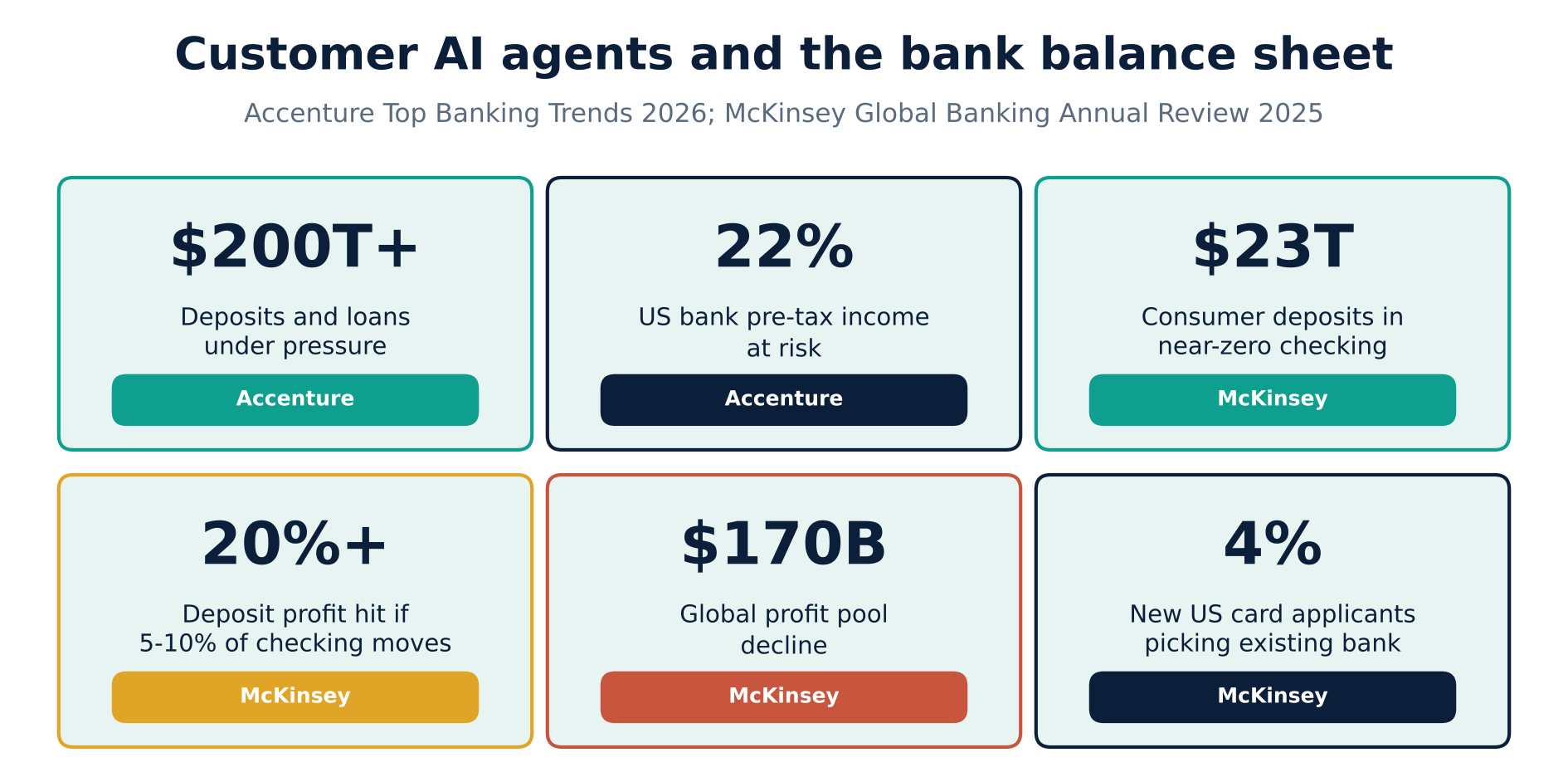
The sensitivity is high. McKinsey found that moving just 5% to 10% of checking balances to top-of-market rates could cut the industry's total deposit profits by 20% or more. Accenture's analysis points the same way: 22% of US banks' pre-tax income could be at risk from relatively small disruption to loan and deposit rates, and two thirds of global banking revenue is net interest income.
The "lazy loyalist" problem
On The Financial Brand's Banking Transformed podcast, Accenture's Michael Abbott described the customers who have stayed with their bank for years without shopping around as "lazy loyalists". He split the $200 trillion roughly evenly, about $100 trillion on the deposit side and $100 trillion on credit. He also noted that US deposit beta runs at about 50%, so banks pass on roughly half of rate moves today. A customer agent that wakes up those loyalists can push that number higher without a single branch conversation.
You may also read: Relationship Banking at Scale
What customer agents mean for lending relationships
Customer agents push lending toward full price transparency, which rewards lenders who decide fast and explain clearly. Borrowers already shop more than banks assume, and agents will make that shopping cheaper and more thorough.
McKinsey's data shows how far loyalty has eroded before agents arrive at scale. Only 4% of new US credit card applicants pick their existing bank without exploring alternatives, down from 10% in 2018. Loyalty-driven US checking account openings fell to 4%, from 25% in 2018. If a primary relationship no longer earns the next product by default, a comparison agent will only widen the gap.
Commercial and small business borrowers
The pressure is not limited to consumers. A business owner's agent can assemble tax returns, bank statements and financials, submit them to several lenders, and line up the term sheets side by side. In that world, the lender that asks for the same document three times, or takes two weeks to give an indication, simply drops out of the comparison.
That does not make relationship lending obsolete. It changes what the relationship has to deliver:
- Speed to a credible answer. The first clear, well-supported indication sets the benchmark the agent compares against.
- Clarity on terms. Covenants, fees and conditions need to be explicit enough for a machine to read without a phone call.
- Value beyond price. Treasury services, advice and responsiveness are what a relationship manager can offer that a rate table cannot, but only if they show up before the customer's agent goes shopping.
Credit judgment stays with your credit officers. What changes is how quickly the file in front of them is complete, checked and documented.
Four moves banks can make now
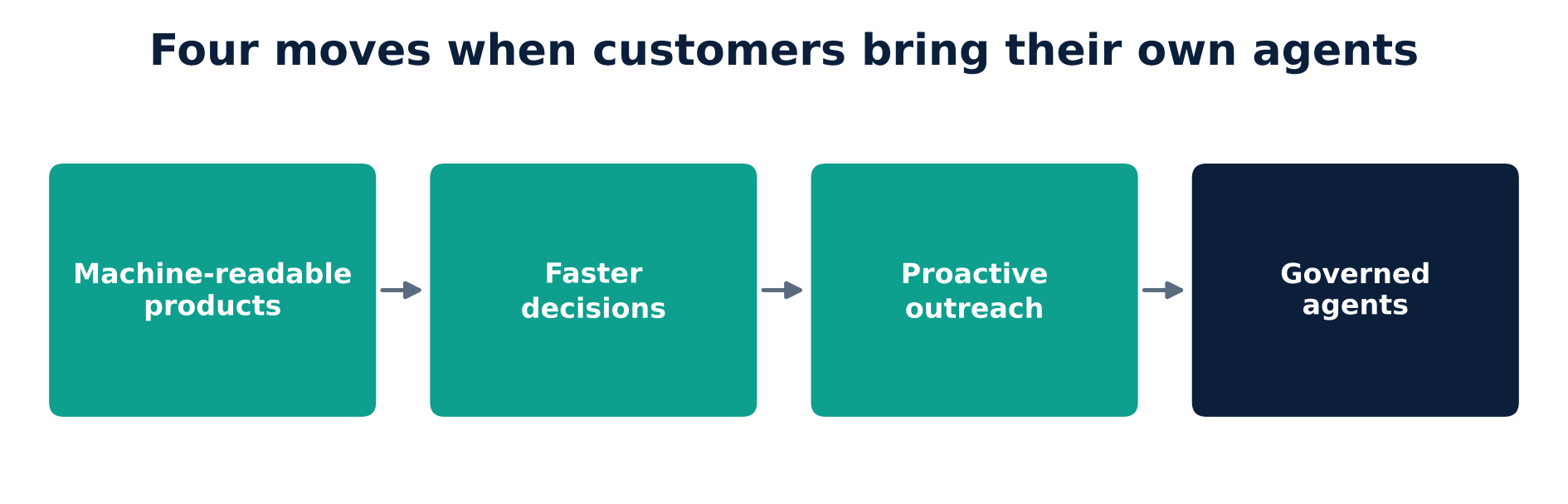
Banks can respond to customer AI agents with four moves: make products and policies machine-readable, decide faster, manage relationships proactively, and run governed agents of their own. Accenture's report frames the defensive playbook in similar terms, from repricing to defend liquidity to breaking product silos and using AI-powered optimization to move first.
1. Make products, rates and policies machine-readable
If a customer's agent cannot read your product terms, eligibility rules and current rates, it will skip you. That means structured, current and consistent product data, not PDFs and branch rate sheets. The same structured knowledge also feeds your own agents, so the answer a customer sees and the answer your staff gives come from one source.
2. Shorten the path to a decision
Agents compare responses as well as prices. Lenders that automate intake, document collection and spreading can return a well-supported indication while competitors are still chasing paperwork. An AI intake agent that collects and checks documents up front is often the fastest place to start.
3. Reach out before the customer's agent does
If idle balances, maturing CDs or a business's growing cash position are visible to the customer's agent, they are visible to you first. Proactive outreach with a relevant offer, made by a relationship manager with context, turns a defensive repricing into a retention conversation. Our glossary entry on AI account management explains how this works in practice.
4. Run governed agents of your own
Your own agents need to act within your policies, leave an audit trail and keep a human in the loop for material decisions. US regulators are already asking banks about agent limits, audit trails and shutdown controls, as Reuters reported in October 2026. The governance side deserves its own playbook, which we cover separately.
You may also read: Banking AI Governance: Why Most Pilots Die and How to Ship Them
Where the Uptiq platform fits
The Uptiq platform gives banks the pieces to compete when customers bring their own agents: modelled knowledge, governed actions and agents that extend relationship and lending teams. It sits as a new tier, not a new core, working alongside the systems you already run. You can see the components on the Uptiq platform overview.
- Knowledge Hub. Products, rates, eligibility rules and credit policies are modelled so agents can use them consistently, which is the foundation for machine-readable products.
- Validation Hub. Governance that checks every action before it runs, so your agents stay within policy and every step is logged.
- Offer and Upsell Agent. Spots retention and cross-sell moments, such as idle balances or maturing deposits, and prepares a relevant offer for the relationship manager to make.
- Account management. Gives relationship teams context on each customer so outreach happens before a third-party agent starts comparing.
- Lending agents. The Intake Agent and Underwriting Agent help shorten time to a decision. Uptiq customers have seen 41% faster underwriting, with credit officers making every credit decision.
For business clients, the Digital Business Banking Agent helps serve small business customers who expect fast, digital answers. The approach is bank-grade, meaning grounded, governed and provable, and Uptiq customers have seen a single agent go live in about 5 business days. The goal is capacity creation for growth: extend your teams so relationship managers spend more time on the conversations an agent cannot have.
Conclusion: Loyalty now has to be earned in machine-readable form
The research is consistent. Accenture sees more than $200 trillion in deposits and loans under pressure, and McKinsey sees a $170 billion hit to global profit pools for banks that do not adapt. Customer agents will not create disloyalty that was not already there, but they will act on it at scale and at speed.
The banks that hold their balance sheets will be the ones whose products are legible to machines, whose decisions arrive first and whose relationship managers call before the customer's agent goes shopping. The Uptiq platform helps you build that with modelled knowledge, governed agents and tools that extend your relationship and lending teams.
See how your bank would respond to customer AI agents
Book a demo to see how the Knowledge Hub, Validation Hub and Offer and Upsell Agent work together to defend deposits and speed up lending decisions at your institution.
Frequently Asked Questions
What is agentic AI in banking?

How could customer AI agents affect bank deposits?
Why is $200 trillion at risk in banking?
Will customer AI agents end relationship banking?
What does machine-readable banking mean?
How should banks respond to agentic AI financial services trends?
Does AI make the credit decision when agents are involved?
About the Author