
AI loan origination for credit unions is the use of AI across the path from member application to funding: reading documents, verifying information, preparing decisions, building closing packages, and boarding the loan. It works alongside your loan origination system and core, not instead of them. For credit union loan origination teams, the question is no longer whether members expect fast decisions. It is how to deliver them without giving up credit quality, fair lending discipline, or the member relationship.
This guide walks the member loan journey stage by stage, shows how it changes by loan type, and answers a question many lending leaders ask midway through LOS shopping: do you need a new system to use AI?
What AI Loan Origination Means for Credit Unions
AI for credit union lending means applying AI across the origination workflow (intake, verification, decisioning, documentation, and funding) while your LOS stays the system of record and your core holds the booked loan. The AI does the reading, checking, and assembling. Your people and your credit policy still decide.
Credit unions have used rules-based auto-decisioning for years: if score, debt-to-income, and loan-to-value fall inside set bands, approve. AI adds what rules cannot do alone. It reads documents, analyzes cash flow from bank statements, spots inconsistencies, and completes multi-step tasks, such as requesting a missing pay stub, extracting it when it arrives, and updating the file. It does not replace credit policy.
The older term "computerized loan origination" described moving applications into a system. AI origination removes the manual work inside it.
Why Credit Unions Need Faster Origination Now
Members compare their credit union with fintech apps that decide in minutes, banks with digital mortgage flows, and captive auto lenders at the dealership. Speed is now part of the member experience.
At the same time, lending operations teams are lean, and experienced processors and underwriters are hard to replace. Loan growth, liquidity, and share pressure shape lending capacity. Track those trends in NCUA's quarterly data summary reports and the economic updates from America's Credit Unions.
Speed matters most where members drop off: in most credit union loan origination processes, the application and document collection. A member asked to retype information you hold, or made to wait three days for a pay stub request, often takes the dealer's or fintech's offer instead.
The Member Loan Journey, Stage by Stage, with AI
Member lending automation works best when you look at the journey one stage at a time. Each stage below covers what happens today, what AI does, the impact on the member, and where a person stays in control.
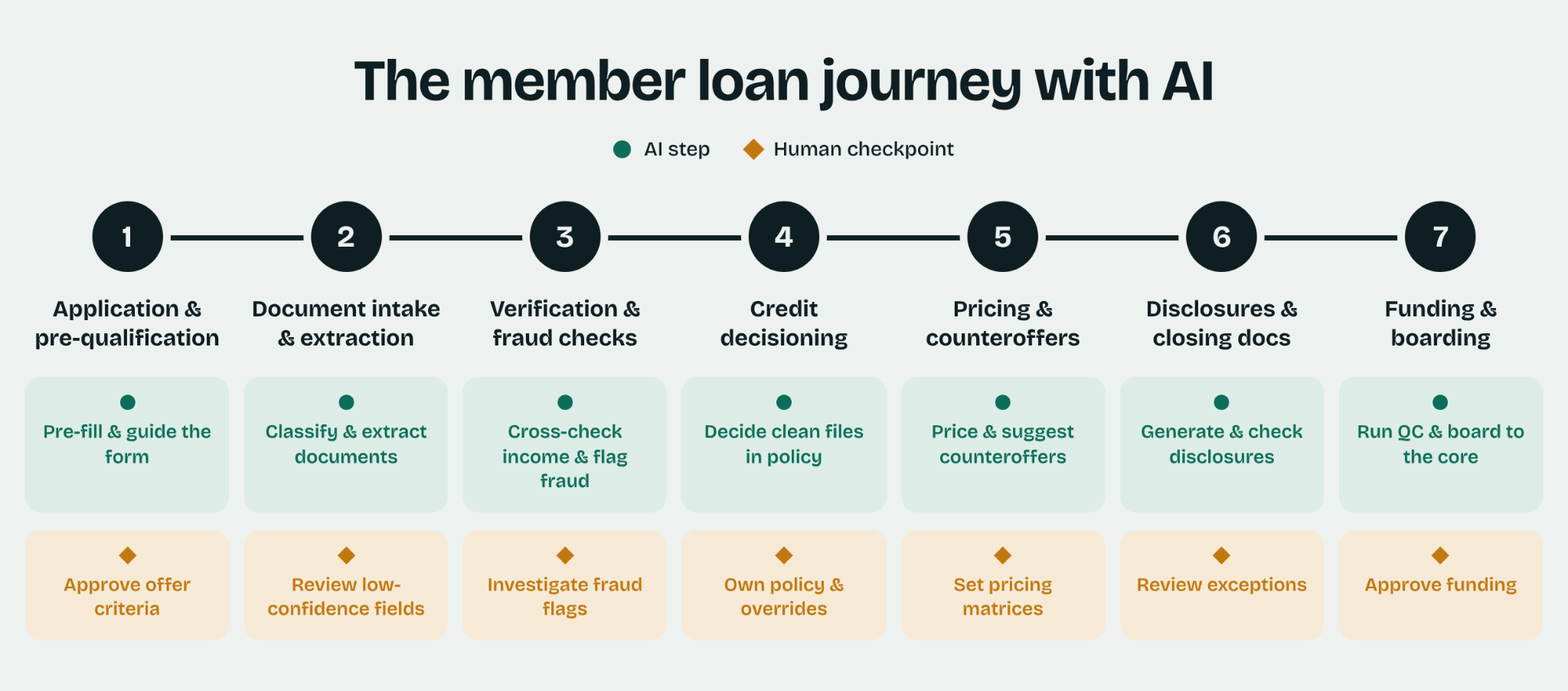
Stage 1: Application and Pre-Qualification
Today: Members fill in long forms with information the credit union already has, such as address, employer, and existing accounts.
What AI does: It pre-fills applications from member data you already hold, helps members through the form conversationally, and supports pre-qualification offers based on the relationship.
Member impact: Fewer fields and fewer abandoned applications. A member who already has direct deposit and a share account with you should be able to apply for a car loan in a few minutes, on a phone, without looking up their employer's address.
Human checkpoint: Offers follow approved criteria, and staff step in when a member needs help.
Stage 2: Document Intake and Data Extraction
Today: Staff request pay stubs, W-2s, tax returns, bank statements, and IDs, then open each file, rename it, and key the data into the LOS. This is the single biggest time sink in origination and where most "stalled" applications sit.
What AI does: Document AI classifies each upload, extracts the figures, and checks completeness against the loan's requirements. If something is missing or does not match, the member is asked right away, not days later.
Member impact: One clear request instead of a back-and-forth.
Illustrative example: a member applying for a personal loan uploads two pay stubs and a bank statement on a Saturday evening. Today, those files sit until Monday, when a processor notices the second pay stub is from the wrong month and emails the member. With document AI, the mismatch is caught in seconds, and the member is asked for the right stub while they still have the app open. The application is ready for decision before anyone arrives on Monday.
Human checkpoint: Staff reviews low-confidence fields and exceptions.
Stage 3: Verification and Fraud Checks
Today: Staff verify income and employment, run identity checks for BSA and Customer Identification Program requirements, and eyeball documents for signs of alteration.
What AI does: It cross-checks stated income against documents and bank deposits, supports identity verification, flags document tampering such as edited pay stubs, and looks for synthetic identity signals and loan stacking, where the same applicant seeks several loans at once. Document fraud detection is especially useful as generative AI makes fake documents easier to produce.
Member impact: Faster verification for genuine members, with less friction.
Human checkpoint: Fraud flags go to trained staff, not automatic declines.
Stage 4: Credit Decisioning
Today: Clean files may auto-decide, but anything slightly unusual lands in an underwriter's queue, where the underwriter rebuilds the picture from scratch.
What AI does: It auto-decides clean files within policy and prepares a summary for underwriter review on exceptions: income analysis, debt-to-income, key risk factors, and any inconsistencies. For thin-file members, it can add cash-flow underwriting from bank transaction data. This is where faster loan decisions at a credit union really come from: fewer files waiting on a human to reassemble the facts.
Member impact: More instant decisions, and faster answers on the rest. An underwriter who opens a file and finds income already calculated, debt-to-income already checked, and the one open question already highlighted can decide in minutes rather than an hour.
Human checkpoint: Credit policy stays human-owned. AI recommends within policy, and every override is documented.
Stage 5: Pricing, Structuring and Counteroffers
Today: Pricing follows a rate matrix, and borderline applications often get declined rather than restructured because restructuring takes time.
What AI does: It applies risk-based pricing within your approved matrices and suggests counteroffers, such as a different term, amount, or collateral, instead of a flat decline.
Member impact: More approvals that fit the member's situation. A member who cannot qualify for $30,000 over 60 months may qualify for $24,000 over 72 months, and offering that alternative keeps the relationship instead of sending the member elsewhere.
Human checkpoint: Counteroffer rules and pricing matrices are set and approved by the credit union.
Stage 6: Disclosures, Compliance Checks and Closing Documents
Today: Staff generate disclosures, check figures by hand, and assemble the closing package.
What AI does: It generates and checks disclosures required under the Truth in Lending Act (Regulation Z), including TRID timing for mortgages, assembles the document package, and routes it for e-signature.
Member impact: A faster, cleaner closing.
Human checkpoint: Compliance staff review exceptions and sample completed packages.
Stage 7: Funding and Loan Boarding
Today: Staff run pre-funding checks and then board the loan to the core, sometimes by re-keying data.
What AI does: It runs pre-funding quality checks, triggers funding when conditions are met, and boards the loan accurately to the core, whether that is Symitar, Corelation KeyStone, Fiserv DNA, or another platform.
Member impact: Funds arrive on time, and the loan is set up correctly from day one. Pre-funding checks catch the familiar errors before they reach the core: a payment date that does not match the disclosure, a missing lien filing, or collateral details that differ between the contract and the application.
Human checkpoint: Funding approval stays with authorized staff. Accurate boarding matters: a wrong rate or payment date becomes a servicing problem, a member complaint, and an exam finding.
How AI Origination Differs by Loan Type
AI origination is not one project. The bottleneck and the best first use case change with the loan type.
Typical patterns; your volumes and policies will shift the priorities.
Indirect Auto Lending: Winning on Dealer Speed
In indirect lending, the dealer sends the same application to several lenders and works with whoever answers first with a good deal. Decisions in minutes are the expectation, and faster loan decisions at a credit union translate directly into booked loans.
AI helps by prioritizing the decision queue so the most likely approvals are worked first, raising the share of applications that auto-decision within policy, reviewing contracts at funding for errors, and clearing stipulations such as proof of income or insurance as soon as the documents arrive. Many credit unions access the dealer channel through shared platforms such as Origence, and AI can sit around that channel rather than replacing it.
Member Business Lending: Where Document AI Pays Off Most
Member business loans look like commercial loans: business tax returns, financial statements, guarantor returns, and global cash flow across related entities. That is exactly where document AI, automated financial spreading, and credit memo drafting save the most time per file.
NCUA's Part 723 member business loan rule also requires sound commercial lending policies and credit risk management, including analysis of the borrower's financial condition. Structured, consistent analysis helps meet that bar. For a credit union with one or two business lenders, every hour saved per file matters.
Serving More Members Fairly: AI and the Credit Union Mission
AI for credit union lending can widen access as well as speed it up. Thin-file and credit-invisible members often have steady income and responsible banking habits that a credit score does not capture. Cash-flow underwriting can show that. It can also support second-chance and credit-builder products by making it cheaper to evaluate smaller loans carefully.
For CDFI-certified and low-income-designated credit unions, lower cost per loan makes mission lending more sustainable, because small loans that were too expensive to underwrite by hand become viable.
Inclusion claims are only credible with fair lending testing behind them. A model that approves more members overall can still treat groups differently, so test outcomes.
Compliance and Governance Guardrails
The same rules apply whether a person or a model makes the recommendation. Under the Equal Credit Opportunity Act and Regulation B, members who are declined are owed specific, accurate reasons. The CFPB has said that creditors using complex algorithms must still meet that requirement, in Circular 2022-03. [EDITOR: confirm the circular's status as of publish date.] Decision models also need fair lending and disparate impact testing.
On the supervisory side, NCUA expects credit unions to manage third-party relationships carefully, and it has published AI resources for credit unions. Because NCUA does not have the same direct vendor examination authority as bank regulators, more of that oversight falls on the credit union. Model risk management principles apply to decision models too.
See our overview of AI governance.
Governance checklist:
- Model inventory that includes vendor models
- Validation before use and ongoing performance monitoring
- Override logging with reasons
- Explainable outputs that support adverse action notices
- Fair lending and disparate impact testing
- Vendor due diligence and contract terms on data use
- An audit trail of what the AI produced and what staff changed
Do You Need a New Credit Union LOS to Use AI?
Not necessarily. AI can often layer onto an existing credit union LOS, such as MeridianLink, Origence arcLOS, Temenos, or nCino, through integrations. Your LOS manages workflow well; AI removes the manual work inside it.
Evaluation Criteria for AI Origination Tools
- Integration with your LOS and core, including write-back, not just display
- Document AI accuracy on your real member files, not vendor samples
- Explainability of recommendations and support for adverse action reasons
- Fair lending testing support
- Implementation time and who does the work
- Pricing model: per loan, per document, or subscription
- References from credit unions of similar size
What Changes for Your Lending Team
Loan officers spend less time chasing documents and more time talking with members about what they actually need. Underwriters focus on exceptions and judgment calls instead of rebuilding clean files. Processors become quality reviewers, checking AI output and clearing exceptions.
That shift needs training: staff should know what the AI does, when to trust it, and how to challenge it. Frame AI as capacity, not headcount cuts. That fits credit union culture, and it is usually true.
Metrics That Prove AI Origination Is Working
Baseline these before your pilot, then track them the same way afterward.
You may also read: Lending Trends 2027: 10 Shifts Banks and Credit Unions Must Prepare For Now
Getting Started: A Plan by Credit Union Size
Under $500M: Start Small, Share Costs
Start with document intake on one loan type, usually the one with the most volume or the most stalled applications. Look at CUSO or shared platforms to split cost and expertise.
$500M to $5B: Pilot, Measure, Expand
Start with indirect auto or consumer document automation, where volume shows results quickly, then expand to member business lending.
Over $5B: Orchestrate Across Channels
Build an enterprise AI governance function, then automate origination across products and channels.
You may also read: AI Budget for Banks in 2027: Benchmarks, Priorities and a Spend Plan
AI Loan Origination for Credit Unions: Remove the Manual Work
The fastest credit unions will not be the ones with the newest LOS. They will be the ones that removed the manual work between application and funding: the retyping, the document chasing, and the files waiting for someone to reassemble the facts. AI loan origination for credit unions makes that possible while keeping credit decisions and the member relationship with your people.
Ready to Take the Manual Work Out of Origination?
Uptiq's Qore platform gives credit unions domain-trained agents for intake and Document AI, plus financial spreading and credit memo generation for member business lending. They work over your existing LOS and core, and a single agent typically goes live in about five business days. Qore delivers 95%+ extraction accuracy, and institutions using Qore have reported 36% less financial spreading time and 63% less credit memo prep time. Start with an origination workflow assessment. See also AI agents for credit unions.
Frequently Asked Questions
How do credit unions use AI in loan origination?

Can AI make credit decisions for credit union loans?
Do credit unions need a new LOS to use AI?
How does AI speed up indirect auto lending?
Is AI loan decisioning compliant with fair lending rules?
Can AI help credit unions lend to members with thin credit files?
What should small credit unions automate first in lending?
How does AI help with member business lending?
About the Author