
The traditional assumption about documents in financial services is simple. A document arrives, a person reads it, the information is entered, and review begins. The bottleneck in that model is volume, so the obvious fix is to read faster.
That framing has aged badly. US financial institutions reported fraud losses of $12.5 billion in 2024, a 25 percent rise on the prior year, and the first half of 2025 added a further $7.11 billion, according to America's Credit Unions. Seven in 10 financial institutions reported major increases in fraud in 2025. Separately, the Alloy 2026 State of Fraud Report, conducted with The Harris Poll across more than 500 fraud, risk, and compliance leaders, found the biggest increases were reported by credit unions and regional or community banks.
Volume was never the interesting part. The harder problem is that a document can be readable, well-formatted, and entirely plausible while containing subtle alterations, inconsistent values, manipulated content, unreadable sections, or figures that an AI has quietly inferred rather than read.
If the document looks right to a human, that doesn't mean the information inside it is right.
OCR got Financial Institutions Part of the Way
Optical character recognition solved a real problem. It got text off the page and into a system, and for two decades that was the constraint. What OCR was never designed to do is understand financial context or judge whether a value it produced should be trusted. It reports characters, not meaning.
Generic AI improved the apparent quality of that output considerably. Layouts stopped mattering as much. Handwriting became tractable. Fields that used to require a template started resolving on their own.
It also introduced a failure mode that OCR did not have. A generic model predicts what should come next. When a region is blurry, cut off, or ambiguous, prediction fills the gap, and the result reads perfectly while being completely wrong. OCR failed visibly, returning garbled characters a reviewer would catch at a glance. A language model fails invisibly, returning a clean number in the right format.
A plausible answer is not the same thing as a verified answer.
Extraction is Not Verification
Extraction and verification answer different questions, and most product evaluations only ask the first one.
Extraction asks: what does this document say? Verification asks: can I trust what the system says this document says? The first is a reading problem. The second is an evidence problem, and financial institutions need both because extracted values do not stop at the extraction layer.
A figure pulled from a tax return flows into underwriting, credit analysis, compliance review, fraud review, financial spreading, the credit memo, and eventually portfolio decisions. At that point, a wrong number is not a bad extraction. It is an input to a consequential financial decision, and it has already been laundered through several systems that treated it as fact.
This is why a single accuracy percentage is a weak answer to a serious question. It tells a reviewer how often the system is right in aggregate. It tells them nothing about whether to trust the specific field in front of them right now, which is the only question they actually have.
Verification is a product decision, not a side effect of better extraction.
Every number should have a source
The practical form verification takes is traceability. Every extracted value should point back to the exact region of the exact page it came from, and the reviewer should be able to get there in one click rather than by searching a 200-page file.
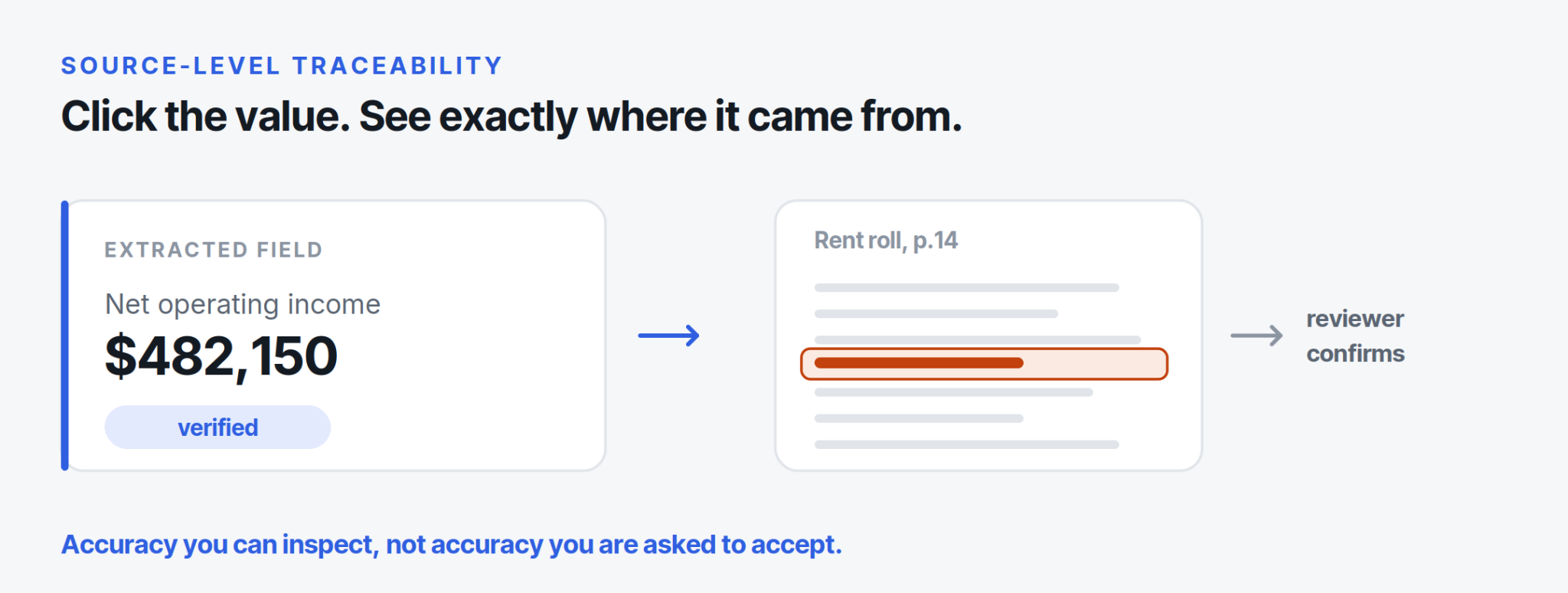
The difference in review behaviour is larger than it sounds. When checking a number costs two minutes of scrolling, reviewers check the ones that look odd and accept the rest. When checking costs one click, they check everything that matters. Traceability does not just support the audit. It changes whether the review happens at all.
For a financial institution, accuracy on its own is not the standard. A number needs to be traceable, reviewable, attributable to its source, and defensible months later to someone who was not involved.
Don't report accuracy as a percentage. Make accuracy inspectable.
AI Should Refuse to Guess
When a document is blurry, incomplete, badly scanned, or genuinely ambiguous, a generic system will usually still produce an answer. That is what it was built to do. The dangerous output is not a system saying it does not know. It is a system returning a confident value that the document does not actually support.
This failure has a name in the standards literature. NIST's Generative AI Profile lists confabulation, the confident generation of erroneous content, among the risks that are novel to or exacerbated by generative systems. It is treated as a distinct risk category precisely because the output looks indistinguishable from a correct one.
The right behaviour for financial document AI is explicit failure. Unreadable input should produce an error and a routing decision, not a plausible number. A system that says "page 14 is illegible, human review required" has done its job. A system that reports $482,150 from an illegible page has created a liability and hidden it inside a clean-looking field.
Unreadable documents should fail loudly. The quiet failure is the expensive one.
Don't Trust One AI to Check its Own Work
Self-assessed confidence has a structural weakness: the same model that produced an error is rarely the best judge of whether it made one. A model confident in a confabulated value will report high confidence in it.
The stronger pattern is independent validation, where a second process rereads the source document and evaluates what the first one produced, rather than evaluating the first one's reasoning.
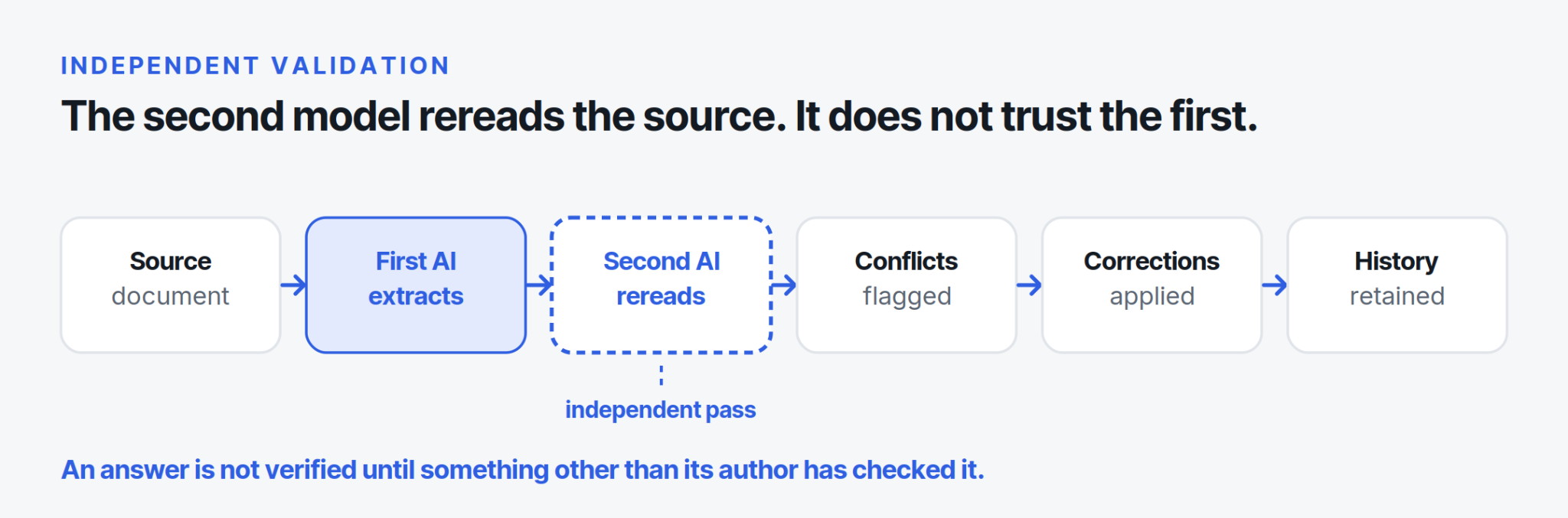
That sequence identifies fields that are missing, internally inconsistent, or miscategorised, applies corrections, and, critically, keeps both versions. The correction history is the part that gets skipped and the part that matters for review. A reviewer should be able to see what the first pass produced, what was challenged, what changed, and why.
The system shouldn't just produce an answer. It should have a mechanism for challenging the answer.
Financial Documents aren't Generic Documents
Generic document AI treats every file as pages of text with some structure. Financial institutions do not handle generic documents. They handle bank statements, tax returns, financial statements, rent rolls, loan contracts, entity formation documents, and a long tail of specialised records that each carry their own meaning.
A bank statement is a transaction table with running balances that must reconcile. A rent roll is a tenant ledger where unit counts, occupancy, and totals have to agree with each other. Treating either as undifferentiated text discards the structure that makes verification possible in the first place, because there is nothing left to check the values against.
Handling each document type according to its own schema and pipeline is what allows the system to know what a field should look like, what it should reconcile with, and when something is wrong. This is the argument for document AI built for financial services rather than adapted to it.
The more consequential the document, the less acceptable a generic reading approach becomes.
You may also read: Intelligent Document Processing Tools for Finance in the USA
What Better Document AI Changes for Fraud
With those capabilities in place, the fraud story stops being a separate product and becomes a property of how documents are processed. The workflow changes shape.
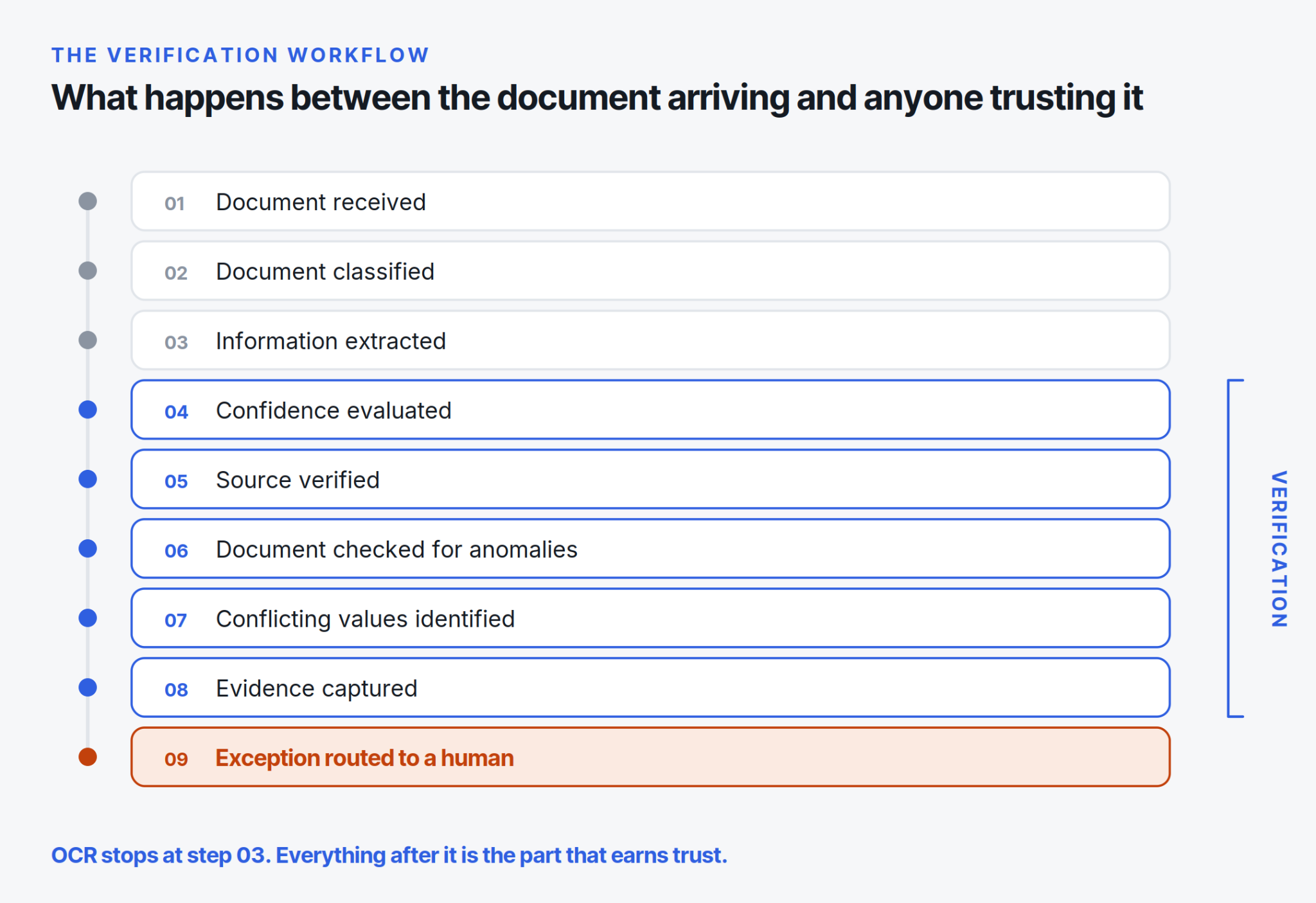
Compare that with document, OCR, underwriter. The older path has no step at which anything is checked against anything. Every value that enters is trusted by default, and the only control is whether a reviewer happens to notice. Adding verification and fraud controls inline means anomalies surface with the evidence attached rather than as an alert someone has to go and investigate from scratch.
The shift worth naming is not speed. It is that unverified information stops becoming trusted information by default. That is a different claim from catching fraud, and it is the more defensible one.
You may also read: AI Mortgage Underwriting Fraud Detection in 2026
The Same Verification Layer Supports Compliance and Underwriting
Fraud is the most visible application, not the only one. The same capabilities do work across several functions that are usually treated as unrelated.
- In fraud. Surface alterations, internal inconsistencies, and anomalies with the supporting evidence captured at the moment it is found.
- In compliance. Verify reported information against the source document and retain evidence that survives a later review.
- In underwriting. Ensure the figures feeding spreading and credit analysis are grounded in what the borrower actually submitted.
- In operations. Reduce manual review without turning the reviewer into someone who approves AI output without reading it.
That last one deserves attention. A review step that a reviewer cannot realistically perform is not a control; it is a signature. The traceability and confidence signals are what make the human step genuine rather than ceremonial.
Fraud, compliance, and underwriting share one dependency: information somebody has to be able to trust.
What financial institutions should expect from document AI
Eight questions, in the order that separates a serious system from a good demo.
- Verification, not just extraction: Does the system tell you why a field should be trusted, or only that it is?
- Source-level traceability: Can every extracted value be traced to the exact region of the exact page?
- No guessing: Does the system explicitly flag unreadable or unsupported input rather than filling the gap?
- Independent validation: Does something other than the extracting model check the extraction?
- Financial-services specialisation: Does it understand the structure and schema of each document type?
- Human review: Can reviewers inspect, challenge, and override results, with the evidence in front of them?
- Auditability: Is the extraction and correction history retained and reconstructable?
- Evidence: Can the institution show what supported a flagged or extracted value?
Run these against your own documents, not the vendor's sample set. The behaviour that matters is what happens on a bad scan of a document type they have not seen, which is precisely the case a curated demo will not include.
You may also read: Best AI for Business Document Analysis: A Buyer's Guide
From Document AI to the Rest of the Workflow
Document AI should not sit alone as an extraction tool. Its output is the input to everything downstream, which gives it a role in the architecture that is more strategic than the category name suggests.
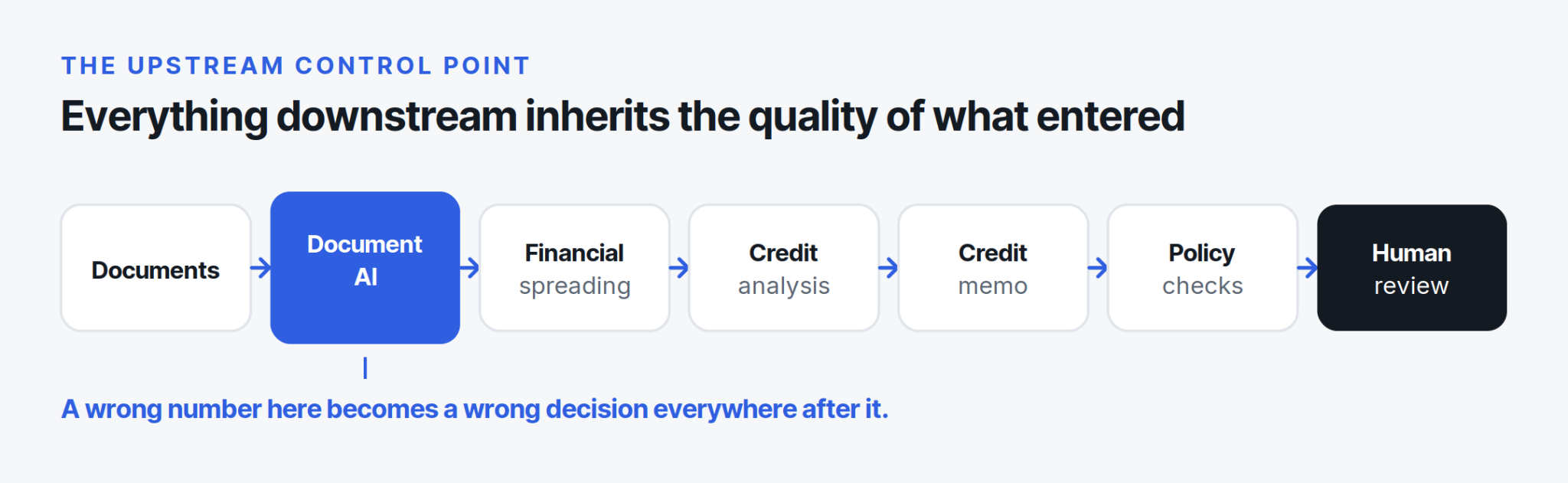
Every workflow after the first box inherits the quality of what entered it. Financial spreading built on an unverified figure produces a clean spread of a wrong number. A credit memo drafted from that spread cites it. A policy check tests against it. The error does not get caught downstream; it gets formatted.
Document AI isn't a document-processing feature. It's the upstream control point for every financial workflow behind it.
Where Uptiq fits
Uptiq Document AI is built around the principles above rather than around throughput. It handles a wide library of financial document types with document-specific schemas and processing pipelines rather than one generic reader, applies targeted models by document type, produces confidence signals a reviewer can interrogate, traces values to their source region, checks readability and fails explicitly when a document cannot be read, validates extractions independently, retains correction history, and analyses documents for tampering indicators with the evidence captured.
Downstream, those outputs feed the rest of the platform rather than an export file: spreading, credit analysis, memo preparation, and compliance and risk workflows, all running on the same audit record.
Uptiq Document AI isn't designed simply to extract what's on a page. It's designed to let an institution verify, trace, and act on what's inside it.
Your AI Should Know When It Knows
The goal was never to remove humans from document review. Most institutions would not want that even if it were available, and the regulatory posture would not support it.
The goal is to make the information humans review more trustworthy, which is a smaller ambition and a far more useful one. A reviewer with a traceable figure, a confidence signal they can interrogate, and an explicit flag on anything unreadable is doing a different job from a reviewer handed a clean spreadsheet and asked to trust it.
AI that reads documents is useful. AI that can show you why its answer should be trusted is worth considerably more, because it is the only version that survives contact with an examiner.
The next generation of financial document AI will not be defined by how much it can extract. It will be defined by how well it can verify what it extracts.
Test it on a Bad Scan
Take the worst document in your pipeline, the one that is skewed, partially illegible, and three generations of photocopy old. Run it through whatever you use today. If it returns numbers instead of an error, you have found the gap this article is about.
About the Author