An NCUA examiner asks where your credit union is using AI. That question is just the opening. What comes next determines whether you pass the governance test. What policy does it operate against? Who approved it? What happens when it hits an exception? Can you show what it used to reach its decision?
NCUA has no separate AI rulebook, it evaluates AI through the frameworks you already operate under. That's the harder version of the test. There's no checklist to memorize. There's only whether you can show your work.
What Does Credit Union AI Governance Actually Require?
Credit union AI governance works best when it's built into the workflow before an agent does any work, not assembled into documentation after deployment.
Most institutions default to the wrong order: deploy the AI, then write the policy explaining what it does. That creates a permanent gap between the policy in a binder and the system running in production.
The better model runs policy first: policy → configured workflow → agent action → human review → documented outcome.
An agent shouldn't receive a loan package and figure out what to do on its own. It should operate against your credit policies, approval thresholds, required documentation, and exception criteria,all configured before a single file arrives.
NCUA updated its AI resource hub in December 2025, explicitly tying AI oversight back to existing third-party relationship guidance rather than introducing a separate AI rulebook. That's the signal: if your AI vendor relationship isn't governed like any other material vendor relationship, that's the gap an examiner is most likely to find first.
What Does a Policy-Configured Agent Actually Do?
A policy-configured agent checks a file against your institution's configured requirements, instead of just reading documents and moving them along.
An Intake Agent ingests documents from wherever they arrive, classifies them, checks completeness against your requirements, extracts what's needed, flags what's missing, and triggers the next step. It isn't reading documents in the abstract,it's checking the file against rules your credit union configured.
An Underwriting Agent reads financial documents, extracts and structures numbers, spreads them, calculates ratios, and checks results against policy, routing exceptions for review. Mechanical work at 95%+ extraction accuracy; your credit team keeps judgment over the actual decision.
A Continuous Monitoring Agent keeps tracking covenants, recalculating ratios, and flagging exceptions after the loan closes. Oversight doesn't stop the moment the file funds,it becomes a quarterly manual review.
That distinction,mechanical work versus judgment,matters more than any single feature on a spec sheet.
You may also read: Risks of Using AI in Lending: Compliance, Bias & Auditability
What Five Questions Should Your Credit Union AI Governance Answer?
Credit union AI governance should be able to answer five specific questions about every workflow you run. Keep this list on file for every agent you deploy.
1. What was the agent supposed to do?
Define its purpose and scope in writing before it touches a file. A purpose-built agent that does one job well is easier to govern than a generic tool asked to do everything.
2. What policy was it operating under?
The agent should be configured against your credit union's own rules and thresholds, not a vendor's generic defaults.
3. What information did it use?
Every output should trace back to the source document or data point it came from.
4. What happened when it hit an exception?
The system shouldn't force an answer it isn't confident in. It should flag the exception and route it to the right person.
5. Can you show what happened?
You should have an audit trail of the actions, reviews, overrides, and workflow decisions, generated automatically rather than reconstructed after the fact.
If you can answer all five for every AI workflow running in your credit union today, you're ahead of most institutions who asked the question for the first time in an exam.
You may also read: AI vs Rule-Based Systems in Credit Decisioning: What's the Difference?
Who Should Own the Credit Decision,the Agent or the Human?
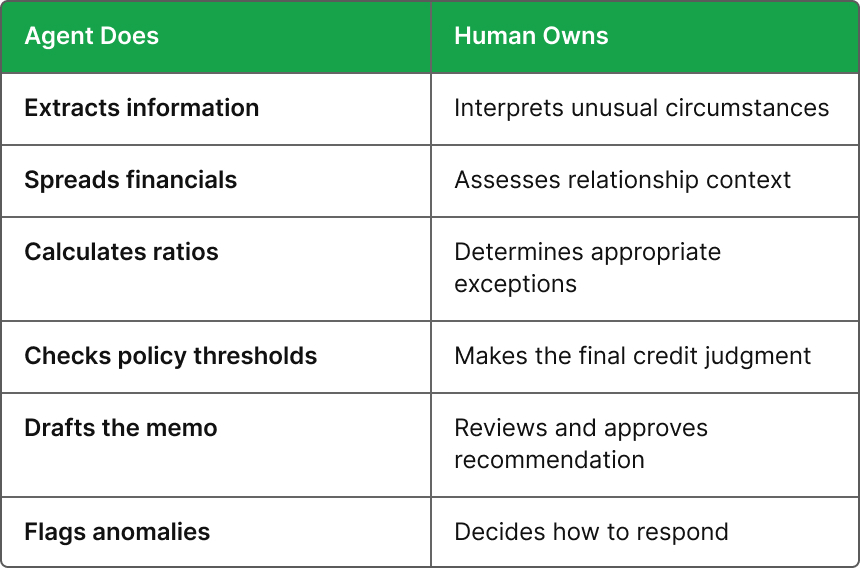
The agent does the mechanical work. The human owns the judgment call. That line shouldn't blur, and a well-governed AI deployment keeps it visible on purpose.
Human-in-the-loop isn't a concession to imperfect AI. For a decision that affects a member's financial life, it's the correct operating model. Every automated output should be reviewable and overridable by a credit officer, with the approve, decline, or conditional call staying with the person accountable for it.
Where Does Qore Fit Into Credit Union AI Governance?
Qore is the layer that lets you configure, connect, and govern the agents doing the work, not a separate AI initiative sitting on top of your lending program.
Every agent runs on finance-native skills tuned for lending, not a generic model. Policy and workflow controls mean an agent's actions get checked against your configured rules before they execute, not after.
Qore connects into your environment through 100+ integrations, and every action carries a traceable record, source, and sign-off,the audit trail examiners actually want to see, produced as a byproduct of the workflow instead of a separate reporting task.
Your core banking system and LOS don't go anywhere. They stay in the systems of record; the agents execute specific workflows around them, connecting through APIs and existing integrations rather than asking your credit union to migrate its operating foundation.
You may also read: AI Agents vs Traditional LOS: What's the Real Difference?
What Does an Examiner-Ready AI Workflow Look Like?
An examiner-ready AI workflow looks like governance embedded in the process itself, not a compliance binder sitting next to it.
Picture one loan file: the application arrives, an Intake Agent classifies documents and checks completeness, an Underwriting Agent extracts financials and spreads them, a policy check tests the file against your configured credit policy, any exception routes to a human reviewer while everything else continues, a credit officer makes the final decision, and an audit trail records the relevant actions, sources, reviews, and overrides automatically.
Build toward that one workflow at a time. Start with the highest-friction stage: document intake, financial spreading, or credit memo preparation. Define what the agent can and cannot do,scope, inputs, outputs, policies, exceptions, human checkpoints.
Run it alongside your existing process before you expand its role. Establish the audit trail from day one. Expand only once that first workflow is proven.
The difference shows up the moment an examiner asks the question. "We have an AI vendor" is weak. "We have a defined use case, documented controls, configured policies, human review points, ongoing monitoring, and an auditable record" is the answer that holds up.
Ready to Make Your AI Governance Examiner-Ready?
Uptiq gives your credit union agents that do the operational lending work, while Qore provides the infrastructure to configure, connect, govern, and scale them within your policies.
About the Author