Assemble examination evidence, respond to RFIs on deadline, and track every MRA finding through remediation, maintaining the documentation depth that examiners expect and that management and legal need to approve before anything is submitted.


Replace last-minute evidence scrambles, missed RFI deadlines, and manually tracked MRA registers with a continuous exam-readiness workflow that keeps documentation current, responses on schedule, and findings progressing toward closure, with management and legal approving every submission.


The Uptiq Exam & Audit Management Agent is an AI-powered solution that prepares institutions for regulatory examinations and external audits by assembling evidence packages in advance, managing RFI responses under deadline, and tracking MRA findings through remediation to closure. Management and legal retain approval authority over every document submitted to an examiner; the agent organizes, assembles, and tracks it, while human reviewers authorize every submission.
The result is an examination process that starts with a complete, defensible evidence package rather than a last-minute search across multiple systems, responds to every RFI on time without pulling teams away from their primary work, and maintains the finding-to-closure traceability that regulators now treat as a governance indicator in its own right. By making examination preparation continuous rather than cyclical, institutions reduce both the stress and the risk of each examination cycle.
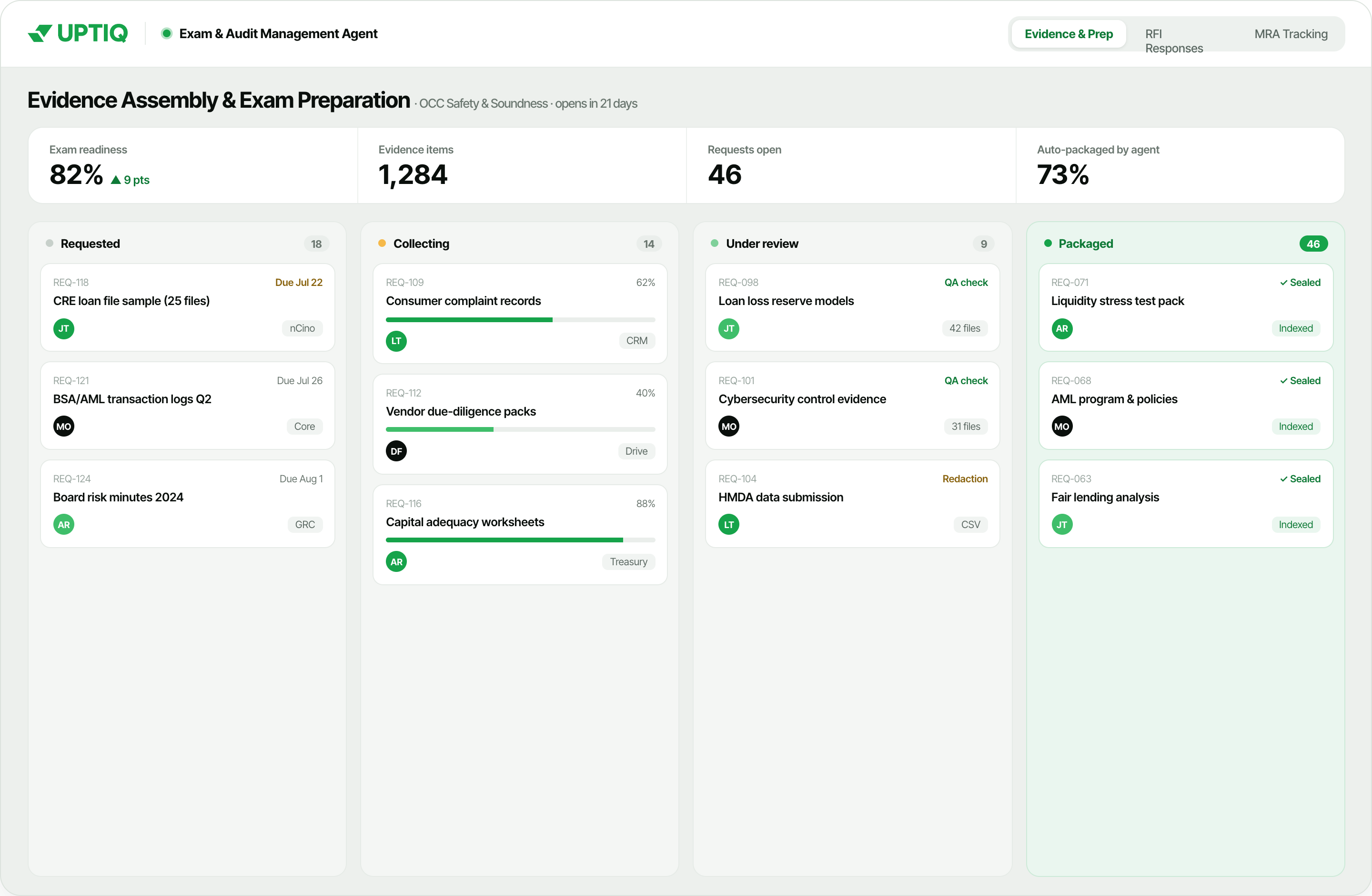
The agent maintains a standing evidence inventory organized by examination type, operational risk, BSA/AML, consumer compliance, IT, and others, and continuously checks that required documentation categories are current, complete, and accessible. When an examination is scheduled, the agent identifies which evidence categories apply based on the examiner type and stated scope, maps available documents to each category, and assembles the package for management review well before the examination start date.
This continuous readiness approach replaces the common pattern of scrambling to assemble evidence in the weeks before an examination, a period when the examination itself creates the most pressure and the least capacity for careful documentation review. Institutions that walk into examinations with pre-assembled, management-reviewed packages set a different tone with examiners from the first day, which consistently affects how the examination proceeds.
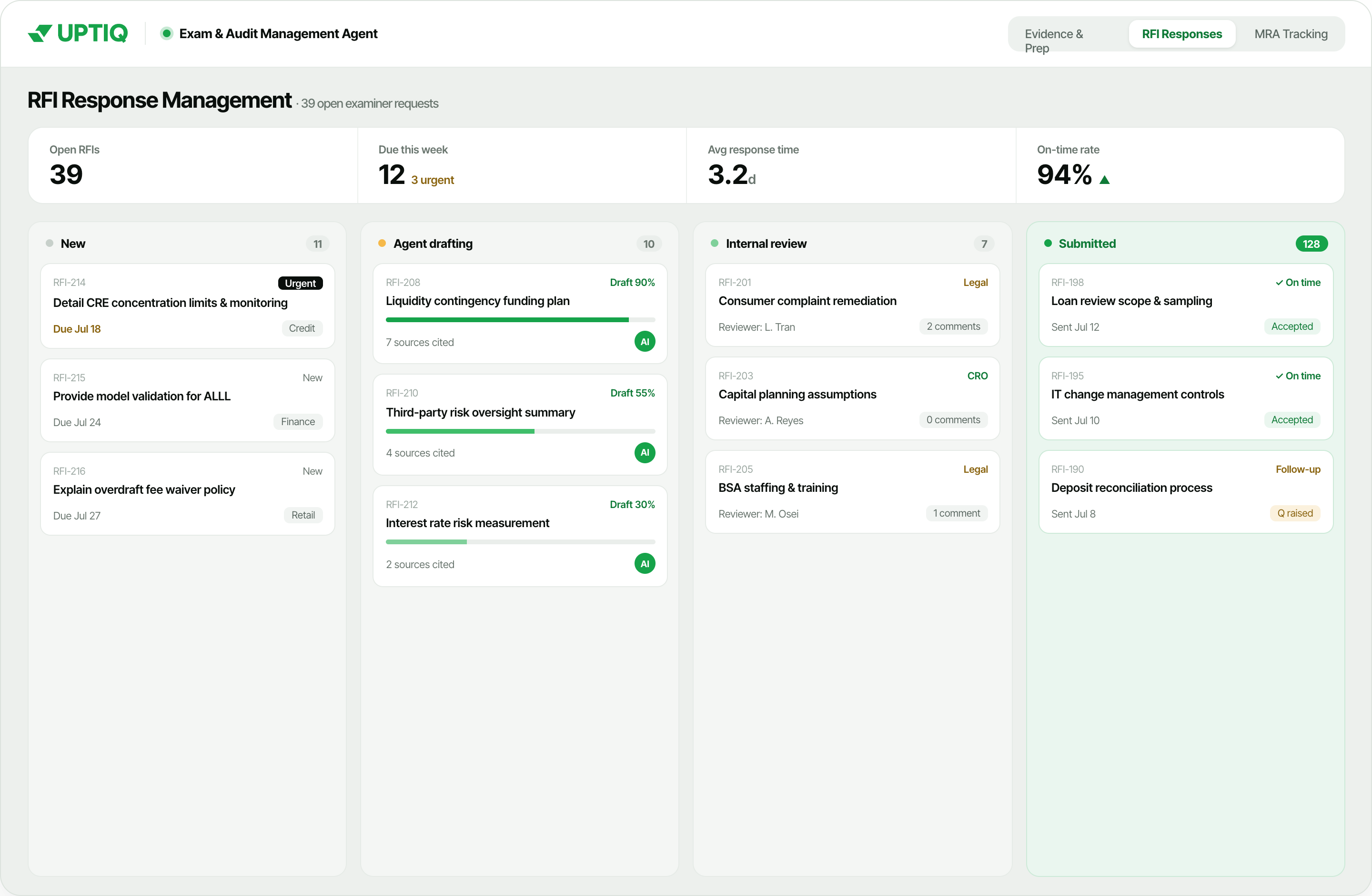
Every RFI received during an examination is logged immediately, with the examiner's question, the requested information type, the response deadline, and the assigned institutional owner recorded at intake. The agent assembles available responsive documentation from connected repositories, tracks the completeness of the response package against the RFI requirements, and presents the assembled response to the authorized reviewer for approval before submission.
Deadline proximity alerts escalate to designated managers when a response is approaching its due date without a completed review, giving the institution time to act rather than explaining missed deadlines. Sustained overdue responses are one of the clearest signals to examiners that an institution lacks the governance infrastructure to manage its examination effectively, which routinely leads to expanded scope. The agent eliminates the operational cause of that signal without requiring an examiner-relationship conversation.
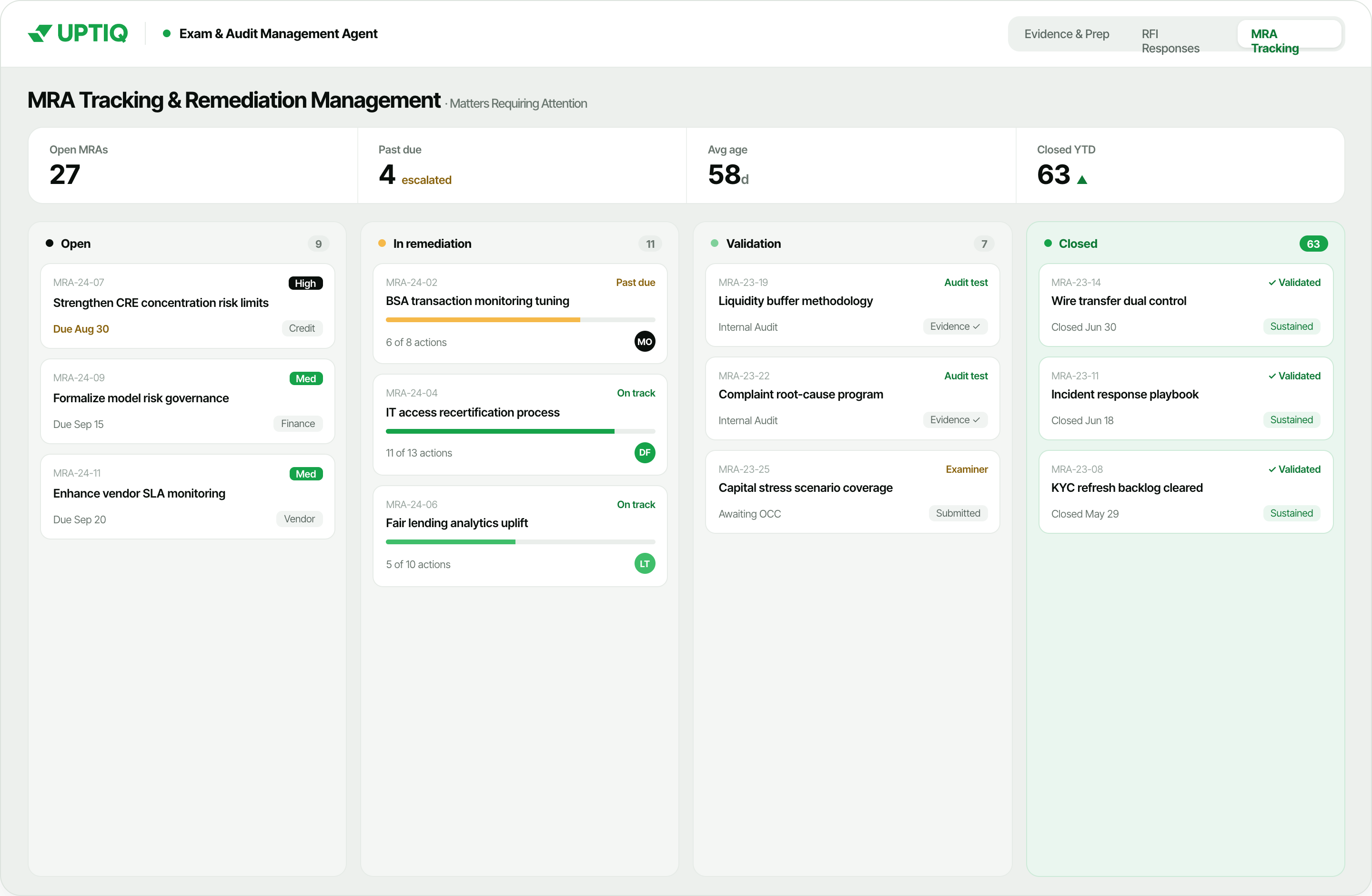
Each MRA is logged with the examiner's stated concern, the institution's formal response commitment, the remediation timeline, and the owner responsible for driving the work to closure. As remediation milestones are reached and supporting evidence is collected, the agent updates the finding record and flags when a finding is ready for examiner closure validation. The full history of every MRA, from issuance through every status change to final closure, is retained in a searchable, exportable format.
The agent also links each MRA to the root cause identified during remediation and to any compensating controls put in place, producing the governance traceability that the Federal Reserve's 2025 supervisory guidance and OCC examination standards both now treat as a component of adequate MRA management, not simply a documentation preference. Institutions that can demonstrate root-cause linkage and sustainability monitoring for closed MRAs consistently receive better examiner confidence ratings than those that can only show that the finding was marked closed.
Most financial institutions are examination-ready with the agent within a matter of weeks, not months. Uptiq manages deployment end-to-end, including document repository connections, examination-type configuration, RFI workflow setup, and MRA register initialization. For institutions with an active MRA inventory, existing findings are loaded and mapped during deployment so the tracking capability is current from day one rather than building only from future issuances.
Many institutions begin with RFI management and MRA tracking, the two capabilities with the most immediate examination cycle impact, and add evidence assembly and continuous readiness management in a subsequent phase once the team is comfortable with the workflow. This approach keeps deployment focused and produces visible results quickly enough to validate the investment before broader rollout.
Yes. The platform includes SOC 2 Type II compliance, encrypted data handling, role-based access controls that restrict examination package and MRA register visibility to authorized legal and compliance personnel, and comprehensive audit logging of every evidence assembly and submission action. Examination correspondence and MRA documentation processed by the agent remain within the institution's configured data environment and are never shared outside the defined workflow.
The agent's human-approval architecture ensures that no document is submitted to a regulator without explicit authorization from the designated management or legal reviewer. This is not a convenience feature; it is the foundational control that keeps the agent consistent with the legal and governance framework governing regulatory submissions, which requires authorized human judgment at the point of submission regardless of how the package was assembled.
Manual examination preparation concentrates a disproportionate amount of institutional effort into the weeks immediately before and during an examination, exactly when that effort is most disruptive and least likely to produce the most considered, defensible documentation. Evidence that should be current and organized throughout the year instead gets assembled under deadline pressure by staff who are simultaneously responding to live examiner requests. The agent makes preparation continuous and evidence assembly fast, so the examination itself becomes a review process rather than a documentation exercise.
GRC tracking spreadsheets for MRAs have a structural problem: they require manual updates, which means finding records is only as current as the last time someone remembered to update them. The agent maintains every finding record in real time, with automatic escalation when deadlines approach and automatic linkage when remediation evidence is collected, producing the kind of active, always-current governance record that examiners now expect to see, not the retrospective documentation that spreadsheets produce.
Our team handles deployment end-to-end, from configuration to go-live. Most financial institutions are live within days, and not months.