
Your members experience one loan application. Inside your credit union, the same application bounces among three or four systems, with someone manually transferring information between them. The systems aren't bad; they work fine independently. The problem is the gaps between them. Here's what those gaps are actually costing you, and what changes when an AI layer connects your core, LOS, and CRM without replacing any of them.
What Is Credit Union Core, LOS, and CRM Integration Actually Costing You?
A member applies for a loan. Their information already lives in three places: the LOS, the core, and the CRM. But nobody's connecting them.
An analyst pulls account history from the core. Checks the CRM for relationship notes. Downloads financial statements from email. Spreads them by hand into a template. Compares the numbers field by field against what's already in the file, since nothing confirms it automatically. Then re-keys everything back into the LOS.
None of that is underwriting. It's data movement.
McKinsey research found that most credit unions still run on systems that fall short of true end-to-end automation. And because lending makes up 70-85% of a credit union's total assets, every manual handoff sits directly on your institution's largest source of risk and revenue.
The visible cost is turnaround time; members wait longer for decisions than they would from fintechs. The invisible cost is what your analysts aren't doing while they're re-keying data: reviewing exceptions, building relationships, catching the deal that actually needs judgment.
You may also read: Why Workflow Automation Tools Fail in Lending, and What Works Instead
Do Your Core, LOS, and CRM Need to Become One System?
No, your core, LOS, and CRM don't need to merge. That's the reframe most institutions miss: consolidation isn't the goal. Execution is.
Each system already does its job well. Your core is the system of record for member and account information. Your LOS manages loan origination. Your CRM holds relationship context. None of that needs to change.
What's missing is an intelligence layer that reads what's in one system, acts on it, and hands the result to the next, the way a person does today, just without the person doing the copying.
Uptiq's agents sit alongside your existing stack and connect through 100+ pre-built integrations. Instead of moving a field from A to B, an agent reads a document, understands it, acts on it, updates the record, and hands the file forward- the same sequence your analyst runs today, at API speed.
The goal was never one giant platform. It's keeping your LOS, keeping your core, keeping your CRM, and removing the manual work between them.
What Does an AI Agent Actually Do Between Your Core, LOS, and CRM?
An AI agent reads a document or data field, decides what to do with it, and updates every downstream system without a person carrying the file by hand. That's automation that understands what it's moving, not just moves it.
An Intake Agent classifies what's arrived, extracts relevant fields, flags what's missing, and pushes structured, validated information into the workflow. That closes the gap between "member submitted something" and "lending team has a complete file."
An Underwriting Agent reads financial documents. A Financial Spreading Agent extracts and structures numbers into a review-ready spread, the exact task consuming hours of analyst time today.
A Credit Memo Agent drafts the memo from that structured data in your format. The analyst edits a first draft instead of building one from four documents by hand.
A Continuous Monitoring Agent keeps working after the loan funds, tracking covenants and portfolio signals, surfacing exceptions instead of waiting for quarterly reviews to catch what happened months earlier.
Credit staff still make every call. Agents just stop making them rebuild the same information three times to get there.
What Does One Connected Loan Look Like From Application to Close?
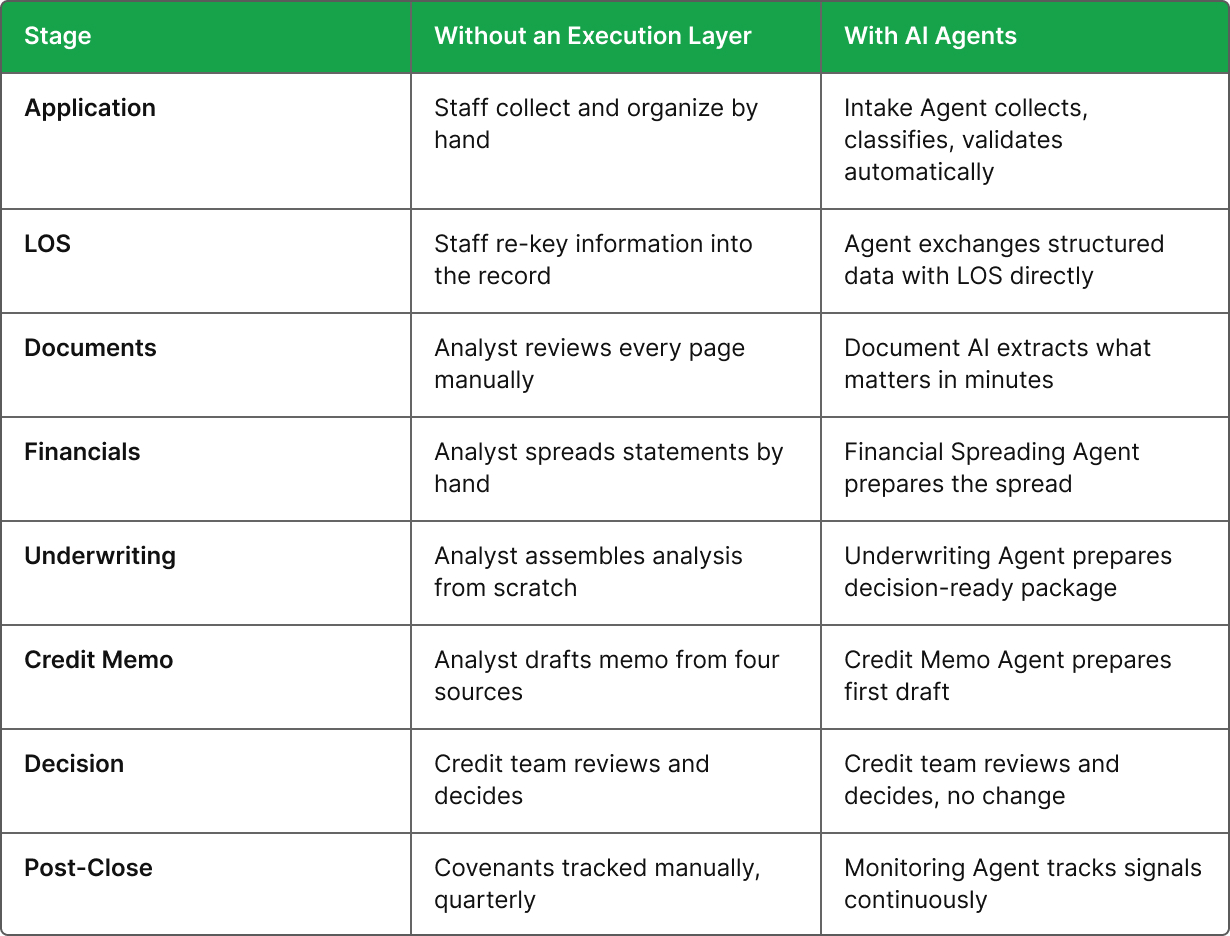
The systems stay exactly where they are. The manual handoffs shrink.
What Does "No Rip and Replace" Mean for Credit Union Core, LOS, and CRM Integration?
"No rip and replace" means your LOS stays the system of record for workflow, your core stays the system of record for member data, and your CRM stays your relationship layer, while an AI agent layer does the work of connecting them.
Your LOS keeps managing the application and record. Agents work alongside it, automating what happens between workflow stages rather than rebuilding the stages themselves.
Your core keeps running. Nothing about how it stores member and account data needs to change for it to benefit from AI. Agents connect into your existing environment and push structured data into the systems of record you already trust.
Your CRM keeps being your CRM. An agent pulls relationship context from it and returns outputs to the tools your team already works in.
And your IT team doesn't need another multi-year transformation. Pre-built integrations substantially shorten that lift compared to a platform migration, not eliminating implementation work, but reducing it to something a lean IT team can absorb alongside everything else already on their plate.
You may also read: Financial Document AI: The Lending Operations Guide 2026
Where Should Your Credit Union Start With Core, LOS, and CRM Integration?
Start with one workflow where handoffs hurt the most, not a plan to fix everything at once.
Look at where your team loses the most time: application intake, document collection, financial spreading, underwriting prep, or credit memo generation. Pick the one costing you the most analyst hours or member patience, deploy an agent there, and prove it before you touch anything else.
Confirm the data flows correctly, outputs match what your team expects, staff knows when to step in and review, and exceptions route to a person instead of disappearing. Your core, LOS, and CRM stay exactly what they were: systems of record, not systems you're replacing.
Once that first agent is working, connect the next stage. Intake feeds underwriting. Underwriting feeds the credit memo. The credit memo feeds monitoring.
Industry research has tied meaningful per-loan cost directly to this kind of manual re-entry and reconciliation between systems, not to any single system being deficient. Shrinking that manual middle, one workflow at a time, is what moves the numbers your board sees.
You don't need to replace what your credit union spent years building. You need to stop asking your lending team to be the integration layer.
Ready to Close the Gap Between Your Systems?
Uptiq connects AI agents to the core, LOS, CRM, and document systems your credit union already runs, so the manual handoffs between them disappear without a migration project. Your team keeps working in the systems they know; the agents just do the moving.
About the Author