
Ask any credit union for a list of the certificates maturing this quarter, and you will have it in minutes. Member name, product, balance, rate, maturity date, branch. The report is accurate; it is current, and it has existed for years.
Now look at the number behind the number: $1.6 trillion in CDs are maturing this quarter. The question is no longer which certificates are coming due. It is which members are likely to take that money somewhere else.
Most institutions cannot answer that from the same report. They know when the money is leaving, but not necessarily whether the member is already showing signs of leaving, or what the credit union should do before the maturity date arrives.
The signals that could answer those questions already exist inside the institution: digital banking activity, core data, CRM history, transaction behavior, product relationships, and changes in member engagement. The problem is that those signals are often spread across systems, disconnected from the maturity schedule, and not turned into an action soon enough.
Credit unions do not have a CD maturity problem. They have a retention and action gap.
The Problem isn't Knowing when a Certificate Matures
The maturity report is a reporting artifact, not intelligence. It tells you what is scheduled to happen. It says nothing about likelihood, and likelihood is what leadership actually needs in order to allocate anyone's time.
The stakes have grown with the balances. Over the year ending in the first quarter of 2026, share certificate accounts at federally insured credit unions grew by $35.7 billion, or 6.3 percent, with money market accounts up 8.7 percent over the same period, according to the NCUA Quarterly Data Summary.
More balance sitting in dated products means more of the deposit base passing through a decision point every quarter.
The membership picture underneath is less comfortable than the headline. Federally insured credit unions added 2.5 million members over that year and reached 145.8 million in total, but NCUA's state-level data shows that at the median, membership actually declined by 0.5 percent. The aggregate grows because larger institutions grow. A typical credit union was losing members in the same period.
‘Aggregate credit union membership grew. At the median, membership fell 0.5 percent. (NCUA, Q1 2026)’
That is the tension. More balances are arriving at maturity, in an environment where the median institution is not adding members to replace what walks out.
A Maturity Date is One Signal, not a Prediction
A member approaching maturity is usually generating other signals at the same time, and those are the ones that carry predictive weight. Depending on what a given credit union actually captures, the picture around a maturing certificate might include:
- Declining digital banking engagement, or a login pattern that has gone quiet
- Falling balances in the checking or savings relationship alongside the certificate
- An increase in external transfers, particularly recurring ones to another institution
- Changes in transaction behaviour, such as direct deposit stopping or shrinking
- No engagement with any other product in the last year
- Rate-shopping behaviour, where the institution has a legitimate way to observe it
- Relationship depth, in either direction: several products held, or exactly one
Two caveats belong here rather than in a footnote. Not every credit union captures all of these, and a signal a credit union cannot actually observe is not a signal; it is a wish.
Second, these are candidates to evaluate against your own rulebook, not a validated model. What predicts attrition at a 300,000-member institution with a strong digital channel will not necessarily predict it at a 30,000-member one with three branches.
There is also a timing dimension that reports handle badly. A balance that fell three months ago and a balance that started falling last week mean very different things for the same member, and a snapshot flattens both into one number. Trend direction is often more informative.
The maturity date tells you when the event happens. Behavioural data can help suggest what happens next.
Why Static Segmentation isn't a Retention Strategy
"Members with certificates maturing in 30 days" is a list. A useful one, and it is where most retention campaigns begin and end. The trouble is that it treats every member in it identically, when the appropriate response varies enormously across the same list.
A more useful segmentation groups members by the action required rather than by the date. The shape looks something like this.
There is a second reason the calendar sort persists, and it is organisational rather than analytical. A date-sorted list can be produced by one team and handed to another without either having to agree on anything. An action-sorted list requires someone to decide what the institution actually believes about its members, which is a harder conversation and the one that moves credit union deposit retention.
Note what changes. The first list sorts by calendar. The second sorts by what someone should do, which means it can be handed to a person or a workflow without further interpretation. The specific scoring behind it has to be institution-specific, built on the signals that the credit union genuinely has and validated against its own attrition history rather than borrowed from a vendor deck.
Start with the Signals You Actually Have
The practical starting point is an inventory, not a model. Before designing anything, write down which of the candidate signals your institution can actually observe today, where each one lives, how fresh it is, and whether anyone is permitted to use it for this purpose.
That last column matters more than it might seem. Member data carries obligations about how it is used and disclosed, and a retention programme built on behavioural inference should be reviewed by the same people who review any other use of member information. Getting compliance involved at the design stage is considerably cheaper than getting them involved after launch.
A reasonable first pass is narrow on purpose:
- Pick one product and one maturity window, for example, certificates maturing in 60 days
- Choose three or four signals you can retrieve reliably, not ten you can retrieve occasionally
- Define what each combination of signals should trigger, in plain language
- Decide where a human has to be involved and where they do not
- Run it against last year's outcomes before you run it against next quarter's members
The last point is the one most often skipped. If a scoring approach cannot retrospectively identify the members who actually left, it will not identify the ones about to.
You may also read: AI Agents for Financial Services: What They Do and How to Govern Them
Where an AI Agent Changes the Workflow
The reason credit union deposit retention programmes stall is rarely analysis. It is that the output of the analysis lands as a list in someone's inbox, and that person already has a job. An agent changes the shape of the work rather than the quality of the insight.
Instead of producing another dashboard, a digital banking agent can run the sequence continuously:
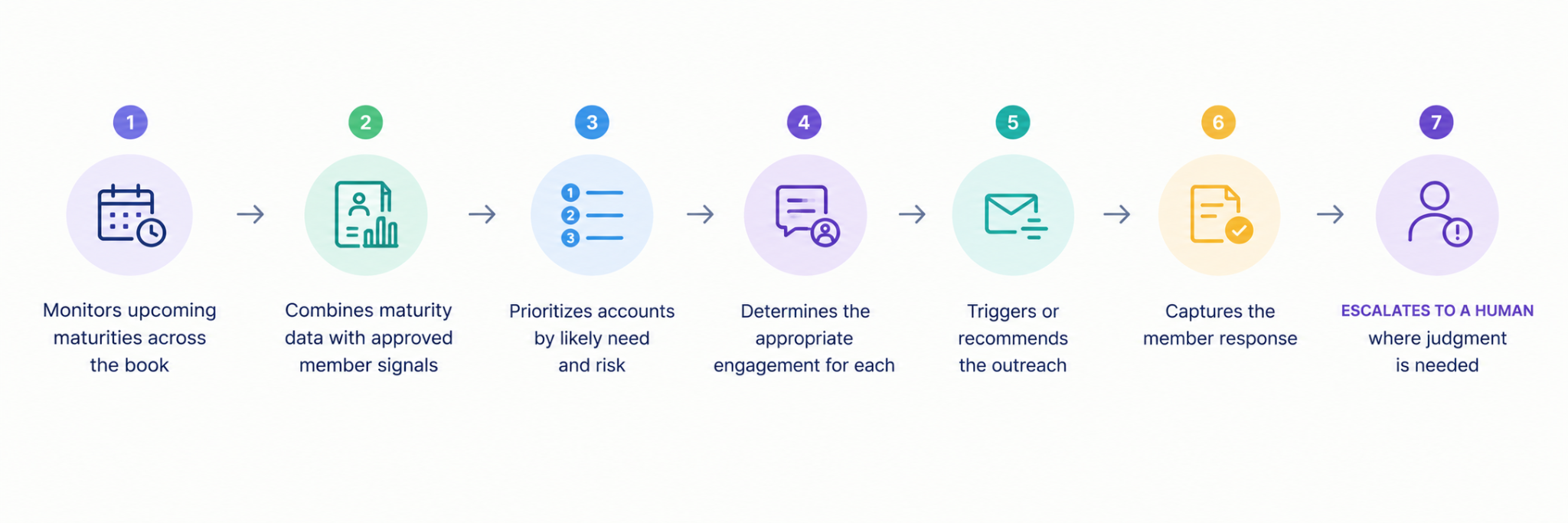
Nothing in that sequence removes the relationship manager. What it removes is the interval between a signal appearing and anyone acting on it, which in most institutions is measured in weeks and sometimes in never. The escalation step is the important one: high-value or ambiguous situations should reach a person, and the agent's job is to make sure they reach the right person while there is still time to do something.
Analytics alone does not retain a deposit. Action does.
Business Members Make the Opportunity Bigger
For a business member, a maturing certificate is rarely just savings. The same balance carries a different meaning, and treating it as a retail retention event misses most of what it represents.
A $250,000 certificate maturing on a business relationship could indicate excess operating liquidity, an upcoming capital expenditure, a seasonal working capital cycle, an unmet need for treasury products, an approaching borrowing requirement, or simply a business that has outgrown the products it was sold three years ago.
So the question worth asking is not what the balance is. It is what the balance represents in the context of this member's relationship, and answering that requires the business banking picture alongside the deposit record. That is where SMB analytics does work that a maturity report structurally cannot: cash flow patterns, transaction seasonality, payment behaviour, and the shape of the operating relationship. Digital business banking data turns a retention event into a commercial conversation.
Stop asking what the $250,000 is. Start asking what it represents.
The economics follow. A retail retention save protects a balance. A business conversation triggered by the same event can protect the balance and open a treasury or credit discussion, which is a materially different return on the same piece of intelligence.
One obstacle is worth naming. At many credit unions, the business relationship and the deposit relationship are owned by different teams, held in different systems, and reviewed on different cycles. The maturing certificate surfaces in one place and the context that would turn it into a commercial conversation sits in the other. That is an organisational gap rather than a data gap, and it is why these opportunities tend to be noticed after the money has already moved.
You may also read: AI Agent Automation for Credit Union Operations
From Dashboards to Decisions
Credit unions have spent a decade investing in the infrastructure this argument depends on. Data warehouses, digital banking platforms, CRM, business intelligence, analytics teams. The visibility problem has largely been solved.
What has not been solved is the distance between visibility and action. Another dashboard adds another thing for a person to check, and checking is exactly the step that fails under load. The next investment is not more reporting surface. It is turning the signals already visible into work that happens without anyone having to notice first.
That reframes what the analytics stack is for. It stops being a place where people go to look at things and becomes a source that financial insights platforms feed into an execution layer. The reporting does not go away. It stops being the last step.
There is a simple test for where an institution currently sits. Count how many people have to take a deliberate action between a signal appearing in the warehouse and a member hearing from the credit union. If the answer is more than one, the reporting is working, and the retention programme is not.
Analytics tells the credit union what is happening. An agent helps determine what to do next.
Where Uptiq fits
Uptiq sits between member intelligence and frontline action. The agents are the execution layer: they consume the signals a credit union already produces, apply the institution's own rules about what each combination should trigger, and carry the work through to an outreach, a task, or an escalation to a person.
For deposit retention specifically, that means the digital banking agent handling the monitoring and prioritisation, SMB analytics supplying the business relationship context, and the whole sequence running on the platform alongside the core, digital banking, and CRM systems already in place rather than replacing them. AI for credit unions works when it plugs into the stack a credit union has already paid for.
It's the connection that matters, and not the pieces. Analytics identifies the member. The agent does something about it, on a schedule, without waiting for a person to open a report.
The Report was Never the Problem
The maturity report does its job. It has always done its job. It tells the institution what is scheduled to happen, which is precisely the question it was built to answer and precisely not the question leadership is asking.
The harder question, which of these members will leave, is answerable at most credit unions today. The signals exist. What is usually missing is the mechanism that connects them, ranks them, and puts the result in front of someone while the outcome can still be changed.
Credit union deposit retention is not a reporting capability. It is an operating one, and the institutions that treat it that way will find they already own most of what they need.
You already know which certificates are maturing. The question is whether that knowledge reaches anyone in time to matter.
Try it on One Maturity Window
Take your next 60-day maturity list and add three columns: relationship depth, digital engagement trend, and external transfer activity. Sort by those instead of by date. If the ordering changes materially, you have found the gap between your reporting and your retention strategy.
About the Author