you run a commercial banking team, a portfolio, or a credit union business lending group, you already know that this is where most of your bankers' week disappears.
This guide walks through what commercial banking AI actually does across the relationship lifecycle, how it changes each role, what data you need, the controls examiners will expect, and a 90-day plan to start.
What AI Account Management Means in Banking (and What It Doesn't)
AI account management in banking is AI that monitors, prepares, and acts on tasks across existing commercial and business relationships, under banker oversight. It reads documents, tracks obligations, spots changes, and drafts the work product a banker would otherwise build by hand. For the short definition, see our glossary entry on AI account management.
The term gets used loosely, so here is where the line sits:
Think about it this way. A CRM records what happened. Account management automation does the next step: it summarizes the call, flags the overdue statement, drafts the follow-up email, and reminds the RM that the line renews in 90 days. The CRM is still the system of record. The AI does the work around it.
Assistive AI vs. Agentic AI in Account Management
Assistive AI suggests. It surfaces an insight, writes a summary, or recommends a next action, and a person does the rest. Agentic AI completes multi-step tasks. For example, it requests missing financials from the borrower, extracts and spreads them when they arrive, tests the covenants, flags a breach, and drafts the review section for the banker to approve.
Some banks have already described agentic AI for account opening. [EDITOR: add the SouthState reference with link, verified.] The bigger opportunity is extending the same idea across the full relationship lifecycle, where the volume of repetitive work is far higher.
Why Relationship and Portfolio Teams Need It Now
Commercial banking AI matters now because books keep growing while the hours to manage them do not. Industry research has repeatedly found that relationship managers spend a large share of their week on administrative work rather than with clients.
Three other pressures stack on top. Books per RM and per portfolio manager keep getting bigger. Experienced credit talent is retiring faster than it can be replaced. And CRE and portfolio risk remain a supervisory focus, as reflected in the interagency policy statement on prudent CRE loan accommodations and workouts.
The cost of the status quo shows up in familiar places:
- Financial statements arrive late, and nobody notices until the review is due.
- A covenant breach sits in a spreadsheet for a quarter before anyone tests it.
- Renewals get rushed, and pricing or structure gets worse because there was no time to prepare.
- Cross-sell is reactive, so a competitor wins the treasury relationship you should have offered first.
None of these are system failures. Your core, CRM, and credit platform store the data fine. The problem is how much human effort is still needed to turn that data into action.
The Commercial Relationship Lifecycle: Where AI Fits
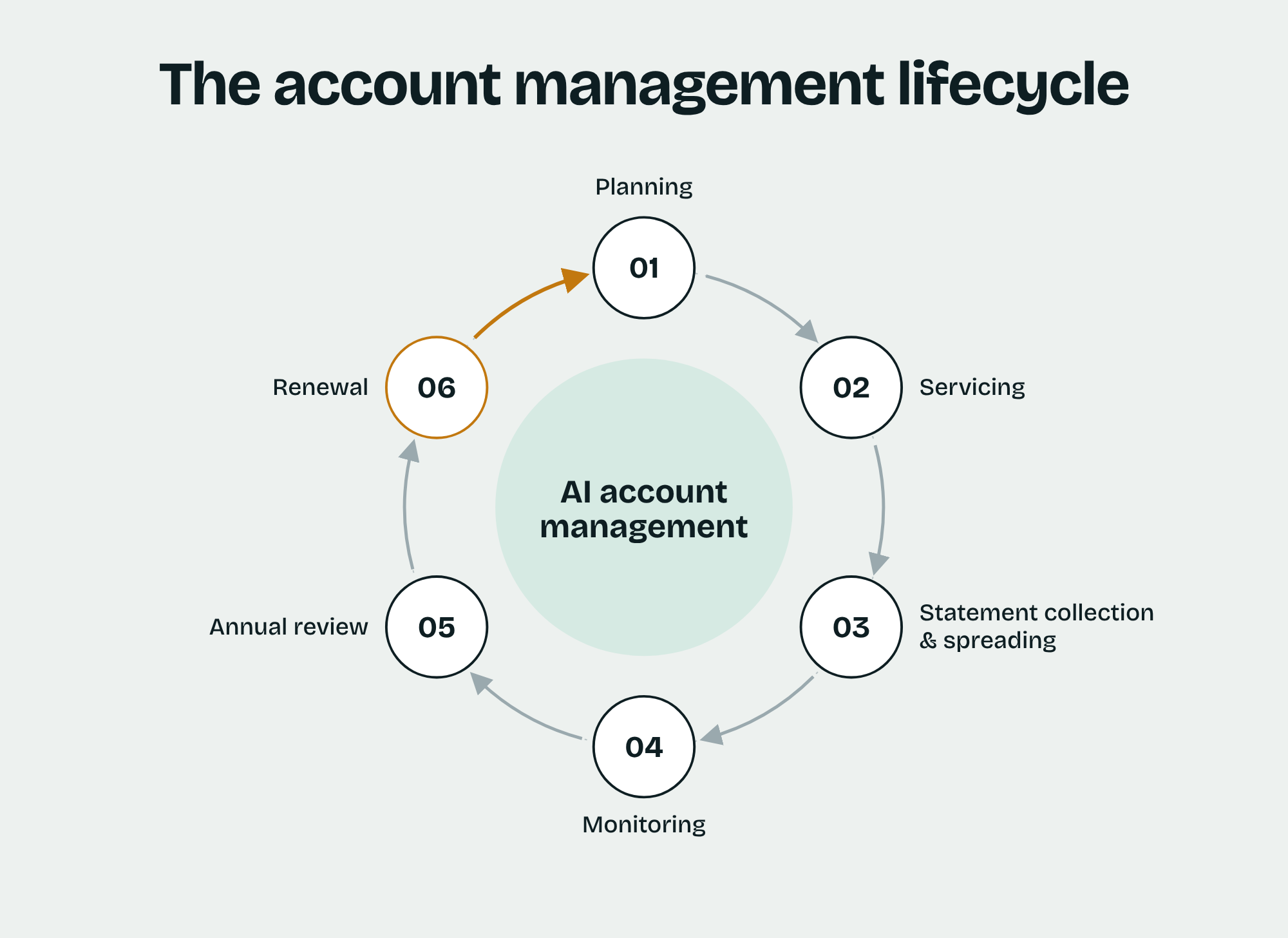
AI fits at every stage of the commercial relationship lifecycle, and the clearest way to see it is stage by stage:
Relationship Planning and Client Insight
Before a client meeting, AI relationship management tools assemble a brief: deposits, loans, treasury services, recent activity, open requests, and relevant news or financial signals about the client. It can also point to wallet-share gaps, such as an operating company that keeps its payroll account elsewhere or a borrower with growing deposits and no sweep product.
The RM still decides what to raise and how. The difference is walking in prepared instead of spending an hour pulling screens.
Ongoing Servicing and Client Requests
Between meetings, AI for relationship managers summarizes calls and email threads, triages incoming requests, sends document requests, and drafts follow-ups. A request for a payoff letter or an updated rent roll gets logged, routed, and tracked without the RM retyping it into three systems.
Financial Statement Collection and Spreading
This is the biggest hidden time sink for portfolio teams. Someone has to notice the statement is due, chase the borrower, chase again, receive a PDF, and spread it by hand into the credit system.
AI takes over most of that loop. Automated tickler follow-ups go out on schedule. When documents arrive, document AI classifies them and extracts the figures, and automated financial spreading maps them into your template for an analyst to review.
Covenant Monitoring and Early-Warning Signals
Portfolio management AI in banking tests covenant compliance as soon as a new spread lands. It flags breaches and near-breaches, tracks deteriorating trends across periods, and watches for early-warning signals like falling deposit balances or rising line utilization.
The AI flags. The banker decides. Waivers, amendments, and workout actions stay with the people authorized to make them.
You may also read: How to Implement Continuous Credit Monitoring on an Existing Loan Portfolio
Annual Reviews and Risk-Rating Updates
For annual reviews, AI drafts the narrative from the spreads, covenant history, and relationship activity. It can recommend a risk-rating change and lay out the evidence behind it. A credit officer reviews, edits, and approves.
This matters for exams. Timely, documented reviews with a clear rating rationale are exactly what examiners look for, and an audit trail of what the AI drafted and what the banker changed makes that rationale easy to show.
Renewals and Expansion
AI identifies renewals early, assembles the credit package from current spreads and review history, and drafts the credit memo update. The RM starts the renewal conversation months ahead instead of weeks.
That ties straight to revenue. Faster, better-prepared renewals mean fewer relationships lost to a competitor who simply showed up first.
How AI Changes Each Role
AI changes each role by taking over preparation and tracking, so people spend their time on judgment and clients.
The skills shift follows the same pattern for each role. RMs become better advisers because they have the context. Portfolio managers learn to trust and tune exception thresholds. Analysts become reviewers of AI output, which builds credit judgment faster. Credit administration moves from tracking items to closing them.
A Day in the Life: Before and After AI Account Management
Illustrative example. Picture a portfolio manager responsible for 120 commercial relationships, starting a Monday.
Before: The inbox has 60 unread emails, a few of them borrowers sending financials as attachments. The tickler report shows 18 overdue statements, but some of those already came in and were never logged. The covenant spreadsheet was last updated three weeks ago. She spends the morning matching attachments to borrowers, sends a batch of reminder emails one by one, and starts spreading the two statements that look most urgent. By lunch, she has not looked at the relationship that is actually getting worse.
After: She opens a queue, not an inbox. The received statements are already filed, extracted, and spread, waiting for review. Reminders for the overdue ones went out Friday. Two relationships are flagged: one tripped a debt service coverage covenant on the new spread, and another shows deposits falling three months in a row. She reviews the spreads, confirms the breach, and calls the RM before 10 a.m. The rest of the book needs no action today, and the system shows her why.
Same person, same portfolio. The difference is that the routine work ran itself, and her attention went to the two relationships that needed it.
What Data and Systems You Need
AI account management needs access to the systems where relationship and portfolio data already lives: the core banking system, CRM, LOS and credit platform, spreading tool, document repository, tickler and exception tracking, and email and calendar.
Data readiness checklist:
- Clean relationship hierarchies, so guarantors and related entities roll up correctly
- A consistent covenant library, with definitions the system can test against
- Accessible document history, so prior statements and reviews can be used as context
Questions to ask vendors:
- Do you connect by API, file transfer, or manual upload?
- Can you write results back to our credit system and CRM, or only display them?
- What audit logs do you keep of AI outputs and human edits?
Governance, Controls and Human-in-the-Loop
Good governance for AI account management means the AI prepares and the authorized banker decides, with every step logged. Credit decisions, risk-rating changes, and covenant waivers stay with authorized bankers, and each has a clear approval checkpoint.
Examiners will apply existing guidance. Model risk management expectations in the Federal Reserve's SR 11-7 and the OCC's Bulletin 2011-12 cover AI and vendor models. The interagency guidance on third-party relationships covers how you oversee the vendor. Expect questions about explainability (why did the AI flag this?) and about audit trails showing what the AI produced and what a banker changed.
Client confidentiality applies too. AI-drafted emails and summaries must respect your data privacy policies, and a banker should review anything that goes to a client.
Benefits and the Metrics That Prove Them
The benefits of AI account management show up in a short list of portfolio and relationship metrics, measured against a baseline taken before you start.
Measure three of these for at least a month before you change anything. Without a baseline, you have anecdotes, not results.
You may also read: AI Budget for Banks in 2027: Benchmarks, Priorities and a Spend Plan
AI Account Management for Community Banks and Credit Unions
AI account management is often more valuable for a $1 billion to $10 billion institution than for a megabank, because small teams manage large books with no slack. A megabank can add analysts. A community bank usually cannot, so capacity without new hires is the whole point.
Credit unions face the same math in member business lending. Portfolios are smaller, but staffing is thinner, and one person may originate, spread, and monitor the same relationship. NCUA expects credit unions to manage third-party and AI risk themselves, and its AI resources are a useful starting point. CUSOs and shared-service options can spread the cost across several institutions.
For segment-specific views, see AI agents for banks and AI agents for credit unions.
How to Get Started: A 90-Day Rollout Plan
A 90-day rollout works best when it starts with one workflow, one small team, and a baseline.
Days 1 to 30: Pick One Workflow and Baseline It
Choose financial statement collection and spreading, or covenant monitoring. Both are high volume and easy to measure. Record statements past due, hours per spread, and covenant tests completed on time.
Days 31 to 60: Pilot with a Small Portfolio Team
Run the workflow with one portfolio team. Define success criteria up front, set approval checkpoints for every AI output that touches credit, and hold a weekly feedback session to tune thresholds.
Days 61 to 90: Measure, Govern, Expand
Compare results to the baseline. Document the use case for model risk and audit: inventory entry, validation approach, monitoring plan. Then add the next lifecycle stage, such as annual review drafting.
Build vs. Buy vs. Platform Add-On
The Best Relationship Bankers Will Let Portfolio Work Run Itself
AI account management in banking does not replace relationship bankers. It removes the chasing, retyping, and spreadsheet checking that keeps them from their clients. The best relationship bankers in the next few years will be the ones whose portfolio work runs itself, so their judgment goes where it matters.
Start by finding where your team still chases, retypes, and re-checks. That is your first workflow.
You may also read: Lending Trends 2027: 10 Shifts Banks and Credit Unions Must Prepare For Now
Ready to Take the Routine Work Off Your Portfolio Team?
Uptiq's Qore platform gives banks and credit unions domain-trained agents for intake and document AI, financial spreading, covenant monitoring, and credit memo generation. They work over your existing core, CRM, and credit systems, and a single agent typically goes live in about five business days. Customers have reported 36% less financial spreading time and 63% less credit memo prep time. Start with a portfolio workflow assessment.
Frequently Asked Questions
How is AI account management different from a banking CRM?

Can AI change a borrower's risk rating automatically?
How do relationship managers use AI day to day?
What is AI covenant monitoring?
Is AI account management only for large banks?
What data does AI account management need?
How do examiners view AI in portfolio management?
What's the best first workflow to automate for a commercial lending team?
About the Author