AI credit card operations is where card programs are finding the most practical return on AI right now. It is not the fraud score at the point of sale. It is the post-issuance work behind it: dispute cases running against a regulatory clock, credit limit decisions that need explainable reasons, and cardholder service queues that never empty. If you run a card program, disputes, servicing, or card risk at a bank or credit union, this article maps where AI for card issuers fits today, what the regulations require, and how to start.
One idea runs through all of it. AI wins in card operations by hitting every deadline, every time, with a cleaner audit trail than the manual process it replaces.
What AI Credit Card Operations Means for Issuers
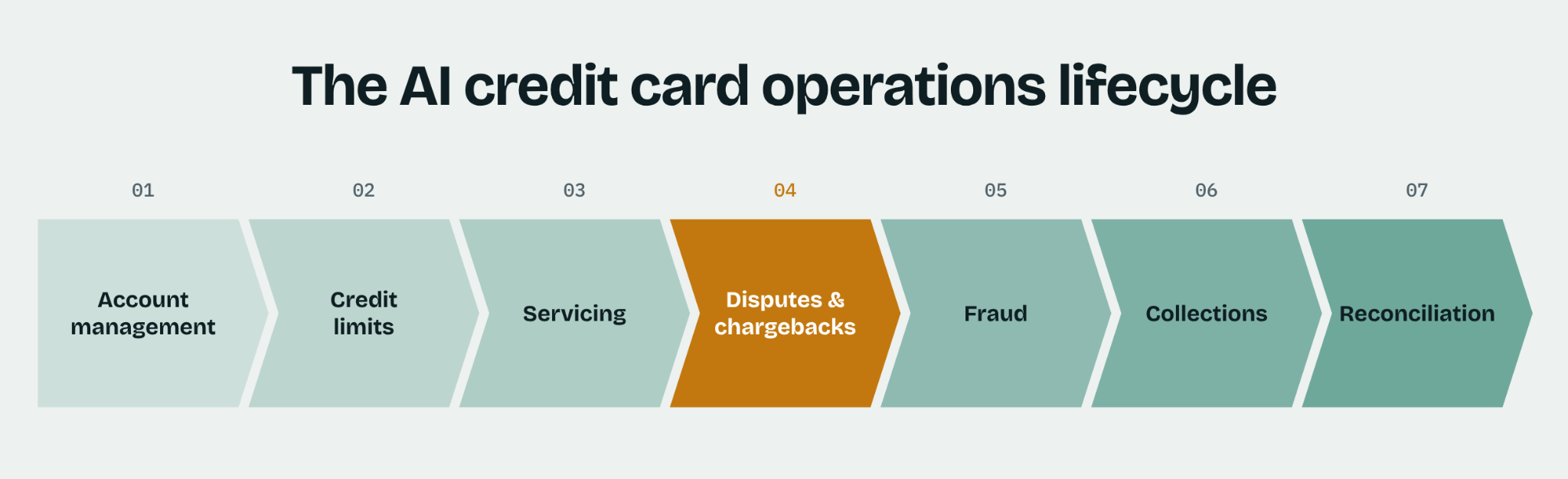
AI credit card operations means applying AI to the issuer's operating work after the card is in the cardholder's hands: managing accounts and limits, servicing requests, resolving disputes and chargebacks, following up on fraud, early collections, and reconciliation. Fraud scoring is one piece. Most of the cost and regulatory risk sits in the operations around it.
Across the card operations lifecycle, the fit looks like this:
Two kinds of AI show up across these stages. Assistive AI helps a person: it summarizes a call, suggests a reason code, or drafts a letter. Agentic AI completes a multi-step task under rules and oversight. For example, it can take a dispute from intake to a recommended outcome with the evidence attached, leaving the decision and any denial to an analyst.
Why Card Operations Are Under Pressure in 2027
Card operations teams are being squeezed from several directions at once:
- Dispute volumes keep climbing. Digital commerce and easy in-app dispute buttons make filing simple, and volume follows.
- First-party fraud is growing. Some cardholders dispute purchases they actually made, and those cases are harder to separate from genuine errors.
- Cardholders expect speed. Real-time payments elsewhere set the expectation that problems get fixed in days, not cycles.
- Contact-center costs and staffing. Experienced dispute and servicing staff are hard to hire and keep. The Federal Reserve's payments study is a useful reference for card payment volume trends.
Regulatory scrutiny adds to the load. The CFPB supervises card practices and publishes complaint data, and card disputes remain a common complaint topic. The CFPB's 2024 credit card late fee rule was vacated by a federal court in 2025. [EDITOR: confirm and state the rule's status as of publish date.] Whatever happens to individual rules, the underlying billing-error and adverse action requirements are long-standing, and they are where automation has to be most careful.
Pillar 1: AI-Powered Dispute and Chargeback Automation
Credit card dispute automation is the pillar most issuers start with because the work is high-volume, rules-driven, and deadline-bound.
The Dispute Lifecycle and Its Regulatory Clock
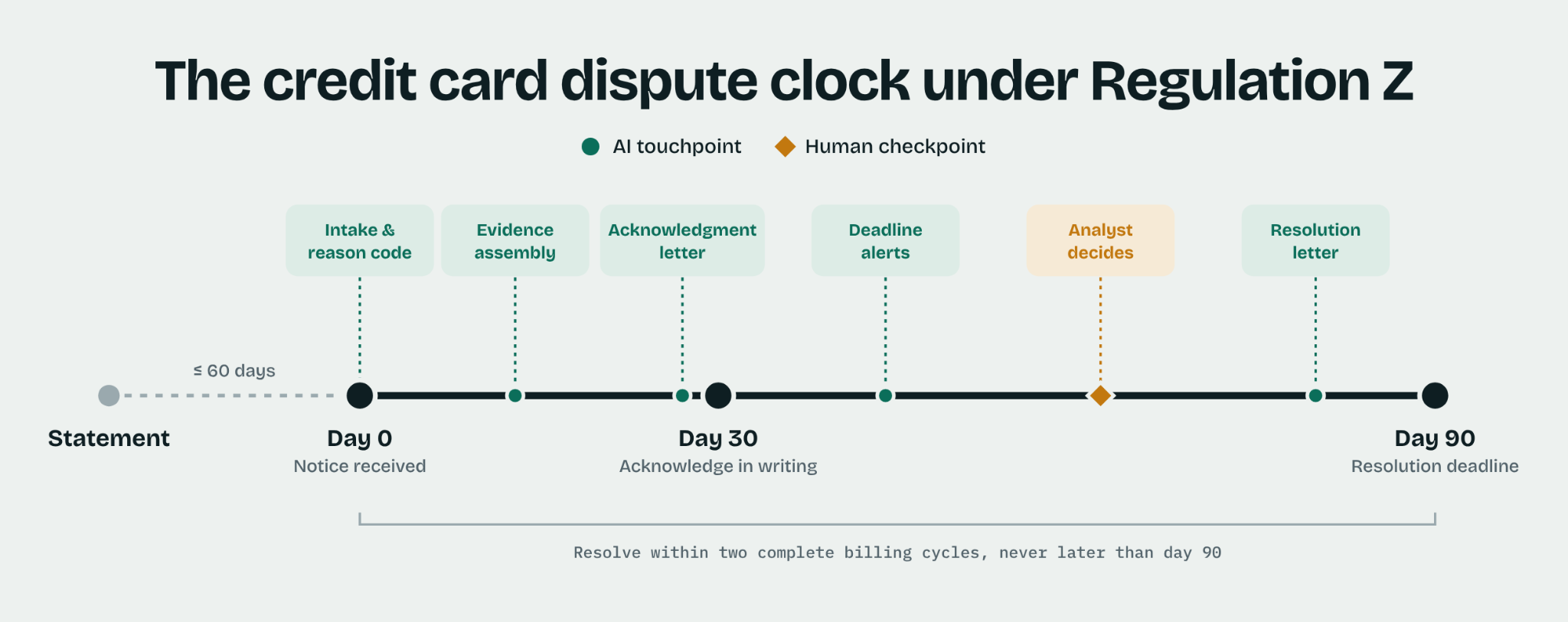
For credit cards, Regulation Z's billing-error rules (§1026.13) set the clock. The cardholder must send notice within 60 days after the creditor sent the first periodic statement showing the error. The creditor must acknowledge the notice in writing within 30 days, unless it resolves the dispute in that time. It must resolve the dispute within two complete billing cycles, and in no case more than 90 days after receiving the notice.
For debit cards, Regulation E (§1005.11) applies. The institution generally has 10 business days to investigate. If it needs longer, it can take up to 45 days (90 days for certain transactions, such as point-of-sale, foreign-initiated, or new-account transactions), provided it gives provisional credit within the 10 business days. New accounts get extended timeframes.
On top of the regulations sit the network frameworks: Visa Claims Resolution and Mastercard's dispute processes via Mastercom, each with reason codes, response windows, and evidence requirements.
Missed deadlines cost twice. You can lose the chargeback right against the merchant and absorb the loss, and you can create a compliance finding. [EDITOR: verify every timeline above against the current regulation text and network rules as of publish date.]
Where AI Fits in the Dispute Workflow
Intake: AI classifies disputes arriving by phone, chat, app, or letter, captures the details the regulation and networks require, and suggests the right reason code. It also recognizes when a call that sounds like a question is actually a billing-error notice, which starts the regulatory clock.
Investigation: It pulls transaction history, merchant data, and prior disputes, assembles the evidence file, and recommends an outcome: file a chargeback, write off, or deny.
Correspondence: It drafts compliant acknowledgment and resolution letters and tracks every deadline automatically, escalating cases before they breach.
Human checkpoint: Denials and edge cases go to an analyst. A denial is where cardholder harm and complaint risk concentrate, so a person should own it.
Fighting First-Party and Friendly Fraud
AI helps with friendly fraud by looking at patterns a single analyst would miss: a cardholder's dispute history, delivery confirmation, device and login data, and continued use of a subscription after claiming it was unauthorized. Chargeback automation AI can also assemble merchant-provided evidence under network programs such as Visa's Compelling Evidence 3.0, which uses prior undisputed transactions to help resolve certain fraud disputes.
The balance matters. Wrongly denying a legitimate dispute creates UDAAP and complaint risk, and that cost can exceed the chargeback you saved. Friendly-fraud flags should route to review, not trigger automatic denials.
Dispute Metrics That Matter
- Average cycle time from notice to resolution
- Percentage resolved within regulatory windows
- Chargeback win and recovery rate
- Provisional credit written off
- Cost per case
Pillar 2: AI for Credit Limit Management
Smarter Credit Limit Increases
Credit limit increase AI uses behavior and cash-flow signals, such as payment patterns, utilization trends, and deposit relationships, to find cardholders who can handle more credit and would use it. Issuers can offer proactive increases instead of waiting for requests, and price the trade-off between interchange and balance growth on one side and loss risk on the other.
Ability to pay still applies. Regulation Z §1026.51, from the CARD Act, requires issuers to consider the consumer's ability to make the required payments before increasing a limit. An AI model can support that analysis, but it cannot skip it.
Line Decreases and Adverse Action
Credit line decreases can be adverse action, which means the cardholder may be owed a notice with specific principal reasons. A complex model does not change that. The CFPB has said that creditors using complex algorithms must still give specific, accurate reasons, in Circular 2022-03 and its 2023 follow-up. [EDITOR: confirm the current status of these circulars as of publish date.] Limit models also need fair lending testing for disparate impact, because a model that reduces lines more often for a protected group creates real legal risk even without intent.
Governance for Limit Models
Limit models are models. The Federal Reserve's SR 11-7 and the OCC's Bulletin 2011-12 apply, including to vendor models. That means validation before use, ongoing performance monitoring, tracking how often staff overrides the model and why, and documentation an examiner can follow. See also our overview of AI governance.
Pillar 3: AI in Cardholder Servicing
Front Line: Self-Service and Agent Assist
Card servicing automation handles the high-volume, low-complexity requests well: balance and payment questions, card lock and unlock, travel notices, replacement cards. Intent detection routes the rest. For calls that reach a person, agent assist pulls up the account context and summarizes the call afterward, which cuts after-call work.
The watch-out is deflection for its own sake. A bot that keeps cardholders from reaching a person may look good on containment but drive repeat contacts and complaints. Measure resolution, not containment.
Back Office: Hardship, Payment Plans and Early Collections
AI can screen hardship requests against program eligibility, set up payment plans, and run early-stage collections outreach at the right time and channel. Every automated communication needs a compliance check, because collections language is closely watched and tone that reads as threatening becomes a UDAAP problem quickly.
Complaint Handling and Root-Cause Analysis
AI classifies complaints by product and issue, tracks response deadlines for complaints arriving through the CFPB complaint portal, and looks across complaints for patterns. Ten complaints about the same merchant or the same letter template are an early warning of a systemic issue, and finding it in week one is far cheaper than finding it in an exam.
Fraud, Reconciliation and the Rest of the Back Office
Real-time authorization fraud scoring is mature and widely covered, so the bigger opportunity for most issuers is the follow-through: opening the fraud case, contacting the cardholder, blocking and reissuing the card, and linking the case to any related dispute. AI can run that sequence consistently so nothing waits in a queue.
Reconciliation and settlement exceptions are another quiet cost. AI can match mismatched settlement records, classify the exception, and route it to the right team with the supporting data, so staff resolve exceptions instead of hunting for them.
What Agentic Commerce Means for Card Operations
The networks are preparing for AI agents that shop on behalf of cardholders. Visa has announced Visa Intelligent Commerce and Mastercard has announced Agent Pay, both aimed at letting authorized AI agents make purchases with cardholder consent.
For card operations, that raises practical questions:
- Reason codes: How will a dispute over an agent-initiated purchase be classified?
- Evidence: What proof of authentication and cardholder consent will be available?
- Liability: Who bears the loss when an agent buys the wrong thing?
- New dispute types: "My agent did not do what I asked" is a different claim from "I did not make this purchase."
Issuers do not need answers today, but they should watch network rule updates and make sure dispute intake can recognize and tag agent-initiated transactions when they appear.
Community Banks and Credit Unions: What You Can Control
Many community banks and credit unions do not run their card programs alone, and AI for card issuers looks different depending on the model.
Typical patterns; your contracts define the actual split.
Questions to ask your processor:
- What AI capabilities do you offer for disputes, servicing, and limits today?
- Can we access our dispute and servicing data through an API?
- Do you report deadline performance against Reg Z and Reg E windows?
- Who owns adverse action reasons and fair lending testing for limit changes?
For credit unions, the case usually rests on member experience and cost-to-serve. Fraud and dispute pressure falls hard on small teams, and faster, fairer dispute handling is a member-service win in its own right.
See also AI agents for banks and AI agents for credit unions.
Governance, Compliance and Exam Readiness
AI should make the audit trail better, not thinner. Before you scale anything, check that you have:
- Automated tracking of every Reg Z and Reg E deadline, with escalation before breach
- Documented dispute decisions, including the evidence and who decided
- Specific, accurate adverse action reasons for limit decreases and denials
- Fair lending testing of limit and dispute models
- UDAAP review of automated letters, scripts, and collections messages
- Complaint monitoring linked to root-cause review
- Model risk and third-party risk management for every AI tool and vendor
How to Measure ROI Across Card Operations
Baseline these before any pilot, then track the same way afterward.
You may also read: AI Budget for Banks in 2027: Benchmarks, Priorities and a Spend Plan
Where to Start: A 90-Day Plan
Days 1 to 30:
Map dispute volumes by channel and reason code, and measure deadline performance today. Pick one pillar. Disputes usually has the clearest ROI because volume, cost, and deadlines are all measurable.
Days 31 to 60:
Pilot intake classification and case assembly, with an analyst reviewing every recommendation and owning every denial.
Days 61 to 90:
Measure against the baseline, document the controls for model risk and compliance, then expand to servicing or limits.
You may also read: Lending Trends 2027: 10 Shifts Banks and Credit Unions Must Prepare For Now
AI Credit Card Operations: Every Deadline, Every Time
AI credit card operations is not about replacing card teams. It is about making sure every dispute meets its regulatory deadline, every limit decision has a clear reason, and every service request gets resolved, with an audit trail stronger than the one you have today. Start where the clock is tightest, which for most issuers is disputes.
Ready to See Where AI Fits in Your Operations?
Uptiq's Qore platform is an AI workforce for financial institution operations, with domain-trained agents that work over the systems you already run. More than 150 financial institutions work with Uptiq, and Qore connects to 100+ integrations. Start with an operations assessment to find the workflow where AI will pay back first.
Frequently Asked Questions
How is AI used in credit card operations?

Can AI automate credit card disputes and chargebacks?
What are the Regulation Z timelines for credit card disputes?
How does AI detect friendly fraud in disputes?
Can banks use AI to decide credit limit increases?
Do AI-driven credit line decreases require adverse action notices?
What is agentic commerce and how will it affect card disputes?
Can community banks and credit unions use AI if their card program is outsourced?
About the Author