AI financial spreading takes the tax returns, financial statements and interim reports a borrower sends and turns them into a spread on your bank's own template, with every number traced back to the page it came from. Most commercial lending teams have seen the demo. The harder questions come after it: how accurate is accurate enough, what speed gain is real once review is counted, and what your analysts do with the hours they get back. This guide is written for credit administrators, chief credit officers and lending operations leads who are evaluating spreading automation or trying to scale a pilot. It explains what the technology does step by step, how to test accuracy properly, how to measure speed honestly, how the analyst role changes and what to put on your evaluation checklist.
What AI financial spreading actually does
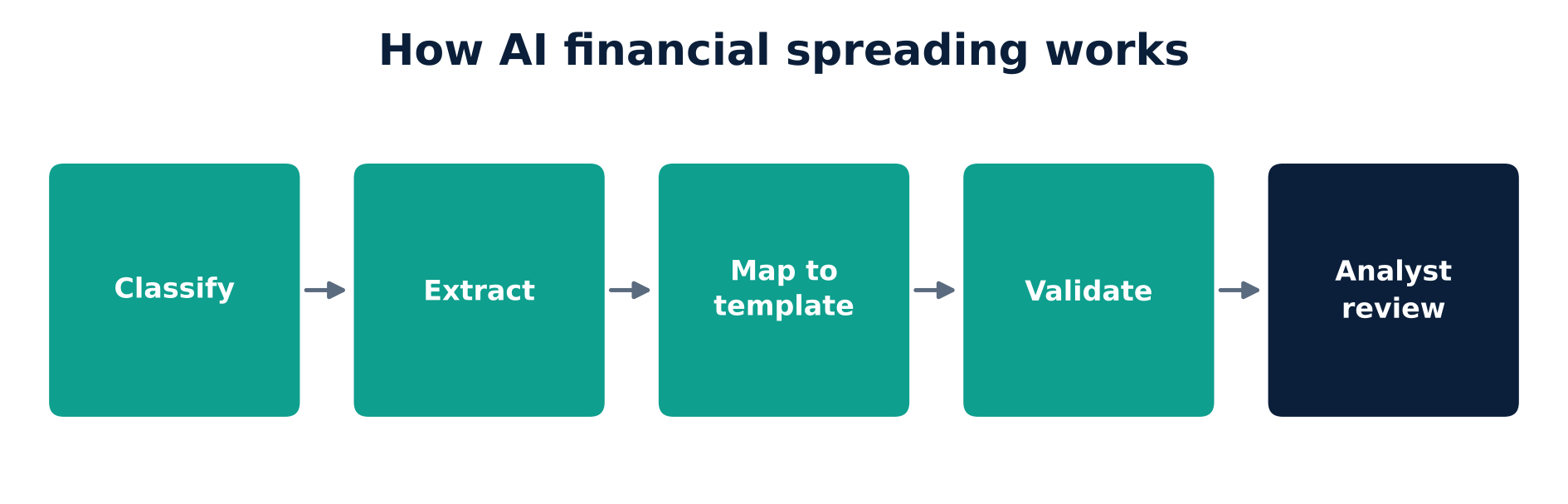
AI financial spreading does four distinct jobs: it classifies each document, extracts the line items, maps them to your template and validates the result before an analyst sees it. Vendors often describe all four as "extraction", which hides where errors actually come from. A spread can have perfectly read numbers and still be wrong because a line was mapped to the wrong row. Breaking the work into steps lets you test each one separately.
1. Classify
The system identifies what each file is: a Form 1120S, a Schedule K-1, a CPA-reviewed balance sheet, a year-to-date interim statement or a personal financial statement. A single upload often contains several documents stitched together, so classification also splits the package and labels the period each document covers. Get this wrong and everything downstream inherits the error.
2. Extract
Extraction reads the values and their labels from each page, including scanned and photographed documents, multi-column statements and handwritten adjustments. This is where traditional OCR tools struggle, because a number without its label and period is not usable data. Our explainer on OCR vs IDP vs document AI covers why reading the layout matters as much as reading the characters.
3. Map to your template
Mapping places each extracted line into the right row of your bank's spreading template and chart of accounts. "Officer compensation" on a tax return and "salaries, owners" on a compiled statement may need to land in the same row, while an unusual line such as a one-time insurance recovery should be flagged rather than buried in other income. Mapping is where your institution's credit policy lives, so it should be configurable by your team, not fixed by the vendor.
4. Validate
Validation checks the spread against itself and against the source. Balance sheets should balance, subtotals should foot, net income should tie between the income statement and retained earnings, and the tax return should reconcile to the financial statements within a tolerance. Each failed check becomes an exception for an analyst, with the page and line attached.
How to judge spreading accuracy
You judge spreading accuracy at the field level, using confidence scores, thresholds and a review step, rather than trusting a single headline percentage. A document-level score can look high while the handful of fields that drive debt service coverage are the ones being missed. The useful question is not "how accurate is it?" but "which fields are wrong, how often, and will we know before a credit officer relies on them?"
Field-level confidence and thresholds
A well-designed system attaches a confidence score to every extracted and mapped value. Your team sets the threshold above which a value can flow straight into the spread and below which it goes to a review queue. Critical fields such as revenue, EBITDA components, interest expense, depreciation and total debt deserve stricter thresholds than footnote items.
Human review that is designed in
Human review should be a queue with a clear owner, not an informal habit of "eyeballing" the output. Analysts confirm or correct flagged fields, and every correction should be logged so you can see whether accuracy is improving by document type over time. If the review rate never falls, the thresholds or the mapping rules need work.
Source lineage back to the page
Every number in the spread should link back to the exact page and location it came from. Lineage is what makes a spread provable to a credit officer, a loan review team or an examiner. Without it, reviewers end up re-opening the PDF to check numbers by hand, and much of the time saving disappears.
You may also read: From prompt to production: a guided tour of Uptiq's bank-grade AI console
What the speed gains really mean
Speed gains from spreading automation are real only when you measure analyst touch time per spread, including review, not just the minutes between upload and first draft. A system that produces a draft spread in two minutes but needs forty minutes of checking has moved the work, not removed it. Elapsed time matters to the borrower, but touch time is what determines how many deals each analyst can carry.
Track a small set of measures before and after you go live, using the same deal mix in both periods.
Faster spreading also changes what happens next. When spreads arrive quickly and with lineage attached, AI credit memo generation and global cash flow work can start the same day. That is where the bigger cycle time gains in commercial loan underwriting automation tend to show up.
How the analyst's role changes
The analyst's role shifts from re-keying numbers into a template to reviewing exceptions, normalizing results and analyzing the credit. Spreading has long been the training ground for junior credit analysts, and that does not have to change. What changes is the ratio: less time typing, more time asking why margins moved, whether an add-back is defensible and what the cash flow says about repayment.
Moody's makes a similar point in its October 2026 piece on lending decisions that require a current view of risk, noting that lending teams often spend time "revisiting information" and arguing that technology should free credit professionals to focus on "judgment, relationships, and risk assessment".
What the analyst owns in an automated workflow
- Exceptions. Resolving low-confidence fields and failed validation checks, with the source page in view.
- Normalization. Deciding on add-backs, owner compensation adjustments and non-recurring items, which remain judgment calls.
- Analysis. Interpreting trends, ratios and covenant headroom instead of building the spread that shows them.
- Training the system. Flagging recurring mapping issues so rules improve for the next deal.
The credit decision itself does not move. Credit officers decide; the AI prepares the spread, checks it and documents where every number came from. Framed this way, spreading automation is capacity creation for growth: the same team can take on more deals, respond to borrowers sooner and spend more time on the credits that need it.
A practical evaluation checklist
A practical evaluation checklist tests AI financial spreading on your own documents, your own template and your own governance requirements before you sign. Ask each vendor to run a pilot on a sample of recent deals that includes clean audited statements and the messy ones: scanned tax returns, multi-entity packages and handwritten adjustments.
Accuracy and workflow
- Run the pilot on your documents and report accuracy by document type and by critical field.
- Confirm every value carries a confidence score and that your team controls the thresholds.
- Click from a sample of spread cells back to the source page and check the lineage.
- Review the default validation rules and add your own tie-outs and tolerances.
- Confirm the output lands in your existing spreading template and loan origination system without re-keying.
Governance and risk
Governance questions belong in the evaluation, not after go-live. In April 2026 the Federal Reserve, OCC and FDIC issued revised model risk management guidance (Federal Reserve SR 26-2, announced alongside OCC Bulletin 2026-13). It replaces SR 11-7 with a risk-based approach and keeps principles such as inventory, documentation, effective challenge and validation of vendor models, while a footnote places generative and agentic AI models outside its scope as "novel and rapidly evolving". Whether your extraction engine counts as a model is a call for your model risk team, and many institutions will also apply the interagency third-party risk management guidance and the voluntary NIST AI Risk Management Framework.
Supervisors are already asking. Reuters reported in October 2026 that US regulators are questioning banks on AI agent limits, audit trails, safeguards on authority, human involvement and the ability to shut systems down.
- Ask for model documentation, validation evidence and a change log for model updates.
- Confirm audit trails capture every extraction, correction and approval with user and time.
- Check that the AI cannot approve, decline or price a credit on its own.
- Confirm data residency, retention and access controls with your information security team.
- Agree the metrics from the speed table above and a review date before the pilot starts.
You may also read: Commercial loan underwriting automation
Where the Uptiq platform fits
The Uptiq platform handles spreading as one governed step in a wider commercial lending workflow, sitting as a new tier, not a new core, alongside your existing loan origination and core systems. Uptiq Document AI classifies, extracts and validates borrower documents, and Uptiq financial spreading automation maps results to your template with field-level confidence and lineage back to the page. The Underwriting Agent then carries spreads into analysis and memo preparation, while credit officers keep every decision.
Uptiq describes its AI as bank-grade, meaning grounded, governed and provable: grounded in your documents and policies, governed by Validation Hub, which checks every action before it runs, and provable through source lineage and audit trails. Uptiq customers have seen the results below.
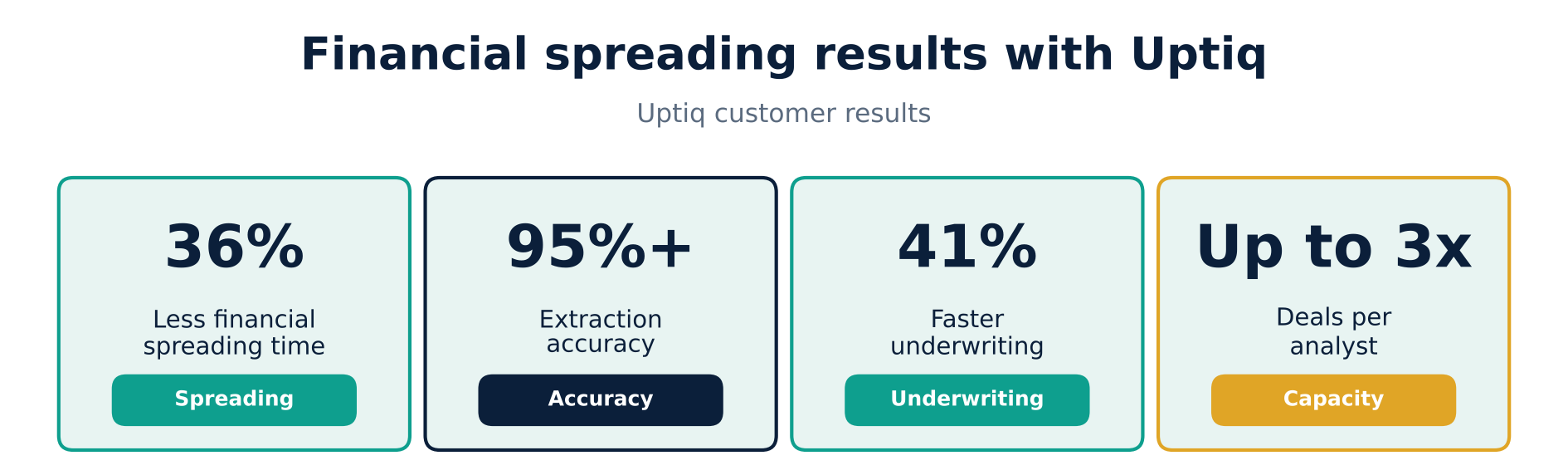
- Uptiq customers have seen 36% less financial spreading time.
- Uptiq customers have seen 95%+ extraction accuracy, with low-confidence fields routed to analysts for review.
- Uptiq customers have seen 41% faster underwriting.
- Uptiq customers have seen up to 3x deals per analyst.
Conclusion: Spreading is a review workflow, not a typing job
AI financial spreading works when you treat it as four testable steps with field-level confidence, clear thresholds, designed-in review and lineage back to the page. Measure touch time, not just turnaround, and give analysts ownership of exceptions, normalization and analysis rather than data entry.
The Uptiq platform brings Document AI, spreading automation and the Underwriting Agent together as a governed new tier beside your existing systems, so your analysts get spreads they can verify and your credit officers get more time for the decisions only they should make.
See AI financial spreading on your own deals
Bring a recent borrower package and your spreading template, and we will show you classification, extraction, mapping and validation on your documents, with confidence scores and lineage for every field.
Frequently Asked Questions
What is AI financial spreading?

How is AI used in commercial lending?
How long does commercial loan underwriting take with AI?
How accurate is AI financial spreading?
Does AI financial spreading replace credit analysts?
What documents can AI spreading handle?
How does AI loan document processing support model risk management?
About the Author