You can automate every single step in a lending process and still have a manual workflow.
Walk a commercial file from application to decision at a typical bank. Document AI extracts the financials. An employee reviews the output and emails it to the spreading team. Spreading produces standardized financials. An employee moves those into underwriting. Underwriting produces an analysis. An employee hand-carries the relevant information into decisioning. Another system takes over for monitoring after close.
Each step is automated. Each transition between steps is not. The file spends most of its elapsed life waiting at a boundary, not being worked on inside a system.
Most institutions count tools and call this progress. They're measuring the wrong thing. The question that matters is not how many AI systems you run. It's how many times a human has to touch a file just to move it forward.
That touch, that handoff, is where the cost lives. That's where the cycle time goes. That's where the capacity ceiling sits. The expensive part of a fragmented AI stack is not the software. It's the glue.
Every Tool is Automated. So Why is the Workflow Still Slow?
Because automating a task is not the same as automating the work. And the gap between the two is filled by employees.
A lending operation can hold five sophisticated systems and still move at the speed of the slowest person routing output between them. That person, the connector, the router, the queue manager, is not a feature of the workflow. They are a bottleneck that the workflow is built around.
The fragmented lending stack was not a strategic decision. It was an accumulation. Each purchase solved a real problem at the time. Document AI to stop analysts from re-keying tax returns. A spreading engine. A decisioning layer. Underwriting support. Portfolio monitoring. Compliance checks.
Every one of those tools is defensible on its own terms. The problem is that none of them owns the space between itself and the next one. So that space defaults to a person.
A collection of good tools can still produce a bad workflow.
The Real Cost of Fragmentation Shows Up Between Systems
The handoff tax is what an institution pays every time work has to cross from one system into another. When that crossing requires a human, the bill arrives in seven forms. Only the first one is obvious.
- Time: Someone has to open the output, read it, and move it. That is real capacity, spent on transport rather than analysis.
- Reconciliation: The employee has to work out whether what System A produced is what System B expects, in the shape it expects.
- Re-entry: Data gets copied, reformatted, or re-keyed a second time. This is the single most avoidable cost in the list.
- Context loss: The next system receives a number without the reasoning, the source, or the caveat that came with it.
- Error risk: Every manual transfer is a fresh opportunity for the wrong figure to land in the right field.
- Queueing: The downstream task cannot begin until someone completes the transfer. Elapsed time accumulates in the gaps.
- Accountability gaps: When an outcome is wrong, it becomes harder to establish which system, or which transfer, produced it. And that matters. Federal Reserve and OCC guidance SR 11-7 on third-party relationships is explicit: using third parties does not reduce a banking organization's responsibility for the activity. A workflow stitched together by hand is a harder thing to answer for.
The more systems a workflow touches, the more the transitions between them determine its performance.
You may also read: AI Agents for Commercial Lending Workflows: A Practical Guide
Follow One Loan Through the Stack
The clearest way to see the handoff tax is to stop looking at tools and follow a single file. Here is one commercial application moving through a stack where every component is automated.
- STAGE 1- Intake: Application information enters the LOS. (No handoff yet.)
- STAGE 2 - Document AI: Documents classified, financials extracted. (An employee reviews the extraction and moves output to spreading.)
- STAGE 3 - Financial spreading: Financials standardized, ratios calculated. (An employee transfers the analysis into underwriting.)
- STAGE 4 - Underwriting: Analysis and recommendations generated. (An employee moves the relevant information into decisioning.)
- STAGE 5 - Decision: The credit decision is made. (Approved loan information is entered into servicing.)
- STAGE 6 - Monitoring: Borrower performance is tracked. (If the data it needs isn't available, another manual process starts.)
Five handoffs. Five people. Five queues.
Note that nothing in that sequence failed. The extraction was accurate. The financial spreading was correct. The underwriting analysis was sound. Every individual tool did exactly what it was bought to do.
The workflow still required employees to operate it as a relay.
Handoffs Create More Than Operational Drag
Manual transfers cost more than the minutes they consume, because each one compounds into a structural constraint. Six effects show up in the operating numbers before they ever surface in a technology review.
- Slower cycle times: A downstream task cannot start until upstream output has been reviewed and moved. Waiting accumulates faster than processing.
- More operational headcount: People become the middleware. Roles get created to keep the stack moving rather than to assess credit.
- More exceptions: Different systems carry different formats, schemas, and assumptions. Every mismatch becomes a queue.
- More rework: Teams spend time correcting information that should have moved cleanly the first time.
- Less throughput: Capacity gets capped by the people coordinating the workflow, not by the systems doing the work.
- Less visibility: With a file split across disconnected applications, nobody can see its full state without asking someone else.
This is where the conversation becomes an operations conversation rather than a technology one. The useful question for a COO is not how many AI tools the institution runs. It's how many times a human has to touch a file simply to move it forward.
Why More AI Tools Can Make the Workflow More Complicated
Adding automated tools can increase total workflow friction, because each new system introduces a new boundary someone has to cross.
Picture an institution that adds five AI systems, each saving thirty minutes. On the business case, that's two and a half hours recovered per file. In practice, employees now log into five systems, review five outputs, reconcile five formats, move information five times, and manage five exception queues.
The cost of that switching is measurable. Harvard Business Review tracked 137 employees across three Fortune 500 companies and found workers toggled between applications around 1,200 times a day, losing close to four hours a week just reorienting themselves. In one supply chain case, completing a single transaction meant each person involved switched about 350 times across 22 different applications.
That institution has not built one automated workflow. It has built five automated tasks connected by manual operations.
Task automation measures what a tool can do. Workflow automation measures what the organization no longer has to do.
Data Can Move Between Systems. Context Often Doesn't.
An integration can pass a number without passing anything that makes the number usable.
Extracted revenue. EBITDA. DSCR. A risk score. A policy result. All of these can move cleanly between two systems and still arrive stripped of everything a reviewer needs. The receiving system typically does not know where the figure came from, which document supported it, why an exception was flagged, which version of policy was applied, what an earlier step found, or what a human changed along the way.
The data moved. The reasoning did not.
In lending, that gap is not only inefficient. It is a governance problem. Supervisory expectations for model risk management under SR 11-7 assume an institution can explain how an output was produced. If the rationale is scattered across five applications and one analyst's memory, the file is defensible only as long as that analyst is available.
An integrated workflow has to move more than data. It has to preserve context, rationale, and state.
You may also read: How to Review AI-Generated Financial Spreads
Connecting Every Tool Isn't the Same as Connecting the Workflow
Integration solves connectivity. It does not solve coordination. A stack can be fully integrated; every system can technically exchange data with every other, and still require a person to decide what moves, when, in what shape, and whether it landed.
It helps to separate three things that get sold under the same word.
- Integration: System A sends data to System B. But the person decides when, in what form, and whether it landed.
- Automation: System B processes that data without manual input. But the person decides what happens next.
- Orchestration: The workflow itself knows what should happen next, carries context forward, handles exceptions, and routes work to the right agent or human. The person decides the credit.
Most lending stacks sit at the first two layers and are described as though they sit at the third. That gap is exactly where the handoff tax is paid. It's why counting integrations is a poor proxy for how connected a workflow actually is.
Integration connects systems. Orchestration connects work.
The Future Stack Looks Less Like a Toolbox and More Like a Workflow
A connected lending workflow replaces the tool-human-tool relay with a sequence in which work and context pass forward automatically, and people are called in where judgment is required.
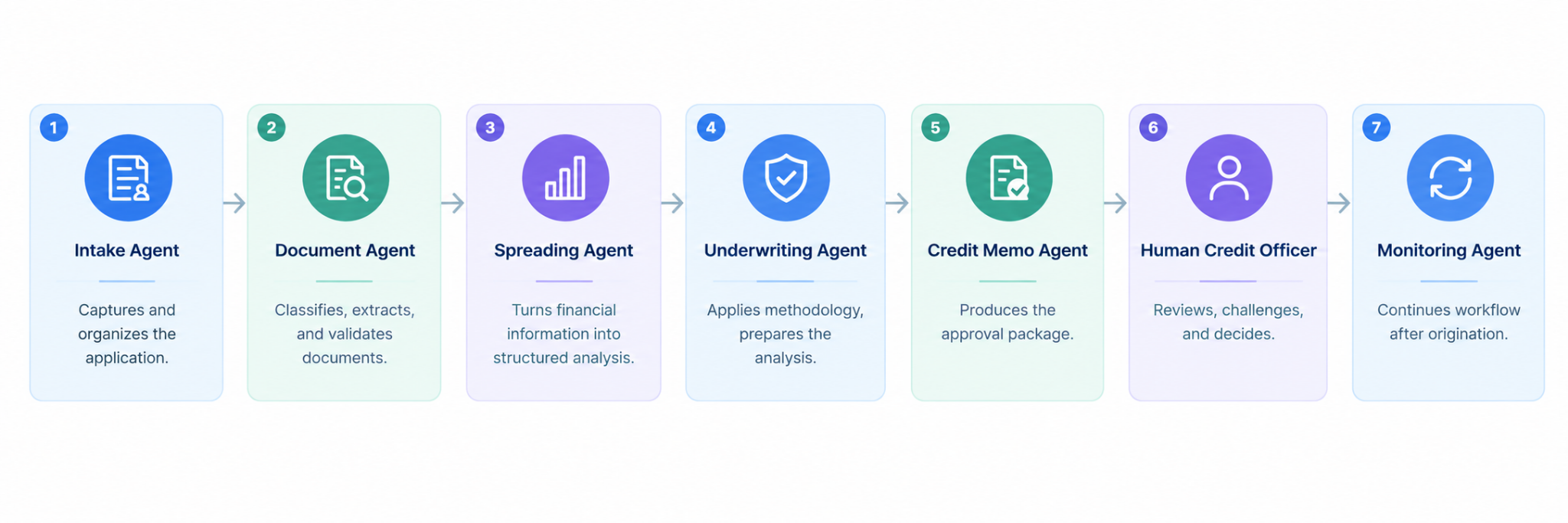
The distinction that matters is not that the work is done by AI agents rather than software. It's that each step receives the output, the sources, and the open questions from the step before it. The credit officer still owns the decision. They are no longer the mechanism that carries the file from one system to the next.
People Should Handle Judgment, Not Data Movement
The human role in a connected workflow gets larger in substance and smaller in volume. Credit professionals should spend their time where interpretation is required: exceptions, complex borrower situations, risk assessment, deal structure, relationship context, final approval, escalation.
What they should not spend it on is copying numbers between screens, moving documents into the next queue, reconciling fields, confirming one system received another's output, or manually triggering the next stage of a process that already knows what comes next.
Judgment work compounds in value as an analyst gets more experienced. Transport work does not. And paying senior credit salaries to perform it is the most expensive way an institution can move a file.
If a credit professional spends more time connecting AI systems than evaluating credit, the stack is working against the organization.
Stop Measuring AI Adoption. Start Measuring Workflow Friction.
AI adoption metrics describe what an institution has bought, not what its workflow costs. A better set of measures looks at the seams, because that is where the time and the risk actually sit.
Measure:
- Human touches per loan
- Handoffs required per application
- Re-keying rate (entries made twice across systems)
- Exception resolution time
- How many applications one employee needs to complete
- End-to-end cycle time (application to decision)
The last one is the metric to lead with. Time from application to decision is where every form of workflow friction eventually surfaces. It's the number the borrower experiences. An institution can improve every task-level measure it tracks and see that number stay flat. That's usually the first sign the problem lives between the tools rather than inside them.
You may also read: SOC 2 Type II for Commercial Lending AI: The Vendor Questions That Matter
The ROI of Lending Workflow Automation Is Bigger When the Workflow Is Connected
Removing a handoff pays differently from automating a task, because it changes capacity rather than duration.
One automated task returns minutes to an individual. A connected workflow returns throughput to the organization.
The compounding effects are the ones worth modelling: faster decisions, greater analyst capacity, more applications processed by the same team, lower operational cost per file, fewer transfer errors, cleaner exception handling, and an audit trail that survives without reconstruction.
Post-origination, the same logic extends to covenant monitoring, where the cost of watching a portfolio has historically risen in step with its size.
This is why the business case built on tool-level time savings tends to disappoint. It measures the wrong thing. Task savings show up on a spreadsheet. Workflow savings show up in how many loans the same credit organization can carry.
Where Uptiq Fits: Built Around the Workflow, Not the Individual Task
Uptiq is an AI operating layer for lending rather than another point solution in the stack. The design premise is that agents should hand work to each other, so employees are not the mechanism that moves a file between them.
Intake → Document intelligence → Financial analysis → Underwriting → Credit memo → Decision preparation → Monitoring
The existing environment stays in place. Agents read from and write to the core, the LOS, the CRM, and the document repository rather than replacing them. A bank can start with one workflow instead of redesigning the entire operation.
More than 150 financial institutions run agents on the platform today. Connected workflows also have to stay controllable, which means source citations on every figure, the policy version applied, the rationale behind each step, recorded human approvals, a complete audit trail, and defined exception handling.
A workflow that moves faster but cannot be explained afterwards has traded one problem for a worse one.
See how Uptiq connects the lending workflow →
The Best AI Stack May Be the One With the Fewest Human Handoffs
The AI arms race has trained institutions to ask how many processes they can automate. The more useful question is how much human work remains between the processes already automated.
A lending operation can run sophisticated models at every stage and still behave like a manual process, because sophistication at the task level says nothing about coordination at the workflow level.
The tools were never the constraint. The seams were.
The next phase of lending workflow automation is not about buying better models or more point solutions. It's about removing the operational friction between the ones already in place.
he value of AI isn't determined by how much of the workflow each tool automates. It's determined by how little manual work remains between application and outcome.
Count the Handoffs in One of Your Own Files
Take a single commercial application from the last quarter and mark every point where an employee had to move work from one system into another.
That count, not the number of AI tools in the stack, is the number worth acting on.
Frequently Asked Questions
Why is our lending workflow still slow when every tool is automated?

What is workflow friction in lending?
What is the difference between integration, automation, and orchestration?
Can adding more AI tools slow a lending workflow down?
What should a COO measure instead of AI adoption?
What does a connected AI lending workflow look like?
About the Author