Here's the thing most lending executives don't say out loud: they're throttling SMB growth deliberately.
Not because demand is missing. Not because the credit looks bad. They're throttling demand because their credit shop is already at capacity, and they know exactly what another fifty applications a month would do to turnaround times, quality, and headcount.
That's an economics problem disguised as an underwriting problem. A lender can want more small business relationships, price them sensibly, hold the credit standard steady, and still find the segment hard to scale. The reason is rarely the credit box. It's that the operational cost of processing a $250,000 loan doesn't fall anywhere near as fast as the loan balance does.
Set a $250,000 SMB loan next to a $2.5 million commercial loan. The second is ten times larger. The work required to originate the first is not one-tenth of the work required for the second. Documents still get collected. Financials still get spread. A memo still gets written. Policy still gets checked. The borrower still gets monitored after close.
That gap is the entire problem. And it is an operating model problem, not a verdict on the segment.
The Loan Gets Smaller. The Work Doesn't.
Most of the cost in an SMB credit file is fixed or semi-fixed per application, not proportional to the balance. A lender does not spend money because the loan is large. It spends money because the workflow exists, and the workflow runs at close to full length regardless of the number on the note.
A few of those stages do flex with size. A larger, more complex borrower has more entities to consolidate and more schedules to trace. But the floor is high. Even a clean, single-entity $250,000 request needs a complete document set, a spread, a defensible analysis, a memo, a policy test, and a monitoring plan.
The lender pays for the shape of the process before it pays for the complexity of the deal.
The lender is not spending money because the loan is large. It is spending money because the workflow exists.
The Problem Isn't the Underwriter. It's What the Underwriter Has to Do.
The cost problem in SMB lending is not caused by credit professionals being slow or expensive. It's caused by how much of their day goes to work that does not require their judgment.
Separating the two categories is the single most useful thing a lending leader can do before evaluating any technology.
Left column (requires judgment):
- Final credit decision
- Policy exceptions
- Deal structure and pricing
- Relationship context and history
- Risk appetite
- Borrower conversations
- Accountability for the outcome
Right column (repeatable and checkable):
- Document collection and reading
- Data extraction and classification
- Financial spreading and normalization
- Ratio calculation and analysis
- Policy testing against defined rules
- Memo drafting and summary preparation
- File assembly and oversight
Everything in the right column has a defined input, a defined output, and a right answer that a reviewer can verify. Everything in the left column depends on context, appetite, and accountability.
The FDIC's 2024 Small Business Lending Survey found that despite widespread technology adoption, small business lending remains relationship-oriented and staff-intensive, and is still generally underwritten and approved by people at banks of every size.
The expensive part of SMB lending isn't the decision. It's all the work required to get a human ready to make the decision.
Why Adding More SMB Loans Usually Means Adding More People
Scale the individual loan problem to the portfolio, and it becomes a capacity problem. In the traditional model, the only way to process more SMB applications is to add more people to process them.
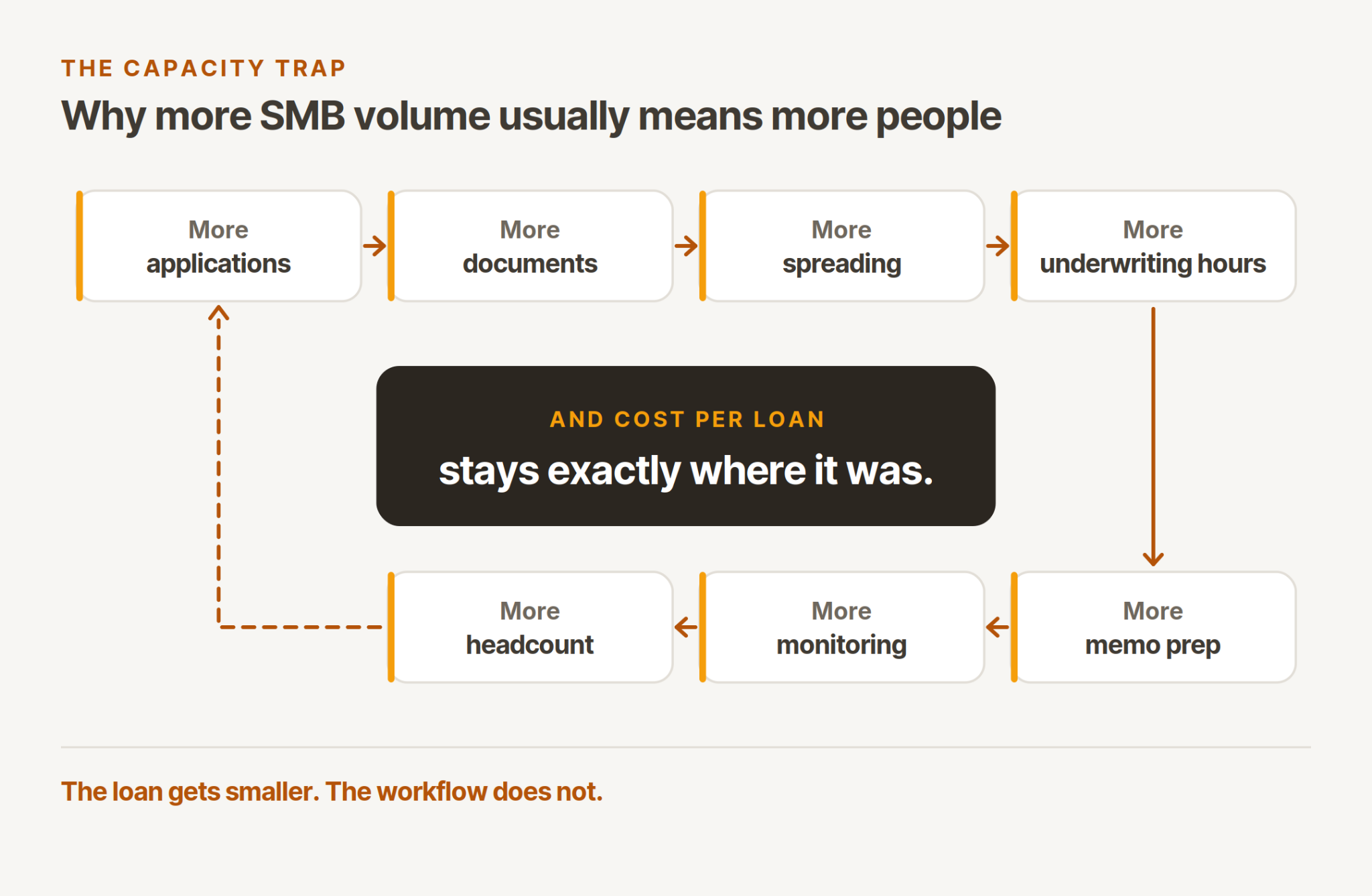
That loop creates a ceiling. And the ceiling is often self-imposed. Plenty of lenders throttle SMB growth deliberately. Not because demand is missing, but because they already know what another fifty applications a month would do to turnaround times and error rates.
A lender in that position doesn't have a demand problem. It has a capacity economics problem. And the two call for completely different responses.
Putting the Workflow Online Doesn't Fix the Economics
Digitization and automation get treated as the same project. They are not.
A lender can run a fully digital front end, online application, loan origination system, portal-based document upload, digital signatures, automated status notifications, and still carry an entirely manual middle.
The digital layer moves files faster between people. Underneath it, analysts are still opening documents, reading them, keying figures into templates, spreading statements, calculating ratios, drafting memos, and checking files against policy by hand.
The file moves faster between people. The work inside each stop takes exactly as long as it did before.
That's why lenders often report better borrower experience scores after a digital program without seeing the cost per loan move at all.
Digitizing the handoff doesn't eliminate the work inside the handoff.
You may also read: How to Use AI to Automate Loan Underwriting and Origination Workflows
The Answer Isn't Fully Automated Credit. It's Less Human Work Per Loan.
This is the point where the argument usually goes wrong. The tempting conclusion is that AI should approve small business loans, since balances are modest and volume is high. That is a different product with a different risk profile.
The credible version is narrower. AI should reduce the amount of human effort required to move a loan from application to a decision-ready state. The decision itself stays where it is.
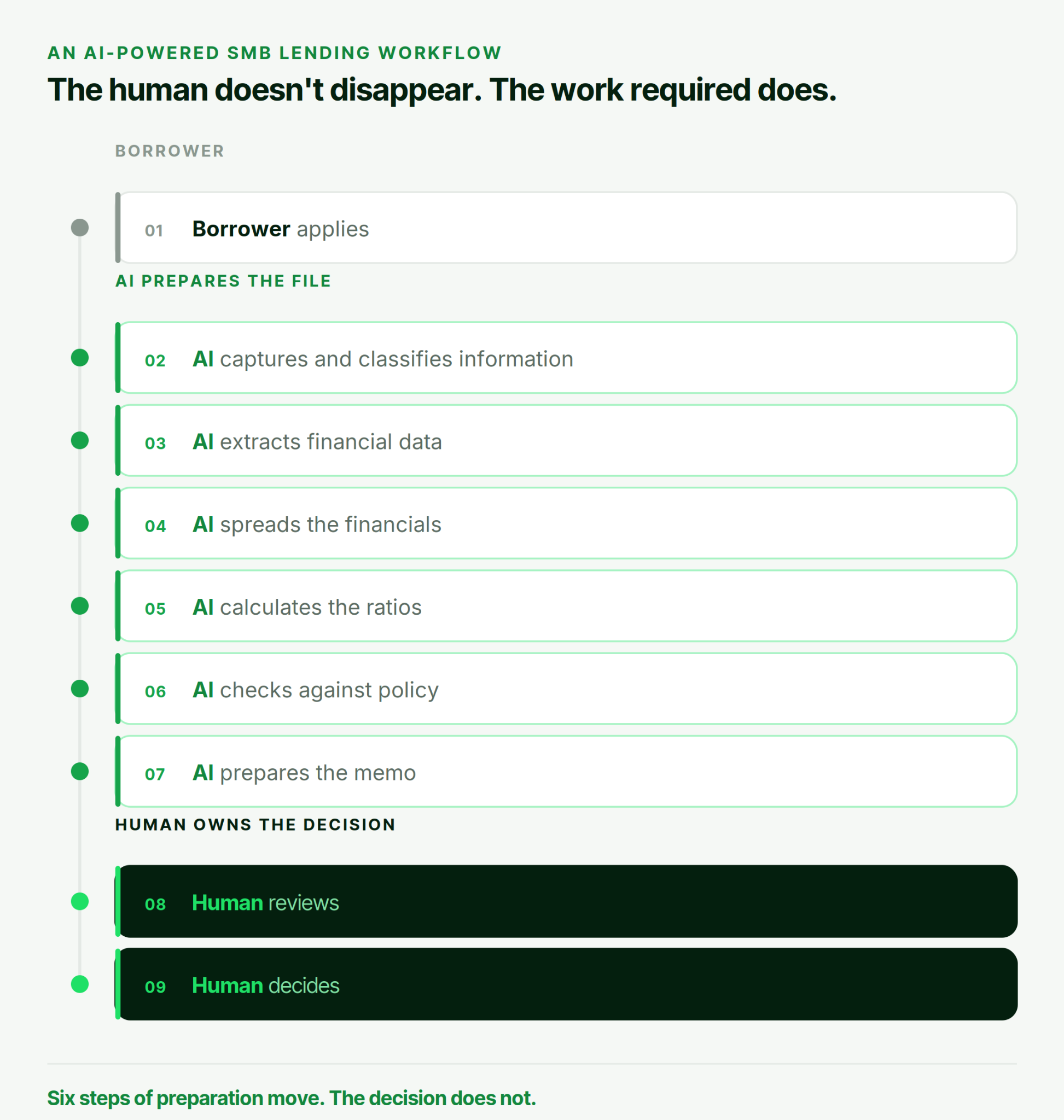
The human does not disappear. The volume of work required from the human does. And that is the variable the unit economics actually turn on.
Automate the Work That Scales With Loan Volume
The useful test for any stage is simple: Does the effort consumed rise in step with application volume? If it does, it's a candidate.
Six stages meet that test in most SMB shops.
01. Intake
Handles application information, entity documents, ownership details, financial document collection, and identification of missing pieces. Economic impact: more applications enter the pipeline without a matching rise in intake workload; the chase for missing items starts immediately.
02. Document processing
Handles classification, data extraction, validation, source traceability, and flagging absent or unreadable documents. Economic impact: analyst hours spent reading and re-keying come down; figures arrive already tied to their source page.
03. Financial spreading
Handles historical and current financials, standardized categories, ratio calculations, multi-year comparison. This is the single most repetitive stage in SMB credit prep. Economic impact: removes the largest block of repeatable analyst time in the file.
04. Underwriting preparation
Handles financial analysis, risk indicators, policy checks, exception identification, assembly of the underwriting picture. Economic impact: underwriters spend time evaluating risk rather than assembling the evidence.
05. Credit memo
Handles structure, financial summaries, key risks, supporting data, policy references, source citations. Economic impact: compresses the gap between finished analysis and approval-ready package.
06. Monitoring
Handles borrower performance, cash flow changes, covenant tracking, risk signals, compliance flags. Economic impact: portfolio cost stops rising in a straight line with portfolio size.
You may also read: AI Agents for Commercial Lending Workflows: A Practical Guide
The Goal isn't to Make One Loan Cheaper. It's to Make the Team More Productive.
Time savings are the wrong unit of measure. Nobody funds a technology program to make analysts faster at typing.
The question that matters to a chief lending officer is what the same credit organization can carry. Can the same team process more applications? Work more underwriting files? Hold more SMB relationships? Complete more portfolio reviews?
When the answer is yes, the lender can grow without adding operational headcount at the same rate. That is the shift from cost per loan to capacity per team. And it is the one that changes strategy, not just a line item.
Across Uptiq deployments in small business lending, institutions report processing twice the applications with the same team, 41% faster underwriting cycles, and a 29% reduction in operational costs. These are outcomes from production deployments, and they vary with scope, data readiness, and how much of the workflow is connected.
Automation is not valuable because it makes analysts faster. It is valuable because the same credit organization can support more lending volume.
The Economics Improve When Humans Spend Time on Judgment
None of this works if the credit team loses ownership of credit. The model depends on a clean line, drawn before deployment, not after, between what the system prepares and what a person decides.
Spreads, ratios, and memo drafts are reviewed by a credit officer who can override any figure. The prior value, the new value, and the reason are retained. Supervisory expectations for model risk management (Federal Reserve and OCC guidance SR 11-7) apply the same way here as anywhere else.
The goal isn't fewer credit professionals. It's fewer credit professionals doing clerical work.
When the Workflow Gets Cheaper, the SMB Strategy Changes
Change the cost and capacity equation, and a set of decisions that were previously closed start to open up.
- Serving smaller borrowers: Requests that never justified the operational effort become viable. The addressable book extends downward rather than only upward.
- Increasing application volume: The lender stops throttling demand to protect a credit team already at capacity.
- Improving turnaround: Speed becomes a competitive position. The Federal Reserve Banks' Small Business Credit Survey found applicant satisfaction declining even as approval rates held steady. Time to decision is a recurring theme underneath that.
- Growing without proportional headcount: Portfolio growth stops requiring a matching percentage increase in credit operations.
- Deepening relationships: Relationship managers spend less time chasing paperwork and more time in front of business owners. Which is the part of the job that actually compounds.
SMB Lending Only Scales When the Workflow Scales With It
The traditional equation reads: more SMB loans equals more people.
The version worth building toward reads: more SMB loans equals more work handled by the same operating infrastructure.
In practice, that infrastructure looks less like one system and more like a set of specialized roles. One agent handles intake. Another handles documents. Another handles spreading. Another prepares the underwriting. Another watches the portfolio after close. Humans coordinate the judgment and own the decisions.
That is a different claim from the one usually made about AI in lending. And a more defensible one. It does not require believing that a model can underwrite. It only requires believing that a large share of the work surrounding underwriting is repeatable.
Anyone who has staffed an SMB credit shop already knows that it is.
The goal isn't to automate lending. The goal is to change the cost structure of lending.
If You're Evaluating AI for SMB Lending, Start With the Workflow
Most evaluations start with the model and end up in the wrong conversation. Six questions keep it on the economics.
- Can it automate the work, or only digitize it?
Does the system perform the task, or does it move information between screens faster than a person would?
- Can agents work across the lifecycle?
Intake → documents → spreading → underwriting → memo → monitoring. If each step needs a separate integration and a person at every boundary, the re-keying comes back.
- Does it preserve human control?
The credit team should retain decision authority, with explicit escalation points rather than implied ones.
- Is the output auditable?
Every figure, policy check, and recommendation should trace back to a source, so review is verification rather than reconstruction.
- Does it work with the existing stack?
The LOS, core, and CRM should not have to be replaced. A program that requires that rarely survives its own business case.
- Can you start with one workflow?
A lender should be able to begin with intake, spreading, or whichever stage carries the most drag, and expand from there.
Ask them in that order. The first two determine whether the economics move at all. The next two determine whether risk will sign it off. The last two determine whether it can be deployed this year.
Uptiq Changes the Amount of Human Work Inside Every SMB Loan
Uptiq is an AI operating layer for lending. Rather than a single system that claims to decide credit, it connects specialized agents across the SMB credit workflow so the output of one becomes the structured input to the next.
Intake Agent → captures and organizes the application ↓ Document AI → turns unstructured documents into usable data ↓ Underwriting Agent → analyzes the borrower and prepares credit work ↓ Credit Memo Agent → turns analysis into an approval-ready package ↓ Monitoring Agent → continues workflow after origination
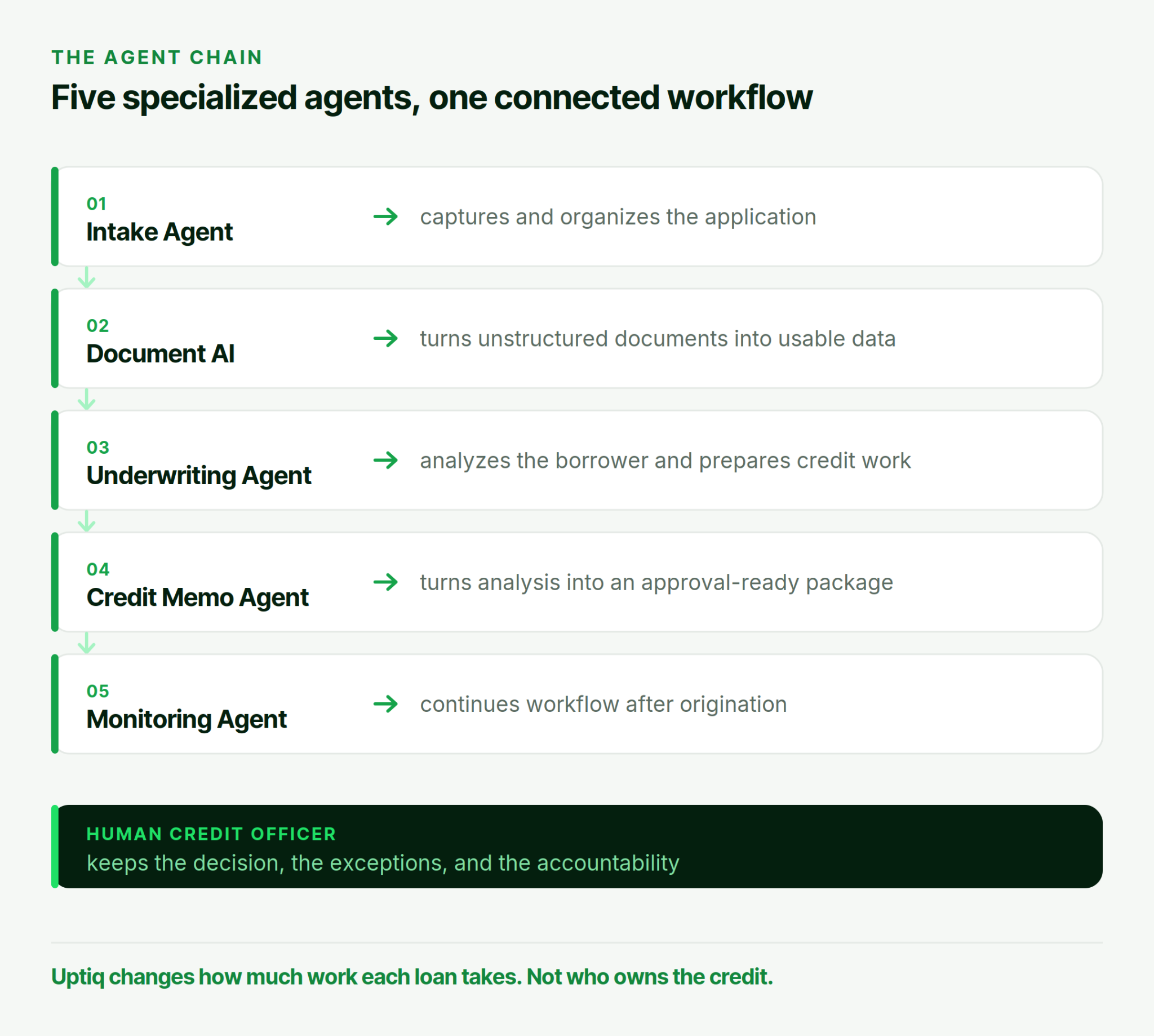
The agents run alongside the existing core, LOS, CRM, and document systems rather than replacing them. The point is not that Uptiq replaces the credit team. It changes how much work the credit team has to do for every loan.
Which is the only version of this story that is actually about economics.
The SMB Lending Problem Was Never Just Loan Size
SMB lending does not become economically difficult because the loans are small. It becomes difficult when the cost of processing a small loan stays too close to the cost of processing a much larger one.
The traditional responses to that are all constraints dressed as strategy: Process fewer loans. Specialize into a narrow niche. Raise the minimum. Add people and accept the margin.
Each one works. Each one caps the business.
SMB lending automation introduces a different option: reduce the amount of human work required per loan without touching the credit standard or the credit decision.
When the workflow gets cheaper, a lender can serve more borrowers without building a proportionally larger organization.
The future of profitable SMB lending is probably not bigger loans. It's lower human effort per loan.
Ready to Fix Your SMB Lending Unit Economics?
Uptiq Qore deploys specialized AI agents across SMB credit workflows, from intake and document processing through spreading, underwriting preparation, credit memo generation, and continuous monitoring, with human review points where your policy requires them. Start with whichever stage carries the most drag.
Frequently Asked Questions
Why is SMB lending hard to make profitable?

What drives the cost of originating a small business loan?
Does digitizing a lending workflow reduce cost per loan?
Can AI underwrite small business loans?
Which parts of SMB lending should be automated first?
What should stay with human credit officers?
About the Author