Credit union member retention rarely fails all at once. Attrition starts months before a closed account, with a smaller paycheck deposit, a quieter debit card, and a car loan financed somewhere else. By the time the share account closes, the decision was made long ago. This piece follows one illustrative member through his last six months at his credit union twice: once as it happened, and once as it could have gone. Along the way, it covers the early warning signs, why most credit unions can't act on them today, how to reach every member without adding staff, and how to keep proactive outreach fair, private, and examiner-ready.
Meet a 12-year member who quietly left
David's share account closed on a Tuesday.
A week later, an exit survey hit his inbox. Nobody at the credit union had seen it coming.
But that is the thing about member departures: they don't come unannounced. They arrive in whispers, a skipped payment, a transfer to another institution, a loan that didn't renew, and sit in the data long enough for someone to notice, if anyone is watching.
David is illustrative, not real. Thirty-four, teaches middle school science. He joined the credit union twelve years ago when it financed his first car. The loan officer took time to explain how his rate worked. He stayed. The kind of steady, mid-balance member who makes up the backbone of any credit union's field of membership. Reliable. Invisible. Until he was gone.
Here is the uncomfortable part: David wasn't pushed out by policy. He was lost to neglect.
His last six months tell the story twice. First as it happened. Then as it could have gone if someone had noticed.
The slow goodbye: six months, as it happened
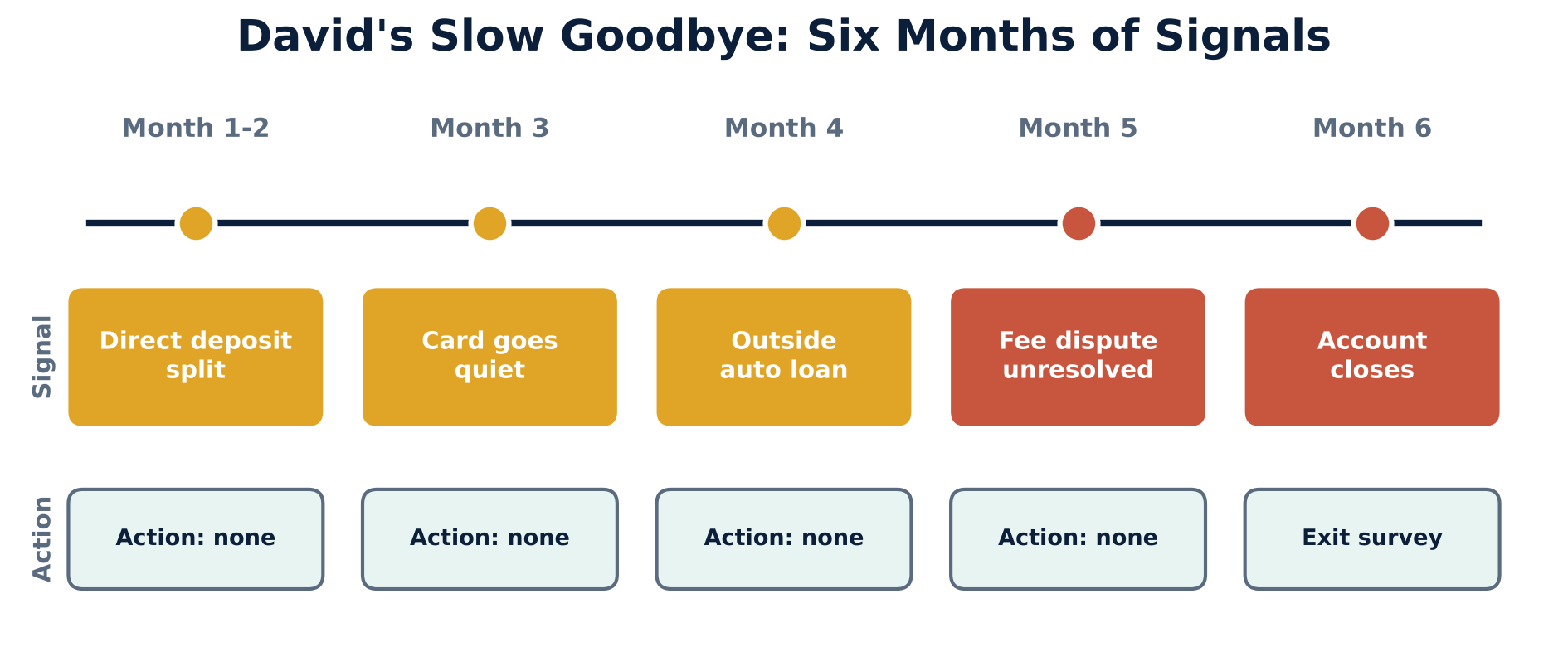
Silent attrition follows a recognizable pattern: the primary relationship shifts first, everyday activity follows, and the account closure comes last. David's story tracks that pattern almost exactly.
Months 1-2: the paycheck splits
David sees an ad for a fintech high-yield savings account paying well above what his share savings earns. He opens one in ten minutes on his phone and redirects part of his paycheck there. His credit union balance still looks healthy, so nothing flags.
This is one of the earliest signs that a primary financial institution relationship is shifting. Direct deposit is the anchor: MX research found that 89% of consumers use direct deposit, and the ability to earn a higher interest rate is the top reason they say would prompt them to switch it, cited by 42%. Among people who have already switched, the most common move was to an account paying more. A partial redirect is often the first step, not the last.
Months 3-4: the card goes quiet
The fintech offers a debit card, then a credit card with rewards. David's credit union debit card swipes drop by half, then by more. A recurring ACH transfer starts moving money out on the first of each month.
Then his car needs replacing. He finances the new one at the dealership, through a lender he has never heard of. Within weeks, a new recurring ACH payment to that lender appears in his transaction history. Three clear attrition signals are now visible: falling card activity, recurring transfers out, and an outside auto loan. The credit union still has not reached out.
David is not unusual. PYMNTS Intelligence data reported by EMARKETER shows 61% of credit union account holders call their credit union their primary financial institution, yet only 48% of credit union cardholders keep its card at the top of their wallet, compared with 69% for national bank cardholders. Primacy on paper doesn't guarantee member engagement in practice.
Months 5-6: the account closes
David's balance drains toward the minimum. Along the way, he was charged an overdraft fee during the switch and disputed it through the contact center. The ticket sat in a queue and was never fully resolved. That was the moment he stopped feeling like a member and started feeling like an account number.
In month six, he closes the account. The exit survey asks why, after the fact.
The signals at a glance
Signals shown are examples of what typically appears in a credit union's own deposit, card, and service data.
Why member attrition at credit unions hits the 95%
Member attrition at credit unions hits mid-balance members hardest because no one is assigned to watch them. This isn't a failure of caring. Credit unions are built on people helping people. It's a failure of visibility and economics.
Most core reports and CRMs are built to show who already left, not who is drifting. A closed-account report arrives on schedule. A report showing that 400 members cut their direct deposit by a third last quarter usually doesn't exist, because building it means stitching together deposit, card, ACH, lending, and service data that live in different places.
The economics make it worse. A proactive, high-touch interaction (reviewing a member's activity, deciding what to offer, and reaching out personally) costs about $20 of staff time, according to Uptiq estimates. At that price, concierge retention gets rationed to the top 5% of deposit holders. David, with a mid-size balance, a car loan, and a teacher's paycheck, was never on anyone's list. Neither are most members.
That matters because churn is a measurable gap between institutions. In a 2025 PYMNTS Intelligence and Velera study, credit unions that invested most in innovation reported member churn of 1.7%, against 3.3% for those that invested least. The full economic case for reaching the whole membership is laid out in Relationship Banking at Scale: Reaching the Whole Book Beyond the Top 5%.
What MSRs face today
Member service representatives want to help members like David. But spotting drift today means manual detective work: pulling transaction histories, scrolling through months of activity, and guessing which pattern matters. That is work there is no time for between branch traffic, phone calls, and the next member at the window. So it doesn't happen, and the exit survey becomes the first conversation about why.
You may also read: Credit Union Trends 2027: 10 Trends Backed by 11 Industry Reports
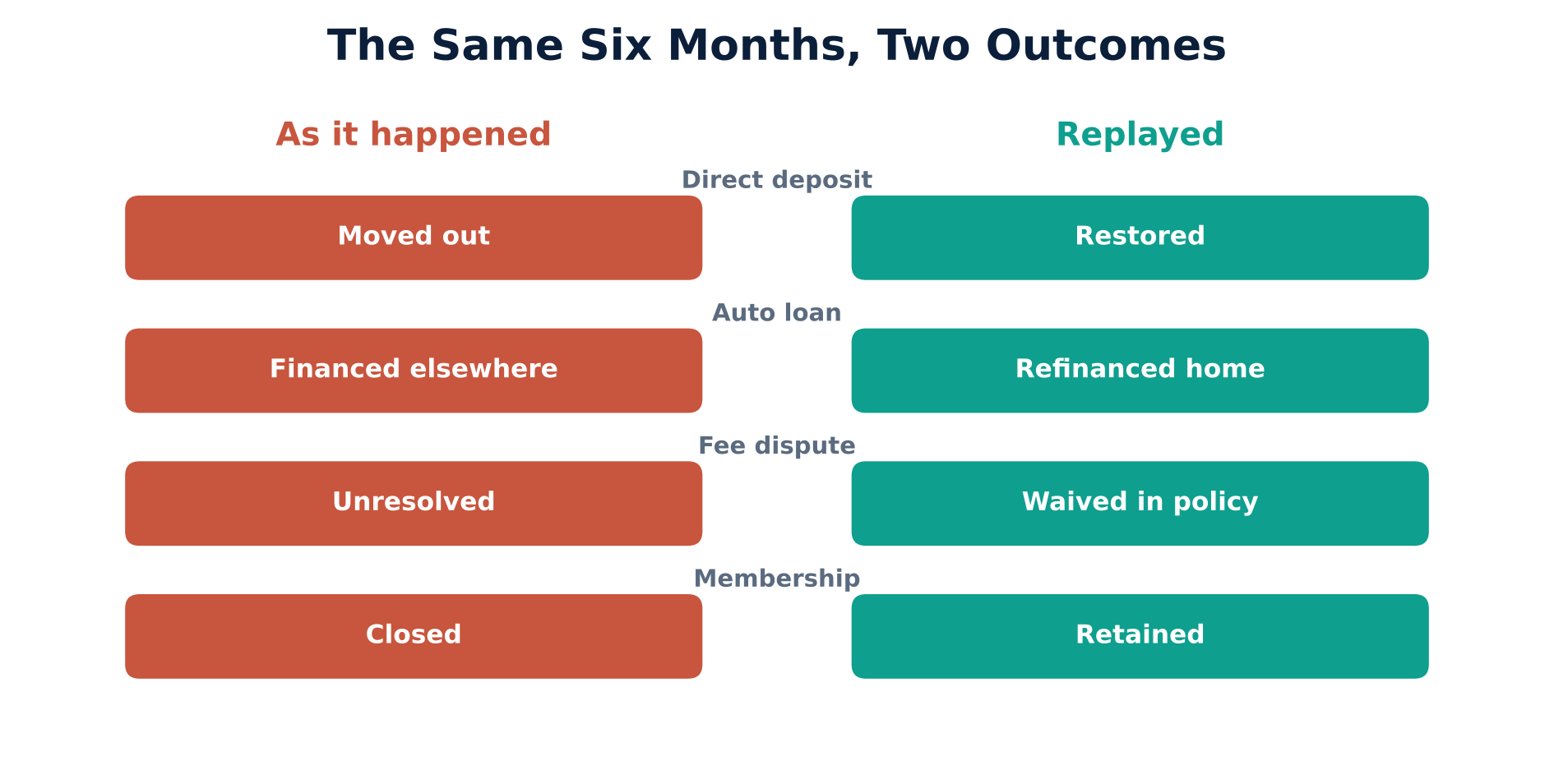
The same six months, replayed
Proactive member service changes the story by turning each signal into a timely, helpful touchpoint, delivered where the member already is. For David, that is his phone. Here are the same six months, with someone paying attention.
Months 1-2: The split is noticed
When David's direct deposit drops by a steady amount two pay periods in a row, the change is flagged. The next time he opens the credit union's mobile app, he sees a short savings comparison: what $10,000 would earn over 12 months in the credit union's share certificate, next to a typical variable-rate high-yield account, with a note that variable rates can change. It doesn't say "we noticed you moved money." It offers to help him compare, with a button to talk to someone at his branch.
David taps it. An MSR follows up with a short personal note. He moves part of his savings into a certificate. He keeps the fintech account for now, but the conversation has started.
Months 3-4: The right offer at the right time
When his debit card activity falls, he gets an in-app card-care check: whether his card is working well for him, with a reminder of the credit union's own card features. When a new recurring payment to an outside auto lender appears, a competitive refinance offer is prepared, priced from the credit union's own rate sheets and refinance policy. This one goes through a person. An MSR reviews it, confirms it is within her approval limit, and sends it with a personal note.
His fee dispute is also handled proactively. Instead of waiting in a queue, the open ticket is surfaced with the relevant policy, and the fee is waived within the credit union's guidelines. He gets a message saying so before he has to ask twice.
Months 5-6: David stays
David refinances his auto loan back with the credit union at a better rate than the dealer gave him. He moves his full direct deposit home, because the certificate and the refinance make his credit union the place his money works hardest. His relationship is deeper than it was six months earlier.
Not every member will stay. Some will keep the fintech account, and some will leave anyway. The difference is that the credit union gets the conversation, not the exit survey.
[IMAGE: member-attrition-credit-union-replayed.png | Alt: Member attrition credit union comparison of six months as it happened versus replayed with proactive outreach]
Doing this for every member, not just the top 5%
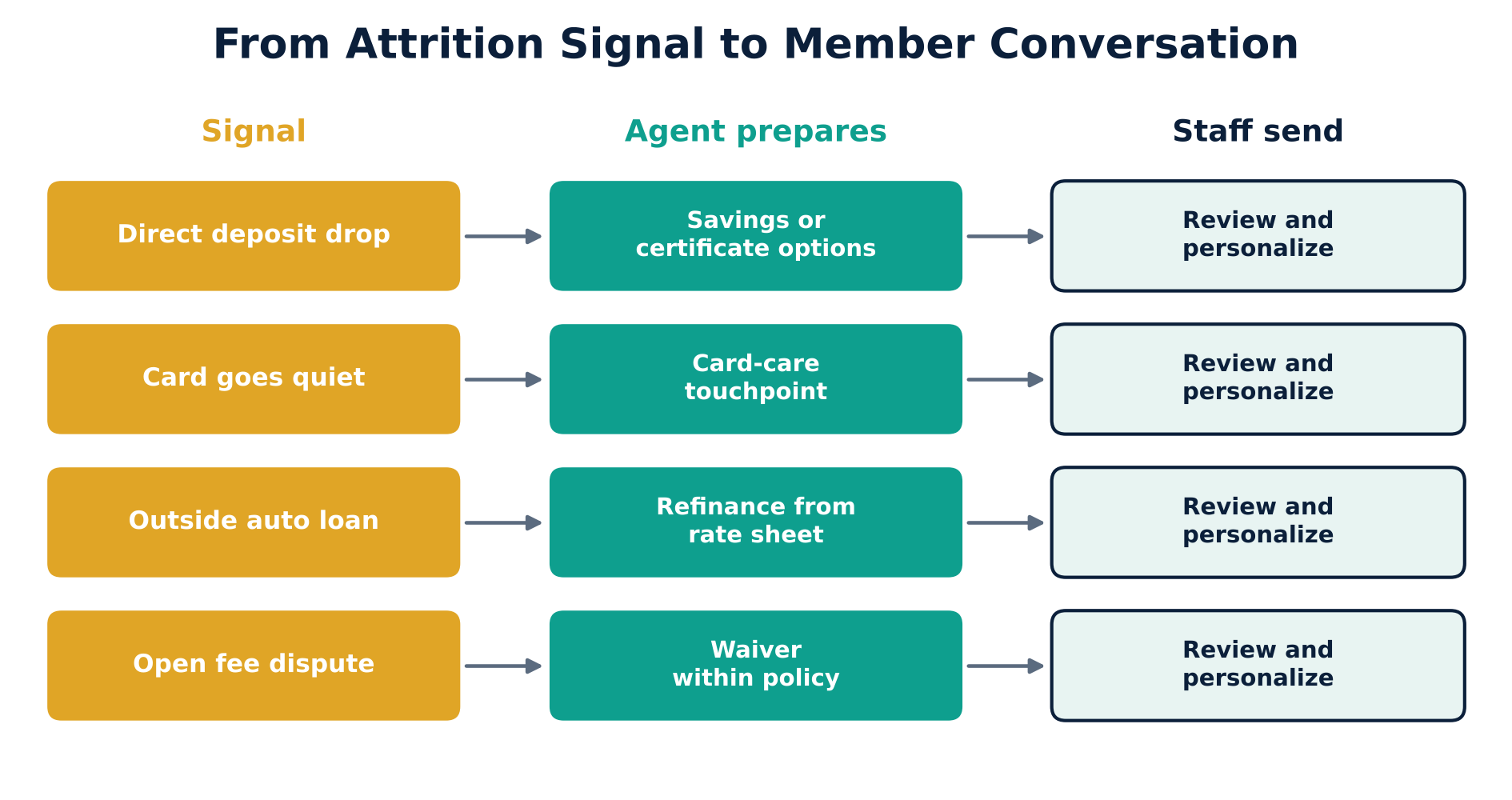
AI account management makes proactive care possible for every member by doing the detective work automatically and leaving the conversation to people. AI agents monitor 100% of the membership for attrition signals, connect them to the member's full relationship, and prepare a personalized touchpoint for staff to review, or an in-app message within limits the credit union sets.
That changes the cost of each proactive action to about 1/100th of the manual version, according to Uptiq estimates. At that cost, proactive member service stops being a privilege of the top 5% and becomes the default, with the team you already have. MSRs review and personalize instead of investigating from scratch. Learn more about AI account management.
It also doesn't ask you to rip anything out. Uptiq works as a new software tier over your existing core, reading from and writing to platforms such as Jack Henry Symitar and Fiserv, plus the CRM and digital banking tools you already run. There is no core migration. Start with retention monitoring over your current stack, then expand or consolidate point tools as contracts renew. Plug in or replace, your call. The same tier can also unify lending, as described in Credit Union Loan Origination: One System for Every Loan Type.
How to measure retention success
Credit union member retention improves only when you measure it below the headline attrition number. Track these six metrics:
- Attrition rate by segment: by age band, tenure, balance tier, and branch, so mid-balance and younger members aren't hidden in an average.
- Primary direct deposit retention: the share of members whose full direct deposit stays home, quarter over quarter.
- Recaptured outside loans: auto and personal loans refinanced back from outside lenders.
- Intervention response rate: how often members reply to or act on proactive outreach.
- Member satisfaction: satisfaction or NPS among members who received outreach, compared with those who didn't.
- Retained balances: deposits and loan balances kept or recovered after an intervention.
You may also read: Relationship Banking at Scale: Reaching the Whole Book Beyond the Top 5%
Trust built in: fair, compliant, examiner-ready outreach
Proactive outreach only builds member loyalty if it is fair, accurate, and respectful of member privacy. Every offer has to be something the credit union can stand behind in front of a member and an NCUA examiner. Uptiq is designed around three tests:
- Grounded. Offers and rate matches are based only on the credit union's official rate sheets, disclosures, and policies, never on guesses, and every output traces back to its source.
- Provable. Every outreach runs through a defined chain of agents, skills, and handoffs and leaves a timestamped receipt with source citations, ready for NCUA examiner review.
- Governed. Pre-execution checks are designed to block non-compliant or inconsistent offers before they reach the member. Authority grids keep rate matches and fee waivers within each staff member's approval limits, and the credit union decides which touchpoints always need a person.
For more on how these controls work, see AI governance in lending.
Privacy and fairness guardrails
- Member privacy. Use member data in line with the Gramm-Leach-Bliley Act and your credit union's privacy notice. Retention outreach based on a member's own accounts should stay within what that notice describes.
- Credit data. In David's story, the outside auto loan shows up as a recurring payment in his own transaction history. If outside-loan detection instead relies on credit bureau prescreen or trigger data, the Fair Credit Reporting Act and Regulation V apply, including firm-offer rules.
- Fair lending. Apply rate matches and pricing exceptions consistently across similarly situated members, in line with Regulation B.
- Outreach channels. Respect consent rules for calls and texts under the Telephone Consumer Protection Act, and follow CAN-SPAM rules for email.
- Tone. Frame outreach as helpful, never as surveillance. "We have a certificate special you might like" builds trust. "We noticed you moved money" erodes it.
These guardrails are designed to support your compliance program, not replace it.
The conversations that kept David
Go back to David. The difference between losing him and keeping him wasn't a new product or a bigger marketing budget. It was a few timely, human conversations: a note about a certificate, a refinance offer, a fee waived without a fight. The signals were there all along. Someone just needed the time to see them.
That time is the real gain: capacity creation for member service. When agents handle the detective work, MSRs spend their days on conversations, not on scrolling through transaction histories. Attrition becomes something you catch early instead of reading about in an exit survey. Explore AI agents for credit unions to see what that looks like in practice.
Ready to see which members are drifting?
Uptiq is the Bank-Grade AI platform for credit unions, with AI solutions for account management and origination. Its account management solution runs as a new tier over your existing core, CRM, and digital banking, with 100+ integrations, and a single agent is typically live in about five business days.
Start with a member retention assessment. We will look at the attrition signals already sitting in your data, show where members like David are drifting, and map the proactive touchpoints that would reach them first.
Frequently Asked Questions
What causes member attrition at credit unions?

What are the early warning signs that a member is leaving?
How can credit unions predict member churn?
Why do members move their direct deposit to fintechs?
How can credit unions win back members' auto loans?
Can credit unions do proactive outreach for every member without more staff?
Is it compliant for credit unions to use transaction data for retention?
How should credit unions measure member retention?
About the Author