Most lists of AI use cases for credit unions are organized by technology: machine learning here, document processing there. That is not how AI in credit unions actually gets used. Work happens in teams, and each team has its own queue, its own rules and its own decisions that should stay with people. This blog to AI for credit unions takes a department tour instead. For each of five teams, from lending to compliance, it covers where the work piles up, what an agent can take off the plate, what stays human, and which controls apply. It closes with a practical answer to the question most COOs ask first: which team should we start with?
One credit union, five teams, one day
The work that slows a credit union down piles up in the same five places every week. Picture a Monday morning at an illustrative $1.5 billion credit union.
In lending, a dozen applications are waiting on documents: a missing pay stub here, last year's business return there. In account opening, new account requests sit in a queue while a staff member re-enters an ID that did not scan cleanly. The contact center lights up at 9 a.m. with balance questions, card replacements and a member who wants to know why a fee posted. In collections, a past-due report prints, and someone starts working it by hand. Down the hall, the compliance officer is pulling files for an NCUA exam that starts in three weeks.
None of this is unusual, and very little of it is a member conversation. Most of it is gathering, checking and re-keying. That is where AI agents fit: not in place of the people who serve members, but under them, doing the preparation so staff can do the part that matters.
The sections below take each team in turn: what an agent takes off the plate, what stays human and the controls that apply.
Lending: Intake, validation and spreading
Lending is usually the heaviest team for credit union automation, because so much of its day is document work rather than credit judgment.
Where the work piles up. Consumer lending staff chase pay stubs, W-2s, tax returns and bank statements, then re-key figures into the LOS. Member business lending is heavier still: business returns such as 1120-S filings and K-1s, interim financial statements, rent rolls and manual spreading in spreadsheets. It is also the part of lending most credit union AI content leaves out.
What the agent does: The Intake Agent collects documents, classifies them, validates each one against what the file requires and flags what is missing, so a loan officer sees a complete file instead of a pile. The Underwriting Agent spreads financials and prepares the analysis. Uptiq customers have seen 36% less financial spreading time and 41% faster underwriting cycle time, and on member business loans, 63% less credit memo prep time.
What stays human: The loan officer and the credit committee decide. Exceptions and policy overrides are documented with the reason, by a person.
Controls: The credit union's own credit policy and rate sheets are the source of truth. Adverse action notices must still give specific principal reasons under Regulation B, so the reasons an agent's analysis surfaces have to be traceable to the file. Member business loans also sit under NCUA Part 723, including its commercial lending policy and oversight expectations.
For the full member journey from application to funding, see our article on the credit union loan origination system.
Account opening: Faster, cleaner new accounts
Account opening is where small errors turn into big problems later, because a missing document or mismatched ID often surfaces only after the account is open.
Where the work piles up: Identity checks that need a second look, business entity documents, beneficial ownership certifications, the right disclosure package for each product, and fixes after the fact when something was missed.
What the agent does: The Account Opening Agent gathers and validates identity and entity documents, runs completeness checks before the account is opened and assembles the right disclosures for the product the member chose.
What stays human: Staff review flagged identity or ownership issues, decide on anything outside policy and handle the member conversation when something does not match.
Controls: BSA customer identification program (CIP) requirements apply to every new member account. For business accounts, the FinCEN customer due diligence rule requires identifying and verifying beneficial owners; under FinCEN's February 2026 exceptive relief, that happens at the member's first account and is then updated when risk-based procedures call for it, rather than at every new account. Deposit disclosures follow Truth in Savings, NCUA Part 707.
You may also read: Credit Union Trends 2027
Member service: Routine requests handled, complex ones routed
Member service is where "people helping people" is most visible, which is exactly why automation here needs the most care.
- Where the work piles up - Balance and payment questions, card replacements, fee questions, address changes, and calls where staff spend the first minutes finding context across three screens before they can help.
- What the agent does - An agent handles routine requests within policy, such as a card replacement or a payment date question, and routes complex or sensitive ones to staff with the member's context already gathered: recent transactions, open requests and prior contacts. The member service representative starts the call already knowing why the member is calling. That handoff matters more than it sounds. The first two minutes of a call spent searching screens are two minutes the member spends waiting. When context arrives with the call, the conversation starts where the member is, and the representative has time for the question behind the question.
- What stays human - Hardship conversations, complaints, financial guidance and anything where the member asks for a person. The path to a person should always be one step away.
- Controls - Answers are grounded in the credit union's own products, rates and disclosures, never the public web. Automated messages get the same UDAAP review as any other member communication. Disputes on debit and electronic transactions follow the error resolution rules in Regulation E, so an agent that receives a dispute must log it and start that clock, not just answer it.
Member service automation should be judged on resolution, not deflection. A system that keeps members away from people may look efficient on a dashboard and still erode the trust that makes a credit union different.
Collections and portfolio: Early warning instead of late surprises
Collections and portfolio teams do their best work early, and most of the manual effort today happens late.
- Where the work piles up: Past-due lists reviewed by hand, member business loan financial statements collected months late, covenant checks tracked in spreadsheets, and members contacted only once they are already behind.
- What the agent does: The Continuous Monitoring Agent watches the portfolio for early-warning signals, tracks financial statement collection and covenants on member business loans, and prepares outreach for staff to review before anything is sent.
- What stays human: Hardship plans, loan modifications and every collections decision. An early signal is a reason for a conversation, not an automated action.
- Controls: Members in similar situations should be treated consistently, and every contact should respect communication frequency and consent rules, including the TCPA for calls and texts. Regulation F generally applies to third-party debt collectors rather than credit unions collecting their own loans, but many credit unions use it as a best-practice benchmark for contact frequency and messaging.
The same early signals matter for retention, not only repayment. Our post on member attrition at credit unions covers that side.
Compliance and risk: One evidence trail across every team
Compliance is usually treated as the team that slows AI down. In practice, it is one of the teams that benefits most.
- Where the work piles up: Pulling evidence from five systems before an exam, sampling files by hand and reconstructing months later why a decision was made, often from the memory of someone who has since changed roles.
- How agents help compliance: Every action an agent takes, in every department, carries an evidence receipt: the rule invoked, the source and its version, the model and its version, the actor and the timestamp. Examiners can replay it on demand. Instead of rebuilding a file from five systems, the compliance officer starts from one trail.
The same trail changes how testing works between exams. Rather than sampling a handful of files by hand each quarter, compliance can review every agent action against the rule it invoked, spot patterns early and fix a policy gap before an examiner finds it. Compliance stops being only the gatekeeper and becomes a team with better evidence than it has ever had.
This is what bank-grade means in practice: grounded, governed and provable. Grounded in the credit union's own policies, loaded into the Knowledge Hub. Governed by pre-execution checks in the Validation Hub, designed to block actions outside policy before they run. Provable through the evidence trail.
Controls. Model risk management and third-party risk management both apply. NCUA's artificial intelligence resource page states that credit unions using AI provided by a third-party vendor must conduct appropriate due diligence, and points to its existing letters on evaluating third-party relationships. On data, the platform runs inside the credit union's own environment: external calls are blocked by default, PII is masked before any external model sees it, and there is no retention and no training on member data.
You may also read: Banking AI Governance: Why Most Pilots Die and How to Ship Them
What stays human
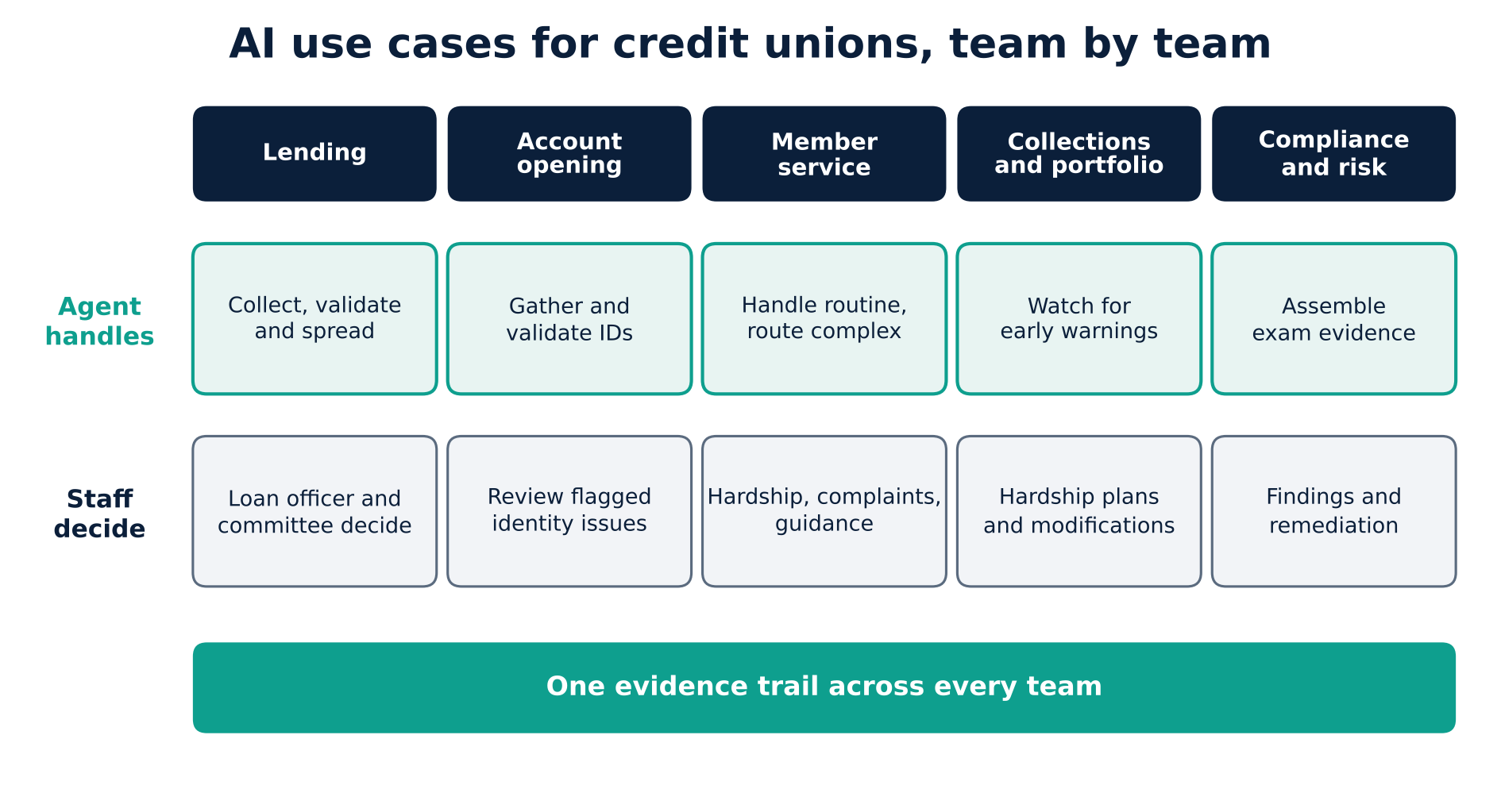
In every team, agents prepare, check and route; people decide where the credit union sets the gate. The table below makes that concrete.
This is capacity creation for member service. The hours an agent returns go to members and community: more time for the hardship conversation, the business owner who needs advice and the first-time borrower who needs patience. It extends your teams. It does not replace them.
Where to start with AI use cases for credit unions
Start with your heaviest team: the one with the most repetitive, document-heavy work and a clear owner. For many credit unions, that is lending intake, and often member business lending, where files are long and spreading is manual.
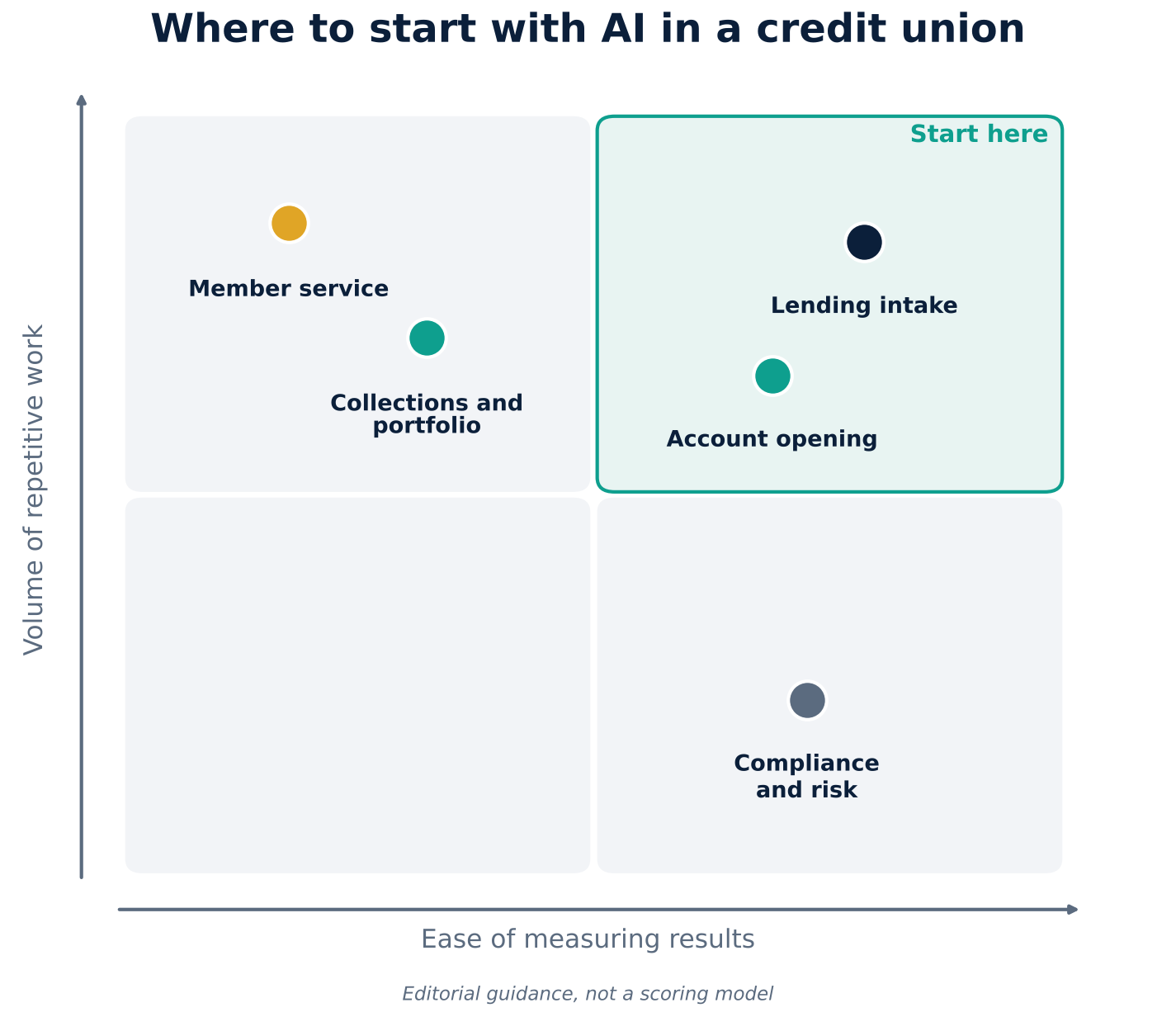
Baseline it first. Measure hours per file, rework rates and time to decision for lending, or time to open for new accounts. Without a baseline, there is no result to show the board.
A sensible first 30 days looks like this:
- Week 1: pick the workflow, name one owner, record the baseline and bring compliance in on day one.
- Week 2: run the agent on live files with every output reviewed by staff.
- Weeks 3 and 4: narrow review to exceptions as results hold up, then add the next agent on the same foundation.
Credit union AI adoption works best when it moves quickly but carefully. One agent can be live in about five business days, with the full suite in about 30 days, as a new tier over your existing core and LOS, not a new core. Whether you run Jack Henry Symitar, Fiserv DNA, Corelation KeyStone or another core, the agent connects to what you have. Plug it into your current LOS or replace the LOS; your call. Smaller credit unions can also start through a CUSO or shared arrangement that spreads the setup across several institutions.
Conclusion: Start with your heaviest team
Go back to that Monday morning. The same five teams arrive, but the gathering and checking are already done. Loan files are complete or clearly flagged. New accounts are validated. Routine member requests are handled, and the complex ones are waiting with context. Early-warning cases are ready for review. The compliance officer starts from one evidence trail instead of five systems.
That is what AI for credit unions looks like when it is done well: agents under every team, people making every decision. Uptiq is the bank-grade AI platform for financial services, grounded, governed and provable, built to work over the systems you already run and trusted by 150+ financial institutions.
See AI working across your credit union's teams
Book a demo to see the Intake Agent and Underwriting Agent on a member business loan file, and how the evidence trail looks to your compliance team.
Frequently Asked Questions
What are the best AI use cases for credit unions?

Which credit union department should adopt AI first?
Can AI help with member business lending?
Will AI replace credit union staff?
How do credit unions keep AI compliant with NCUA expectations?
Do credit unions need a new core to use AI agents?
Can small credit unions afford AI?
About the Author