A credit union loan origination system should know your members the way your people do. Too often it doesn't. A member who has banked with you for a decade applies for an auto loan in one portal, a business loan through another process, and a business account in a third tool, and gets asked for the same documents each time. This piece follows one illustrative member through that journey twice: once as most credit unions run it today, and once through a single, unified flow. Then it covers what fragmentation costs, how a unified system works with your existing core, and how it holds up to an NCUA exam.
The multi-LOS dilemma
Credit unions are built on knowing their members, yet their lending systems often don't recognize the same member from one product to the next. That gap sits at the center of credit union lending today.
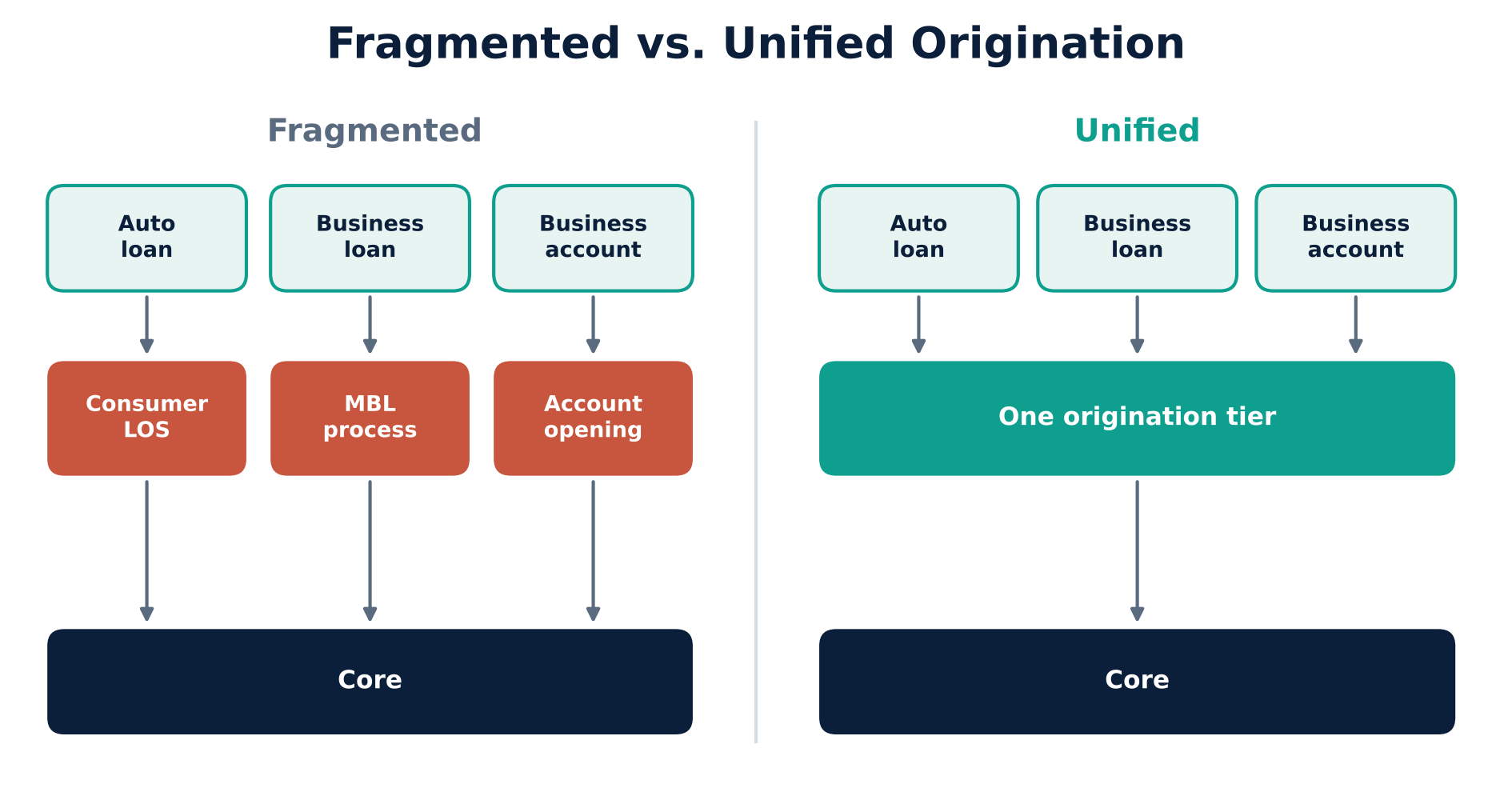
The typical setup grew one need at a time. A consumer LOS handles auto and personal loans. Member business lending runs through a separate process, sometimes a commercial platform, sometimes email and spreadsheets. A digital account opening tool handles new shares and business accounts. Each has its own portal, its own document requests, and often its own team.
None of those decisions were bad in isolation. Together, they mean the member experiences three institutions instead of one. The argument here is simple: one member deserves one origination experience, and the credit union deserves one system to deliver it.
One member's journey today
Today, a member who borrows across products often repeats the same steps in different systems. To make that concrete, meet Maria. She is an illustrative member, not a real one: a 12-year member who owns a bakery in town.
Step 1: The auto loan
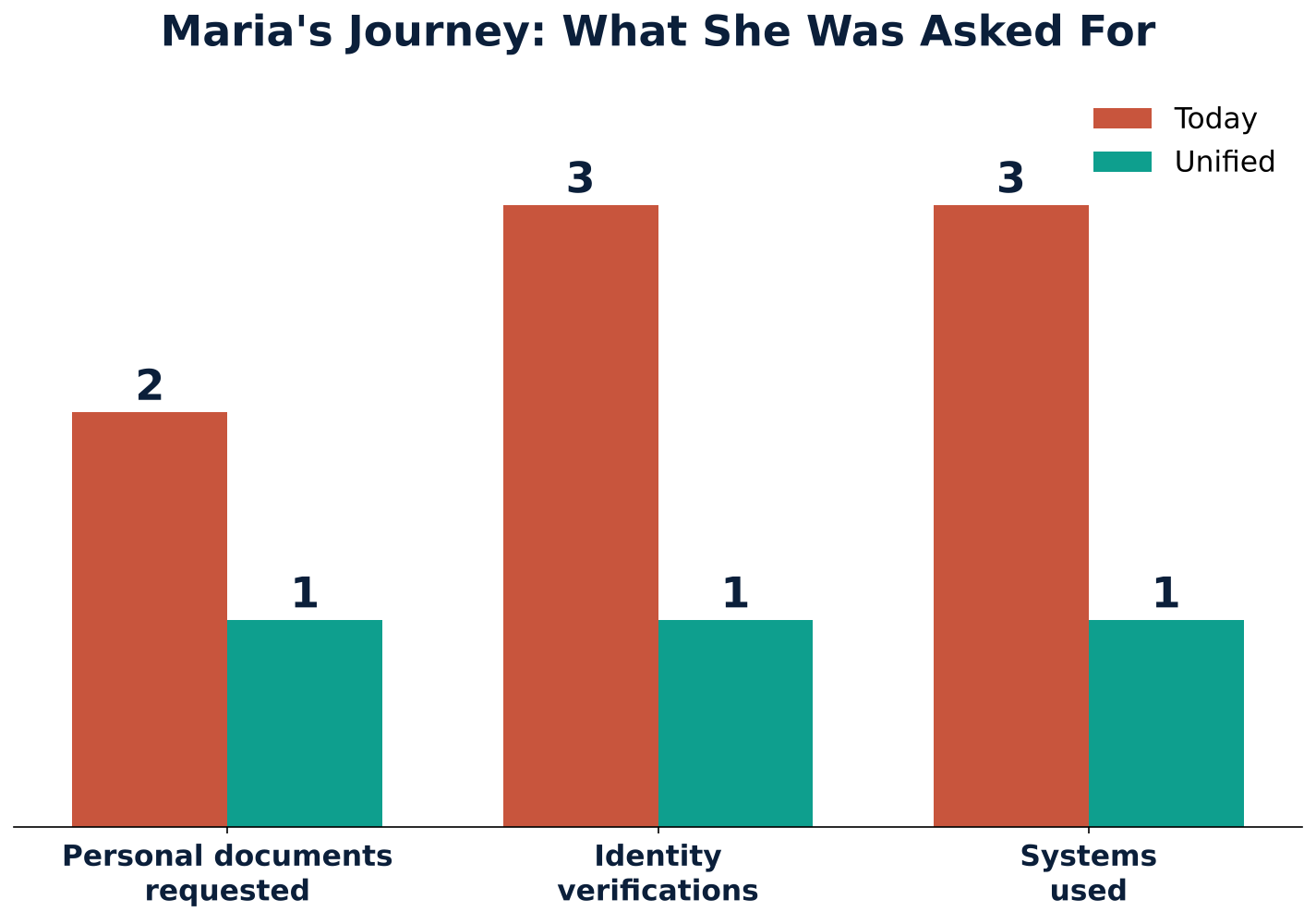
Maria needs a new family car, so she applies for an auto loan through the consumer portal. She uploads pay stubs, her driver's license, and last year's tax return. The loan is approved, but only after a few days of back-and-forth: a stub was cut off, and the tax return needed a second page.
Step 2: The member business loan
Six months later, the bakery needs a new oven. That is a member business loan, and it lives somewhere else. Maria talks to a different team, fills out a different application, and emails her documents. She resubmits her personal tax returns, then adds business returns, a year-to-date profit and loss statement, and a balance sheet. An underwriter keys the financials into a spreadsheet to spread them by hand.
Step 3: The business deposit account
To close the loan, Maria needs a business operating account. That means a third tool. She verifies her identity again, uploads her articles of organization and operating agreement, and answers beneficial ownership questions she has partly answered twice already.
The journey at a glance
What fragmentation costs
Fragmented origination costs members time and trust, and costs the credit union staff hours, software spend, and growth. Both sides add up.
The cost to members
For members, fragmentation means slower approvals, repeated document requests, and experiences that feel different depending on which door they walk through. The quiet cost is a feeling: "my credit union doesn't know me." That feeling undercuts the member experience a credit union is supposed to be built on.
Some members simply stop. Drop-off rises sharply once an application runs past 5 to 11 minutes , and every separate system adds its own questions to the clock. For member business lending, the alternative is often a bank or online lender that asks once.
The cost to the credit union
Inside the credit union, staff re-key data between systems, chase the same documents twice, and work separate exception queues. Each tool brings its own contract, integrations, and upgrade cycle. Disconnected member views also block cross-product insight: the consumer team rarely sees that a borrower owns a growing business, and the MBL team rarely sees the full personal relationship.
The software math matters too. Uptiq estimates that consolidating point origination systems reduces blended origination software spend by about 25%. Our post on loan origination system consolidation walks through the full model.
The MBL bottleneck
MBL origination is often the slowest lane. Business tax returns are complex, financial spreading is manual, entity verification takes several documents, and the team is usually small. That is where automation helps most: institutions using Uptiq have reported 41% faster underwriting, 36% less financial spreading time, and 63% less credit memo prep time.
You may also read: Credit Union Trends 2027: 10 Trends Backed by 11 Industry Reports
The same journey, unified
In a unified system, Maria applies once per need, provides each document once, and verifies her identity once. Here is the same journey replayed through a single unified loan origination flow.
Single intake, documents extracted once
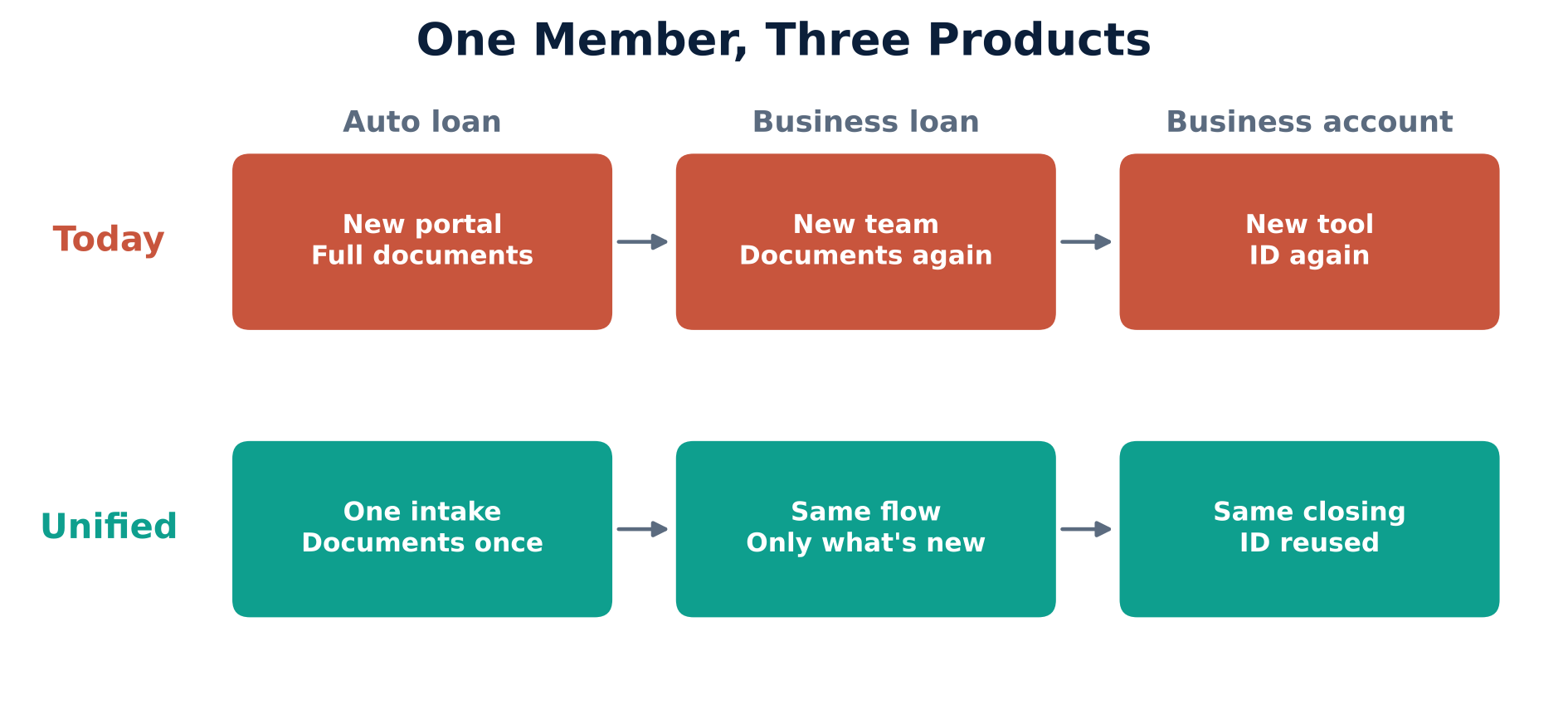
When Maria applies for the auto loan, a short guided intake asks only what the credit union doesn't already know. Her pay stubs, license, and tax return are classified, extracted, and validated once, the vehicle valuation is pulled automatically, and the data is saved to her member profile. When she applies for the business loan six months later, her personal information is already there. She adds only what's new: business returns and current financials.
Document AI covers the documents credit union lending runs on: pay stubs, W-2s, 1040s, business returns such as the 1120-S, bank statements, and entity agreements.
The same flow covers the rest of the member's borrowing and saving: personal and business lines of credit, credit cards, and share savings and checking accounts. Each product follows its own credit policy, but the member never starts from zero.
Consumer and business credit without resubmission
Personal and business credit are evaluated in one flow. The bakery's financials are spread automatically through automated financial statement spreading, and global cash flow includes Maria's personal position because the system already has it. The underwriter reviews and decides instead of re-keying.
One closing experience
The member business loan and the business operating account go into one closing package. Maria's identity was verified at the start, so the account opening reuses that verification and adds only the entity and beneficial ownership details. She signs once. The account is funded, and the loan is boarded together.
The journey at a glance, revisited
You may also read: AI Loan Origination for Credit Unions: A Stage-by-Stage Guide to Faster, Fairer Member Lending
Beyond origination: knowing the whole member
Once Maria is one member record instead of three, the credit union can do something a fragmented stack never could: keep paying attention after the loan closes.
Six months on, the bakery's deposits are growing and its card spend is rising. The system notices, prepares a short summary, and suggests a conversation about a line increase or a second location. A member service representative reviews it and reaches out before Maria starts shopping elsewhere. The same signals can flag the opposite pattern, such as balances drifting to another institution, while there is still time to help.
That is where origination and account management meet. The member is known at the start of the relationship and stays known as it grows. For the account management side of the story, see relationship banking at scale.
Why this matters more for credit unions
Unified origination matters more for credit unions because the member relationship spans personal and business life. Many member business borrowers are long-time personal members, like Maria. A unified view lets the credit union serve the whole member instead of three separate accounts.
It is also mission alignment, not just efficiency. People helping people includes helping the bakery, the auto shop, and the family farm that anchor a community. When a member business loan closes in days instead of weeks, a local business opens its new location sooner.
And it is a competitive edge. Banks and online lenders can match speed. Few can match a relationship that already knows the member's personal history, deposits, and goals. A unified credit union LOS turns that history into a faster, more personal yes.
How a credit union loan origination system works with your existing systems
A unified credit union loan origination system works as a new software tier over your existing core. It reads from and writes to the core your credit union already runs.
Plug in or replace, your call. Many credit unions start by unifying intake and documents over the tools they have, so members see one experience right away. Then they consolidate point systems as contracts renew, product by product, at a pace the team is comfortable with.
Just as important is what it isn't. It is not a core conversion. Your core stays where it is, your member records stay where they are, and the project stays smaller and lower risk than replacing the system your credit union runs on.
Three more things matter to a credit union choosing that tier:
- Speed. A single agent can be live in about five business days and a first product line in weeks. Incumbent LOS implementations typically run 8 to 16 months.
- Your rules, your changes. Your own team can adjust product rules, intake questions, and workflows without waiting on a vendor release or a services engagement.
- No lock-in. Agent specifications, skills, and the credit union's knowledge can be exported; the platform is not tied to one AI model provider, and member data stays in the credit union's own private cloud.
Examiner-ready by design
Multi-product origination means multi-product compliance, and a unified flow is designed to apply each rule consistently across every product. A member who borrows personally, borrows for business, and opens a business account touches several regulations in one relationship:
- NCUA Part 723 for member business loans and commercial lending, including the board-approved commercial loan policy and credit risk rating requirements.
- Regulation B and adverse action notices, plus FCRA for credit reports.
- CIP/KYC and beneficial ownership for business accounts.
- NCUA Part 707 (Truth in Savings) disclosures for share accounts.
Three properties make AI in that flow safe to use:
- Grounded. Decisions and recommendations reason only over the credit union's own credit policy, rate sheets, and charter guidelines, with every output traceable to its source.
- Provable. Every action runs through a defined chain of agents, skills, and handoffs and leaves a timestamped receipt with source citations, ready for NCUA examiner review.
- Governed. Pre-execution checks are designed to block non-compliant offers or out-of-policy approvals before they happen. Authority grids set what needs staff approval, access is role-based, and the platform runs in the credit union's private cloud with external calls blocked by default.
One member, one origination experience
Go back to Maria. In the unified journey, she gave each document once, proved who she was once, and signed once. Her credit union got the loan done faster and opened a business account in the same visit. It took less of her time and less of your staff's time.
That time is the real gain: capacity creation for member service. Loan officers and member service representatives spend it on conversations, financial guidance, and community, not paperwork. A modern credit union loan origination system is not about doing less for members. It is about having more time to do what credit unions do best. Explore AI agents for credit unions to see what that looks like in practice.
Ready to see your member journey, unified?
Uptiq is the Bank-Grade AI platform for credit unions, with AI solutions for account management and origination. Its origination solution brings consumer, member business, and deposit origination into one tier over your existing core, with 100+ integrations and a single agent typically live in about five business days.
Start with a member journey assessment. We will map how one of your members moves through your lending systems today and where a unified flow would save them, and your team, the most time.
Frequently Asked Questions
What is a credit union loan origination system?

Can one system handle consumer loans and member business loans?
Why do credit unions run multiple loan origination systems?
How does a unified LOS improve the member experience?
Do credit unions need to replace their LOS or core to unify origination?
How does unified origination help with member business lending?
About the Author