Uptiq's AI Innovation Workshop reached New York City, and the room had a different center of gravity. In New York we saw participation from non-bank lenders, bankers, private credit firms, fintechs, and partners who came ready to get their hands into the platform. It showed in what they built. Here's a recap of the day, and what attendees told us.
A room that came to build
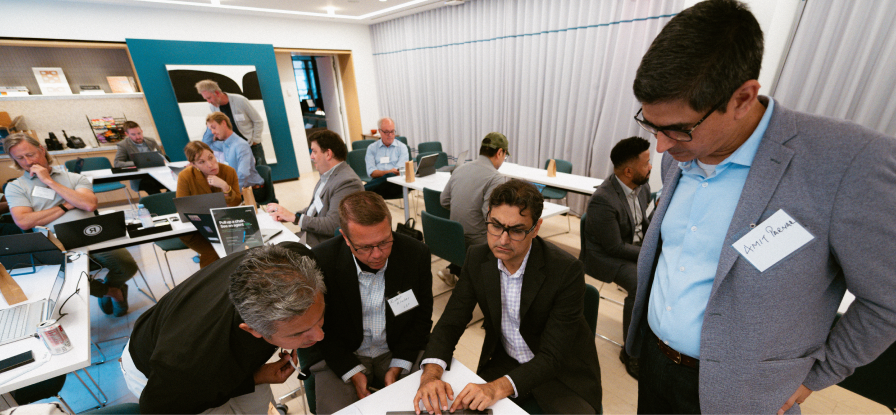
By New York, the format was well established: no keynote, no slide marathon, and a working prototype in every attendee's hands by the end of the afternoon. What changed was the audience. This was a more technical room, and it asked sharper questions, whether it could plug in existing skills, how the platform compared to building on a general-purpose AI tool, what actually sat under the hood. Those are the questions of people who intend to build, not just evaluate, and the day was better for them.
With proper desks and the platform open, attendees spent less time being convinced and more time constructing. Several of the builds went well beyond a single-purpose agent.
The award worthy agents
The builds in New York leaned technical and ranged well past traditional lending and by the end a few stood out enough to take home awards.
A credit decision, application to answer. One builder created the entire path for a secured line of credit, front to back. A merchant enters their details and consents to a soft credit pull; a "unified credit monitor" agent gathers scores across all three bureaus; and a "credit profile analyzer" checks them against a clear bar, a 700-plus score everywhere and no adverse marks and returns a qualification verdict. Intake form, agents, and database, working as one application.
Onboarding that only interrupts you when it matters. Another built a customer onboarding platform that takes an application, runs KYC, and checks the applicant's credit, then goes quiet unless someone clears both a clean KYC and the top ten percent on credit, at which point it emails the owner with the details. Everyone else moves through the dashboard as pending, approved, or declined without anyone lifting a finger.
The clever part wasn't the automation; it was the restraint. The agent's real job was to protect the owner's attention and surface only the applicants worth a personal look.
Watching two thousand jobs so no one has to. One build went deep into IT operations. The agent monitored a fleet of thousands of batch jobs, sorted them by outcome, success, failure, still running, checked connectivity, and rolled everything into an operational health dashboard, with a simulation mode that spins up mock jobs so it can be tested without a live feed.
It was the clearest tell of how technical the room was. Handed an open platform, this attendee didn't automate a lending task at all. They built themselves an operations command center.
The rules were part of the build, not a review after it
A technical room builds fast, which is exactly why the guardrails matter, and in New York they lived inside the builds rather than in a review afterward.
The line-of-credit application never pulled anyone's credit without explicit consent, and it judged qualification against a clear, stated bar rather than a black box. The onboarding platform ran real KYC before anything else moved. Even the quickest builds took as given what a regulated institution takes as given: consent is required, the criteria have to be explainable, and a person stays on the decisions that carry weight.
Why building beats watching
There is a reason we keep handing over the keyboard instead of some slide decks or demo. A demo answers "can it do this?" Building answers "can I do this?", and for the audience New York drew, the second question is the only one that counts.
The attendees who spent the afternoon constructing left with a working prototype and, more usefully, a grounded sense of what it would take to run it for real. That is a very different place to end a conversation than a slide with a roadmap on it.
What attendees told us
"Great event — everyone was present and helpful, and I loved having proper desks to work at." — An attendee from a private credit firm
Where we go from here
New York showed how far the room has widened, from community banks to the fintechs and private credit firms building at the edges of the industry. Wherever an institution sits on that spectrum, the invitation is the same: bring the workflow you'd most like to hand off, and leave having built the first version of it yourself.
Reserve a seat at an upcoming AI Innovation Workshop, or book a discovery call to see what this could look like on your own data.
About the Author