
Your AI agent passed its risk review in March. By June, the rate sheet had changed, compliance had revised a disclosure and the team had shipped a new version. Which of those changes did anyone review? Often, the honest answer is none.
That is the gap in governing AI agents in production. Approval is the first review, not the last; governance has to cover every change after it. Here are four questions every leader should be able to answer.
Why AI agents change more often than the systems around them
A core or loan origination system changes only when IT releases an update; an AI agent can shift with a new document, a new instruction or a revised policy.
An agent here is a named worker, like an Intake Agent, running a job end to end while a person decides where the gate sits. That is what makes governing AI agents in production hard: most early setups keep no record of what changed or who said yes.
You may also read: Artificial Intelligence in Financial Services in 2026
What bank-grade governance means
Bank-grade governance has three parts.
- Grounded: answers come from the institution's own facts in Govern Graph and its documents in Knowledge.
- Governed: when approval is on, changes to agents, apps, flows and knowledge need maker-checker approval before going live (Govern Graph approval is coming).
- Provable: you can show every step later. The four questions test each part.
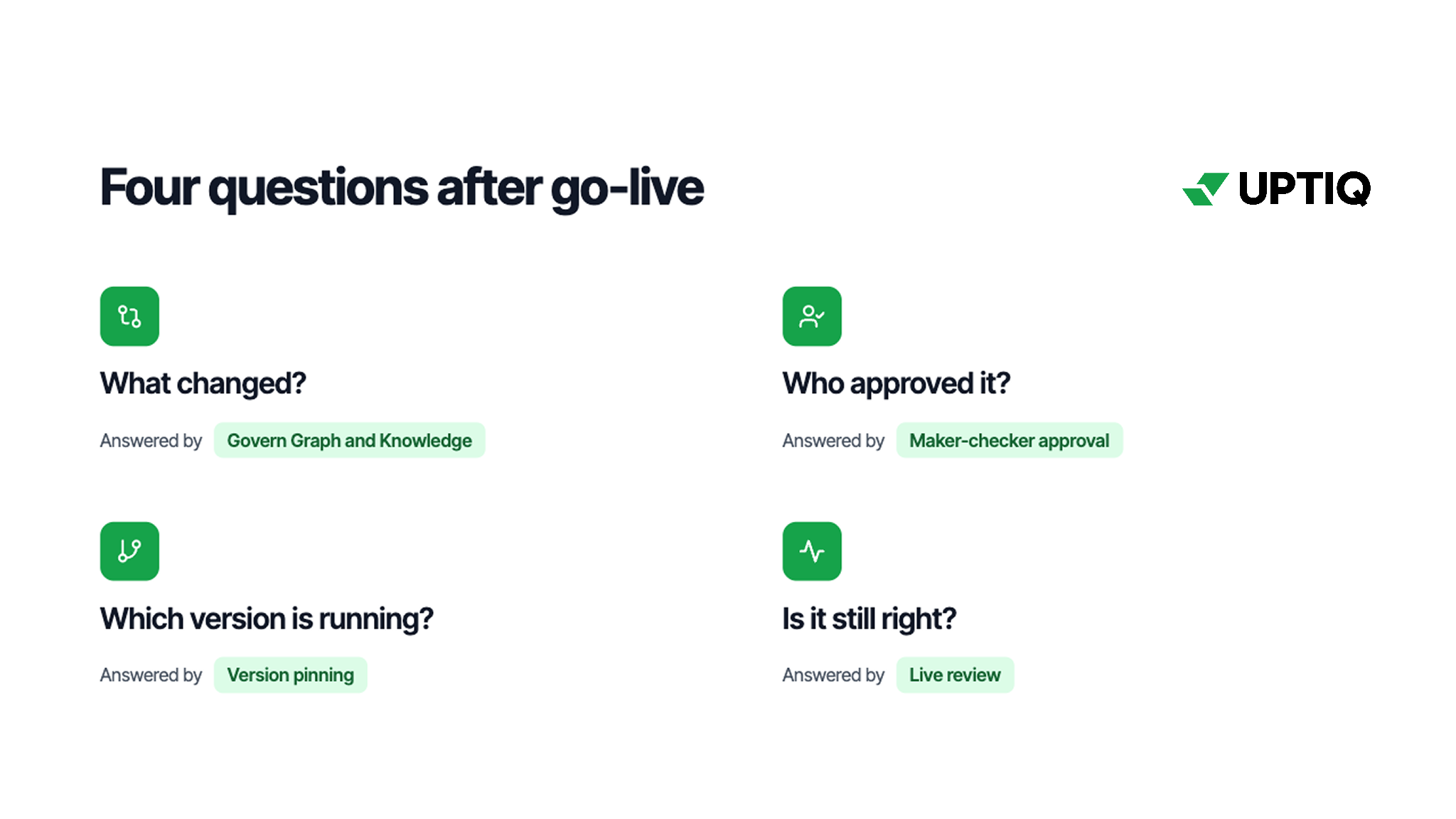
Question 1: What changed, and where did it come from?
Govern Graph holds the institution's products, pricing, policies, disclosures, document requirements, rule thresholds and decision authority as connected facts; Knowledge holds its documents. The team creates a new Govern Graph version by uploading a revised graph or restoring an earlier one. Agents switch only when the new version finishes processing, and a failed update never affects them.
Every fact traces to its source, owner and effective date, and rule bundles load the obligations for the institution's type. Customer-facing agents only read it; changes need a Governance Manager or Admin, or a person's permission for the builder assistant. Govern Graph never stores customer data.
Teams can preview and revert Knowledge versions too. Two limits: sign-off of facts is in preview, and Govern Graph changes go live once processed, with approval coming.
Question 2: Who approved it?
Maker-checker, the control every bank already runs, now applies to AI. Approval can be switched on or off, and the number of approvals set, for each type of change. When it is on, publish requests for agents, apps, knowledge, design systems and flows wait in one queue; Govern Graph approval is coming.
Nobody approves their own change, and one rejection stops it, with a written reason. Each request links to the change and keeps a timeline of every decision. Meanwhile, the live version keeps running.
Question 3: Which version is running?
The version running is the last one approved. The team builds the next one without touching what customers see. A system that asks for version 3 keeps getting version 3 until someone deliberately moves it, and a conversation stays on the version it started on.
Teams can pin agents and workflows used inside a larger agent the same way. That is AI version control a bank can explain: this version, approved by this person, on this date.
Question 4: Is it still right?
Agents get checked twice: before release and every day after. Before release, the team tests each one against known right answers (handwritten, generated from its instructions or imported from procedures) and applies suggested fixes.
After release, independent AI reviewers score live conversations, including the documents retrieved and tools called, against the institution's checklist of requirements. A missed critical requirement fails the answer outright. Failures and uncertain results go to a person who agrees or overrides, and both verdicts are kept.
Four answers, one loop
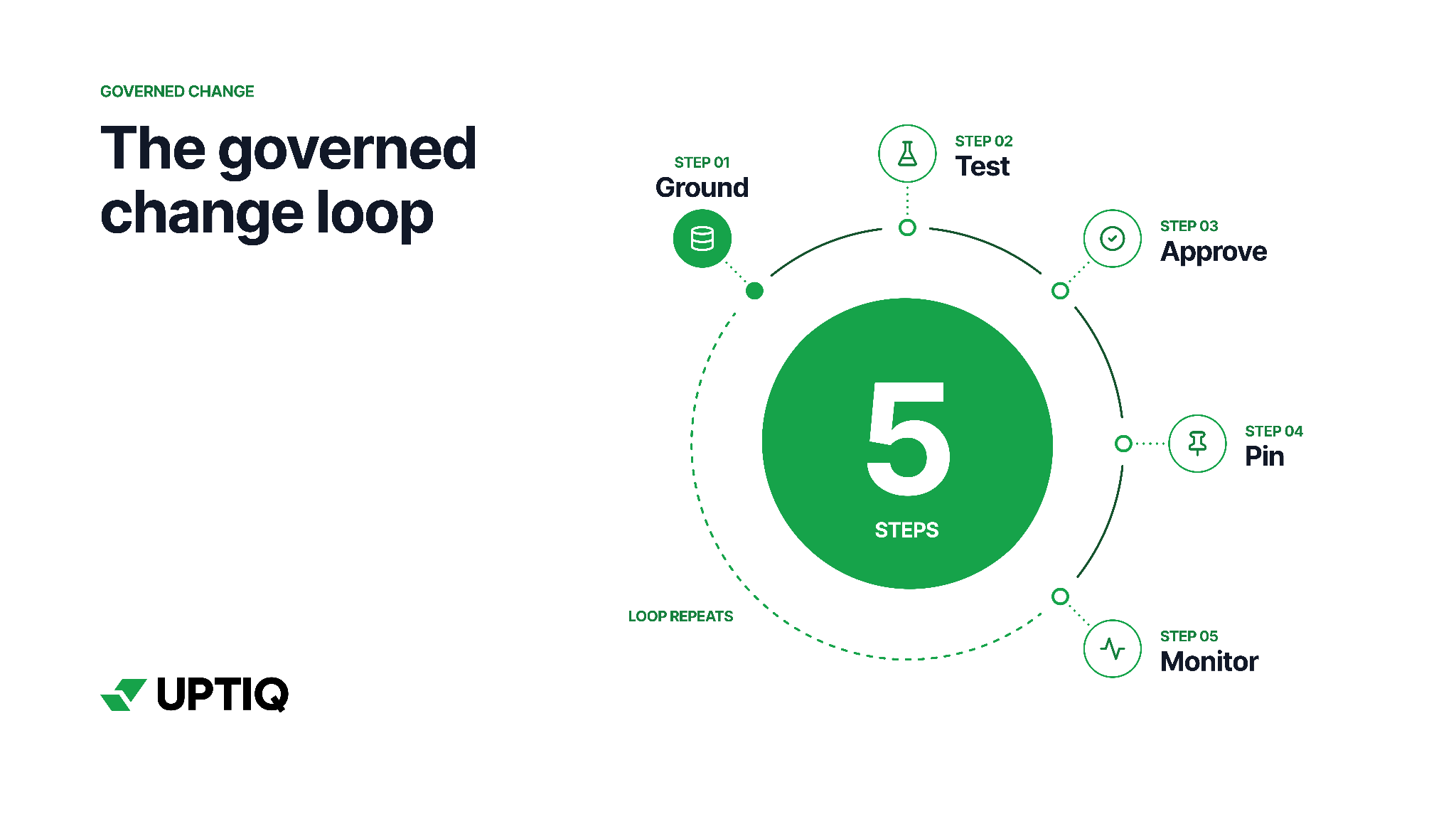
The four answers form one loop: ground, test, approve, pin, monitor, and back to ground when a reviewer finds a gap. The loop keeps an agent grounded, governed and provable.
It also speeds things up. When AI agent oversight lives in the platform, governing AI agents in production stops restarting the review from zero for each change. That is how a single agent, such as one for commercial lending, goes live in a few business days.
Six checks for your team this quarter
- Can you show the last change to an agent's rules, and its source?
- Who approved the current version?
- Which version is every system calling?
- What happens to answers the reviewers are unsure about?
- Can you go back if a change goes wrong?
- Can you stop an agent immediately if you need to?
An emergency stop halts one agent or all of them at once.
Bring one agent and one recent change. We'll show you its change history, its approvals and its live scores. Book a demo →
Frequently Asked Questions
Why does AI governance continue after an agent is approved?

How do banks control changes to an AI agent in production?
What is maker-checker approval for AI agents?
Can a bank go back to an earlier version of an AI agent?
How do you monitor whether an AI agent is still accurate after launch?
Does an AI agent store customer data in its knowledge?
About the Author