
Almost every AI conversation in banking eventually reaches the phrase "bank-grade AI," and almost nobody defines it. It gets used as a badge, a way of signalling that a system is serious enough for a regulated institution, without stating what would actually have to be true for that to hold.
The problem is not theoretical. A bank evaluates an AI system, and the pitch lands on capability. How well does it reason? How accurately does it read a document? Can it work across large volumes of information, use tools, complete multi-step tasks? These are fair questions. They answer a real one: can the AI do the work?
But a bank has to answer a different question, and the two are not the same. Can we safely put that capability to work inside our institution?
That distinction is where most AI deployments in banking fall apart. A bank does not deploy a model. It deploys a system that uses a model, and that system has to operate inside the institution's knowledge, policies, workflows, permissions, and regulatory obligations. Bank-grade AI is not a feature flag on a model. It is a property of the whole thing around the model.
What Does "Bank-Grade" Actually Mean?
Bank-grade AI means three things working together. The institution can understand what the AI is doing. The institution can prove what it did afterwards. The institution controls what it is allowed to do.
Those three standards are worth stating separately because vendors tend to satisfy one and imply the other two.
Explainable
The institution should be able to understand how the AI’s work aligns with its own policies and processes, and where its outputs came from. This is groundedness: the AI works from the institution’s approved policies, products, procedures, regulatory requirements, knowledge, and source documents rather than generating plausible-sounding answers from general information.
Auditable
The institution can reconstruct what happened. What information was used, what the agent did, what it produced, which sources informed it, which policies applied, where a human intervened, and what the outcome was. That record has to survive without the person who made the decision.
Governed
The institution stays in control. It defines what agents can access, which systems they can touch, what actions they may take, what requires approval, which policies constrain behaviour, when an agent must stop, and when work escalates.
These are not novel inventions. The NIST AI Risk Management Framework organizes its core around govern, map, measure, and manage, and names accountability, transparency, and explainability as characteristics of trustworthy AI. What changes in banking is the consequence of failing them.
Capability without boundaries is not bank-grade.
Explainable AI Starts with Grounded AI
Explainability in banking gets misread constantly. The misreading sounds like this: the model explains its reasoning.
That is not explainability. That is an articulate hallucination. A model can produce a fluent explanation for a conclusion it reached on the wrong basis, and that explanation is worth very little to a credit committee.
What an institution needs is groundedness: the AI working from the right context in the first place. In lending, a file might hold tax returns, financial statements, bank statements, entity documents, existing exposure, credit policy, and product requirements. An agent that reports "the borrower appears financially healthy" has told nobody anything useful.
The institution needs to see which financial information supported that conclusion, where each figure came from, which policy was relevant, what calculations ran, whether documents conflicted, and what exceptions were raised.
The practical shape of this is a chain that stays intact: source document → extraction → validation → calculation → policy context → output.
Document AI handles the front of that chain, and the value is not only accurate extraction but the fact that every extracted figure keeps a pointer back to the page it came from. A spread or a ratio that cannot be traced to a source is an opinion, not analysis.
Explainability isn't the AI explaining itself. It's the institution being able to understand the work.
Auditable AI Means You can Prove What Happened
An audit trail is not a log file. The real test of auditable AI is whether the institution could reconstruct the AI's work six months later, in front of someone who was not there and is not inclined to take it on trust.
Take a commercial credit file. What has to survive?
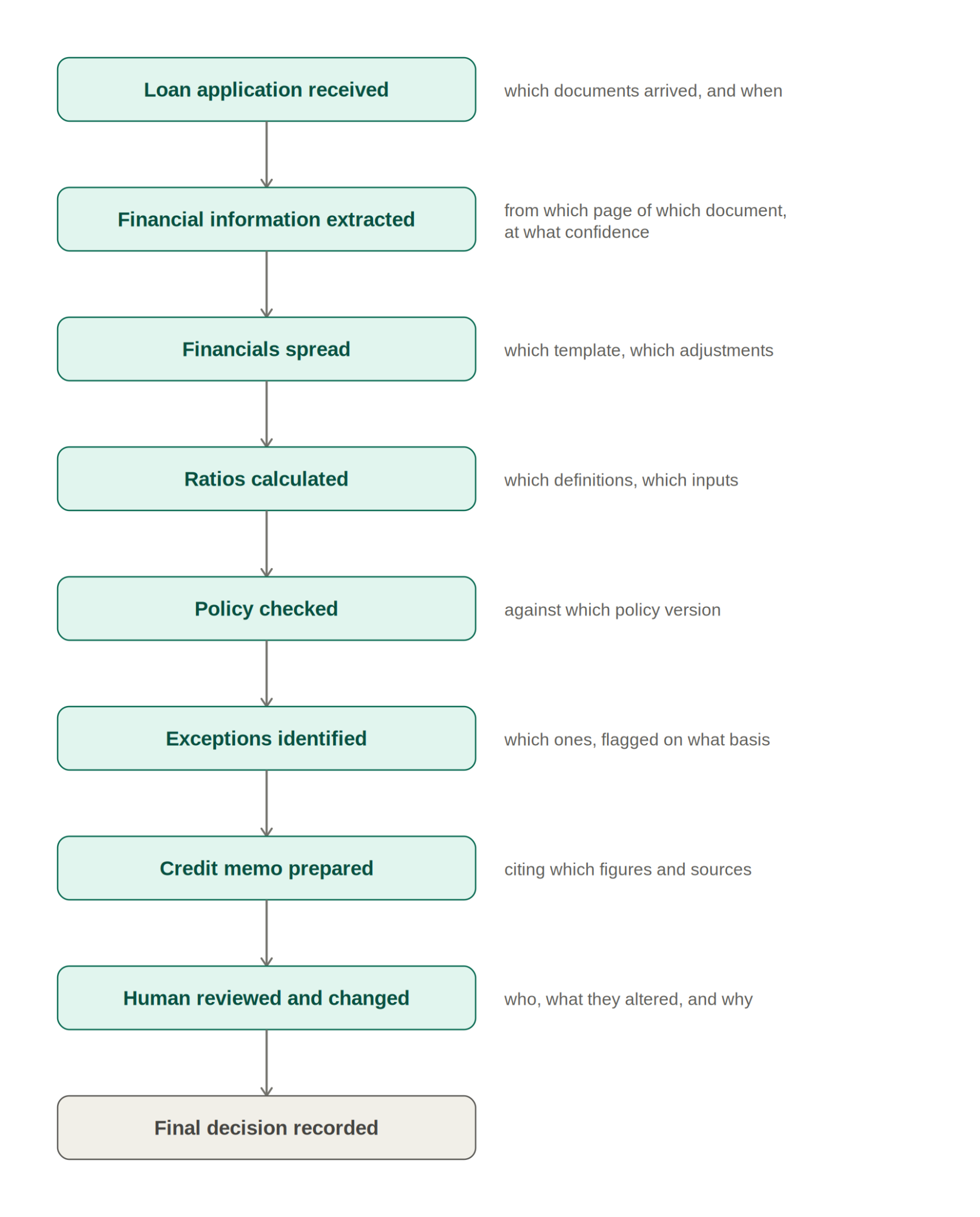
Supervisory expectations already assume this is possible. Model risk management guidance under SR 11-7 rests on an institution being able to explain how an output was produced and to demonstrate the controls around it. Nothing in that expectation is relaxed because the model got better at drafting prose. If anything, a system that produces polished, confident output raises the bar for evidence.
The practical difference between a log and an audit trail is who it is written for. A log is written for engineers debugging a system. An audit trail is written for someone reconstructing a decision they did not make, under time pressure, possibly during an examination. It has to carry the reasoning, not only the events, and it has to survive staff turnover, vendor changes, and model upgrades.
Speed without provability is not efficiency. It is a new operational risk wearing efficiency's clothes.
You may also read: How to Review AI-Generated Financial Spreads
Governed AI Means the Bank Sets the Boundaries
Governance in bank-grade AI has to live inside execution, not only in an annual model review or a quarterly AI committee. A policy that exists in a document but not in the runtime is a policy the agent will cheerfully ignore.
Concretely, the institution should be able to set:
- What the agent can access, and which data it may use
- Which systems it can connect to and write back into
- What actions it can perform, and which of those require human approval
- Which policies constrain its behaviour, and at which thresholds
- What happens when it meets an exception it was not configured for
- When a human takes over, and how the handover is recorded
There is a straightforward test for whether governance is real rather than declared. Ask what the system does when it meets something it was not configured for. A governed agent stops and escalates, and records that it did so. An ungoverned one produces its best guess and passes it downstream, where it arrives looking identical to output the institution actually sanctioned. That is the failure mode worth designing against, because it is silent.
The corollary matters as much as the list. Two banks with the same product will not have the same credit policy, the same approval hierarchy, or the same risk appetite, so agents have to be configurable per institution rather than shipped with one opinion baked in. The workflow should adapt to the bank, not the other way round.
The Human Still Owns the Decision
Bank-grade AI is not an argument for autonomy. AI performs work; people retain judgment and accountability wherever judgment is genuinely required, and commercial lending shows the split cleanly.
AI can collect and classify documents, extract financial information, spread statements, calculate ratios, test policy thresholds, draft the credit memo, and flag exceptions. Every one of those is repeatable and checkable, which is exactly what makes it a candidate for delegation.
The credit officer still weighs relationship context, unusual circumstances, exceptions, deal structure, and risk judgment, and still owns the recommendation and the decision. Automated outputs such as spreads, ratios, and memo drafts remain reviewable and overrideable, which is the point. The credit memo generation step produces a first draft, not a verdict.
Human-in-the-loop isn't a concession to AI's limitations. It's part of what makes the workflow bank-grade.
Frontier Models Still Matter. They Just Aren't the Whole System.
None of this is an argument against frontier models. Model capability is the reason any of this is possible, and the gains in reasoning, language understanding, multimodal interpretation, summarization, planning, and tool use are real and still compounding.
The point is where that capability sits in the stack.
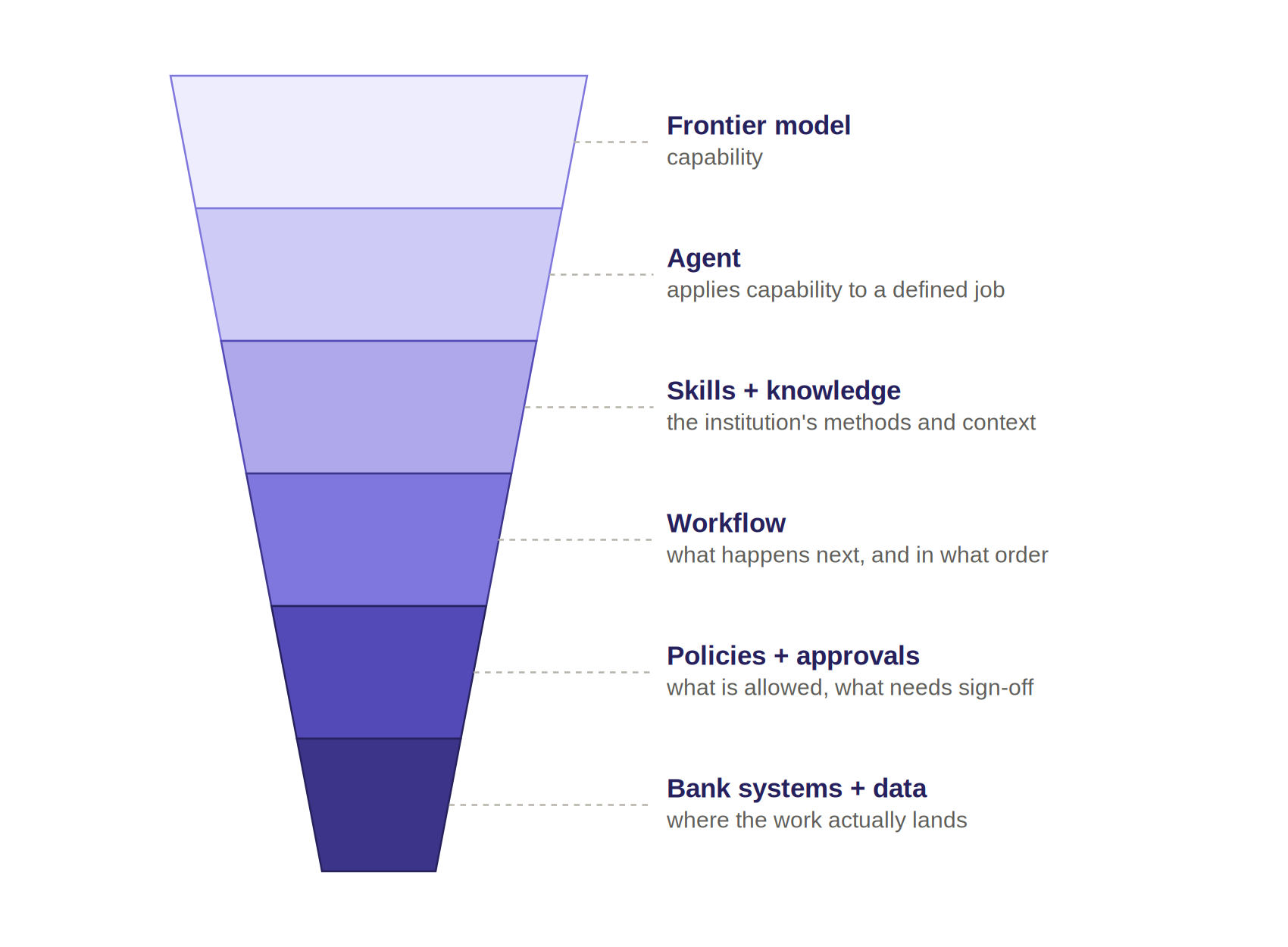
Swap the model at the top, and the institution gets a better engine. Remove the five layers beneath it, and the institution gets a demo.
The model is where intelligence comes from. The surrounding system determines whether a bank can trust it, control it, and operate it.
You may also read: SOC 2 Type II for Commercial Lending AI: The Vendor Questions That Matter
What Bank Buyers Should Ask AI Vendors
The most useful vendor questions are organized by the three standards rather than by feature category, because that is how the answers will be judged later.
Explainable
- What knowledge grounds the agent, and who controls it?
- Can outputs be traced to source information, down to the document and page?
- Can the institution configure its own policies and procedures?
- How does the system handle conflicting or incomplete information?
- Can a user see why the agent produced a given output?
Auditable
- Is every agent action logged, not just the final output?
- Can a workflow be reconstructed after the fact, months later?
- Are source citations retained with the record?
- Can we see where humans intervened and what they changed?
- Can we prove which policy and which information informed an output?
Governed
- What can the agent access, and what can it change?
- Which actions require approval, and can that vary by role?
- Can agents be stopped or escalated mid-workflow?
- Can the institution configure policy constraints itself?
Then the question that separates a good answer from a good demo: can all three exist inside the actual workflow, on our data, rather than in the documentation?
What Bank-Grade AI Looks Like in Practice
The three standards are easiest to judge when they run together across one real workflow. Here is a commercial loan moving through a governed agent chain.
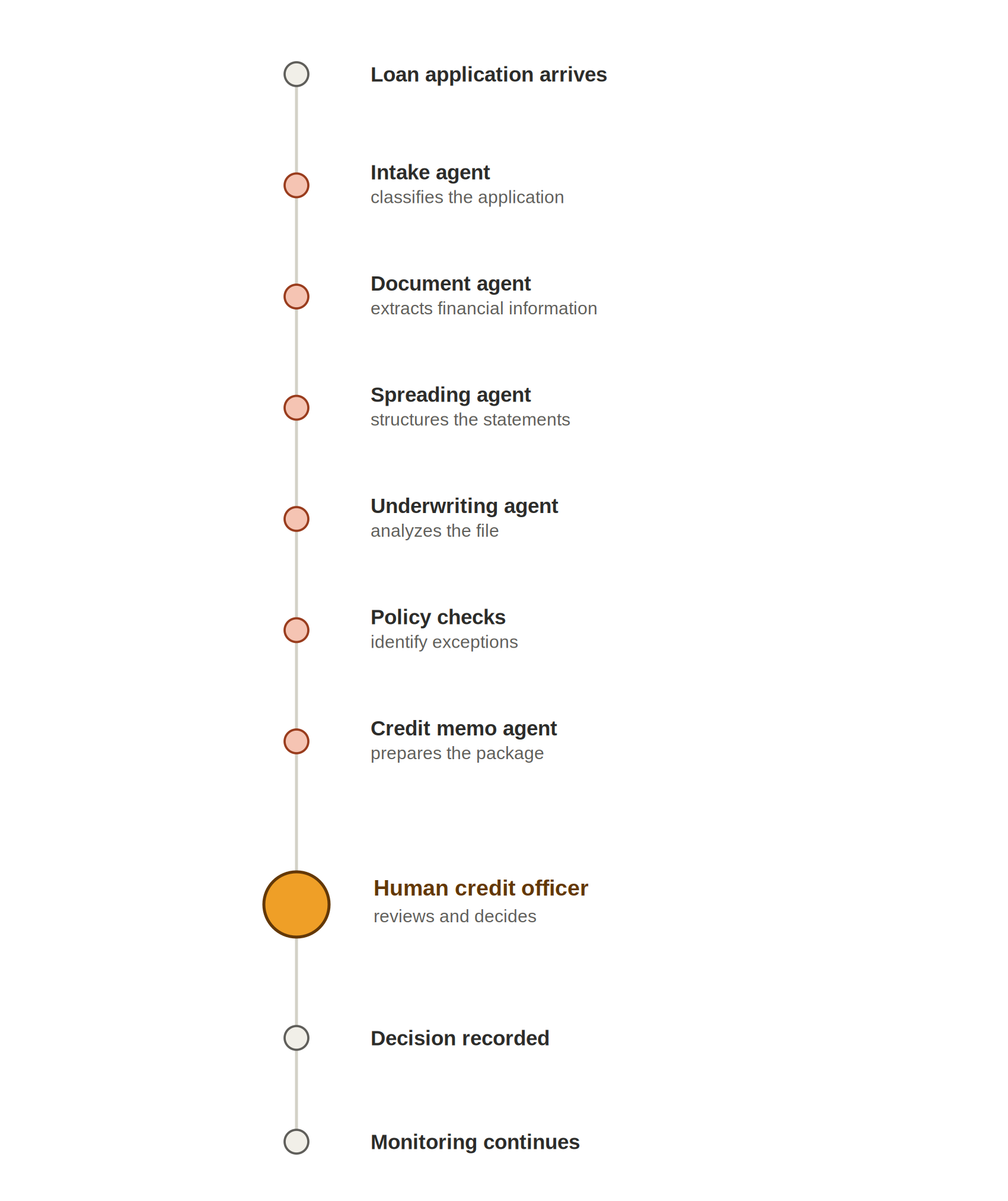
Read the same chain three ways.
- Explainable: every output is grounded in the institution's data, knowledge, and policies, with figures traceable to sources.
- Auditable: actions, sources, outputs, exceptions, and human intervention are all recorded as the work happens.
- Governed: each agent operates inside defined permissions, policy constraints, and approval gates.
Notice that no single agent in that chain is bank-grade on its own. The property belongs to the workflow. The same is true across commercial lending, where the standard has to hold from intake through monitoring rather than at one convenient step.
Bank-grade isn't a property of an individual AI model. It's a property of the workflow surrounding it.
You may also read: AI Agents for Commercial Lending Workflows: A Practical Guide
The Difference Between AI That Can Work and AI a Bank Can Run
Generic capability and bank-grade implementation describe the same underlying model doing very different jobs. The left column is a product demo. The right column is something an institution can put into production.
AI that can work demonstrates capability. AI that a bank can run demonstrates capability, control, and proof. The gap between the two columns is not model quality. It is everything the institution had to build or buy around the model.
Where Uptiq Fits
Uptiq builds specialized financial-services agents that do the work, grounded in institution-specific knowledge and connected to the systems a bank already runs. Configurable workflows, policy-based execution, human oversight, and source traceability are properties of the platform rather than features bolted onto it.
Underneath the agents sits QORE, the infrastructure that makes that work explainable, auditable, and governed: orchestration across workflows, the knowledge and skills layer agents reason from, permission and policy enforcement at execution, and the audit record that accumulates as work happens. The platform is designed to run alongside existing infrastructure rather than requiring rip-and-replace, and the same controls extend to compliance and risk workflows outside lending.
See how QORE makes agent work explainable, auditable, and governed →
Test Your Own Stack Against the Three Standards
Take one AI workflow already running in your institution and test it against the three standards. Can you show where each output came from? Can you reconstruct what happened six months ago? Can you state what the system is not permitted to do?
Any gap is the place to start.
Frequently Asked Questions
What is bank-grade AI?

What is explainable AI in banking?
What is auditable AI?
What is governed AI in banking?
Does bank-grade AI replace credit officers?
What should banks ask AI vendors about bank-grade AI?
About the Author