Every enterprise AI procurement conversation eventually reaches the same sentence. The vendor says: " Your data is secure for most industries, " which closes the topic. For a bank, it opens one.
Private AI for banks is not really a question about encryption. It is a question about control, and the institution needs answers with more resolution than a reassurance: where does the data go, which model processes it, how is that model accessed, what is the AI permitted to do, who holds the credentials, how are outputs logged, how is PII protected, and what can the institution change or restrict on its own authority?
Strip those down, and one question sits underneath all of them: Who actually controls the AI environment?
That is the question this article is about, because fraud detection, compliance, and governance all fail in the same place when the answer is unclear.
Why Model Choice is Becoming a Governance Question
Frontier models are not interchangeable from a governance perspective, even when they perform similarly on benchmarks. Two models that answer a question equally well can differ completely on where the data travels, what is retained, and how much the institution can inspect.
A bank weighing a model is really weighing eight things at once: capability, latency, cost, data residency, privacy posture, deployment model, explainability, and control. Those priorities do not rank the same way across workflows.
A conversational assistant used for internal research has a different risk profile than an agent extracting personally identifiable information from a customer's bank statements. The first can tolerate a general-purpose model reached over an API. The second may not, depending on the institution's posture and its regulator's expectations.
That leads somewhere useful. Model selection stops being a one-time procurement decision and becomes a per-workflow decision, which is exactly how banks already handle model risk elsewhere. Institutions with a formal model risk management function already accept that different models carry different validation burdens. Applying that logic to AI models is continuity, not novelty.
Banking AI infrastructure should let the institution choose the model based on the workflow and its risk profile, not force every use case through one model.
Frontier Models, SLMs, and Private Models have Different Tradeoffs
Most conversations about private AI for banks collapse into a binary: send the data to a frontier model, or host something yourself. The real choice has more than two options, and no approach is universally correct. Any vendor claiming otherwise is describing their inventory rather than the institution's problem. The honest framing is a set of tradeoffs.
Each row has a legitimate place. A bank that puts everything through a frontier model is paying capability rates for classification tasks. A bank that puts everything through small models will find them straining on genuine analysis. A bank that self-hosts everything has taken on an infrastructure programme it may not have wanted.
The hybrid row is the interesting one, and it comes with a condition. Matching models to workflows only works if something in the architecture is capable of doing the matching, enforcing it, and recording which model ran what. Without that, hybrid is just fragmentation with better intentions.
Where Should Sensitive Banking Data Go?
The most useful thing a bank can do in an AI evaluation is trace the data path end to end and write down what happens at each hop. The questions are unglamorous, and they are the ones that matter.
- Does sensitive information leave the institution's controlled environment, and at which step?
- Is PII masked or tokenised before model processing, or after?
- Are encryption keys controlled by the institution or by the vendor?
- How long is data retained, in what form, and by whom?
- Who can access it, including vendor personnel, and under what conditions?
- What happens to prompts and outputs after a session ends?
- Are model providers permitted to retain data, and is that contractual or configurable?
These are not new obligations dressed up for AI. The Interagency Guidelines Establishing Information Security Standards, issued under GLBA section 501(b), already require institutions to maintain access controls on customer information systems, encrypt electronic customer information in transit and in storage where unauthorised individuals may have access, and oversee service provider arrangements. An AI system that processes customer documents is a customer information system. The word AI does not create an exemption.
The vendor dimension is equally settled. The interagency guidance on third-party relationships states plainly that using a third party does not diminish the banking organization's own responsibility for the activity. Whatever the model provider's terms say, the accountability sits with the bank, which is why the information security and cyber risk function needs the data path documented rather than described.
You may also read: What Is AI Security in Financial Services?
Private Keys are Useful. But They don't Solve AI Governance.
This is the nuance that gets lost most often. Private keys, dedicated tenancy, and controlled infrastructure are real and worth having. They address access and security: who can reach the environment, who can read the data, who holds the credentials.
None of them addresses what the AI does once it is inside. A perfectly secured environment will still let a model produce a confident wrong answer, apply a policy the institution retired last quarter, take an action nobody authorised, run inside a workflow that was badly designed, or generate an output with no usable record of how it got there. Encryption does not have opinions about any of that.
The distinction matters because security posture is often presented as though it settles the governance question. It does not. NIST's Generative AI Profile catalogues risks that are novel to or exacerbated by generative systems specifically, which is a different risk surface from the one an information security programme is built to cover. A bank needs both, and needs to stop treating one as evidence of the other. The same point runs through most serious writing on AI security in digital banking.
Security controls protect the environment. Governance controls the behaviour. You need both, and one does not substitute for the other.
SLMs can be Part of a Bank-Grade Strategy
Not every task in a banking workflow needs the most capable model available, and routing everything to the largest one is a design decision with a cost attached. Smaller language models earn their place on narrow, well-defined jobs.
The workflows that suit them share a shape: the input is bounded, the output is structured, and correctness is checkable.
- Document classification and categorisation
- Routing work to the right queue or reviewer
- Structured extraction from predictable form types
- Narrow validation and field-level consistency checks
- Repetitive task execution inside a defined process
Those tasks run at higher volume than the analytical ones, which is precisely why latency and cost matter there and why capability headroom is largely wasted. A bank-grade architecture should be able to select the appropriate level of intelligence for the job rather than applying one setting to everything.
The corollary is that the institution has to be able to see which model handled which step. A hybrid approach without that visibility is not a strategy; it is a configuration nobody can explain later.
This is the least discussed part of private AI for banks, because a smaller model makes a duller headline than a frontier one. It is also where a great deal of the cost, the latency, and the volume actually sits.
The Real Control Point is the AI Operating Layer
If model choice varies by workflow and security does not deliver governance, then control has to live somewhere specific in the architecture. It lives in the layer between the models and the bank's workflows.
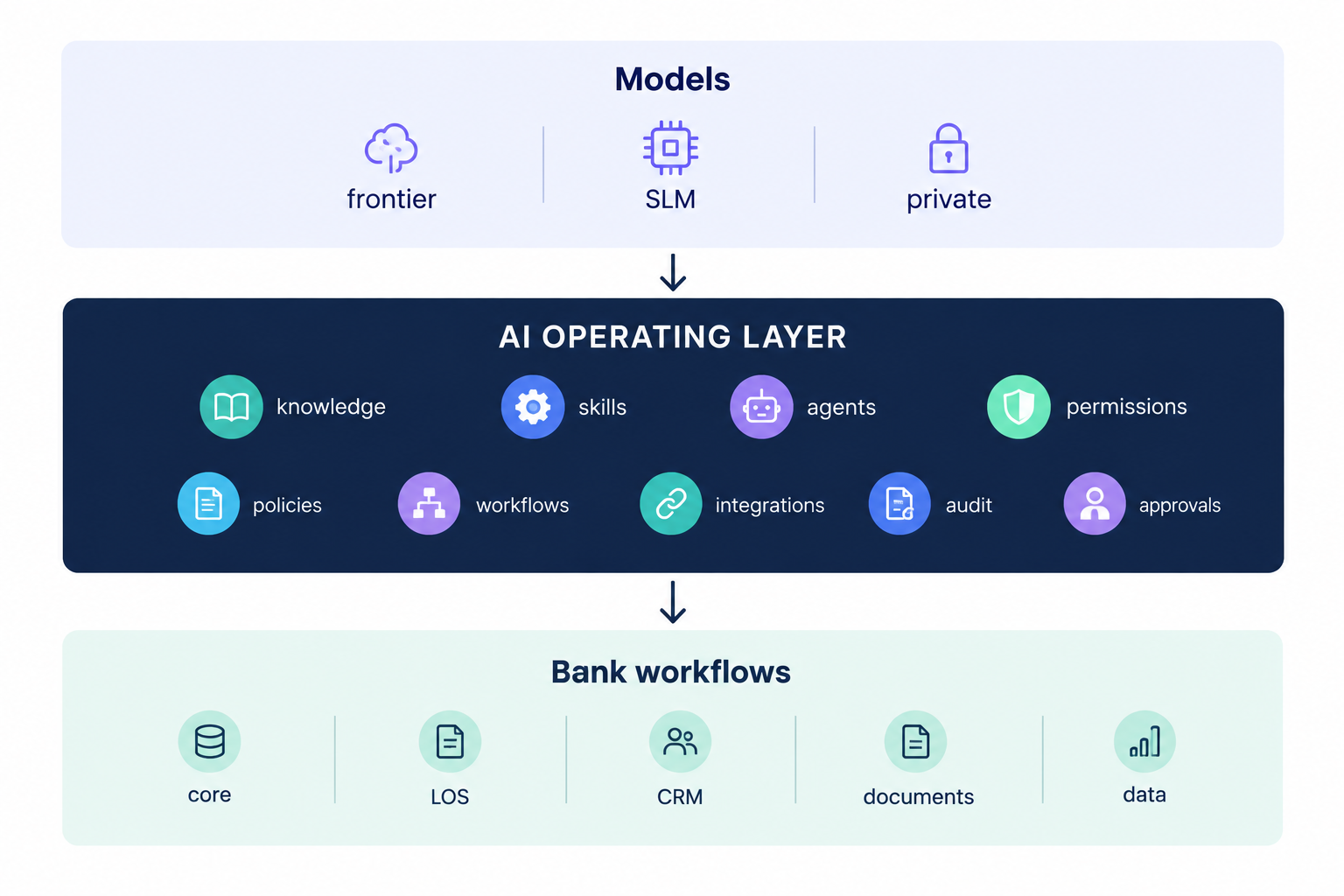
That middle layer is where the institution's decisions actually get enforced. It holds the knowledge agents reason from, the skills they apply, the permissions that bound them, the policies that constrain them, the integrations that connect them to systems of record, the approval gates, and the audit record that accumulates as work happens.
Put the same point negatively. If those controls live inside the model provider, the institution has outsourced its governance along with its inference. If they live in a spreadsheet and a set of internal conventions, they are not controls at all.
You may also read: AI Agents for Financial Services: What They Do and How to Govern Them
What happens when fraud detection runs inside a governed workflow?
Fraud is the clearest test of the whole argument, because fraud detection is where security, compliance, and governance stop being separate subjects. A fraud signal is worthless if the institution cannot act on it, evidence it, and defend the determination afterwards.
Every element in that chain is doing governance work, not only detection work. Document AI produces figures that carry their source. The fraud detection step inspects anomalies inline rather than in a separate system whose findings someone has to reconcile later. PII controls apply before the data moves on. The human makes the determination, and the record of what they saw and decided is captured as it happens rather than reconstructed on request.
A fraud flag with no evidence trail is an opinion. A fraud flag inside a governed workflow is a finding.
Bank-Grade AI Should be Model-Agnostic at the Architecture Level
The most consequential architectural decision a bank makes about AI is whether it can change models later without rebuilding everything around them. Model capability is moving fast enough that permanent dependency on any single provider is a strategic risk rather than a technical detail.
When the architecture is model-agnostic, a model swap changes the engine and leaves the institution's accumulated work intact:
- Workflows keep their shape and sequencing
- Policies keep constraining behaviour on the same terms
- Permissions keep bounding what agents may access and change
- Institutional knowledge stays where the institution built it
- Integrations to the core, LOS, and CRM keep working
- Audit trails remain continuous across the change
That last point deserves emphasis. Under SR 11-7, a change to a model is a change an institution has to be able to describe and validate. An architecture where the audit record survives a model swap makes that a manageable exercise. An architecture where the reasoning lived inside the model makes it a rebuild.
The model can change. The governance layer remains.
What Banks Should Ask About AI Control
These eight questions cut through most vendor positioning on private AI for banks, because each one has a specific answer that can be verified rather than asserted.
- Data. Where does sensitive data go, at which step does it leave our environment, and what is retained?
- Models. Which models can run each workflow, and can we restrict a workflow to a specific one?
- Keys. Who controls the encryption keys and the access credentials?
- Deployment. Can sensitive workloads operate in a controlled environment, and which workloads qualify?
- Governance. Can our policies constrain AI behaviour at execution, not just at review?
- Audit. Can every action be reconstructed after the fact, with sources and human interventions intact?
- Portability. Can we change models without rebuilding the workflow?
- Oversight. Where does human approval remain mandatory, and who configures that?
Ask them in writing. A vendor who can answer the first six but not portability has built you a good system you will struggle to leave.
You may also read: SOC 2 Type II for Commercial Lending AI: What to Ask Vendors
Where Uptiq Fits
The architectural question this article keeps returning to is what sits between the model and the bank's workflow. That is what Uptiq builds.
QORE is the operating layer beneath Uptiq's agents. It handles agent execution, workflow orchestration, policy enforcement, permissions, governance, integrations to existing systems, and the auditability that makes agent work defensible afterwards. The platform is designed to run alongside the core, LOS, CRM, and document repositories a bank already operates rather than replacing them, and the same controls extend to compliance and risk workflows beyond lending.
The claim worth making is architectural rather than promotional. Agents do the work; QORE is the layer that determines whether that work is controllable, explainable, and provable inside a regulated institution. That is the part a bank cannot buy from a model provider, because it is specific to the institution.
Control is the New Definition of Trust
Banks do not need AI that asks to be trusted. They need AI systems built so the institution can control the data, constrain the behaviour, review the output, and prove what happened.
Those four capabilities are what turn a capable model into something usable in a regulated environment. Without them, a bank is relying on a vendor's assurance and its own hope, which is not a control framework and will not read as one to an examiner.
Fraud detection, compliance, and governance all start in the same place, which is why they belong in the same conversation. Each one depends on the institution controlling the environment its AI runs in. Get that layer right and the three become properties of the workflow. Get it wrong, and they become three separate problems, each discovered late.
Private AI for banks, in the end, is not a deployment mode. It is a set of guarantees about who is in charge of the data, the behaviour, and the record.
Trust in banking AI infrastructure is not something a vendor provides. It is something the architecture makes possible.
Trace the Data Path in One Workflow
Pick one AI workflow already running in your institution and map where the data goes at each step, who holds the keys, which model processed what, and what survives in the record afterwards. The first hop you cannot document is the place to start.
See how QORE governs agent execution across banking workflows >
About the Author