AI for private credit is moving from a back-office experiment to a portfolio risk question. Lenders in leveraged and private credit are heading into a year where most expect defaults to rise, confidence in fraud oversight is thin, and the alleged frauds at First Brands and Tricolor have shown how far borrower-supplied data can drift from reality before anyone notices. If you work in credit, portfolio or workout at a bank, BDC or non-bank lender, you will see what lenders told FTI Consulting they worry about, the concrete fraud and early-warning signals that show up in borrower reporting, how AI can move information from the borrower package into portfolio monitoring faster and with fewer gaps, and where human judgment has to stay in charge.
What the 2026 leveraged loan survey says lenders worry about
Lenders are worried about three connected things: rising defaults, weak confidence in fraud oversight, and whether the information they receive is good enough to act on. FTI Consulting's 2026 Leveraged Loan Market Survey, its eighth annual edition, polled large bank and non-bank lenders between November 18 and December 19, 2025. Respondents came from commercial banks, investment banks, private credit platforms, CLOs and BDCs, with titles ranging from Chief Credit Officer and workout group leader to vice president. FTI did not publish a total sample size.
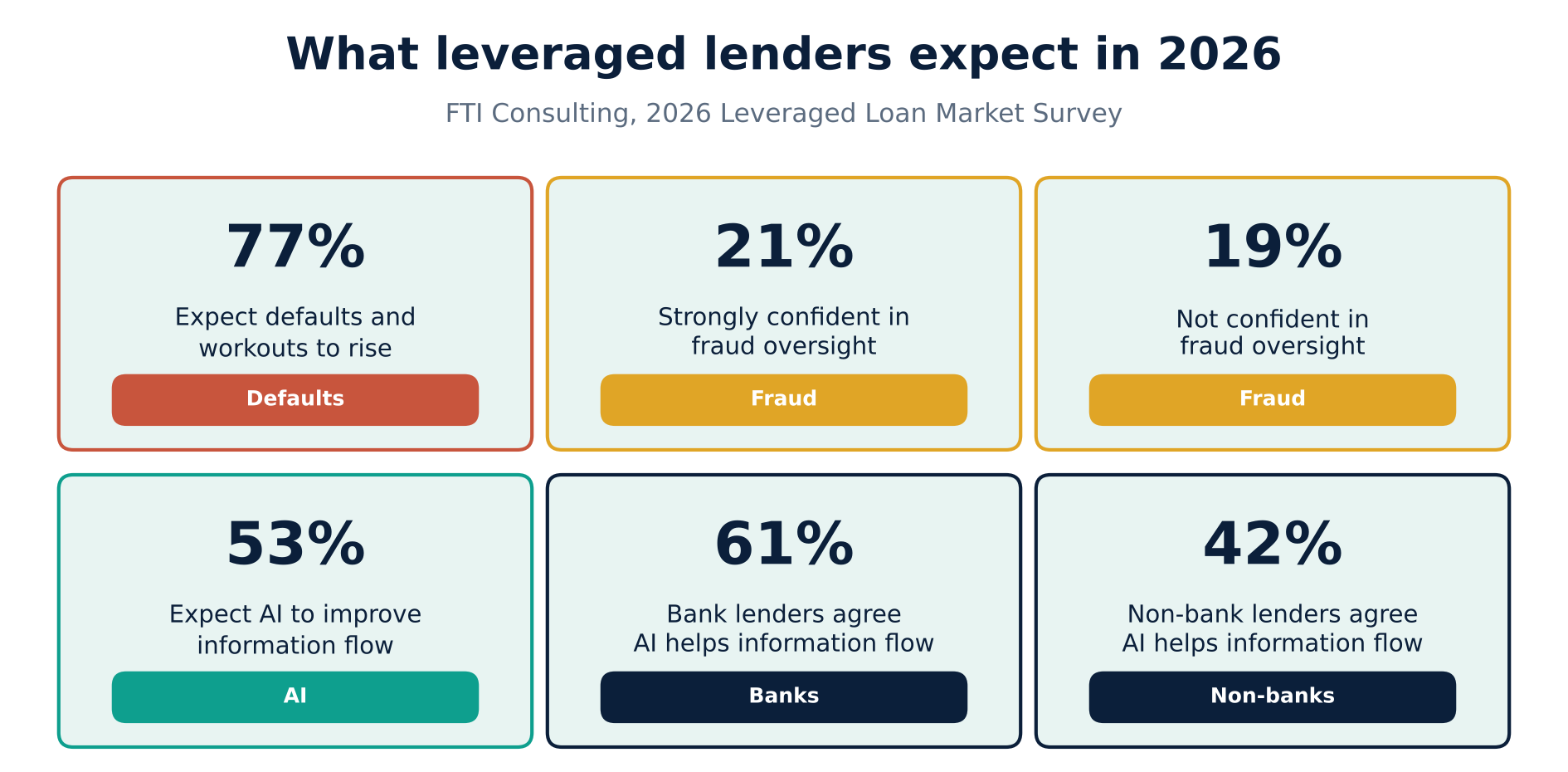
The headline is a more bearish credit outlook. According to FTI Consulting's February 17, 2026 press release, 77% of respondents expect defaults and workouts to rise in 2026 (58% slightly, 19% substantially), compared with 50% who expected an increase a year earlier.
Source: FTI Consulting, 2026 Leveraged Loan Market Survey, published February 17, 2026.
The fraud numbers deserve a second look. Only about one in five lenders is strongly confident in how they oversee fraud risk, and FTI links the concern directly to the alleged mass frauds at First Brands and Tricolor. FTI also notes that non-bank respondents were much more confident than bank lenders that those cases were isolated incidents. That gap matters for anyone building AI for non-bank lenders: confidence is not the same as controls.
Why information flow is the weak point in private credit
Information flow is the weak point because private credit relies heavily on borrower-supplied reporting that arrives in many formats, on different schedules, and is checked by small teams. A leveraged borrower may send monthly financials, a quarterly compliance certificate, a borrowing base certificate, aging reports, bank statements and an annual audit, each prepared by different people. When those documents are reviewed one at a time, the inconsistencies between them are easy to miss.
The recent bankruptcy cases show how this plays out. Morgan Lewis, in its February 2026 analysis of recent bankruptcy cases and managing fraud risk, describes allegations that customer installment loans at Tricolor were double pledged, repackaged or sold multiple times, and that First Brands obligations were excluded from traditional debt metrics. The firm warns that weak verification processes, overreliance on borrower-provided data and infrequent audits can let problems compound undetected. These are allegations in ongoing proceedings, but the lesson for monitoring is the same.
The assembly problem is not unique to private credit. Moody's, in its September 2026 piece on the future of credit assessment, cites a bank that consulted more than 20 platforms and data sources to assemble a single credit memo, and flags data quality, integration complexity and data lineage as issues banks must address.
You may also read: OCR vs IDP vs Document AI
Fraud and early-warning signals hiding in borrower reporting
Most fraud and early-warning signals in private credit are visible in documents the lender already holds, if someone compares them. None of these signals proves fraud on its own. Each one is a reason to ask a question, request support or escalate to the credit officer.
Financials that do not tie across documents
Revenue, EBITDA, receivables or cash that differ between the monthly package, the compliance certificate, the borrowing base and the audited statements are the most common early signal. Small differences can be timing or classification. Persistent or growing gaps, especially ones that always flatter the covenant calculation, need explanation.
Altered or fabricated statements
Bank statements and invoices are easy to edit. Signals include balances that do not reconcile from period to period, fonts or layouts that change mid-document, round-number transactions, and deposits that do not match reported revenue. Comparing borrower-provided statements against independently sourced data where you have it is far stronger than reviewing the PDF in isolation.
Covenant drift and add-back creep
Covenant drift is when headroom shrinks quarter by quarter while the borrower keeps reporting compliance. Watch for growing EBITDA add-backs, definitions applied inconsistently between periods, and leverage that looks stable only because of adjustments. Morgan Lewis recommends looking at the economic substance of transactions, not just headline leverage ratios.
Late, partial or missing reporting
Reporting that slips, arrives incomplete or comes with a new excuse each quarter is a behavioral signal. Morgan Lewis lists audit delays and stalled quality-of-earnings work among the warning signs in the recent cases.
Related-party, off-balance-sheet and collateral flows
Payments to affiliates, new SPV or factoring arrangements, and receivables or inventory that appear to support more than one facility are the signals behind the largest losses. Cross-checking collateral reports against lien searches and other facilities is where these patterns surface.
How AI for private credit improves information flow from package to portfolio
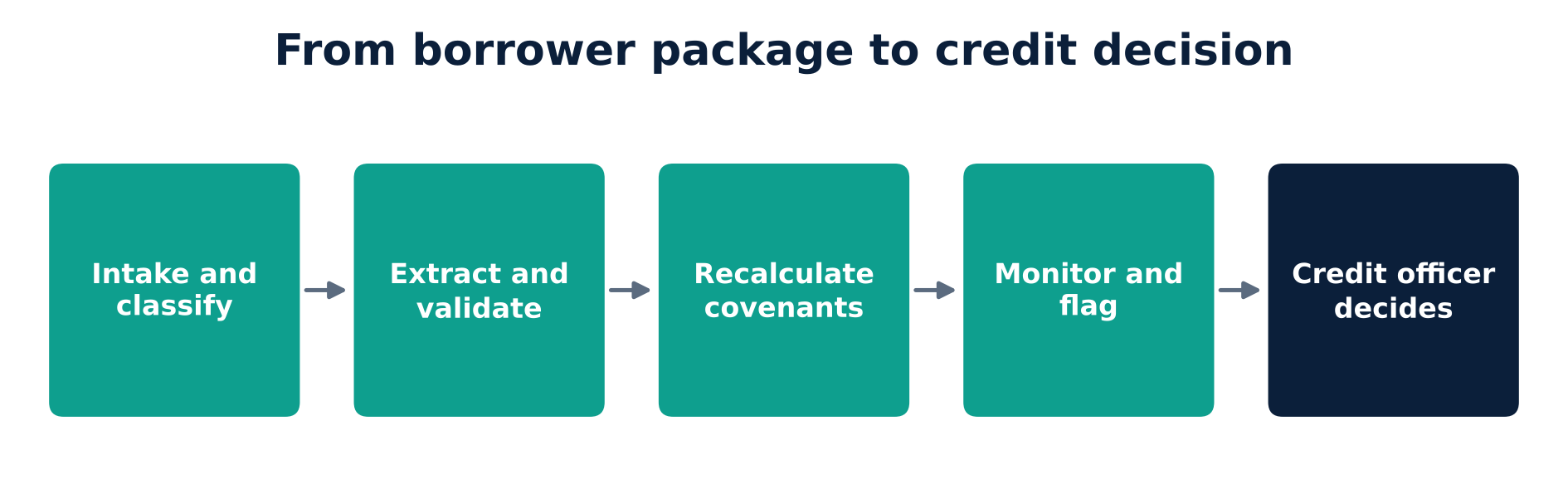
AI for private credit improves information flow by turning each borrower package into structured, validated data on arrival and feeding it straight into portfolio monitoring, so exceptions reach the credit team in days instead of at the next quarterly review.
Intake and classification
The first step is AI loan document processing at intake: every file is identified, classified by type and period, and matched to the right borrower and facility. Missing items are known immediately, which turns late or partial reporting into a tracked event rather than something noticed weeks later.
Extraction with validation
Extraction alone is not enough for fraud signals. The useful step is validation: checking that the extracted numbers are internally consistent, that balances roll forward, and that the same figure matches across the compliance certificate, the financials and the borrowing base. Low-confidence fields go to a person for review instead of flowing silently downstream. Spreading the financials into the lender's template follows from the same data; we cover that workflow in detail in our piece on financial spreading automation, so we will not repeat it here.
Covenant recalculation and trend tracking
AI covenant monitoring means recalculating each covenant from source data, comparing it with what the borrower reported, and tracking headroom and add-backs over time. A certificate that says compliant while the recalculated ratio is close to the limit, or while add-backs keep growing, becomes a flagged item with the supporting numbers attached.
Continuous monitoring and exception queues
Between reporting dates, monitoring agents can watch for new signals such as bank activity that does not match reported results, affiliate payments, or changes in reporting behavior. Each flag carries its evidence and source document so the analyst can confirm or dismiss it quickly, and every action is logged. That is how AI in commercial lending supports the more frequent review of collateral reporting that Morgan Lewis recommends without asking already busy teams to do it by hand.
You may also read: Commercial loan underwriting automation
Where human judgment stays in charge
Human judgment stays in charge of every credit decision, every fraud determination and every workout strategy. AI can flag that numbers do not tie; it cannot decide whether the reason is fraud, an accounting change or a timing difference. That call needs a credit officer who knows the borrower, the sponsor and the documents.
Specifically, people should own:
- Deciding whether a flag is escalated, investigated, explained or closed.
- Waivers, amendments, reservation of rights letters and default notices.
- Setting the thresholds and rules that decide what gets flagged in the first place.
- Restructuring and workout strategy once a credit is in trouble.
Governance matters here too. The revised interagency model risk guidance issued on April 17, 2026 (Federal Reserve SR 26-2, with matching OCC and FDIC releases) keeps principles such as inventory, documentation, effective challenge and vendor model validation, but states that generative and agentic AI models are not within its scope, and the agencies plan a request for information on AI. Reuters reported in October 2026 that US banking regulators are questioning banks on AI agent limits, audit trails, human involvement and shutdown controls. For bank lenders, and for non-bank lenders that answer to bank partners, investors or auditors, the practical answer is the same: document what each agent does, keep humans in the loop, and log every action. The voluntary NIST AI Risk Management Framework is a useful structure for that work, and our glossary entry on AI governance in lending covers the basics.
How the Uptiq platform fits leveraged and private credit monitoring
The Uptiq platform fits as a new tier, not a new core: it sits alongside your loan system and portfolio tools and adds validation and monitoring agents on top of the data you already receive. It is built to be bank-grade, which means grounded, governed and provable.
- Document AI. Uptiq Document AI classifies, extracts and validates borrower packages, with confidence thresholds that route uncertain fields to human review. Uptiq customers have seen 95%+ extraction accuracy.
- AI covenant monitoring. AI covenant monitoring recalculates covenants from source documents, compares them with reported figures and is designed to flag drift and shrinking headroom.
- Continuous Monitoring Agent. The Continuous Monitoring Agent watches portfolio data between reporting dates and is designed to flag early-warning signals with the evidence attached, so analysts review exceptions instead of rereading every package.
- Validation Hub. Governance checks every agent action before it runs and keeps an audit trail of what was checked, flagged and decided.
No tool detects every fraud, and the platform does not claim to. What it is designed to do is surface more of the inconsistencies that already sit in your documents, earlier, with a record of who reviewed them. Uptiq customers have seen 36% less financial spreading time, and a single agent can be live in about 5 business days.
Conclusion: Better information before the next workout
The FTI Consulting survey describes a market where most lenders expect more defaults and few are fully confident in their fraud oversight. The recent cases suggest the warning signs were often sitting in borrower documents and financing arrangements, waiting for someone to compare them. Better information flow, validated on arrival and monitored continuously, is the most practical place to start.
The Uptiq platform helps credit teams do that with Document AI validation, AI covenant monitoring and the Continuous Monitoring Agent, all governed so every flag and every decision is recorded. Credit officers keep the judgment; the platform gives them cleaner evidence, sooner.
See how validation and monitoring work on your borrower packages
Bring a sample borrower package and compliance certificate, and we will show you how the platform validates it, recalculates covenants and flags exceptions for review.
Frequently Asked Questions
What is AI for private credit?

Can AI detect fraud in leveraged loans?
What did the FTI Consulting 2026 Leveraged Loan Market Survey find about fraud?
How does AI covenant monitoring work?
What are early-warning signals in borrower reporting?
Is AI for non-bank lenders different from AI for banks?
Does AI replace credit officers in private credit?
About the Author