Standardized Credit Memo Preparation | Uptiq
Use case · Commercial lending

Standardize credit memo preparation across every analyst and every deal

Uptiq's Underwriting Superagent drafts the credit memo on your template, pulls every figure from the documents already in the file, applies your credit policy, and cites each number back to the page it came from.

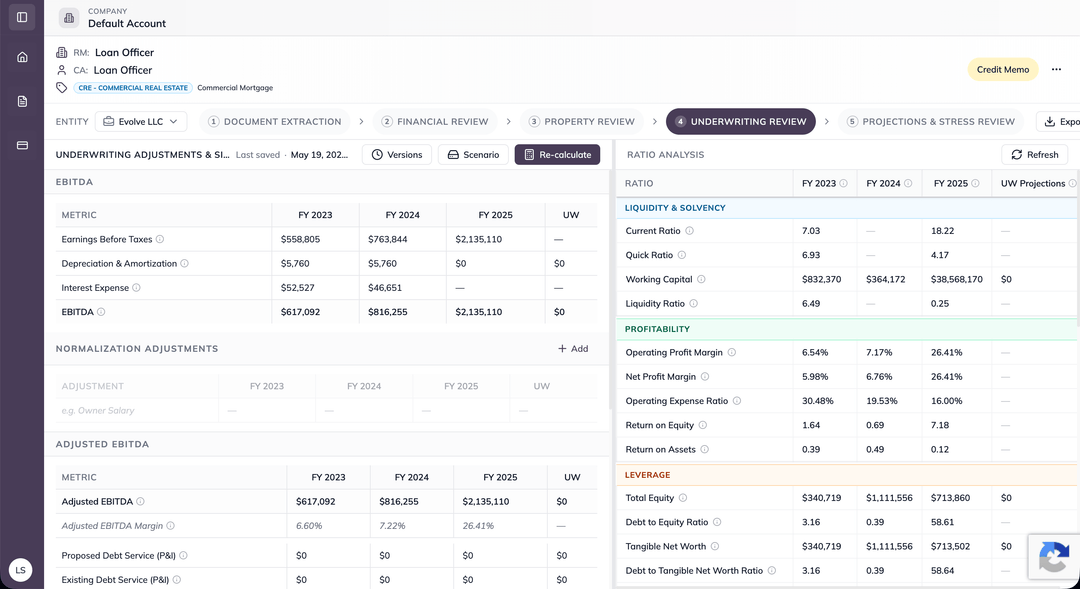
63% reduction in credit memo prep time. Your analysts keep the risk rating and the recommendation — the agent takes the assembly.

See what it drafts
63%

Reduction in credit memo preparation time

41%

Reduction in underwriting cycle time

More deals per underwriter

95%+

Extraction accuracy, certified by former underwriters

The problem § 2.0

Ten analysts, ten different memos, one committee trying to compare them

The credit memo is the most-read document in commercial lending and the least standardized. Every analyst has a slightly different structure, a different depth of analysis and a different way of getting to the same recommendation.

Assembly consumes the analyst's week

Statements are spread by hand, ratios recalculated in a side sheet, prior memos cannibalized for structure, and paragraphs retyped from documents already sitting in the credit file.

“we need minimal touch points” — Head of Lending

Committee time goes to format, not risk

When two memos present the same facility differently, reviewers spend the meeting locating the numbers and reconciling definitions instead of debating the credit.

“application all the way to boarding with quality control stops”

Policy exceptions surface late

A request outside policy is often identified in review rather than at write-up, which pushes rework back onto the analyst and adds a full cycle to time-to-yes.

“automate most of that underwriting based on what we give as policy”

The solution § 3.0

The Underwriting Superagent drafts the memo you already use

A domain-trained agent that reads the credit file, does the arithmetic, writes the evidence-bound sections in your house structure, and hands your analyst a complete draft to challenge rather than a blank template to fill.

  • Spreads statements, tax returns, rent rolls and borrowing base certificates — 36% reduction in spreading and extraction time.
  • Writes each section to your template, in your section order and your house language.
  • Applies your credit policy as tested rules and flags anything outside it as an exception.
  • Cites every figure back to the source document and page for review and examination.
  • Runs over your existing core, LOS and document store. 100+ native integrations, no migration.
Why it matters § 4.0

What changes when every memo arrives in the same shape

Memo prep stops being the bottleneck

63% less time on memo preparation and 41% off the underwriting cycle, because the draft exists before the analyst opens the file.

Committee compares credits, not formats

Identical structure and section order across analysts and deal types means reviewers land on the risk question immediately.

Every number is traceable

Each figure carries a citation to its source document and page, so review and examination follow the evidence rather than the author.

Analyst capacity moves to judgment

Roughly 3× more deals per underwriter, with analyst hours spent on structure, mitigants and the recommendation.

Memo anatomy § 5.0

What the agent drafts, and what stays with your analyst

The split is deliberate. Sections that resolve to evidence are drafted and cited. Sections that resolve to judgment are yours.

Agent drafted · cited to source Written by your analyst
1.0 Transaction summary & request Facility type, amount, term, purpose — from the application and term sheet Agent
2.0 Borrower & sponsor overview Entity structure, ownership, operating history — from formation documents and filings Agent
3.0 Sources, uses & structure Capital stack and proposed terms — from the term sheet and draft agreement Agent
4.0 Financial analysis & spreads Historical spreads and trend commentary — from statements and tax returns Agent
5.0 Ratio & covenant analysis DSCR, leverage, FCCR, current ratio against proposed covenant levels Agent
6.0 Collateral & LTV analysis Appraised values, advance rates, lien position — from appraisals and UCC searches Agent
7.0 Guarantor & global cash flow Personal financial statements and returns rolled into a global position Agent
8.0 Industry & market context Sector conditions relevant to the borrower's operating performance Agent
9.0 Risk factors & mitigants Drafted from the analysis; your analyst edits and adds relationship context Agent → you
10.0 Policy exceptions Agent flags the exception and the policy provision; you write the justification Agent → you
11.0 Risk rating rationale The rating and the reasoning behind it remain a credit judgment You
12.0 Recommendation & conditions Approve, decline or approve-with-conditions — your authority, your call You

Section numbering, headings and depth are configured to your institution's template. The agent does not invent a memo format — it writes into the one your committee already reads.


Capabilities § 6.0

Built for the way commercial credit is written

Template-native drafting

Writes into your memo template, section order, headings and house phrasing rather than producing a generic write-up.

Automated financial spreading

Spreads statements, tax returns and rent rolls at 95%+ extraction accuracy, certified by Uptiq's knowledge team of former underwriters.

Policy-aware risk narrative

Applies your credit policy as tested rules so the narrative reflects your thresholds, not a vendor's default ratio library.

Citation and data lineage

Each figure traces to the document and page it came from, with inputs and timestamps retained for review and examination.

Policy exception detection

Identifies requests outside policy at write-up, names the relevant provision, and surfaces it in the memo instead of in committee.

Ratio and covenant testing

Calculates DSCR, leverage, fixed charge coverage and collateral ratios against proposed covenant levels as part of the draft.

Quality control stops

Review points are placed where your process needs a human sign-off, so standardization does not mean unattended approval.

Integrations, not migrations

100+ native integrations across cores, loan origination systems and document repositories. Private-cloud deployment available.

Continuity into monitoring

Covenants written into the memo carry forward to the Continuous Monitoring Superagent, so the book is watched on the same terms it was approved on.

How it works § 8.0

From credit file to committee-ready draft

Five steps, running on every deal in the same order.

01

Read the credit file

The agent picks up statements, tax returns, appraisals, rent rolls, entity documents and the term sheet from your document repository or LOS.

02

Spread and calculate

Financials are spread into your standard template and the ratios your policy tests are calculated, with each input tied to its source page.

03

Apply credit policy

Thresholds, coverage minimums, concentration limits and eligible collateral rules are applied, and anything falling outside them is flagged as a policy exception.

04

Draft the memo

The evidence-bound sections are written into your template in your house structure, each figure carrying a citation back to the document it came from.

05

Analyst reviews and decides

Your analyst challenges the draft, writes the rating rationale and the recommendation, and the memo goes to committee in the same shape as every other one.

FAQ § 9.0

Credit memo preparation, answered

What is a credit memo in commercial lending?

A credit memo, also called a credit approval memorandum or credit write-up, is the internal document that presents a commercial loan request to the approving authority. It sets out the transaction and structure, the borrower and guarantor analysis, spread financials and trend commentary, ratio and covenant testing, collateral position, industry context, identified risks and mitigants, any policy exceptions, the assigned risk rating and the recommendation with conditions. It is the record the approval decision rests on and the document an examiner reads afterwards.

Can the agent write to our own credit memo template?

Yes. The agent is configured to your institution's memo template, section order, headings and house language rather than producing a generic write-up. Standardization means every analyst's memo arrives at committee in the same structure, with the same sections populated in the same order, so reviewers compare risk instead of reconciling formats.

How does automated credit memo preparation stay consistent with our credit policy?

Your credit policy is configured into the agent as tested rules: ratio thresholds, minimum coverage levels, concentration limits, eligible collateral and required conditions. The agent applies those rules when it drafts, flags any request that falls outside them as a policy exception, and identifies which policy provision the exception relates to — so the exception is surfaced in the memo rather than discovered in committee.

Where do the numbers in an automated credit memo come from?

Every figure originates in a source document the agent has processed: borrower financial statements, tax returns, rent rolls, appraisals, borrowing base certificates and the credit agreement. Extraction is certified at 95% or better accuracy by Uptiq's knowledge team of former underwriters and bankers, and each value in the draft memo is cited back to the document and page it came from, so a reviewer or examiner can trace any number to its origin.

Does this replace the credit analyst?

No. The agent drafts the evidence-bound sections of the memo — the sections that consume the most time and produce the least differentiation. The risk rating rationale, the judgment on mitigants and the recommendation stay with your analyst and your approving authority. Institutions using this approach report roughly three times the deal throughput per underwriter, because analyst time shifts from assembling documents to arguing credit.

How long does it take to get automated credit memo preparation live?

A single agent can be live in production in as little as five business days, with a multi-agent deployment across intake, underwriting and monitoring typically running about 30 days. The agent runs over your existing core, loan origination system and document repository through more than 100 native integrations, so there is no core replacement or data migration involved.

Next step § 10.0

Bring us one of your memos

Send a redacted credit file and your memo template. We will run it through the agent and show you the draft, the citations and the policy exceptions it surfaces — in your structure, not ours.

Request a walkthrough § 11.0

See Uptiq in action

Tell us what your memo template looks like today and where the write-up loses the most time. We will show you the agent drafting that exact structure.

Typical first agent: live in production in as little as five business days.