Reduce Commercial Loan Turnaround Time | Uptiq
Use case · Commercial lending

Reduce commercial loan turnaround time without loosening credit standards

The work in a commercial loan takes hours. The loan takes weeks. Uptiq's agents compress the queue time, the handoffs and the rework loops between stages — and leave your quality control stops exactly where your credit policy puts them.

41% reduction in underwriting cycle time. Modular deployment: start with the stage that holds your deals the longest, live in production in as little as five business days.

See where the days go
41%

Reduction in underwriting cycle time

60%+

Cycle time reduction with the full commercial lending suite deployed

More deals per underwriter

5 days

To get a first agent live in production

The problem

You are not slow at underwriting. You are slow between stages.

Ask an analyst how long it takes to spread a set of statements and the answer is hours. Ask how long the loan took and the answer is weeks. That gap is not skill or effort — it is queue time, handoffs and rework, and none of it shows up on anyone's task list.

Every stage is a queue

A file finishes intake and waits. It finishes spreading and waits. Each handoff parks the deal until the next person has capacity, and elapsed time accumulates while nobody is doing anything wrong.

Ops persona: 40+ handoffs per loan
Handoffs lose context

Each transfer means re-reading the file, re-keying figures into another system and re-establishing what has already been checked. The work is not new — it is the same work, done again by someone else.

“swivel chair experience” — Head of Operations

Rework is the expensive kind of delay

An incomplete package or a policy exception found in committee sends the deal backwards. It does not resume where it stopped — it re-enters the queue behind everything that arrived while it was moving.

“application all the way to boarding with quality control stops”

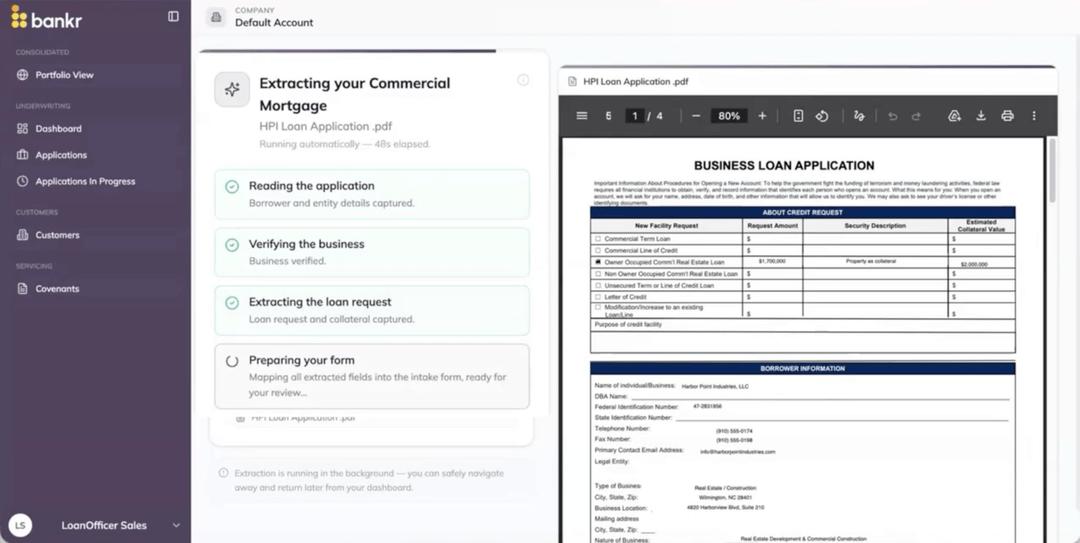
Intake — commercial lending
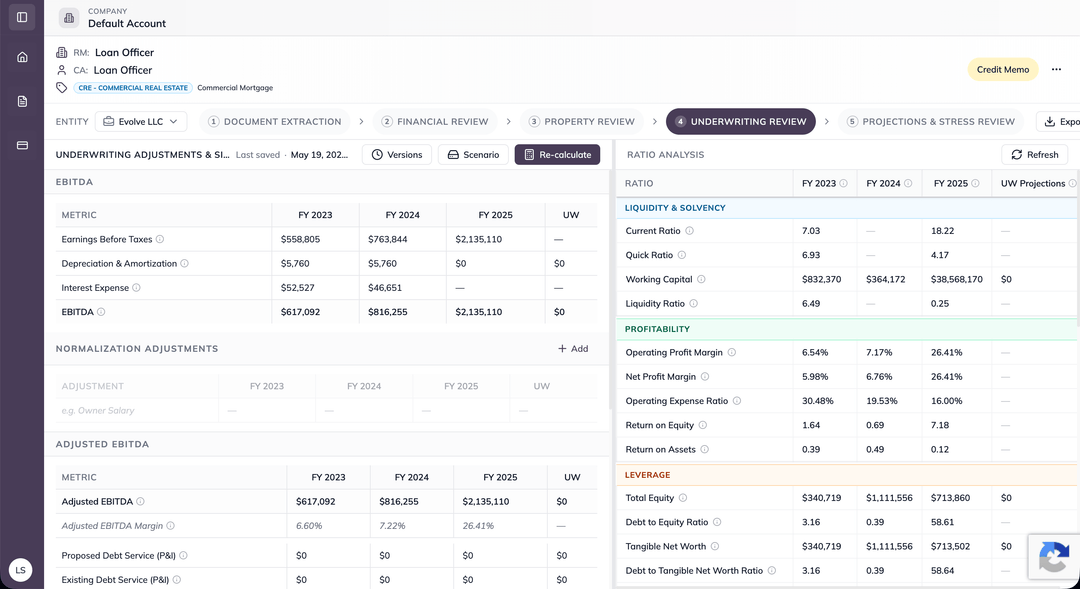
Underwriting — commercial lending
The solution

Agents that hold the file between the people

Uptiq deploys domain-trained agents across the origination pipeline rather than at a single step. The file does not park between stages, because the agent has already validated the package, spread the financials, run the policy checks and drafted the memo before it reaches the person whose judgment is actually required.

  • Validates the application package on receipt and identifies what is missing before the deal enters the queue.
  • Spreads statements automatically — 36% less time on spreading and extraction, at 95%+ accuracy.
  • Applies your credit policy during analysis, so exceptions surface at write-up rather than in committee.
  • Drafts the credit memo on your template — 63% less memo preparation time.
  • Leaves quality control stops wherever your policy requires a human sign-off.
Why it matters

What a shorter cycle actually buys you

A faster answer to the borrower

41% off underwriting cycle time, and more than 60% where the full suite runs end to end — time-to-yes is what borrowers compare when they are shopping the deal.

More deals through the same team

Roughly 3× the throughput per underwriter, without adding headcount to absorb volume that arrives in bursts.

Fewer trips backwards

Incomplete packages and policy exceptions are caught at the stage they arise, so files stop re-entering queues they had already cleared.

Speed that survives an exam

Every figure cited to its source document, every policy test recorded — the file gets faster and more defensible at the same time.

Diagnosis

Where the days go, stage by stage

Cycle time is not one problem. It is seven smaller ones, each with a different cause. Compressing a single stage moves the bottleneck; this is what changes at each of them.

Delay drivers across the commercial origination pipeline
Stage Where the days go What changes Agent
Application & intake Incomplete submissions accepted into the pipeline, then returned days later. The package is validated on receipt and gaps are identified before the deal is queued. Intake
Document collection Nothing progresses until the file is complete, and nobody owns the outstanding list. Outstanding items are tracked per deal and the specific missing document is surfaced to the internal owner with its aging. Intake
Financial spreading Statements spread by hand — the single longest task on most commercial files. Spreading is automated at 95%+ extraction accuracy, cutting spreading and extraction time by 36%. Spreading
Global cash flow A bespoke workbook built per relationship whenever ownership is layered. Consolidation and eliminations are applied by rule and shown as line items. See global cash flow → Underwriting
Underwriting analysis Ratios recalculated manually and policy checked by memory, so exceptions appear late. Policy is applied as tested rules during analysis, and exceptions are named at write-up. Underwriting
Credit memo Assembled by hand from documents already sitting in the credit file. Drafted on your template with every figure cited — 63% less prep time. See memo standardization → Underwriting
Committee review Memos differ by author, so review time goes to locating figures and reconciling formats. Identical structure across analysts and deal types puts the risk question first. Underwriting
Closing & boarding Covenants and reporting obligations re-keyed into a tracking sheet after approval. Approved terms carry forward and are monitored continuously from day one. See covenant monitoring → Monitoring

Deployment is modular. Most institutions instrument the pipeline first, start on the stage holding deals longest, and expand once the change on that stage is measured.

Capabilities

What compresses the pipeline

Intake package validation

Checks the submission against your requirement list on arrival and identifies what is missing before the file is queued.

Outstanding item tracking

Holds the open document list per deal with aging, so the gap is visible to the owner instead of rediscovered later.

Automated financial spreading

Spreads statements, returns and rent rolls at 95%+ extraction accuracy, certified by Uptiq's knowledge team of former underwriters.

Policy applied during analysis

Thresholds, coverage minimums and concentration limits tested as the analysis is built, so exceptions are named at write-up.

Credit memo drafting

Evidence-bound sections written into your house template, leaving the rating rationale and recommendation to your analyst.

Configurable quality control stops

Human sign-off points sit wherever your credit policy places them. Standardization is not unattended approval.

Exception routing

Missing items, policy exceptions and stalled files surface against the owning relationship manager with severity attached.

Stage-level cycle visibility

Where deals are sitting, and for how long, becomes measurable per stage instead of inferred from a total.

Integrations, not migrations

100+ native integrations across cores, loan origination systems and document repositories. Private-cloud deployment available.

Who runs Uptiq

150+ financial institutions, 20+ partners

Banks, credit unions, equipment finance companies and non-bank lenders run Uptiq agents across intake, underwriting and continuous monitoring.

[CUSTOMER LOGO — permission needed] [CUSTOMER LOGO — permission needed] [CUSTOMER LOGO — permission needed] [CUSTOMER LOGO — permission needed]
How it works

How a deployment actually shortens the cycle

Measure first, compress the worst stage, then extend. Not a platform replacement.

01

Instrument the pipeline

Establish where deals are actually sitting and for how long, stage by stage, so the bottleneck is identified from evidence rather than from where the complaints are loudest.

02

Connect, don't migrate

The agent is integrated with your existing core, loan origination system and document repository. No replacement project, no data migration, no benefit deferred behind a platform build.

03

Configure policy and control stops

Your credit policy is configured as tested rules and your quality control stops are placed where sign-off is required, before anything runs on live deals.

04

Go live on the worst stage

A single agent can be in production in as little as five business days, targeted at the stage holding deals longest, with the change measured against the baseline from step one.

05

Extend across the pipeline

Once the first stage is compressed the bottleneck moves, so the next agent is added where the queue has relocated. A multi-agent deployment typically runs about 30 days.

FAQ

Commercial loan turnaround, answered

What is commercial loan turnaround time and how is it measured?

Commercial loan turnaround time is the elapsed time from a borrower's application to a decision, and in most institutions it is tracked in two forms: time-to-decision, measured from a complete application to credit approval or decline, and time-to-close, measured from application to funding. The distinction matters because the two are improved by different things. Time-to-decision is dominated by document collection, spreading and underwriting queue time, while time-to-close adds documentation, conditions clearance and boarding.

Where does the time actually go in a commercial loan?

Very little of the elapsed time is spent working on the loan. The processing itself — spreading statements, calculating ratios, writing the memo — is measured in hours. The weeks come from queue time between stages, handoffs between intake, credit, underwriting and closing, and rework loops where an incomplete file or a late-discovered policy exception sends the deal back to an earlier stage. Rework is the most expensive category, because a returned file does not resume where it stopped; it re-enters the queue.

How much can automation realistically reduce commercial loan cycle time?

Institutions running Uptiq report a 41% reduction in underwriting cycle time, with more than 60% reduction where the full commercial lending suite is deployed across intake, spreading, underwriting, memo preparation and monitoring rather than a single stage. Component improvements include 36% less time on spreading and extraction and 63% less time on credit memo preparation. The size of the gain depends on how much of the pipeline is automated, because compressing one stage moves the bottleneck rather than removing it.

Does faster loan turnaround mean weaker credit discipline?

No, because the compression comes from waiting rather than from reviewing. Quality control stops remain wherever your credit policy requires a human sign-off, and the risk rating and the approval decision stay with your analysts and your approving authority. In practice credit discipline tends to strengthen, because policy exceptions are identified during analysis instead of being discovered in committee, and because every figure in the file is cited back to the source document it came from.

Do we need to replace our loan origination system to reduce turnaround time?

No. Uptiq agents run as a layer over your existing core, loan origination system and document repository, with more than 100 native integrations available. There is no core replacement and no data migration — which matters for cycle time specifically, because a platform replacement project would add far more elapsed time than it removes before any benefit is realised.

How quickly can we see an improvement in turnaround time?

A single agent can be live in production in as little as five business days, and a multi-agent deployment across intake, underwriting and monitoring typically runs about 30 days. Because deployment is modular, most institutions start with the stage that currently holds deals the longest, measure the change on that stage, and expand across the pipeline from there.

Next step

Find out which stage is costing you the deal

Walk us through your origination pipeline and we will map where elapsed time is accumulating, which stage is the current bottleneck, and what compressing it is worth before you commit to anything.

Request a walkthrough

See Uptiq in action

Tell us what your current turnaround time looks like and where deals tend to stall. We will show you the agents running that stage of your pipeline.

Typical first agent: live in production in as little as five business days.