
Turn borrower financial statements, tax returns, and interim reports into a completed, standardized spread — automatically, and with a citation behind every figure.
36% less spreading time. 95%+ extraction accuracy. No rip-and-replace.
Spreading sits at the front of every commercial credit decision, and it is still largely a transcription job. An analyst opens a borrower package, reads statements that no two accountants format the same way, and keys line items into a template one figure at a time — before any real credit thinking begins.
Roughly 3 hours of banker time per deal goes into intake and data entry before underwriting even starts, and a 21-day average time to close leaves little room to absorb it.
Judgment calls on add-backs, non-recurring items, and account mapping drift between people and over time — which shows up later as inconsistent risk ratings and questions from examiners.
On lean commercial teams the same person originates the loan, spreads the financials, drafts the memo, and manages compliance. Portfolio growth turns straight into a hiring conversation.
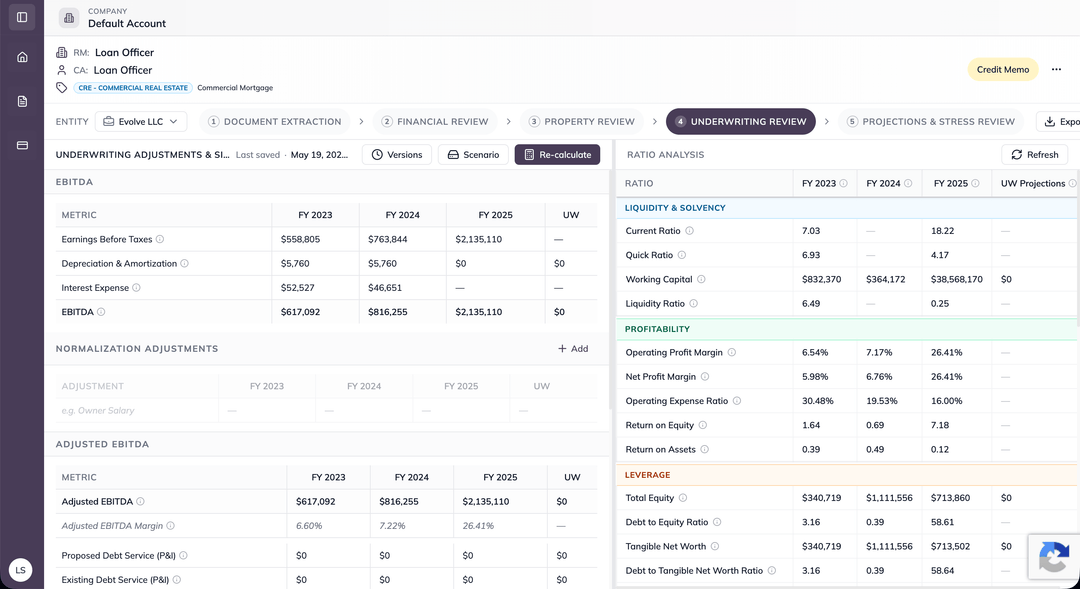
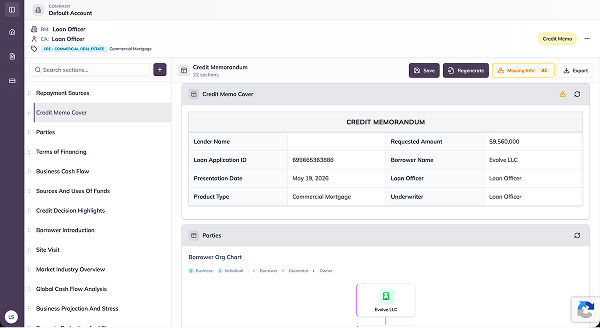
Uptiq's Financial Spreading Agent ingests the borrower package, recasts it into your institution's standardized template, calculates the ratios your policy requires, and hands your analyst a completed spread to review rather than a blank one to build.
Reduction in financial spreading, analysis, and extraction time once the transcription work comes off the analyst's desk.
Certified by a knowledge team of former underwriters, bankers, and analysts, with low-confidence fields flagged for human review.
A spread that lands complete and consistent removes the rework that stalls the rest of the credit decision.
Structured, traceable spread data flows straight into memo generation instead of being re-keyed a second time.
Built for the commercial borrower package as it actually arrives — not for a clean, single-format upload that never happens in practice.
Statements, returns, schedules, and interim reports arrive by email, upload, or API and are captured and sorted without manual triage.
Identifies each statement, schedule, and period, then routes it to the right extraction logic — no per-borrower templates to maintain.
Line items map to your institution's standardized template and spreading conventions, so output matches how your committee already reads a credit.
DSCR, leverage, liquidity, working capital, and covenant tests calculated to your credit policy, with the underlying math visible.
Uncertain fields are surfaced for human-in-the-loop review before the spread moves downstream, rather than passed through silently.
Every figure cites its source document and page, and the finished spread writes back to your LOS, core, and CRM automatically.
Trusted in production by lenders including IBS — live across 24 member credit unions — and C.H. Brown, running document and credit workflows today.
The borrower package arrives through any channel and is captured, split, and organized by entity and period automatically.
Line items are pulled from each statement, return, and schedule, confidence-scored, and cited back to their source page.
Figures map to your chart of accounts across periods and entities, and your policy ratios and covenant tests are calculated.
Your analyst reviews exceptions rather than rebuilding the spread, then the approved output syncs to your LOS, core, and CRM.
Financial statement spreading is the process of taking a borrower's financial statements, tax returns, and interim reports and recasting them into a standardized template so figures are comparable across periods, entities, and borrowers. The resulting spread feeds ratio analysis, covenant testing, risk rating, and the credit memo that a committee ultimately approves.
Automated spreading combines document AI with domain-trained credit logic. The agent ingests the borrower package, identifies each statement and schedule, extracts line items with confidence scoring, maps them to your institution's standardized chart of accounts, calculates the ratios your policy requires, and hands over a completed spread with a traceable link back to the source page for every figure.
Yes. Uptiq is domain-trained on the full commercial borrower package, including company-prepared and CPA-prepared financial statements, business and personal tax returns with their schedules, interim and stub-period statements, debt schedules, and rent rolls, along with multi-entity structures that require consolidating or eliminating across related borrowers and guarantors.
No. It removes the transcription work, not the judgment. Analysts stop keying figures and start reviewing an assembled spread, resolving flagged exceptions, and interrogating the credit. Every low-confidence field is surfaced for human review rather than passed through silently, so the analyst stays accountable for the numbers that reach committee.
No. Uptiq is built for no rip-and-replace. It works alongside your existing core, LOS, CRM, and KYC systems through 100+ native integrations, and writes the completed spread back into the systems your credit team already works in.
Uptiq delivers 95%+ extraction accuracy, certified by a knowledge team of former underwriters, bankers, and analysts. Every extracted figure carries a confidence score and a citation back to the source document and page, so a reviewer can verify any number in the spread without reopening the borrower package.
A single agent typically goes live in about five business days, with multi-agent lending workflows deployed in roughly 30 days. Institutions usually start with spreading alone, prove the time savings on real deals, then extend into credit memo generation and covenant monitoring without re-procurement.
Book a working session with a lending expert and watch the Financial Spreading Agent run on a commercial borrower package from your own portfolio.