Automated Covenant & Portfolio Monitoring | Uptiq
Use case · Commercial lending

Automate covenant and portfolio monitoring across your commercial loan book

Uptiq's Continuous Monitoring Superagent reads every financial statement and compliance certificate as it arrives, tests it against the covenants written into your credit agreements, and flags a breach within 24 hours — not at the next review cycle.

No rip-and-replace. The agent runs over your existing core, LOS and document repository with 100+ native integrations, and a single agent can be live in production in as little as five business days.

See how it works
< 24 hrs

From document received to covenant breach detected

95%+

Extraction accuracy, certified by former underwriters and bankers

150+

Financial institutions running Uptiq agents

100+

Native integrations — no core or LOS replacement

The problem

Your portfolio is monitored on a calendar, not on the facts

Most commercial portfolios are watched through a tickler list and a quarterly review. The covenants are real-time; the process is not. Between the two sits the risk you find out about last.

The tracking sheet is the system of record

Covenant thresholds, due dates and test results live in a spreadsheet maintained by hand. It is accurate on the day it is updated and drifting on every other day.

Head of Operations, credit union:
“we do all the portfolio reporting now on Excel”

Documents arrive faster than they get read

Quarterly financials, compliance certificates, borrowing base certificates and insurance renewals land in shared inboxes. Each one has to be found, spread and tested before it tells you anything.

Spreading and extraction absorb time that never reaches a credit decision.

Exceptions are chased, not routed

When a document is late or a ratio slips, someone has to notice, decide how serious it is, and get it in front of the right relationship manager. That chain breaks quietly.

Ops persona: tickler management, exception management, 40+ handoffs per loan

The solution

The Continuous Monitoring Superagent

A domain-trained agent that owns the back-office half of the credit lifecycle: it holds the covenant terms, watches the documents, does the arithmetic and tells your team what changed. Your underwriters and portfolio managers stay on the judgment calls.

  • Reads covenant terms and reporting obligations directly out of the executed credit agreement.
  • Spreads incoming financials automatically — 36% reduction in spreading and extraction time.
  • Tests against your policy thresholds, your definitions, your cure periods.
  • Raises a breach or watch-status exception within 24 hours of the document arriving.
  • Sits over your existing core, LOS and document store. Nothing gets replaced.
Why it matters

What changes when monitoring stops being a calendar exercise

Deterioration surfaces in the current period

Breaches are detected within 24 hours of the document arriving, so you are still inside the window where a waiver, a cure or a restructure is a live option.

Every result is examiner-ready

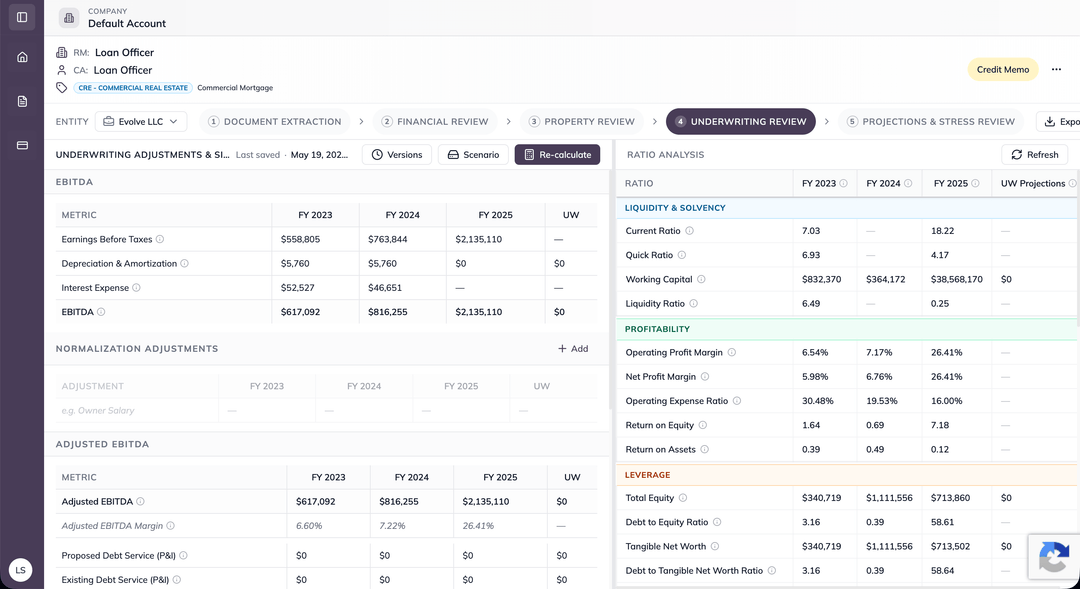
Each calculated value is cited back to the source document and page, with the inputs, thresholds and timestamp retained as data lineage.

One portfolio view, not one spreadsheet per analyst

Covenant status, aging reporting obligations and watch-list movement roll up across the book instead of living in individual tracking files.

Operational leverage without a migration

Modular entry: start with covenant monitoring on one portfolio segment, live in as little as five business days, and expand from there.

Coverage

What the agent tests, and how it reports it

Financial covenants that resolve to a calculable threshold are tested automatically on every incoming statement. Reporting and affirmative covenants are tracked as dated obligations that age until satisfied.

Illustrative covenant test output for a single commercial relationship
Covenant Tested as Type Agent output
Debt service coverage DSCR ≥ threshold Financial In compliance
Leverage / debt to EBITDA Total debt ÷ EBITDA ≤ threshold Financial Trending to breach
Fixed charge coverage FCCR ≥ threshold Financial In compliance
Minimum tangible net worth TNW ≥ floor Financial Breach detected
Loan-to-value / debt yield LTV ≤ cap · debt yield ≥ floor Financial (CRE) In compliance
Capital expenditure limit Period capex ≤ cap Financial In compliance
Financial statement delivery Received by contractual due date Reporting Aging — not received
Compliance certificate Received and signed Reporting Received
Borrowing base certificate Received · availability recalculated Reporting Received
Insurance certificate Active through required coverage period Affirmative Expiring

Illustrative output. Covenant definitions, thresholds, cure periods and severity routing are configured to your credit policy and the language of each executed agreement.

Capabilities

Built for the back office of commercial credit

Covenant extraction

Pulls covenant definitions, thresholds, testing frequency and reporting obligations out of the executed credit agreement.

Automated financial spreading

Spreads incoming statements and tax returns at 95%+ extraction accuracy, certified by Uptiq's knowledge team of former underwriters.

Policy-aware test engine

Applies your covenant definitions, cure periods and materiality thresholds rather than a vendor's generic ratio library.

Reporting obligation tracking

Holds every dated deliverable per relationship and ages it against the contractual due date until it is satisfied.

Exception queue and routing

Breaches, near-breaches and missing documents are raised with severity and surfaced against the owning relationship manager.

Stress simulation

Re-tests the book against changed assumptions so you can see which relationships move to watch status before they get there.

Portfolio rollups

Aggregates covenant status and exception aging across segments, so portfolio reporting stops being rebuilt by hand each cycle.

Audit trail and data lineage

Every value traces to the document and page it came from, with inputs, thresholds and timestamps retained for review.

Integrations, not migrations

100+ native integrations across cores, loan origination systems and document repositories. Private-cloud deployment available.

How it works

Five steps, running continuously

The sequence repeats every time a document lands. There is no batch window to wait for.

01

Ingest

Financial statements, compliance certificates, borrowing base certificates and insurance renewals are picked up from your inbox, portal or document repository as they arrive.

02

Extract and spread

The agent identifies the document type, extracts the line items and spreads them into your standard template at 95%+ extraction accuracy.

03

Test against the agreement

Each covenant is calculated using the definition written into that borrower's credit agreement and compared to the agreed threshold for the period.

04

Flag and route

A breach, a near-breach or a missing deliverable is raised as an exception with severity and owner, within 24 hours of the document being received.

05

Evidence and roll up

Every result is cited back to its source page, the relationship record is updated, and the portfolio view reflects the change without anyone re-keying it.

FAQ

Covenant and portfolio monitoring, answered

What is automated covenant monitoring?

Automated covenant monitoring is the practice of testing a borrower's financial and reporting covenants continuously as documents arrive, rather than manually at a scheduled review. An AI agent extracts the covenant definitions from the credit agreement, spreads each incoming financial statement or compliance certificate, calculates the tested ratios, compares them to the agreed thresholds and raises an exception when a covenant is out of compliance or trending toward it.

How quickly does Uptiq detect a covenant breach?

Uptiq flags a covenant breach within 24 hours of the underlying document being received. Detection is tied to document arrival rather than to your review calendar, so a breach surfaces in the current period instead of at the next quarterly review cycle.

Do we have to replace our core or loan origination system?

No. The Continuous Monitoring Superagent runs as a layer over your existing core, loan origination system and document repository, with more than 100 native integrations available. There is no rip-and-replace, and a single agent can be live in production in as little as five business days.

Which covenants can the agent test automatically?

Financial covenants that resolve to a calculable ratio or threshold are tested automatically, including debt service coverage, leverage and debt-to-EBITDA, fixed charge coverage, minimum tangible net worth, current ratio, capital expenditure limits, loan-to-value and debt yield. Reporting and affirmative covenants such as financial statement delivery, compliance certificates, insurance certificates and borrowing base certificates are tracked as obligations with due dates and aging.

What happens when a borrower does not send their financials on time?

The agent tracks each reporting obligation against its contractual due date. When a document has not arrived, the obligation ages and appears in the exception queue with the specific missing item, the borrower, the relationship manager and the number of days past due — so your portfolio team can act on a named item rather than reconstructing a tickler list from a spreadsheet.

What audit trail does automated covenant monitoring leave?

Every calculated value is cited back to the source document and page it was extracted from, so a reviewer or examiner can trace a covenant result to the statement line that produced it. Extraction is certified at 95% or better accuracy by Uptiq's knowledge team of former underwriters and bankers, and each test retains its inputs, thresholds and timestamp as data lineage.

Next step

Stop finding breaches a quarter late

We will walk one of your covenant structures through the agent — extraction, test, exception and audit trail — against a real credit agreement format your team uses.

Request a walkthrough

See Uptiq in action

Tell us how your portfolio is monitored today and which covenants cause the most rework. We will show you the agent running that exact scenario.

Typical first agent: live in production in as little as five business days.