
AI Agents for Commercial Loan Application Intake | Uptiq
Use case · Commercial lending

AI agents for commercial loan application intake

The incomplete package is the most expensive thing in your pipeline, because you pay for it three days later. Uptiq's Intake Agent reads, classifies and completeness-checks every submission on receipt — so only a ready file reaches underwriting.

Validates against your requirement checklist for the specific facility, names exactly what is missing, and routes a structured file onward. Live in production in as little as five business days.

See how it works
95%+

Extraction accuracy, certified by former underwriters

41%

Reduction in underwriting cycle time downstream

100+

Native integrations — inbox, portal, LOS, document store

5 days

To get a first agent live in production

The problem

The incomplete package doesn't cost you at intake. It costs you three days later.

A submission lands in a shared inbox, gets accepted, and joins the queue. Days later an analyst opens it, discovers the third year of financials is missing and one document is the wrong entity, and the deal goes backwards — behind everything that arrived while it was moving.

Submissions arrive as a pile

Files come in across email, portals and hand-offs, unlabelled and unordered. Before anyone can assess the loan, someone has to work out what each document even is.

Ops persona: intake, sorting, tickler setup — before underwriting starts
Completeness is checked by a person, late

Whether the package has everything the facility requires is a manual judgment, made when the analyst finally reaches the file — not when it arrived and could still be fixed cheaply.

“we need minimal touch points” — Head of Lending

The gap restarts the clock

One missing return sends the request back out, and when it returns it re-enters the queue rather than resuming. The most expensive delay in lending starts with the cheapest thing to catch.

“application all the way to boarding with quality control stops”

The solution

A validated file, not a folder of uploads

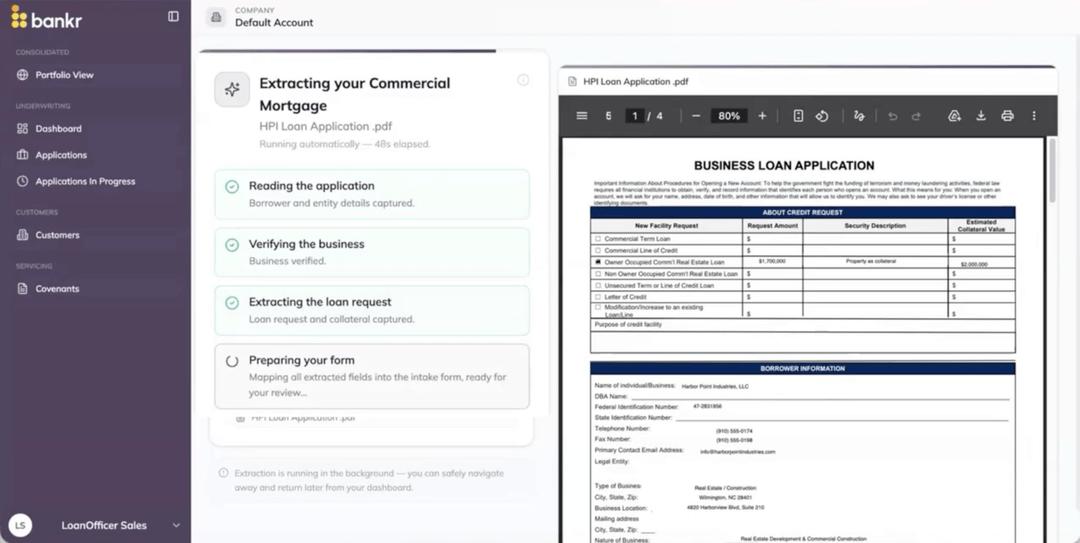
The Intake Agent processes the submission the moment it arrives. It classifies every document, tests the package against your checklist for the requested facility, extracts the identifying fields, and flags what is missing, unreadable or mismatched — so the file that reaches underwriting is complete, structured and ready to work.

  • Classifies each document by type against your taxonomy — returns, statements, rent rolls, entity docs and more.
  • Tests completeness against the requirement checklist for the specific facility requested.
  • Extracts identifying fields at 95%+ accuracy, each cited to the document it came from.
  • Flags missing periods, unreadable scans and documents that belong to the wrong entity.
  • Routes a complete, structured file to underwriting and surfaces the outstanding list to the internal owner.
Why it matters

What changes when the door does the checking

Only complete files enter the queue

Gaps are caught at receipt, where they are cheap to fix, instead of days later where they restart the clock.

Underwriting starts on the analysis

The analyst opens a structured, validated package and spends the first hour on credit, not on working out what each file is.

Nothing is checked twice

Classification and extraction done at intake carry forward, so the same document is not re-read and re-keyed at the next stage.

The file is defensible from day one

Every extracted field is cited to its source document, so provenance is established before the credit work even begins.

Completeness

A different checklist for a different facility

Completeness is not one list. What a CRE term loan needs is not what an equipment finance facility needs. The agent tests each submission against the checklist that applies to the facility actually requested.

Illustrative required-document matrix by facility type
Document C&I line CRE term Equipment finance
Business tax returns (3 yrs) Required Required Required
Interim financial statements Required Required If material
Personal financial statement Required Required Required
Guarantor personal returns Required Required If guaranteed
Debt schedule Required Required Required
Accounts receivable / inventory aging Required
Rent roll & leases Required
Appraisal / valuation If secured Required Required
Purchase order / equipment quote Required
Entity formation & org documents Required Required Required

Illustrative only. Requirement checklists, period counts and conditional rules are configured to your credit policy for each facility type you offer.

Capabilities

What the Intake Agent does at the door

Multi-channel capture

Picks up submissions from shared inboxes, borrower portals, LOS uploads and document repositories as they arrive.

Document classification

Identifies each file by type against your taxonomy, distinguishing business from personal returns and one entity's statements from another's.

Checklist completeness testing

Matches the package to the requirement list for the requested facility and produces a named outstanding-items list, not just a count.

Key field extraction

Pulls borrower and entity names, requested amount and identifying details at 95%+ accuracy, each cited to its source document.

Quality and mismatch flags

Surfaces unreadable scans, expired documents, missing periods and files that belong to the wrong entity or applicant.

Outstanding-item visibility

Holds the open list per deal with aging and surfaces the specific missing document to the internal owner responsible for the file.

Structured routing

Sends a complete, classified file to underwriting, and holds an incomplete one out of the queue until it is ready.

Provenance from intake

Citations and classifications established at the door carry through the file, so nothing is re-read or re-keyed downstream.

Integrations, not migrations

100+ native integrations across cores, loan origination systems and document repositories. Private-cloud deployment available.

How it works

From a submission to a validated file

Five steps, run on every package the moment it lands.

01

Capture on arrival

The agent picks up the submission from whatever channel it came in on — inbox, portal, LOS or document store — without waiting for anyone to open it.

02

Classify every document

Each file is identified by type against your taxonomy, so an unlabelled pile becomes a structured set of known documents tied to the right borrower and entity.

03

Test against the checklist

The classified set is matched to the requirement list for the facility requested, accounting for the number of periods needed and any conditional rules in your policy.

04

Flag and list the gaps

Missing periods, unreadable scans and wrong-entity documents are named in an outstanding-items list and surfaced to the internal owner of the file.

05

Route what's ready

A complete, structured file moves to underwriting with its extractions and citations attached. An incomplete one is held out of the queue until the gap is closed.

What happens next

Intake is the front door. The rest of the pipeline is waiting behind it.

A validated file is only worth having if the next stage moves too. The Intake Agent hands off to the same commercial lending agents that handle spreading, analysis, the memo and post-close monitoring.

Once the file is complete, it flows straight into underwriting

The same structured package feeds global cash flow analysis, the credit memo and covenant monitoring — and shrinks total turnaround, not just the intake step.

FAQ

Commercial loan intake, answered

What does an AI agent do at commercial loan intake?

An intake agent processes a commercial loan application package the moment it arrives. It classifies each file in the submission by document type, checks the package against the requirement checklist for the facility being requested, extracts key identifying fields such as borrower and entity names and requested amount, and flags anything that is missing, unreadable, expired or internally inconsistent. The result is that a structured, complete file reaches underwriting, and an incomplete one is caught at the door rather than three days into the queue.

How is intake automation different from a document upload portal?

A portal collects files; it does not understand them. It cannot tell a personal tax return from a business return, notice that the third year of financials is missing, or recognise that a document is the wrong entity. An intake agent reads and classifies each document, tests the package for completeness against your policy checklist for that facility type, and identifies specific gaps. The portal answers whether something was uploaded; the agent answers whether the file is ready to underwrite.

Which documents can the intake agent recognise and classify?

The agent classifies the documents that make up a commercial credit file, including business and personal tax returns, interim and year-end financial statements, bank statements, debt schedules, rent rolls, leases, appraisals, borrowing base certificates, entity formation and organisational documents, personal financial statements and identification. Classification is configured to your document taxonomy and the requirement checklist that applies to each facility type you offer.

How does the agent decide whether an application is complete?

Completeness is tested against your requirement checklist for the specific facility requested, because a CRE term loan, an equipment finance facility and a C&I line of credit each need a different document set. The agent matches the classified documents to that checklist, accounts for the number of periods required, and produces an outstanding-items list naming exactly which documents are missing rather than reporting only that the package is incomplete.

Does the intake agent make credit decisions?

No. The intake agent establishes whether a file is complete and readable and routes it onward; it does not assess creditworthiness, assign a risk rating or approve or decline anything. Its job ends where underwriting begins. Every field it extracts is cited back to the source document, so the analyst who picks up the file can see where each value came from and is working from a validated package rather than a raw pile of uploads.

Does intake automation require replacing our loan origination system?

No. The Intake Agent runs over your existing loan origination system, document repository and channels such as shared inboxes and portals, with more than 100 native integrations available. There is no core or LOS replacement and no data migration, and a single agent can be live in production in as little as five business days.

Next step

Send us a real submission — incomplete on purpose

Bring a redacted application package with a gap in it. We will run it through the Intake Agent and show you the classification, the completeness check and the exact outstanding list it produces against your facility checklist.

Request a walkthrough

See Uptiq in action

Tell us what your intake process looks like today and where packages tend to stall. We will show you the agent validating that exact submission flow.

Typical first agent: live in production in as little as five business days.