Introduction: Retail Banking Is Being Rebuilt from the Inside Out
Retail banking is undergoing a structural transformation, not at the surface level of mobile apps or chatbots, but deep inside core operations.
For decades, banks have relied on:
- Manual workflows
- Siloed systems
- Rule-based automation
- Human-heavy operations
While digital channels improved customer access, the operational backbone of retail banking remained largely unchanged. Today, that’s no longer sustainable.
Rising customer expectations, regulatory pressure, cost constraints, and competition from fintechs are forcing banks to rethink how work gets done. The answer isn’t more tools, it’s AI agents.
AI agents are not just another layer of automation. They represent a fundamental shift in how retail banking operations are executed, coordinated, and scaled.
What Are AI Agents in Retail Banking?
AI agents are autonomous, goal-driven software entities that can:
- Observe data across systems
- Make context-aware decisions
- Execute tasks independently
- Coordinate with humans and other systems
- Learn and improve over time
Unlike traditional automation scripts or RPA, AI agents operate across workflows, not just individual steps.
In retail banking, AI agents act as:
- Digital operations analysts
- Intelligent workflow coordinators
- Always-on process owners
- Decision-support engines
This makes them uniquely suited to modern banking environments.
Why Core Retail Banking Operations Need AI Agents Now
1. Fragmented Systems Are Slowing Banks Down
Most retail banks operate with:
- Legacy core systems
- Separate loan origination platforms
- Standalone KYC tools
- Independent CRM and servicing systems
AI agents sit above these systems, orchestrating workflows without forcing banks to rip and replace existing infrastructure.
2. Manual Work Is Costly and Error-Prone
Core retail banking processes, like onboarding, account servicing, lending, and compliance, still rely heavily on human review.
This results in:
- Long processing times
- Inconsistent decisions
- Operational risk
- High cost per customer
AI agents dramatically reduce this burden by automating decision-heavy, repetitive work.
3. Customer Expectations Have Changed
Retail customers expect:
- Instant decisions
- Proactive service
- Personalized experiences
- 24/7 availability
Without AI agents running continuously in the background, banks simply can’t meet these expectations at scale.
How AI Agents Are Rewiring Core Retail Banking Operations
1. Customer Onboarding & KYC
Traditional model:
- Manual document collection
- Static rule checks
- Long verification cycles
- High abandonment rates
AI-agent-driven model:
- AI agents collect and classify documents automatically
- Verify identity, address, and financial data in real time
- Flag inconsistencies instantly
- Route exceptions to humans only when needed
Impact:
- Faster account opening
- Lower compliance risk
- Higher onboarding completion rates
2. Lending & Credit Decisioning
Retail lending is one of the most operationally intensive areas of banking.
AI agents transform lending by:
- Reading and validating financial documents
- Analyzing cash flows, income, and liabilities
- Cross-checking data across applications, statements, and credit reports
- Surfacing risk signals before underwriting
- Coordinating approvals across teams
Instead of underwriters spending hours reviewing documents, AI agents prepare decision-ready loan files in minutes.
3. Account Servicing & Customer Requests
Routine servicing requests, address changes, limit increases, payment adjustments, consume massive operational resources.
AI agents:
- Interpret customer intent across channels
- Verify eligibility and compliance rules
- Execute changes automatically
- Escalate only edge cases
This turns servicing from a cost center into a high-efficiency operation.
4. Fraud Detection & Risk Monitoring
Retail banking fraud is no longer rule-based, it’s behavioral.
AI agents continuously:
- Monitor transaction patterns
- Detect anomalies in real time
- Cross-reference customer behavior
- Trigger alerts or actions automatically
Because agents operate continuously, risk is identified before losses occur, not after.
5. Compliance & Regulatory Operations
Compliance teams are overwhelmed by:
- Documentation requirements
- Audit requests
- Ongoing monitoring obligations
AI agents support compliance by:
- Maintaining audit-ready documentation trails
- Verifying policy adherence automatically
- Monitoring regulatory thresholds in real time
- Generating explainable decision logs
This reduces compliance cost while improving regulatory confidence.
AI Agents vs Traditional Banking Automation
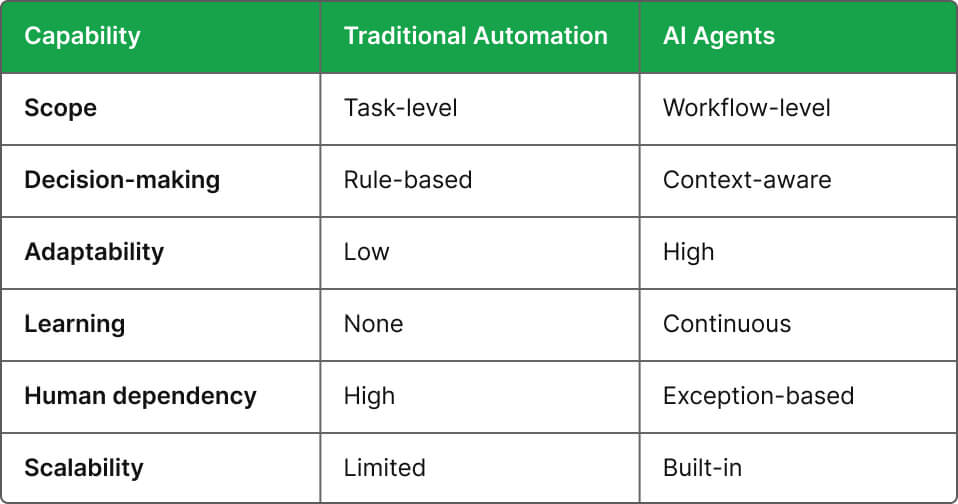
AI agents don’t just automate, they operate.
The Operational Benefits for Retail Banks
Faster Time-to-Decision
Loan approvals, account changes, and servicing requests happen in minutes instead of days.
Lower Cost-to-Serve
Banks reduce headcount pressure without sacrificing service quality.
Improved Risk Control
AI agents catch inconsistencies humans miss.
Better Customer Experience
Always-on operations mean customers aren’t waiting for business hours.
Scalable Growth
Banks grow without linear increases in operational cost.
How Uptiq Enables AI Agents for Retail Banking
Uptiq provides AI-ready banking infrastructure that allows retail banks to deploy AI agents across core operations without system disruption.
What Makes Uptiq Different
- Purpose-built AI agents for banking workflows
- Deep document intelligence across financial, tax, and identity data
- Explainable, audit-ready AI for regulated environments
- Seamless integration with existing core systems
- Modular deployment across onboarding, lending, servicing, and risk
Uptiq doesn’t replace your core, it activates it with intelligence.
Real-World Use Cases Banks Are Implementing Today
- AI-driven retail loan origination
- Automated KYC and customer onboarding
- Intelligent customer servicing
- Proactive fraud prevention
- Continuous compliance monit
Banks adopting AI agents early are already seeing:
- Faster approvals
- Lower operating costs
- Higher customer satisfaction
- Stronger risk posture
The Future of Retail Banking Is Agent-Driven
In the next few years:
- Manual banking operations will become a liability
- Rule-based automation will hit its limits
- AI agents will become the operational standard
Retail banks that adopt AI agents today will outperform competitors on:
- Speed
- Cost
- Experience
- Risk management
Those that don’t will struggle to keep up.
Conclusion: Modern Banks Run on AI Agents
The modern retail bank isn’t defined by branches or apps, it’s defined by how intelligently it operates.
AI agents are rewiring the core of retail banking:
- Making operations autonomous
- Decisions faster
- Risk more manageable
- Customers more satisfied
With platforms like Uptiq enabling AI agent-driven banking, the transformation is no longer theoretical, it’s happening now.
About the Author