AI vendor due diligence just got harder for banks and credit unions, not easier. In April 2026 the federal banking agencies replaced SR 11-7 with new model risk management guidance, then placed generative and agentic AI outside its scope. If you are evaluating an AI lending provider today, the agent that reads tax returns, spreads financials or drafts a credit memo may sit in a gap between your model risk program and your third-party risk program. Examiners are already asking about that gap. This article gives risk, credit and procurement leaders a practical question list for AI lending vendors, grouped into seven areas, with the evidence to request and how each question maps to SR 26-2, the 2023 interagency third-party guidance and the NIST AI Risk Management Framework.
What SR 26-2 changed for vendor models
SR 26-2 replaced the prescriptive SR 11-7 regime with a risk-based, materiality-driven approach, but it kept the expectation that banks understand the vendor models they rely on. On April 17, 2026, the Federal Reserve, OCC and FDIC issued the revised guidance as Federal Reserve SR 26-2, OCC Bulletin 2026-13 and FDIC FIL-15-2026. The Fed's letter says the guidance is "expected to be most relevant to banking organizations with over $30 billion in total assets."
Three shifts matter for any vendor review. First, materiality is the organizing principle. Charles River Associates' July 2026 analysis of SR 26-2 notes that inherent risk, exposure, purpose and use now drive the level of control, and banks must be able to justify their tiering. Second, the definition of a model is narrower, covering complex quantitative methods and excluding simple arithmetic and deterministic, rule-based processes.
Third, the guidance is principles-based. Davis Polk's April 27, 2026 visual memo on the revised guidance points out that it does not establish enforceable legal requirements, yet supervisory action can still follow from unsafe or unsound practices tied to weak model risk management. For vendor models, CRA's authors describe the bar plainly: banks must understand conceptual soundness, design, development data and performance even when source code is proprietary, and must document customizations.
Inventory, documentation, effective challenge and vendor model validation all survive the rewrite. What changes is how much rigor you apply.
Why generative and agentic AI vendors need a different question set
Generative and agentic AI vendors need a different question set because SR 26-2 explicitly leaves them out, while examiners keep asking about them. The guidance states that generative AI and agentic AI models "are novel and rapidly evolving" and "are not within the scope of this guidance," and the agencies plan a request for information on AI. That leaves document reading, memo drafting and multi-step agents without a dedicated playbook.
DefenseStorm's June 2026 analysis of the AI guidance gap puts it simply: "Out of scope is not out of bounds." Its advice is to hold AI vendors to your existing third-party standards and to press on the AI embedded in tools you do not think of as AI vendors, including the fourth-party models sitting behind them. CRA's authors add that agentic systems often embed traditional models, so one underwriting agent may mix in-scope and out-of-scope steps.
What examiners are asking now
Supervisors are not waiting for the request for information. Reuters reported on October 13, 2026 that the OCC, FDIC and Fed are asking banks what limits are placed on systems, whether they can clearly track and audit AI agent decisions, what stops agents exceeding their authority, whether people stay involved in key decisions and how autonomous systems can be shut down. Each lands on your vendor, who built the controls you must explain.
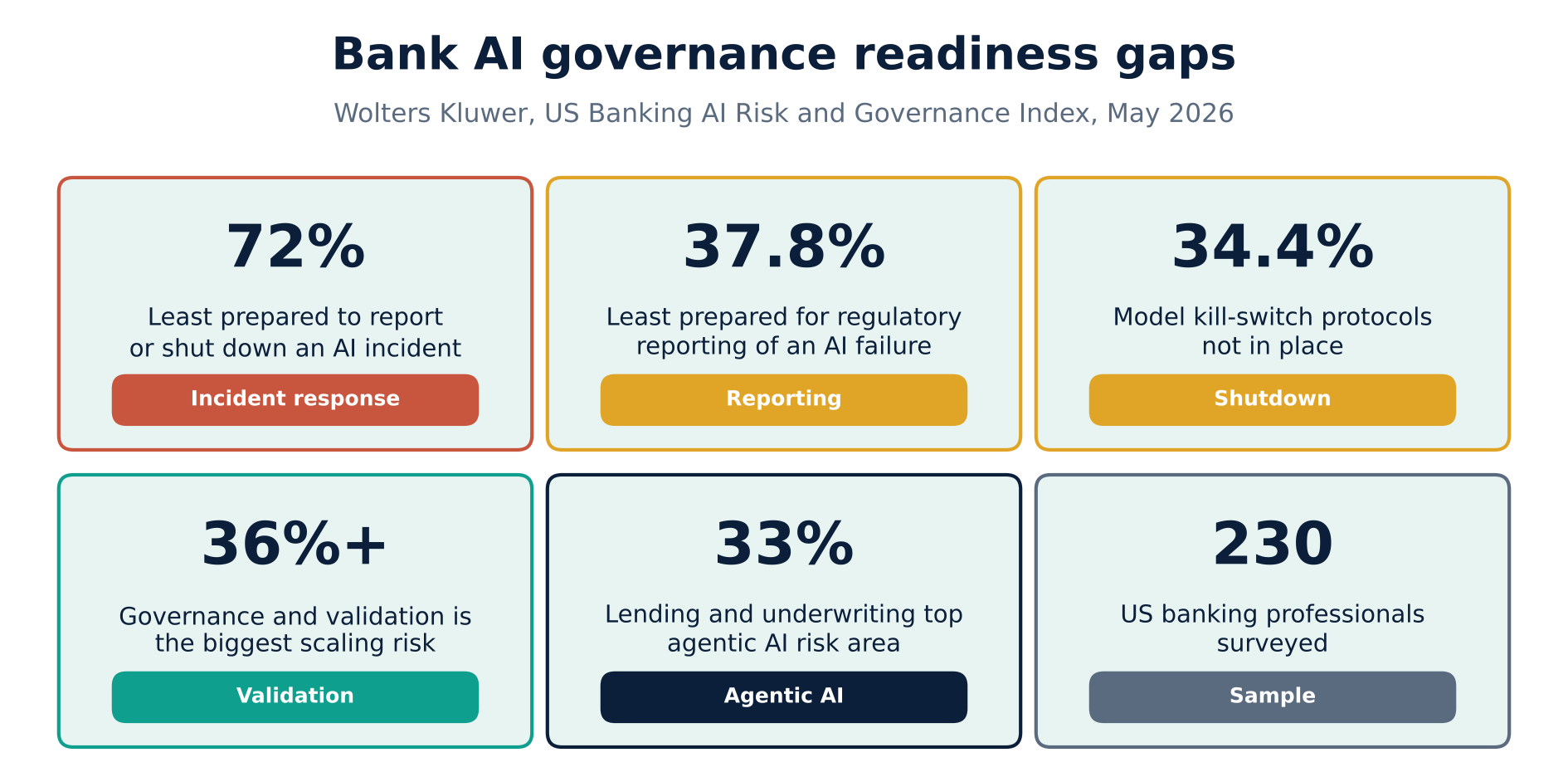
Readiness is thin. The Wolters Kluwer US Banking AI Risk and Governance Index (May 2026), based on 230 US banking professionals, found that 72% said their institution is least prepared for reporting or shutting down an AI incident. In the same survey, 37.8% named regulatory reporting of an AI failure as their least prepared area, 34.4% said model kill-switch protocols are not in place, and over 36% said model governance and validation are their biggest risk factor when scaling AI. For agentic AI, lending and underwriting workflows (33%) were the leading risk area named.
You may also read: Banking AI Governance: Why Most Pilots Die and How to Ship Them
The AI vendor due diligence question list for lending providers
A strong AI vendor due diligence list asks for evidence in seven areas: grounding and data, controls and authority limits, evidence and audit trail, validation and monitoring, security and data handling, contract terms and exit. The table below gives the core questions and the artifacts that prove the answer. Scale depth to materiality.
Grounding and data
Ask the vendor to run a sample of your own documents and show the source page behind every extracted number and draft memo sentence. CIMCON's August 2026 analysis of SR 26-2 notes that source traceability also supports explainable adverse action notices.
Controls, evidence and exit
The Reuters questions map onto three rows: authority limits, audit trail and shutdown. Ask the vendor to pause an agent mid-workflow, show the log entry, then restore it. If they cannot do that in a demo, your team cannot do it in an incident.
How to map vendor answers to SR 26-2, TPRM and NIST AI RMF
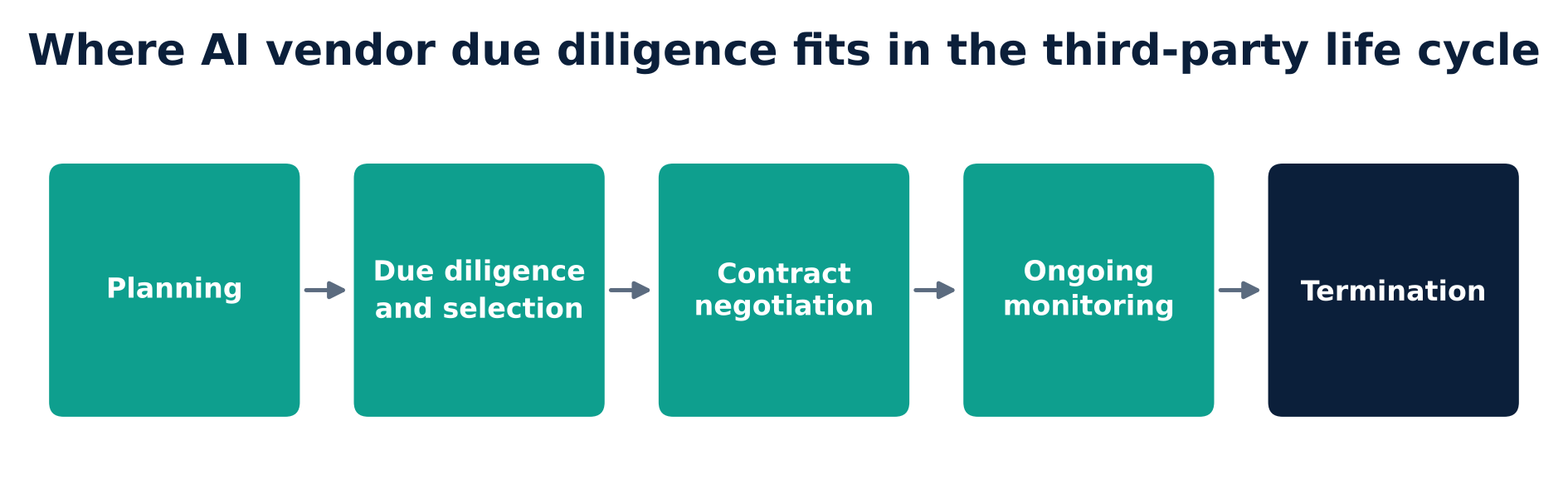
Map vendor answers to three frameworks at once: SR 26-2 for any in-scope model components, the 2023 interagency third-party guidance for the relationship, and the NIST AI RMF for generative and agentic components. The Interagency Guidance on Third-Party Relationships (OCC Bulletin 2023-17, June 6, 2023) says a banking organization's use of third parties "does not diminish its responsibility" to meet legal and regulatory requirements. It sets out five life cycle stages: planning, due diligence and third-party selection, contract negotiation, ongoing monitoring, and termination.
The NIST AI Risk Management Framework, released January 26, 2023 and intended for voluntary use, organizes AI risk into four functions: Govern, Map, Measure and Manage. NIST added a Generative AI Profile (NIST AI 600-1) on July 26, 2024. It gives your team a shared vocabulary for the components SR 26-2 leaves out.
Treat this as a working crosswalk, not a legal opinion. Agree one tiering decision per use case across model risk, compliance and vendor management, so a component approved by one team is not signed under a contract lacking audit or exit rights.
You may also read: Can AI underwriting meet regulatory compliance requirements?
Red flags that should stop or slow a deal
The clearest red flag is a vendor that answers governance questions with assurances instead of artifacts. A few others recur in AI lending evaluations:
- Accuracy without context. No confidence threshold, test set or human review step.
- Post-hoc controls only. Policy checks that run after an agent acts stop nothing.
- Opaque fourth parties. The vendor cannot name the external models it calls.
- Training on your data by default. Reuse of borrower data should be opt-in and contractual.
- No tested shutdown. An unexercised kill switch is a plan, not a control.
- AI that decides. Credit should never be approved, declined or priced without a credit officer.
How the Uptiq platform answers the question list
The Uptiq platform was built to give clear, evidenced answers to this list, because it is designed to be bank-grade: grounded, governed and provable. It works as a new tier, not a new core, sitting alongside your loan origination and core systems. Here is how it maps to each area.
- Grounded. The Knowledge Hub holds your policies, credit guidelines and source documents, and Document AI classifies, extracts, validates and generates with links back to the source page. Uptiq customers have seen 95%+ extraction accuracy, applied with confidence thresholds and human review.
- Governed. The Validation Hub checks every action before it runs against your rules and authority limits. Agents such as the Intake Agent and the Underwriting Agent prepare, check and document. Credit officers make every credit decision.
- Provable. Each step produces an evidence receipt showing inputs, sources, rule checks, reviewer and output, so a file can be reconstructed for an examiner or auditor.
- Information security. The platform runs in your institution's own VPC. External calls are blocked by default, and your team decides which agents can reach outside. Personal data is masked before it reaches any external model, with no retention and no training on your data.
- Control and exit. The platform Console is where your team configures agents, permissions and approvals, and can pause an agent when needed.
Uptiq customers have seen 41% faster underwriting and 63% less credit memo prep time, which teams use as capacity creation for growth rather than as a reason to cut corners on review. See also what agentic AI means in finance and the Uptiq compliance and risk solution.
Conclusion: Govern the agent, not just the model
SR 26-2 narrowed what counts as a model and set generative and agentic AI aside, but examiners are already asking about agent limits, audit trails and shutdown. The practical response is to fold AI vendor due diligence into one materiality-tiered review that spans model risk, third-party risk and the NIST AI RMF, and to demand evidence at every step.
The Uptiq platform is designed to make that review straightforward: grounded outputs through the Knowledge Hub, governed actions through the Validation Hub, and evidence receipts for every step, running in your own VPC. It helps you govern and control your AI while extending your teams.
See the evidence behind every agent action
Bring your vendor due diligence questionnaire to a working session and we will walk through each answer live, from source traceability to a tested agent pause.
Frequently Asked Questions
Does SR 26-2 cover generative AI?

Is AI underwriting compliant with bank regulations?
What is the SR 11-7 replacement?
Does SR 26-2 apply to community banks and credit unions?
How does the NIST AI RMF help with AI vendor due diligence?
What evidence should an AI lending vendor provide?
Who is responsible when a third-party AI tool makes an error?
How often should AI vendors be reviewed after onboarding?
About the Author