Why Borrower Integrity Is the New Frontier of Lending Risk
For decades, loan risk assessment focused on a narrow set of indicators: credit scores, collateral values, and historical financial statements. While these signals still matter, they are no longer enough.
Modern borrowers are more complex.
Lending fraud is more sophisticated.
Regulatory scrutiny is higher than ever.
Today, the biggest risk isn’t just whether a borrower can repay a loan, it’s whether the lender truly understands who the borrower is, how the business operates, and whether the information provided can be trusted.
This is where borrower integrity becomes critical.
Borrower integrity means verifying that:
- Financials are accurate and consistent
- Documents are authentic and complete
- Background disclosures align with reality
- Collateral and assets actually exist
- Risks are identified before approval, not after default
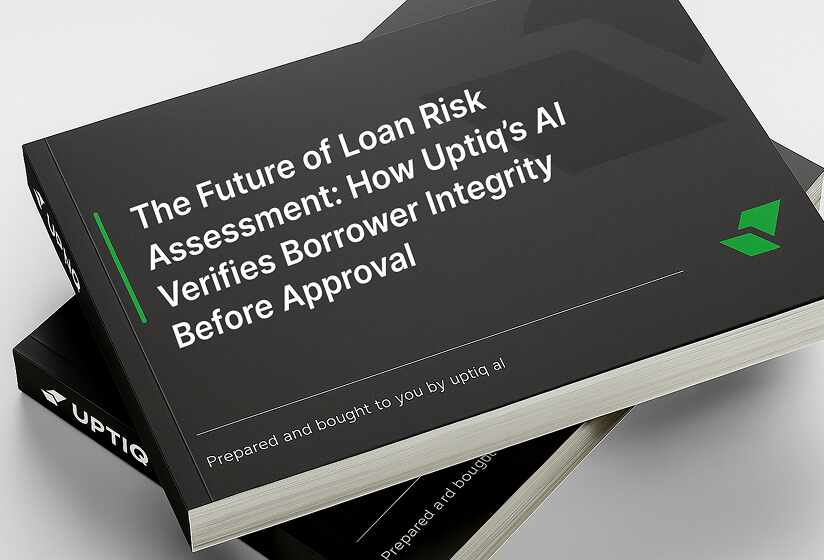
The future of loan risk assessment lies in AI-driven verification, not manual review. Uptiq’s AI platform is built exactly for this future, helping banks, credit unions, and fintech lenders verify borrower integrity before approval, at speed and at scale.
1. Why Traditional Risk Assessment Is No Longer Enough
1.1 Credit Scores Don’t Tell the Full Story
Credit scores are backward-looking. They don’t capture:
- Real-time cash flow stress
- Rapid business changes
- Fraudulent financial behavior
- Entity-level inconsistencies
Two borrowers with the same score can have vastly different risk profiles.
1.2 Manual Document Review Creates Blind Spots
Traditional underwriting depends heavily on human review of:
- Bank statements
- Tax returns
- Appraisals
- Background reports
This approach is:
- Slow
- Inconsistent
- Error-prone
- Difficult to audit
Underwriters simply can’t cross-verify dozens of documents reliably at scale.
1.3 Fraud Has Become Document-Driven
Modern lending fraud often hides in plain sight:
- Altered PDFs
- Inflated revenue statements
- Reused appraisals
- Inconsistent ownership disclosures
- Fake contracts or trade references
Manual processes catch only a fraction of these risks.
2. What Borrower Integrity Really Means
Borrower integrity goes beyond “creditworthiness.”
It answers deeper questions:
- Is the borrower being truthful?
- Do documents align across financial, legal, and background data?
- Are there hidden risks that won’t appear in a credit report?
- Can this borrower be trusted with long-term capital?
Integrity is about verification, not assumption.
3. The Shift to AI-Driven Loan Risk Assessment
The future of lending risk assessment relies on AI that understands lending context, not just generic automation.
AI-driven risk assessment:
- Reads and understands complex documents
- Extracts and standardizes data
- Cross-checks information across sources
- Flags inconsistencies and anomalies
- Produces explainable risk signals
This is the foundation of Uptiq’s approach.
4. How Uptiq Verifies Borrower Integrity Before Approval
Uptiq uses domain-specific AI agents designed for banking and lending workflows. These agents work together to verify borrower integrity across three critical layers:
- Financial Integrity
- Document & Disclosure Integrity
- Background, Collateral & Compliance Integrity
Let’s examine each in detail.
5. Financial Integrity: Verifying the Truth Behind the Numbers
Documents Analyzed
- Bank Statements
- Brokerage Statements
- Business Financial Statements (CPA & Company-Prepared)
- Personal Financial Statements
- Accounts Receivable Aging Reports
- Rent Rolls
- Business Debt Schedules
- Vendor Invoices & Quotes
How Uptiq’s AI Verifies Financial Integrity
Uptiq’s AI agents automatically:
- Extract transaction-level data from bank statements
- Identify revenue patterns and volatility
- Flag unexplained cash inflows or outflows
- Detect overdraft frequency and liquidity stress
- Cross-verify financial statements against bank activity
- Identify undisclosed debt obligations
Instead of trusting summary numbers, Uptiq validates how money actually moves through the business.
Result:
Financial misrepresentation becomes significantly harder to hide.
6. Government & Regulatory Integrity: Eliminating Compliance Gaps
Documents Analyzed
- IRS Forms 1040, 1065, 1120, 1120-S
- IRS K-1 Statements
- IRS Forms 8825, 1099, 941, W-9
- SBA Forms 1919, 413, 912
- USDA Loan Guarantee Applications
AI-Driven Verification Capabilities
Uptiq’s AI:
- Extracts income, ownership, and liability data
- Verifies consistency across tax years
- Aligns tax-reported income with bank deposits
- Identifies missing schedules or incomplete filings
- Flags discrepancies between SBA disclosures and financial data
This ensures lenders are not relying on incomplete or selectively presented information.
7. Background Integrity: Verifying Who You’re Lending To
Documents Analyzed
- Background Reports (Business & Personal)
- Management Resumes
- Customer Lists
- Customer Contracts
- Trade References
How Uptiq Reduces Identity & Relationship Risk
Uptiq’s AI agents:
- Validate management experience against business complexity
- Identify customer concentration risk
- Detect over-reliance on a small number of contracts
- Flag inconsistencies between claimed revenue and contracts
- Surface outdated or missing background disclosures
This helps lenders understand who is behind the business, not just the balance sheet.
8. Collateral & Asset Integrity: Ensuring Real Value Exists
Documents Analyzed
- Commercial Appraisal Reports
- Uniform Residential Appraisal Reports
- Lease Agreements
- Vehicle Titles
- Construction Budgets
AI-Driven Collateral Validation
Uptiq’s platform:
- Extracts asset values and ownership data
- Flags outdated or reused appraisals
- Compares collateral value against loan size (LTV alignment)
- Identifies lease obligations that affect cash flow
- Detects inconsistencies across asset-related documents
Collateral risk becomes quantifiable and verifiable, not assumed.
9. Environmental & Regulatory Integrity
Documents Analyzed
- Environmental Questionnaires
- Flood Zone Determinations
- Lender Site Visit Reports
How Uptiq Protects Lenders from Hidden Exposure
Uptiq’s AI:
- Flags environmental risk indicators
- Identifies flood-zone exposure
- Ensures required site visits are completed
- Highlights missing compliance documentation
This reduces long-term regulatory and legal risk.
10. Cross-Document Intelligence: Where Integrity Is Proven
The most powerful risk signals emerge when data is cross-verified.
Uptiq’s AI agents automatically:
- Compare tax income vs bank deposits
- Validate revenue claims against customer contracts
- Align lease terms with expense projections
- Cross-check ownership data across forms
- Flag inconsistencies across entities and years
This is how integrity is proven, not assumed.
11. Explainable AI: Critical for Regulators and Risk Committees
Unlike black-box AI, Uptiq provides:
- Clear source attribution for every data point
- Document-level traceability
- Explainable risk flags
- Audit-ready decision logic
This makes Uptiq suitable for:
- Regulatory audits
- Internal risk reviews
- Credit committee approvals
12. Benefits for Banks & Credit Unions
Faster Approvals
Loan decisions that once took weeks now take minutes.
Lower Default & Fraud Risk
Integrity-based lending improves portfolio quality.
Reduced Operational Cost
Underwriters spend less time on paperwork and more on judgment.
Stronger Compliance Posture
Every decision is defensible and auditable.
Better Borrower Experience
Fewer follow-ups, less friction, faster outcomes.
13. Why Uptiq’s AI Is Different
Generic AI tools:
- Extract text
- Stops there
Uptiq’s AI:
- Understands lending logic
- Verifies truth across documents
- Aligns with underwriting frameworks
- Is built for banks and credit unions, not generic use cases
This domain specificity is what enables true borrower integrity verification.
14. The Future: Integrity-First Lending Will Be the Standard
In the coming years:
- Trust-based lending will be viewed as risky
- Integrity-verified lending will be expected
- Regulators will demand stronger documentation logic
- Borrowers will expect faster, smarter decisions
The winners will be institutions that adopt AI-driven verification early.
The Future of Loan Risk Assessment Is Integrity-Driven
Loan risk assessment is no longer about checking boxes, it’s about verifying the truth.
With Uptiq’s AI-driven verification platform, lenders can:
- Validate borrower integrity before approval
- Reduce fraud and defaults
- Approve loans faster with confidence
- Deliver better borrower experiences
- Build safer, more profitable loan portfolios
The future of lending belongs to institutions that move from trust to truth.
Learn how Uptiq verifies borrower integrity at scale. Book a demo with us today!
About the Author