SMB lending is a volume game: smaller loans, higher expectations, thinner margins. Yet most lenders still chase documents and rebuild cash flows by hand across fragmented systems.
Spent manually reconstructing cash flows and spreading financials
Driven by fragmented document collection and manual follow-ups
Front-office growth limited by manual back-office bottlenecks
Deploy a single agent to solve a specific operational bottleneck or connect multiple agents to create an end-to-end lending workflow.
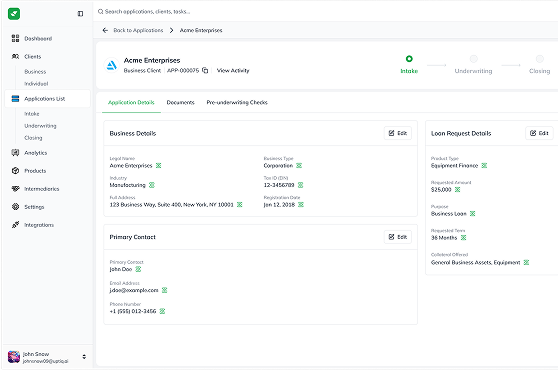
Engages borrowers across channels, collects required documents, validates application completeness, and prepares a fully packaged file before underwriting begins.

Analyzes borrower financials, applies policy rules, and generates structured scorecards and underwriting insights to accelerate credit decisions.

Automatically analyzes tax returns, financial statements, and bank data to generate standardized spreads. Calculates key credit metrics and maintains traceability back to original source documents.

Converts underwriting analysis, financial data, and risk insights into institution-ready credit memorandums. Every conclusion is supported by linked source documentatio

Continuously reviews borrower performance, covenant requirements, and reporting activity to identify potential issues before they affect portfolio quality.
Every agent works from one policy layer. Intake eligibility matches underwriting thresholds, which match the rules applied after funding. One framework, enforced from application through servicing.
Information collected once flows across the journey. Borrowers aren't asked twice, analysts aren't re-entering data, and RMs see the full borrower in one place.
Every score and exception is backed by source data, policy references, and a full activity trail. Teams explain decisions without rebuilding spreadsheets or digging through email.
Term loans, lines of credit, working capital, or SBA, the same workflow scales with volume. Add applications without adding complexity.
Measurable results from small business lenders using Uptiq's AI agents to automate SMB lending workflows.
Automate intake, underwriting, credit memo generation, and portfolio monitoring across complex C&I lending workflows.
Streamline eligibility reviews, SBA documentation, underwriting, and ongoing servicing while maintaining compliance with SBA requirements.
Accelerate property analysis, lease abstraction, financial spreading, covenant tracking, and portfolio monitoring for commercial real estate portfolios.
Automate application intake, credit analysis, document validation, and servicing workflows to improve decision speed and operational efficiency.
Pre-trained financial services capabilities that agents use across the SMB lending lifecycle.
Built with 100+ pre-built integrations across core banking platforms, loan origination systems, CRM platforms, accounting software, and open banking providers. Uptiq works within your existing environment without requiring infrastructure replacement.
Uptiq's SMB Lending solution is designed to help financial institutions automate and streamline the entire small business lending lifecycle. Rather than addressing a single task, the platform combines specialized AI agents that support borrower intake, business onboarding, document collection, cash flow analysis, underwriting, portfolio monitoring, and ongoing relationship management.
These agents work together through a shared data and policy framework, creating a connected workflow from application through portfolio management. Institutions can automate individual bottlenecks or build a more comprehensive lending operation without replacing their existing systems and processes.
The SMB Lending suite includes several purpose-built AI agents, each designed to solve a specific operational challenge. These include the Intake Superagent for borrower onboarding and document collection, the Business Deposit Account Opening Agent for account setup workflows, the Underwriting Superagent for financial analysis and credit decision support, the Cash Flow Analysis Agent for transaction-level liquidity assessment, the Business Analytics Agent for deeper borrower insights, and the Continuous Monitoring Superagent for ongoing portfolio oversight.
Together, these agents create a unified operating layer that helps institutions improve efficiency across the lending lifecycle.
Uptiq's Cash Flow Analysis Agent automatically extracts and analyzes transaction-level activity from borrower bank statements and financial records. The system categorizes deposits, withdrawals, transfers, payroll expenses, debt payments, and other cash movements to build a complete picture of a business's financial behavior. It calculates important metrics such as average monthly cash flow, liquidity trends, account volatility, and spending patterns while identifying potential risk indicators like recurring overdrafts or unusual transactions.
The result is a structured, underwriting-ready cash flow assessment that can be generated in minutes rather than hours of manual review.
Yes. Uptiq is designed to work alongside your existing technology environment rather than replace it. Through more than 100 pre-built integrations and APIs, the platform can connect with core banking systems, loan origination platforms, CRM applications, document repositories, accounting software, open banking providers, and other operational tools.
Information can move automatically between systems, reducing manual data entry and eliminating the need to maintain multiple disconnected workflows. Teams continue using the systems they already know while AI agents automate and accelerate work behind the scenes.
Deployment timelines are designed to be measured in days and weeks rather than months. Many institutions implementing a single agent can be operational within five business days, while broader multi-agent deployments are often completed within 30 days depending on workflow complexity and integration requirements. Uptiq manages implementation activities such as workflow configuration, policy setup, integration mapping, testing, and deployment support. Because the platform integrates with existing infrastructure, institutions can modernize lending operations without undertaking large-scale technology replacement projects.
Yes. Uptiq is built specifically for the security, governance, and compliance requirements of regulated financial institutions. The platform maintains SOC 2 Type II certification and incorporates enterprise-grade controls to protect sensitive borrower and financial data. Every calculation, recommendation, workflow action, and AI-generated output is supported by a complete audit trail and traceable source references. This level of transparency helps institutions satisfy internal governance requirements, regulatory expectations, and audit standards while maintaining confidence in the accuracy and integrity of AI-assisted processes.
Absolutely. Many financial institutions begin by addressing a specific operational bottleneck, such as borrower intake, cash flow analysis, underwriting, or portfolio monitoring. Once value has been demonstrated in one area, additional agents can be introduced gradually as business needs evolve. Because all agents operate on the same platform and policy framework, expanding into new workflows does not require starting over or implementing entirely new systems.
This modular approach allows institutions to modernize lending operations at their own pace while continuing to build on previous investments.
Start with a single workflow or deploy a connected lending experience from intake through portfolio monitoring. Our team handles configuration, integration, and deployment, so you can begin realizing value quickly without replacing existing systems.