Fraud, money laundering, and financial crime are escalating at an alarming rate, driven by digital banking, instant payments, global connectivity, and increasingly sophisticated criminal tactics. For banks, fintechs, and credit unions, the cost of inaction is steep: financial loss, regulatory penalties, reputational damage, and, most importantly, loss of customer trust.
- Recent data shows many banks, credit unions, and fintechs face thousands of fraud attempts per year, with a significant portion resulting in major losses.
- Traditional rule-based and manual review systems simply can’t keep pace with the speed, volume, and complexity of modern transactions.
That’s why in 2026, AI-driven real-time fraud and AML detection isn’t optional; it’s essential.
With the right AI infrastructure, financial institutions can move from reactive defense to proactive prevention: stopping threats before they inflict harm, while improving compliance efficiency and operational resilience.
Why Traditional Methods Are No Longer Enough
Banks historically relied on batch-mode reviews, periodic audits, and static “if-then” rules to flag suspicious activity. While these methods once sufficed, they now fall short:
- Scale & speed mismatch: With thousands of transactions per minute, manual or rule-based systems can’t monitor every activity in real time.
- Static rules = limited detection: Fraudsters constantly adapt, using synthetic identities, mule accounts, and atypical transfer patterns. Static rules struggle to catch novel fraud types.
- Volume of false positives, overwhelming compliance teams, and slowing down operations.
- Regulatory complexity: AML rules, KYC requirements, cross-border payments, manual compliance is error-prone and inefficient.
Given rising fraud losses, with many institutions reporting 500 k USD+ direct losses in a year, the need for smarter, real-time defenses is clear.
How AI Changes the Game: Real-Time, Adaptive, Intelligent Detection
1. Real-Time Transaction Monitoring & Anomaly Detection
AI systems, especially those leveraging machine learning (ML) and behavioral analytics, can inspect every transaction as it happens. They compare patterns against historical data, peer-group benchmarks, and known risk signals. Unlike rule-based systems, AI can:
- Detect subtle anomalies: e.g., sudden changes in volume, geography, timing, or account behavior.
- Flag complex fraud patterns: mule networks, laundering attempts, synthetic identities, or deep-fake-aided schemes.
- Adapt over time: as fraud tactics evolve, the AI learns and updates its detection logic.
This capability transforms fraud prevention from reactive investigations to proactive blocking.
2. AI-Powered AML Fraud Detection and Compliance Monitoring
Compliance teams bear the brunt of regulatory pressure: KYC, AML, sanctions screening, suspicious activity reporting. AI helps by:
- Automatically scanning transactions, customer profiles, and behavioral patterns for money-laundering indicators.
- Flagging suspicious accounts or transactions in real time, enabling faster investigation.
- Reducing manual workload and human error, ensuring compliance at scale without sacrificing speed.
With recent regulatory fines and increasing AML expectations, AI-driven compliance enables institutions to stay ahead.
AI can also work alongside Document AI during KYC and identity verification workflows, helping institutions validate customer information faster while reducing manual reviews.
3. Chargeback and Dispute Prevention
Chargebacks and disputed transactions continue to increase as digital payments grow. Reviewing every dispute manually is time-consuming and often delays resolution.
AI helps institutions identify unusual transaction behavior, evaluate supporting evidence, and prioritize high-risk disputes for investigation. By combining transaction history, behavioral analytics, and risk scoring, financial institutions can reduce fraudulent chargebacks, improve investigation efficiency, and resolve legitimate customer claims more quickly.
4. Continuous Learning & Adaptive Defense
Unlike static systems, AI-based fraud/AML engines evolve. As new fraud patterns surface, like synthetic identity fraud, Generative-AI–driven scams, and account takeovers, AI models retrain to recognize them, enhancing detection over time.
This continuous learning ensures long-term resilience: financial crime evolves, and AI evolves with it.
What to Look for in a Real-Time Fraud & AML Detection System
Not every fraud detection platform delivers the same level of protection. Financial institutions evaluating AI-based fraud detection solutions should look beyond basic rule engines and focus on capabilities that improve detection accuracy, operational efficiency, and regulatory readiness.
A modern fraud and AML platform should include:
- Real-time transaction monitoring to identify suspicious activity as payments occur.
- Adaptive machine learning that continuously learns from evolving fraud patterns instead of relying solely on static rules.
- Explainable alerts and audit trails so investigators and regulators understand why transactions were flagged.
- Integrated AML, KYC, sanctions screening, and SAR workflows to streamline compliance.
- Low false-positive rates that reduce unnecessary investigations while improving analyst productivity.
- Scalable infrastructure capable of monitoring millions of transactions across payment channels.
- Chargeback and dispute management capabilities to identify potentially fraudulent claims, prioritize investigations, and reduce operational overhead.
- Seamless integration with existing banking systems, payment platforms, and case management tools.
Choosing a platform with these capabilities helps financial institutions strengthen fraud prevention while improving customer experience and maintaining regulatory compliance.
Uptiq's AI Security capabilities help institutions maintain secure AI workflows, governance controls, and regulatory compliance across fraud detection operations.
How Uptiq’s AI-Driven Platform Enables Modern Real-Time Fraud & AML Detection
At Qore and Uptiq’s broader AI banking stack, we build systems that help financial institutions fight fraud and financial crime while staying nimble, compliant, and customer-friendly.
Real-time Data Processing & Scalability
- Process millions of transactions per minute across channels, digital banking, payments, and wire transfers in real time.
- Unified data infrastructure ensures consistent visibility and context across accounts, devices, geographies, and channels.
AI-First Fraud & AML Engine
- Machine learning models analyze behavior, transaction patterns, device metadata, and external threat intelligence to detect fraud or money-laundering signals.
- Adaptive learning ensures models stay ahead of evolving fraud tactics , synthetic identities, mule networks, and deep-fakes.
Automated Alerts & Risk Scoring
- Instant alerts with risk scoring for suspicious activities, enabling compliance teams to act instantly or auto-block high-risk transactions.
- Explainable alerts with audit trails, crucial for regulators and internal compliance reviews.
Continuous Monitoring & Post-Detection Analytics
- Tracks flagged accounts over time, monitors for repeat suspicious behavior, and supports downstream investigations.
- Provides analytics dashboards to surface trends, emerging threats, and compliance metrics, enabling proactive risk management.
Compliance, KYC/AML & Governance Built-In
- Supports KYC, identity verification, sanctions screening, regulatory reporting, and suspicious-activity reporting (SAR) workflows.
- Maintains record-keeping, logs, and compliance documentation, offering defensibility during audits or investigations.
Why 2026 Is the Make-or-Break Year for AI in Fraud & AML
As financial crime evolves, with deepfakes, Gen-AI scams, mule networks, and synthetic identities, the complexity of detection far outpaces human capability. Research suggests that by 2026, most leading banks and fintechs will rely heavily on AI-based detection systems to stay secure.
For institutions delaying adoption, risks of loss or regulatory penalty grow. For those who act now, AI-driven fraud and AML detection becomes not just a compliance need, but a competitive differentiator.
Implementation Considerations & Best Practices
When deploying AI-driven fraud and AML systems, institutions should:
- Use High-Quality, Clean Data: AI is only as good as the data it analyzes; ensure consistent, accurate transaction logs, customer metadata, and device info.
- Combine AI With Human Oversight: For sensitive or high-risk alerts, maintain human-in-the-loop review for nuanced judgment.
- Design for Explainability & Compliance: Maintain audit trails and transparency in decision logic, critical for regulators and internal governance.
- Continuously Retrain & Update Models: Fraud evolves; retrain models regularly with new data and emerging threat patterns.
- Balance Security with Customer Experience: Avoid excessive false positives; calibrate sensitivity thresholds to minimize friction for legitimate customers.
- Plan for Scalable Infrastructure: Ensure systems handle high transaction volumes without performance degradation, something Uptiq’s platform is designed to support.
AI Isn’t Optional, It’s Essential
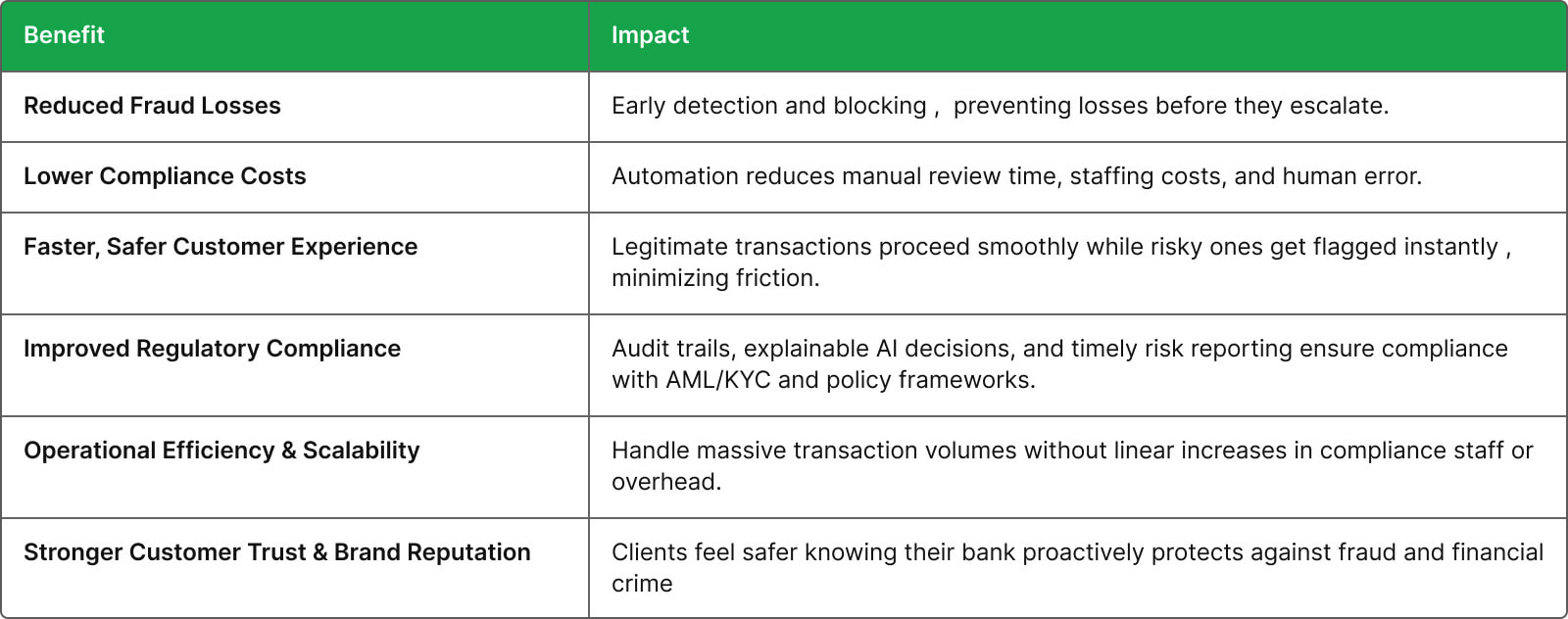
In 2026, real-time fraud and AML detection powered by AI will be the baseline, not the exception. Institutions that invest in AI-driven fraud prevention now will not only reduce losses but also gain customer trust, scalable compliance, operational efficiency, and a competitive edge.
With Uptiq’s AI-enabled banking infrastructure, financial institutions, from banks to credit unions and fintechs, can transform fraud defense from a reactive burden into a proactive, intelligent shield.
Want to learn how AI agents improve fraud investigations? Read our guide on AI Agents in Fraud Detection for Banks.
Ready to see how Uptiq’s AI Agents can safeguard your institution against fraud & money laundering?
Frequently Asked Questions
How does AI improve fraud detection in banking?

What is AI-powered AML detection?
Can AI reduce false positives in fraud detection?
Can AI fraud detection work with existing banking systems?
What should banks look for in an AI fraud and AML platform?
Is AI replacing fraud investigators and compliance teams?
Why is real-time fraud detection becoming essential for banks?
About the Author


%20(1).png)