Run structured vendor due diligence, assess contract and obligation risk, and monitor critical relationships continuously, giving the risk committee the information it needs to make acceptance decisions while keeping procurement moving.


Replace inconsistent point-in-time vendor assessments, manual contract risk reviews, and periodic monitoring that goes stale between cycles with a continuous vendor risk workflow that keeps due diligence current, contract obligations visible, and risk ratings ready for committee decision.


The Uptiq Third-Party / Vendor Risk Management Agent runs vendor due diligence, assesses contract and obligation risk, and monitors the vendor portfolio on a continuous basis, functioning as the governance counterpart to the institution's procurement function rather than a replacement for it. The agent produces due diligence assessments, contract risk findings, and risk rating recommendations for risk committee or owner review; every acceptance decision and every risk rating change is made by a human with the authority and accountability to make it.
The result is a third-party risk program that applies consistent, documented criteria to every vendor relationship, catches contract gaps before they become incidents or examination findings, and keeps risk ratings current between scheduled review cycles through continuous monitoring. For institutions under the June 2023 interagency third-party risk management guidance, which significantly raised expectations for the ongoing monitoring component of vendor risk programs, this continuous monitoring capability is the operational gap that most legacy TPRM programs need to close.
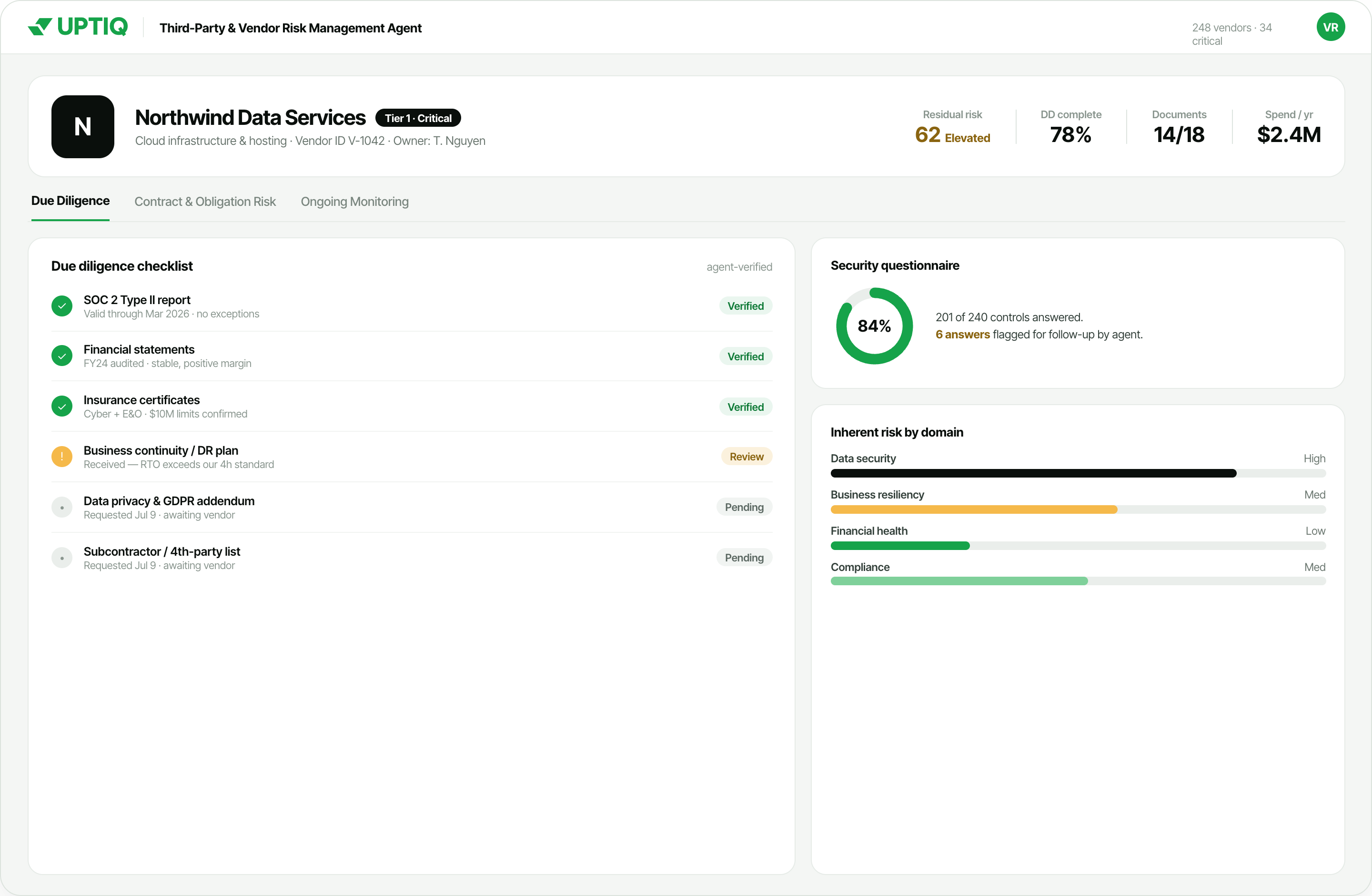
Vendor due diligence begins when a new vendor is identified for onboarding or when an existing vendor is scheduled for periodic re-assessment. The agent collects and reviews the documentation required for the vendor's criticality tier: for critical vendors, this includes financial health indicators, the most recent SOC 2 Type II or SOC 1 report, cybersecurity posture documentation, business continuity plan evidence, regulatory standing, and references or public adverse event records. For lower-criticality vendors, the review scope is appropriately reduced to the provisions that remain material for the relationship type.
Diligence depth is calibrated to a vendor criticality framework configured during deployment, which typically reflects the vendor's data access, system criticality, operational substitutability, and regulatory sensitivity. This risk-based scoping prevents the two most common TPRM program failures: over-investing review resources in low-risk vendor relationships that do not warrant it, and under-investing in critical vendor relationships where the institution's risk exposure requires thorough, documented assessment.
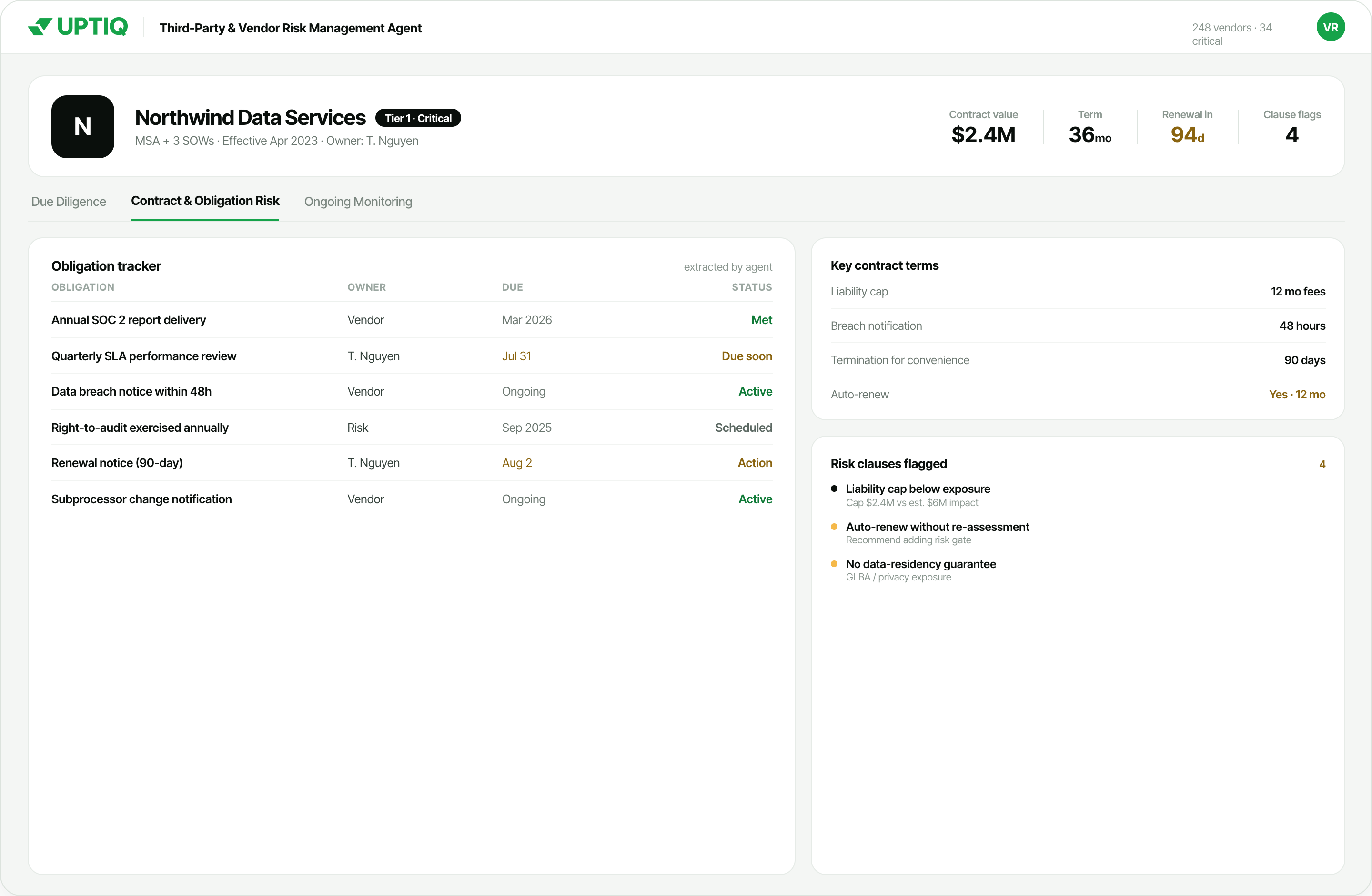
The agent reviews vendor contracts against a configurable checklist of provisions drawn from the institution's third-party risk policy and the June 2023 interagency third-party risk management guidance. Standard provision categories include: data security and privacy requirements commensurate with the vendor's data access; business continuity and recovery obligations with defined RTOs; right-to-audit and examination-access clauses that allow the institution and its regulators to examine the vendor's operations; subcontractor and fourth-party notification requirements; incident notification timelines; compliance with applicable law and regulatory requirements; and limitation of liability provisions that are appropriate for the vendor's criticality tier.
Missing or inadequate provisions are flagged as contract risk findings with the specific provision requirement and the gap identified, for legal and risk review before the contract is executed. This pre-execution review is the correct point in the procurement cycle to address contract risk, renegotiating after execution is more expensive, takes longer, and may not succeed before the relationship and its associated risk obligations are already active.
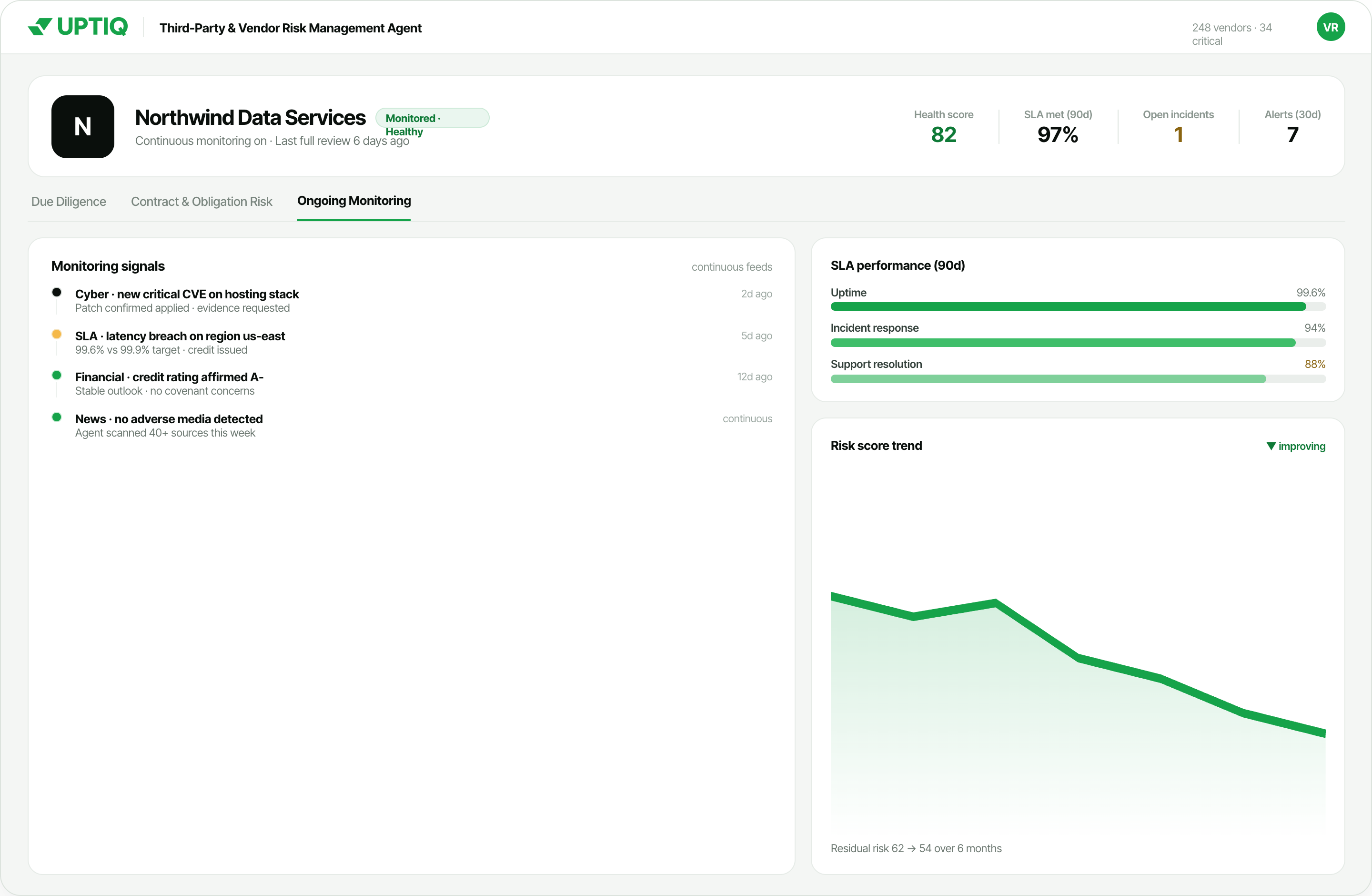
Ongoing monitoring runs continuously against the vendor portfolio, ingesting external data signals, adverse media, regulatory enforcement actions against the vendor, disclosed cybersecurity incidents, changes in financial health indicators, and subcontractor relationship changes flagged in vendor communications, and alerting the assigned risk owner when a material signal is detected. The monitoring cadence and signal sources are calibrated to each vendor's criticality tier, with critical vendors monitored more frequently and against a broader signal set than lower-risk relationships.
When monitoring produces a material signal, the agent generates a structured notification for the risk owner that includes the specific signal, the vendor affected, the potential impact on the institution, and a recommended risk rating update or re-assessment action. The risk owner reviews the notification and decides whether the signal warrants an immediate rating change, an accelerated re-assessment, or documented acceptance of the information without rating change. This decision is recorded in the vendor's risk file, maintaining the audit trail that demonstrates active monitoring rather than passive data collection.
Most institutions are running due diligence and monitoring on their existing vendor portfolio within a matter of weeks. Uptiq handles vendor criticality framework configuration, contract review checklist setup, monitoring source configuration, and procurement system integration during deployment. Existing vendor assessments and contract records are migrated during deployment so the agent begins with a populated vendor inventory rather than requiring the entire portfolio to be re-assessed from scratch before monitoring can begin.
Many institutions begin with ongoing monitoring for their critical vendor tier, which has the most immediate risk management and regulatory examination benefit, and add due diligence workflow automation and contract review in subsequent phases. This approach means the institution's highest-risk vendor relationships are covered by continuous monitoring from day one, even before the full TPRM workflow is operational.
Yes. The platform includes SOC 2 Type II compliance, encrypted data handling, role-based access controls that restrict vendor assessment and contract risk content to authorized risk and legal personnel, and comprehensive audit logging of every assessment, monitoring alert, and risk rating recommendation. Vendor-submitted documentation, SOC reports, financial statements, and contracts are handled within the institution's configured data environment and is not shared outside the defined TPRM workflow.
The agent does not make vendor acceptance decisions, approve contracts, or set final risk ratings; these remain with the designated risk owner or risk committee. This human-decision architecture ensures that the institution's regulatory accountability for third-party risk management is maintained through human judgment rather than delegated to an automated system, consistent with the accountability expectations in the interagency guidance and the broader governance framework for supervised financial institutions.
Manual TPRM spreadsheet processes are inconsistent by construction; the depth of a vendor assessment depends on which team member ran it, which questions they knew to ask, and whether they had time to complete a thorough review given the pressure of procurement timelines. They are also static: once a periodic review is completed, the vendor's risk rating does not change until the next scheduled cycle, regardless of what happens in the intervening period. This is precisely the monitoring gap that produced the most significant TPRM examination findings under the 2023 interagency guidance.
Standalone vendor management platforms solve the documentation and workflow problems of spreadsheet processes, but they typically rely on the institution's team to manually collect and update vendor information rather than monitoring external signals continuously. The agent adds both the consistency of structured, criteria-based assessment and the continuous monitoring that keeps vendor risk ratings current between cycles, addressing the two gaps that manual processes and documentation platforms leave open simultaneously.
Our team handles deployment end-to-end, from configuration to go-live. Most financial institutions are live within days, and not months.