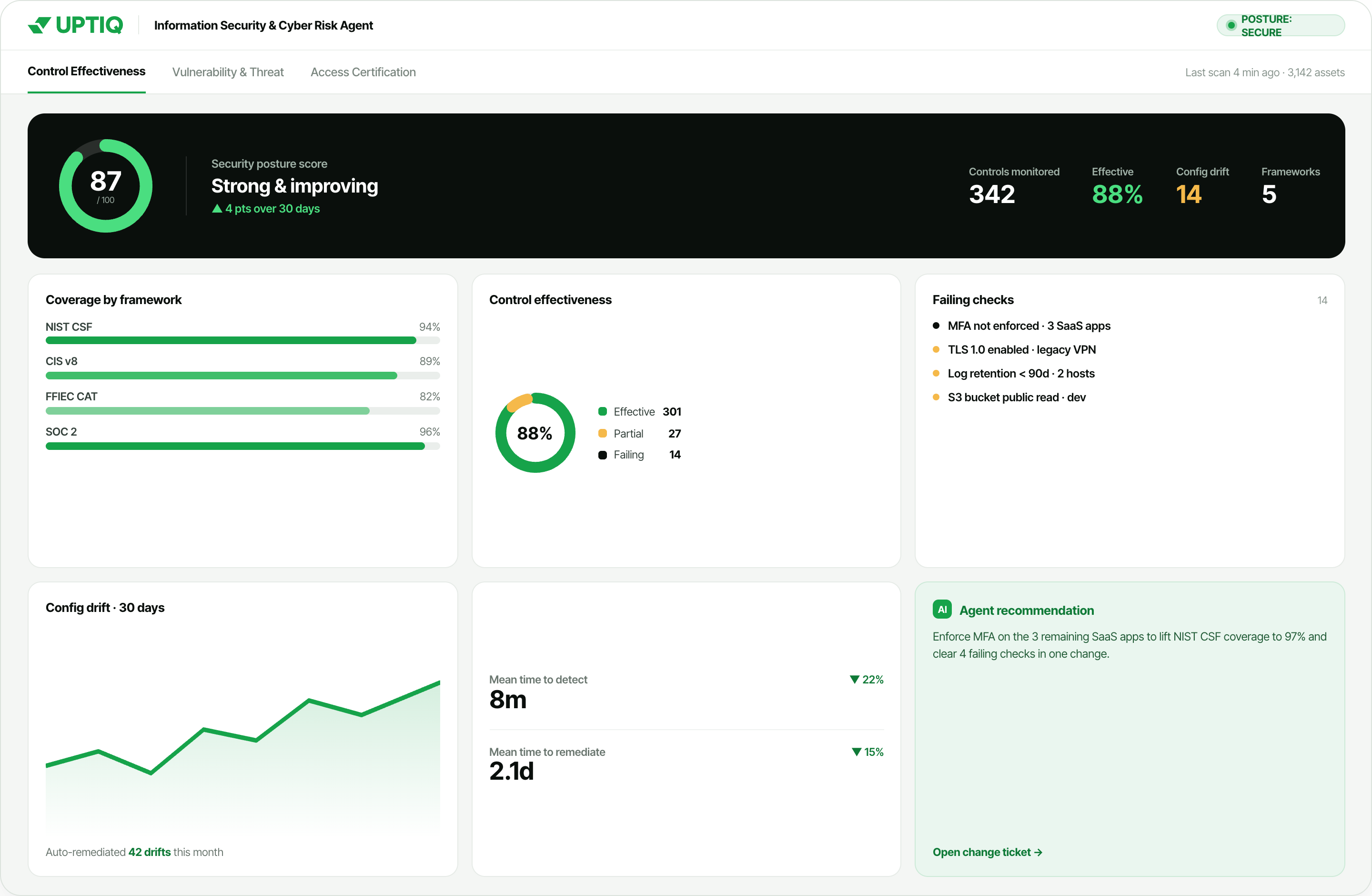
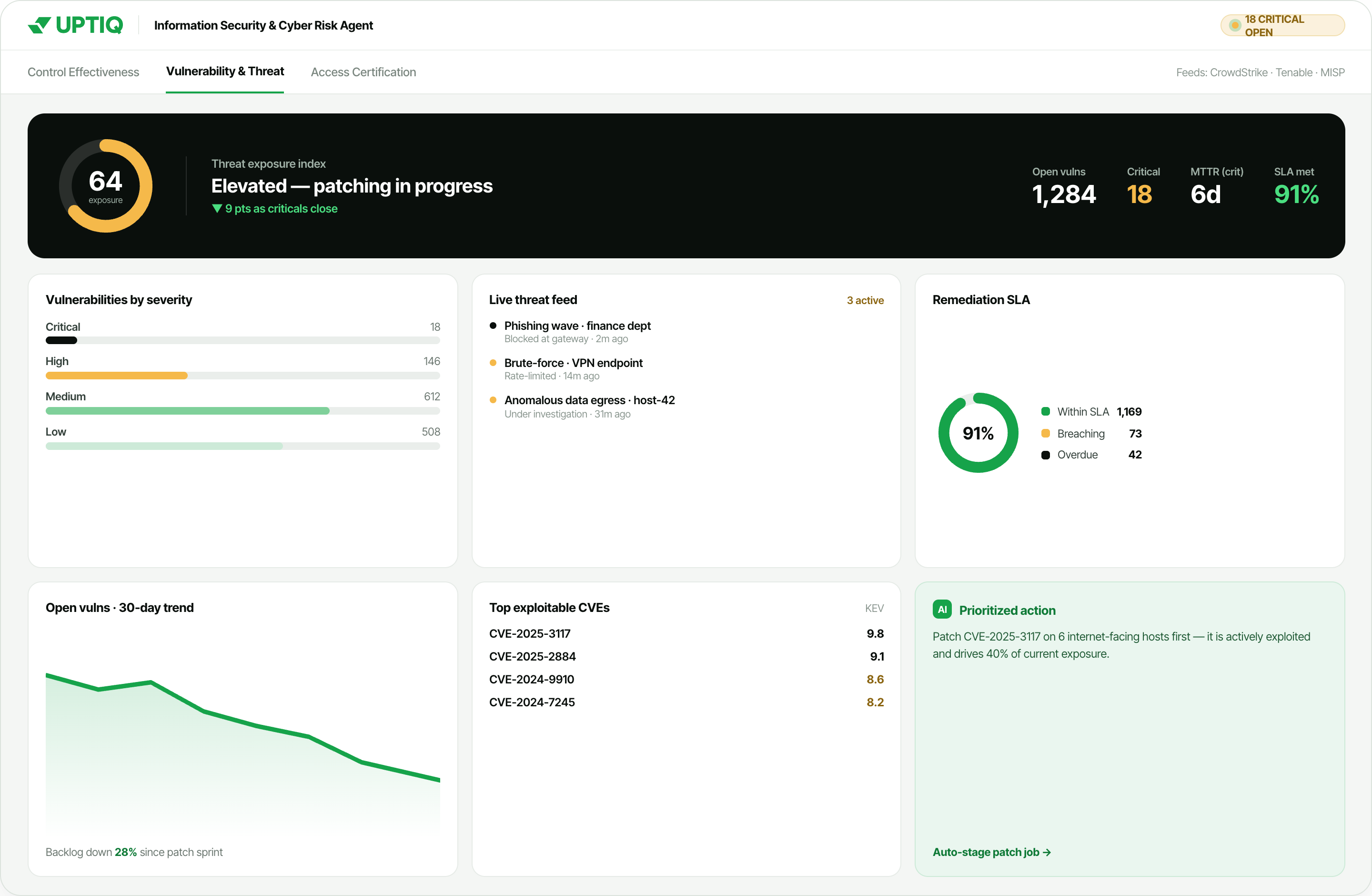
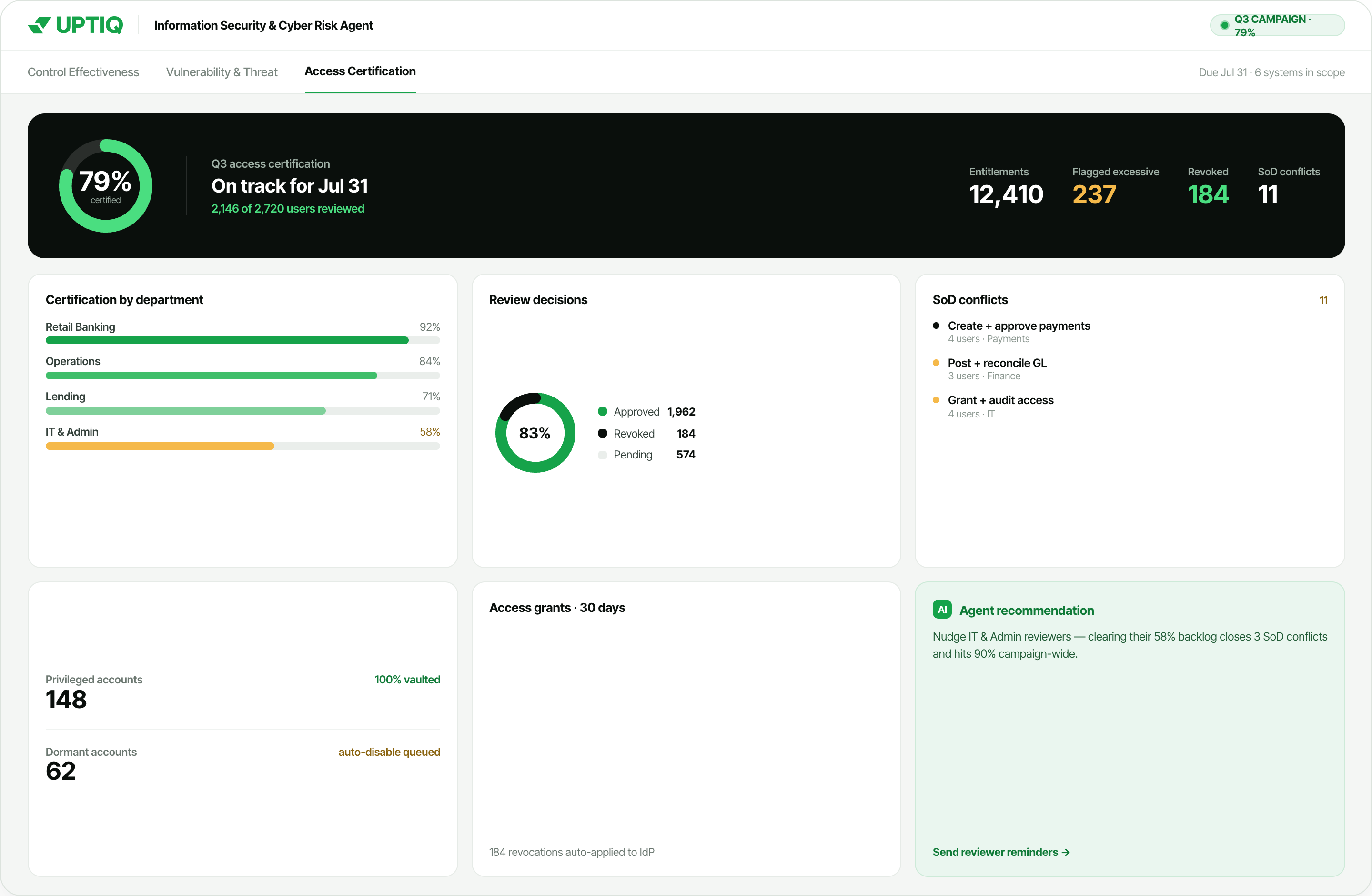
Monitor security control effectiveness, manage vulnerability and threat posture, and certify access entitlements, providing the independent cyber-risk view above IT operations that the CISO and committee need to make informed decisions.


Replace periodic security reports produced by the same team running the controls with continuous, independent cyber-risk monitoring that surfaces the real exposures, certifies that access matches entitlement, and delivers recommendations the CISO can act on with confidence.


The Uptiq Information Security & Cyber Risk Agent provides independent cyber-risk assurance above IT operations, monitoring security control effectiveness, managing vulnerability and threat posture, and certifying access entitlements. The agent operates as an assurance function rather than an operational one: it observes, analyzes, prioritizes, and recommends, with the CISO or risk committee making every decision on remediation, access revocation, and risk acceptance. It does not operate, configure, or modify security infrastructure.
The result is a cyber-risk governance program that gives the CISO and committee a credible, independent picture of the institution's security posture, separate from the self-reporting that IT operations teams produce about their own controls, and a continuous access certification capability that stays current between annual audit cycles rather than lapsing until the next scheduled review. For institutions under FFIEC IT examination expectations or SOC 2 audit requirements, this independent monitoring layer is the evidentiary backbone of a defensible cybersecurity governance program.
Independence is maintained through the agent's structural separation from IT operations, it ingests security data from connected systems and assesses control effectiveness against defined criteria, but it does not have the ability to configure, modify, or remediate the security infrastructure it monitors. This assure-not-operate model is what allows the agent's findings to carry the independence weight that governance frameworks require: a finding about control degradation from a monitoring function that cannot touch the control has different evidentiary value than a self-assessment from the team running it.
The agent's monitoring inputs come from system-generated data, vulnerability scan outputs, control behavior logs, access records, threat intelligence feeds, rather than from the operational teams responsible for the controls being assessed. This data sourcing approach is what makes the agent's control effectiveness assessments independent in the technically meaningful sense that regulators and auditors apply when evaluating the quality of a cyber assurance program.

The agent ingests vulnerability scan data and applies an impact-adjusted prioritization model that weights exposures based on three factors: exploitability in the current threat environment, the institutional systems and data the vulnerability would expose if exploited, and the availability and complexity of remediation. This three-factor model produces a prioritized remediation queue that reflects where actual institutional risk is concentrated, not where CVSS scores are highest, which frequently overweights theoretical vulnerabilities in non-critical systems while underweighting lower-scored vulnerabilities in high-value target systems.
The prioritized queue is delivered to the CISO as a set of recommended remediation actions, each with the supporting evidence for the priority ranking, including the specific vulnerability, the affected systems, the threat intelligence signals that inform the exploitability assessment, and the estimated remediation complexity. The CISO and committee decide which items to remediate, defer, or accept as residual risk; the agent monitors ongoing exposure and updates prioritization as the threat environment and remediation status change.
Access certification runs by comparing current user access grants in connected systems against the role-based entitlement standards configured for each system during deployment. For each certification cycle, the agent produces three finding categories: excessive permissions where a user has access beyond their role entitlement, dormant accounts where credentials exist for users no longer active in the relevant role, and segregation-of-duties violations where a single user holds incompatible access combinations that create fraud or error risk. Each finding is flagged for human review and action by the designated access owner or HR partner.
The certification records produced document that the review occurred, which findings were identified, and how each was resolved, providing the governance evidence that FFIEC IT examiners, SOC 2 auditors, and internal audit teams expect to see when evaluating access governance effectiveness. Certifications run on the schedule required by applicable frameworks and policy, with delinquent cycles flagged for management attention before they become examination findings.
Most institutions are operational within a matter of weeks. Uptiq manages vulnerability management platform integration, SIEM connection, identity and access management system configuration, and framework-specific monitoring criteria setup during deployment. For institutions with existing access certification programs, the current certification schedule and entitlement standards are migrated during deployment so the agent continues existing cycles rather than requiring a fresh start.
Many institutions begin with access certification and control monitoring, the two capabilities with the most direct examination and audit impact, and add threat posture management and vulnerability prioritization in a subsequent phase once the security team has validated the agent's data ingestion and output quality. This sequencing keeps the initial deployment focused and avoids the risk of overwhelming IT operations with a full monitoring scope before the integration points are thoroughly tested.
Yes. The platform includes SOC 2 Type II compliance, encrypted data handling, role-based access controls that restrict security posture and access certification data to authorized security and risk personnel, and comprehensive audit logging of every monitoring action and certification event. The agent's connections to security systems are read-only for data ingestion, it collects the information needed for assurance analysis but does not have write access to the security infrastructure it monitors.
Security data processed by the agent, vulnerability scan results, access logs, threat intelligence inputs, is handled within the institution's configured data environment and is not shared outside the defined monitoring workflow. Given the sensitivity of security posture information, data residency and access controls are configured to the institution's specific requirements during deployment, with options for on-premises or private cloud processing where institutional policy requires it.
IT security team reports are produced by the same teams that operate the controls being reported on, which creates the independence problem that makes self-assessment reports less useful for governance than they appear. A team reporting on its own control effectiveness has an inherent incentive to present results favorably, may undercount degraded controls, and produces findings that reflect what the team chose to measure rather than what an independent assessment would have examined. This is not a character judgment; it is the structural limitation of any self-assessment process.
The agent produces findings from independent observation of control behavior and system data rather than from the operational team's reporting, which gives the CISO and committee a different quality of assurance. It also covers access certification and threat posture monitoring on a continuous basis rather than at the periodic schedule that manual reporting makes practical, meaning the assurance picture it provides is current rather than a point-in-time snapshot that may be weeks or months stale by the time it reaches the committee.
Our team handles deployment end-to-end, from configuration to go-live. Most financial institutions are live within days, and not months.