Facilitate RCSAs, monitor KRIs against risk appetite in real time, and manage operational loss events through a single integrated workflow, so the risk committee always knows where the institution stands and where it is trending.


Replace RCSA spreadsheets, manually compiled KRI dashboards, and disconnected loss event logs with an integrated risk management workflow that keeps assessments current, breaches visible, and findings tracked, without pulling risk teams away from the judgment work only they can do.


The Uptiq Enterprise & Operational Risk Agent is an AI-powered solution that facilitates RCSAs with a standardized risk taxonomy, monitors KRIs against board-approved risk appetite thresholds in real time, and manages operational loss events from ingestion through root-cause analysis and remediation tracking. The agent produces structured recommendations and assessments for human review, risk appetite decisions and acceptance of residual risk remain with the CRO and risk committee throughout.
The result is an operational risk program that stays current, catches emerging issues before they reach the examination stage, and gives the risk committee the integrated view they need to make informed decisions, without requiring the kind of manual effort that currently makes RCSA cycles obsolete before they are finalized. By closing the gap between when risk information is generated and when it reaches decision-makers, the agent helps institutions manage risk rather than document it retrospectively.
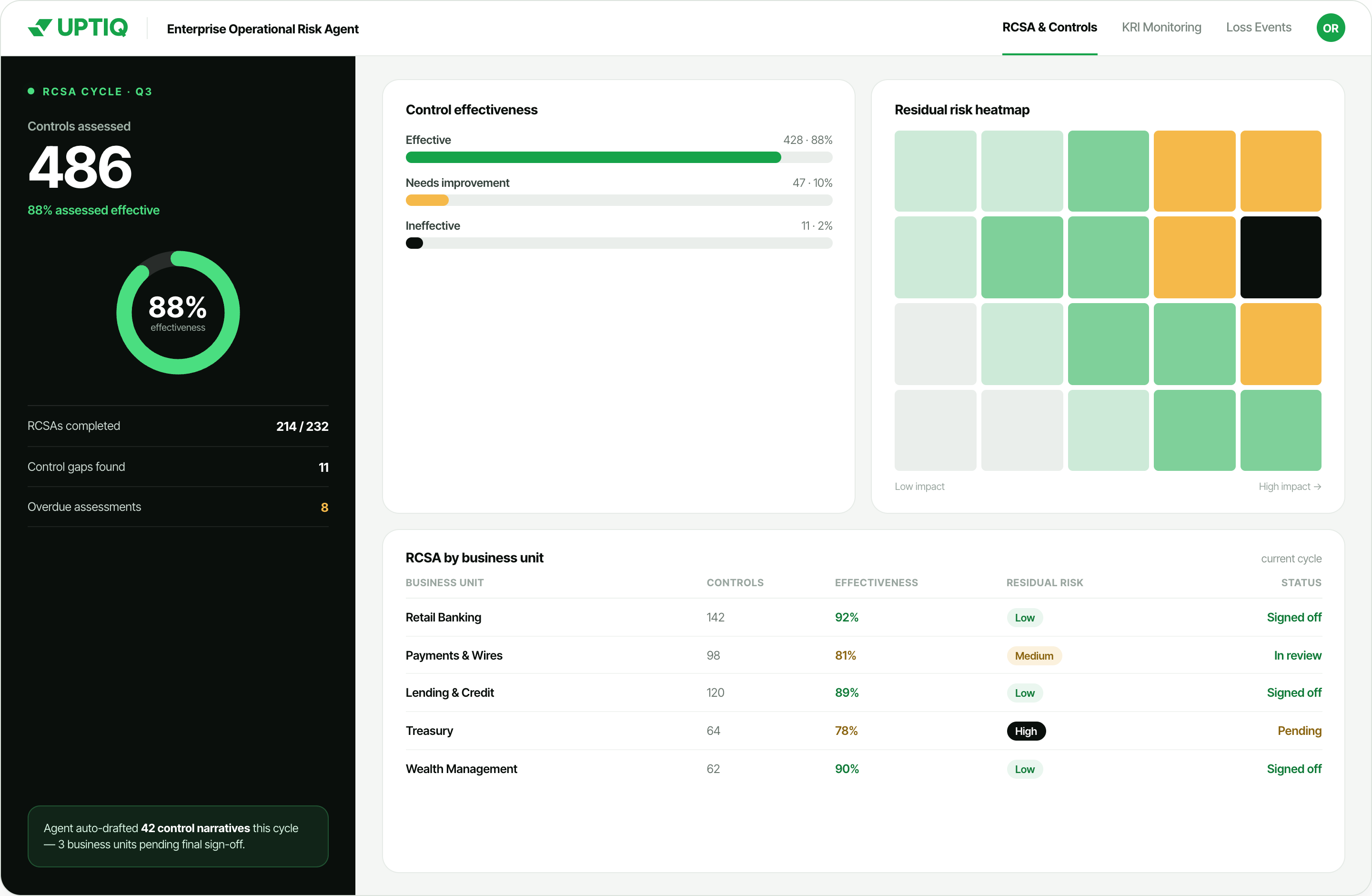
A Risk and Control Self-Assessment is the structured process through which a financial institution's business units identify, score, and document operational risks in their processes and assess the effectiveness of the controls that mitigate them. RCSA is required under the Basel operational risk framework and forms the evidentiary backbone of the institution's operational risk management program for regulatory examination purposes. Traditional RCSA processes in banking take three to six weeks to complete, pull risk and business teams away from their primary work, and often produce assessments that are outdated by the time they are finalized.
AI-assisted RCSA execution addresses all three problems: standardized taxonomy eliminates the inconsistency between business units that produces unreliable heat maps, automated evidence ingestion eliminates the manual coordination that creates the three-to-six-week timeline, and continuous updates ensure the completed RCSA reflects current operational reality rather than a point-in-time snapshot that becomes stale the moment it is submitted. The agent produces drafts for human review; every risk owner validates, adjusts, and approves before anything is finalized.
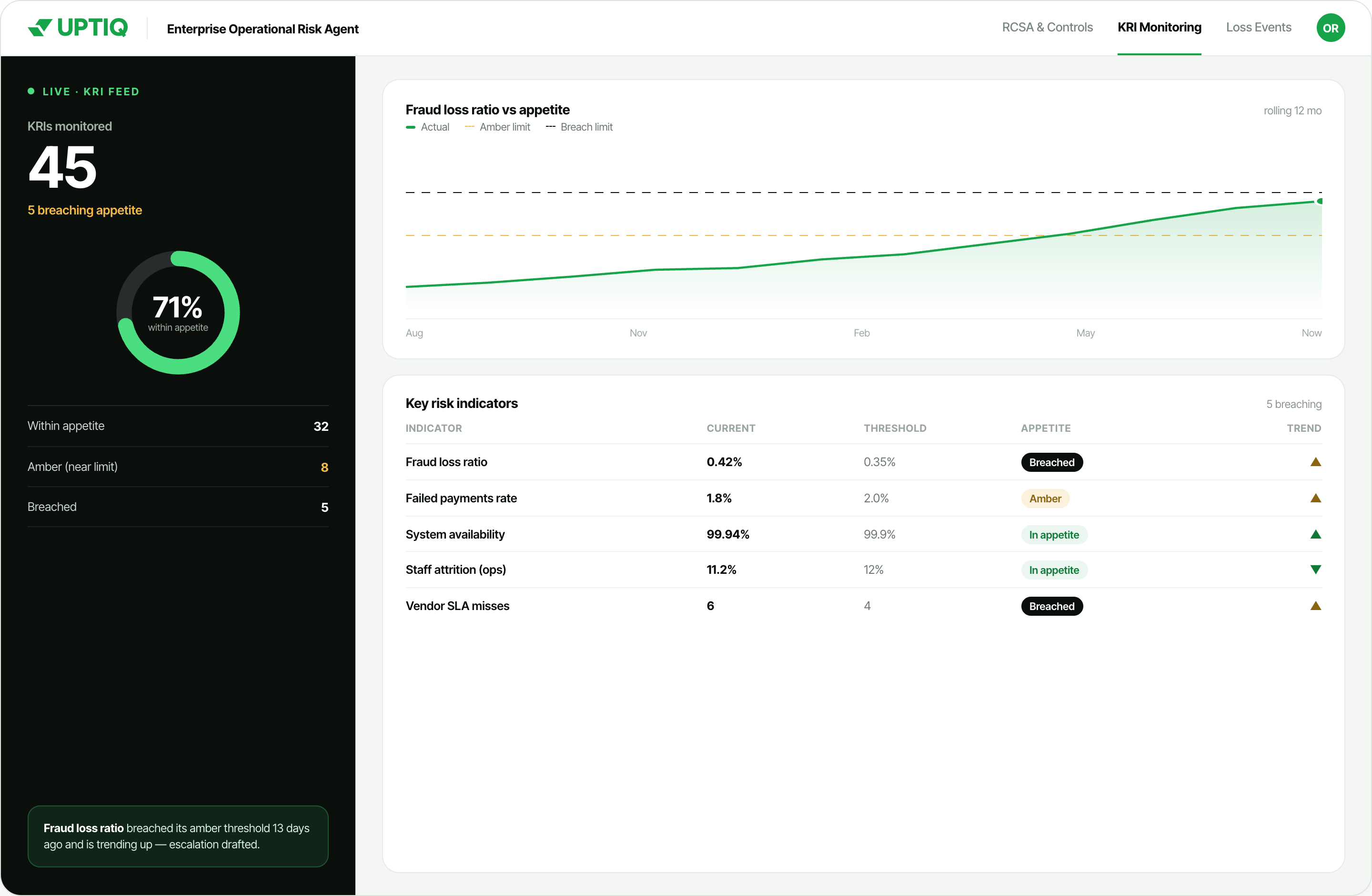
The agent supports KRI monitoring across the five standard operational risk categories: people risk including staff turnover, training completion, and absenteeism; process risk including error rates, exception volumes, and SLA breaches; systems risk including availability, incident frequency, and recovery times; external event risk including fraud attempt rates and third-party failure events; and compliance risk including regulatory finding rates and policy exception volumes. KRI definitions, thresholds, and escalation paths are configured to match the institution's existing risk appetite framework during deployment.
The agent also supports model risk KRI monitoring, tracking AI model performance, drift indicators, and governance gap flags as a distinct KRI category. Given that the agent itself is a governed model within the institution's portfolio, this category is treated as a first-class risk type rather than an afterthought, consistent with the 2026 interagency model risk management guidance that elevated AI model oversight to an explicit examination concern.
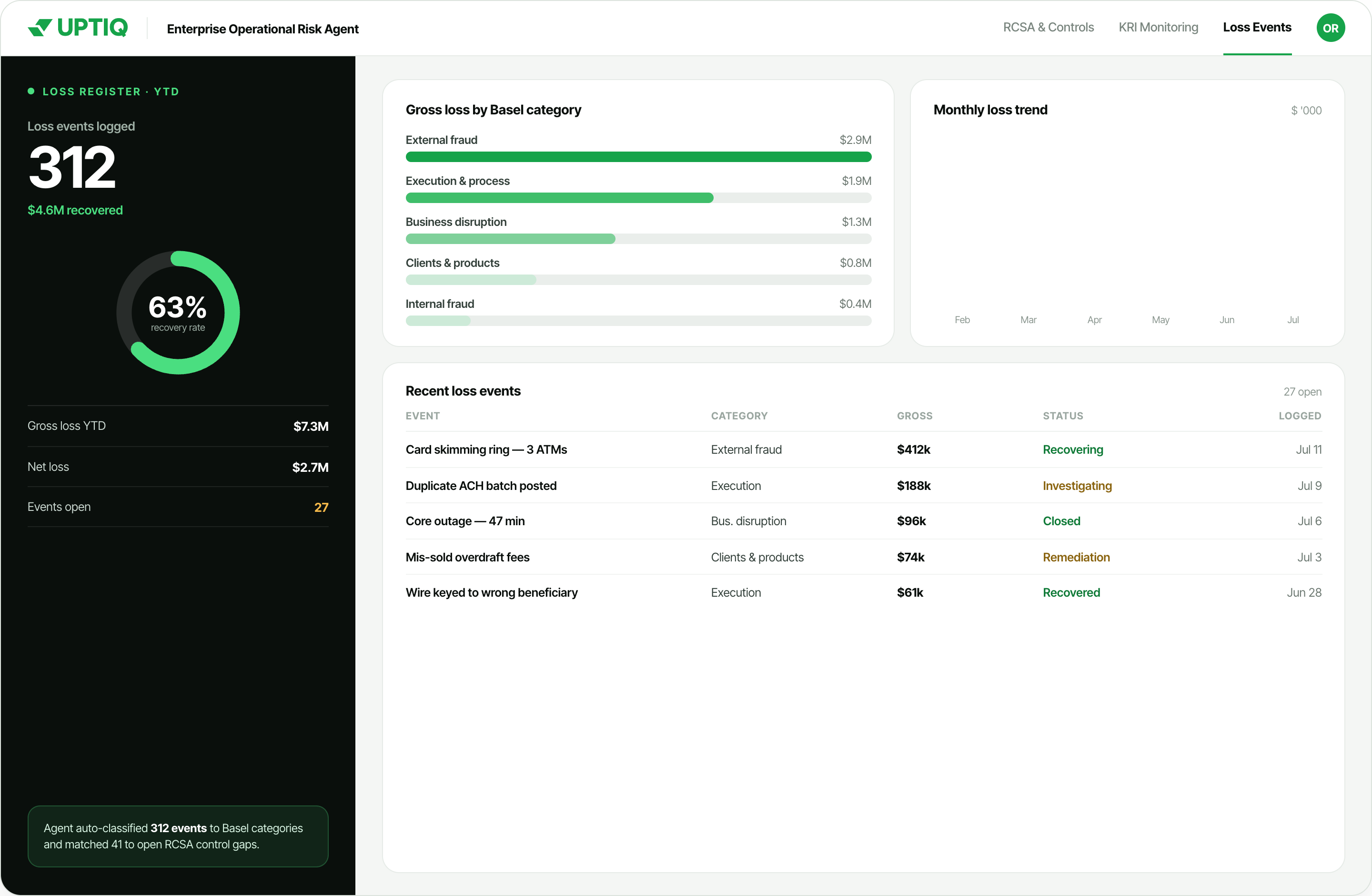
The agent classifies loss events against the seven Basel operational risk event categories: internal fraud, external fraud, employment practices and workplace safety, clients products and business practices, damage to physical assets, business disruption and systems failures, and execution delivery and process management. Classification is AI-assisted, with human confirmation required before any event is finalized in the loss database, classification rationale is documented for each event, supporting regulatory capital calculation and examiner review.
The automatic feedback loop between loss events and the RCSA process is what makes this classification meaningful operationally. When an event is classified and its root cause extracted, the relevant control-effectiveness rating in the RCSA is flagged for review, so the next RCSA cycle incorporates what the institution has actually experienced, not just what was assumed to be true about control performance before the event occurred.
Most institutions are live within five business days. Uptiq handles risk taxonomy configuration, KRI threshold setup, GRC platform integration, and RCSA workflow calibration. For institutions with an existing RCSA program, the agent is configured to extend current workflows rather than replace them, ensuring no disruption to the existing examination documentation cycle and no loss of historical assessment data.
Many institutions begin by deploying the KRI monitoring capability first, which requires only appetite threshold configuration and GRC integration, then add RCSA facilitation once the risk team has validated the agent's output quality through a parallel-run period. This phased approach reduces transition risk and gives risk teams confidence in the agent's assessments before they become the primary basis for committee reporting.
Yes. The platform includes SOC 2 Type II compliance, encrypted data handling, role-based access controls, and comprehensive audit logging. Every RCSA assessment, KRI breach notification, and loss event classification is retained with full source traceability, supporting both internal governance reviews and the examination documentation that FFIEC, OCC, and Federal Reserve examiners expect to see when reviewing the institution's operational risk management program.
Risk appetite parameters, KRI thresholds, and RCSA taxonomy configurations remain under the exclusive control of the risk committee and CRO. The agent does not modify these parameters; it monitors against them and reports deviations. This architecture preserves the human accountability structure that regulators and boards require, while removing the data aggregation and reporting burden that has historically made maintaining that accountability structure so resource-intensive.
GRC platforms are documentation and workflow management tools; they store risk and control inventories, track assessment statuses, and produce reports. They do not facilitate the RCSA process itself by generating structured assessments, do not monitor KRIs in real time against configurable thresholds, and do not automatically classify and route operational loss events or link them back to RCSA control-effectiveness ratings. The agent integrates with GRC platforms rather than replacing them, adding the intelligence layer that transforms data storage into active risk management.
Risk management spreadsheets have a more fundamental problem: they break at scale, produce inconsistent results across business units, and create the version-control and reconciliation overhead that consumes most of a risk team's capacity before any actual risk analysis can begin. The agent replaces the spreadsheet layer entirely, while writing its outputs back to whatever GRC or reporting system the committee already relies on for governance and escalation.
Our team handles deployment end-to-end, from configuration to go-live. Most financial institutions are live within days, and not months.