Keep continuity and disaster-recovery plans genuinely current, drive exercises that produce real gap registers, and track every finding to remediation, before the next examination or the next outage exposes what was never fixed.


Replace static plan documents and inconsistent annual exercises with a continuous readiness workflow that keeps BCP and DR content synchronized with operational reality, facilitates structured scenario testing, and turns every exercise into a tracked, remediated gap register.


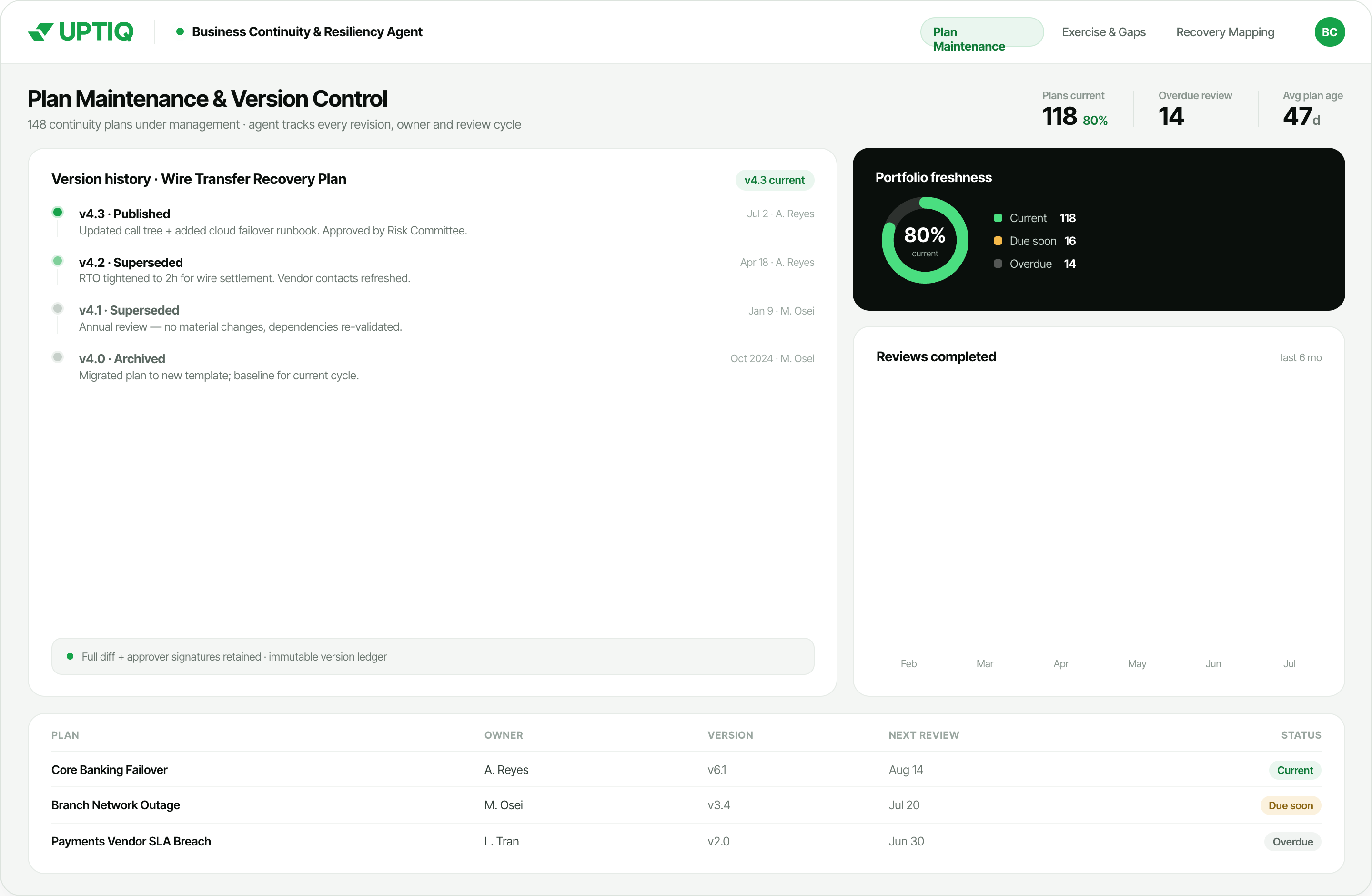
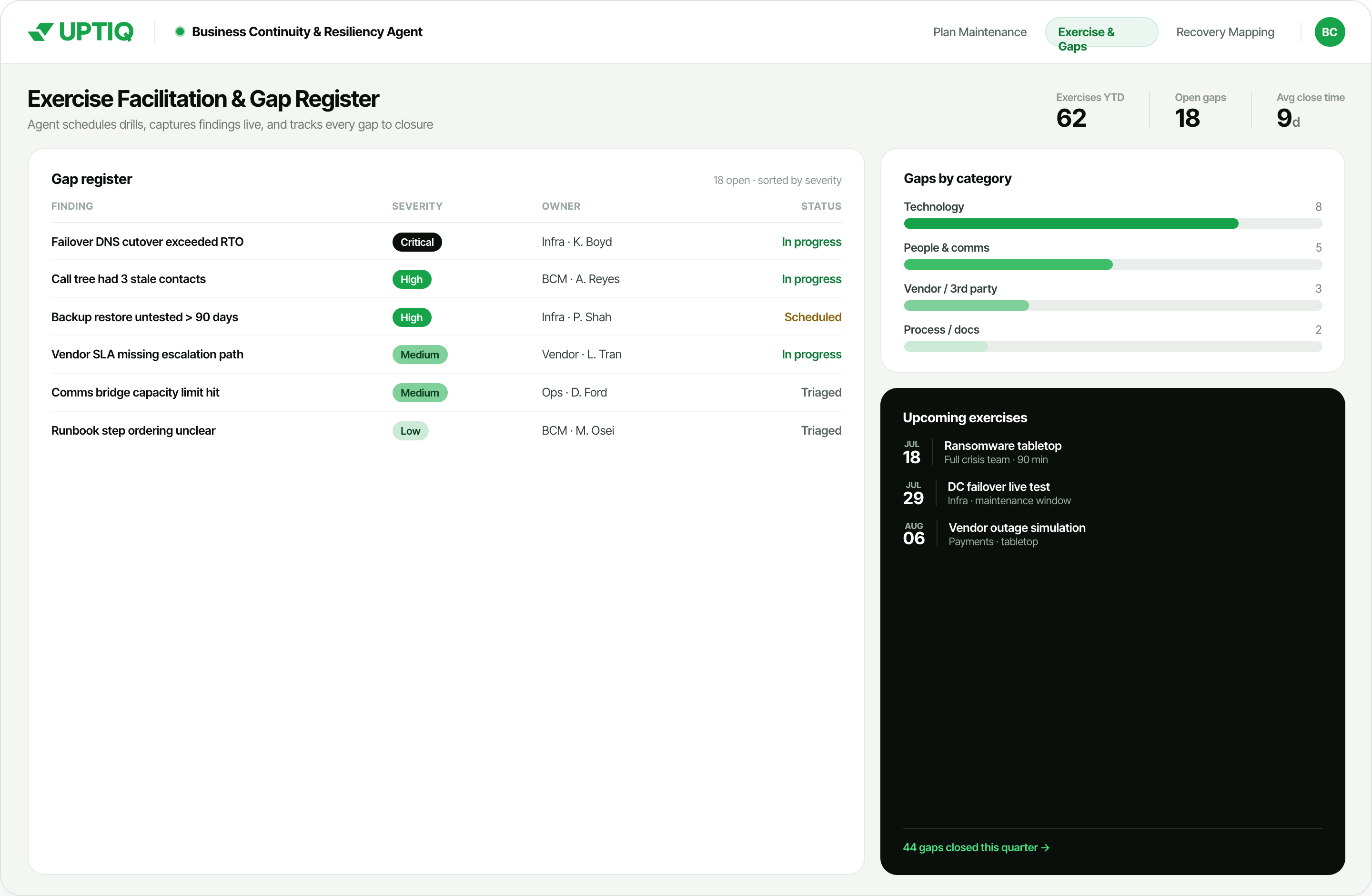
The Uptiq Business Continuity & Resiliency Agent is an AI-powered solution that keeps BCP and DR plans synchronized with the institution's evolving operational environment, structures and facilitates tabletop exercises that generate defensible test records, and tracks exercise findings through remediation to closure. The agent recommends plan updates and exercise actions, business and risk owners retain approval authority for every change and every remediation commitment.
The result is a BCP program that satisfies examiner expectations for currency, testing frequency, and gap documentation without placing the entire burden of maintenance on already-stretched operations and risk teams. By catching recovery sequence gaps in structured exercises rather than real events, institutions protect both operational continuity and regulatory standing simultaneously.
The agent is designed to support the FFIEC Business Continuity Management booklet framework, which governs BCP requirements for US banks and credit unions, as well as FINRA Rule 4370 for broker-dealer continuity obligations. It also supports NIST SP 800-34 for IT contingency planning and ISO 22301 for institutions pursuing international business continuity management system certification. The applicable framework is selected and configured during deployment based on the institution's regulatory profile and charter type.
For institutions subject to multiple frameworks simultaneously, for example, a bank holding company with broker-dealer subsidiaries, the agent is configured to track compliance against each applicable standard and to produce examination-ready documentation organized by the relevant supervisory framework. This avoids the common problem of maintaining separate, inconsistently formatted BCP evidence packages for different regulatory audiences.
The agent supports scenario planning for the disruption types most operationally and regulatorily relevant to financial institutions: core banking platform outage, ransomware and cyber incident, primary facility unavailability due to weather or access loss, critical payment network disruption, key vendor failure including core processor and cloud provider outages, and compliance system outage affecting transaction monitoring or sanctions screening. Scenario complexity and scope are calibrated to the institution's size, critical function inventory, and prior examination findings.
A dedicated compliance system outage playbook, covering who runs manual alert triage, what volume threshold makes manual processing unworkable, and when regulatory notification is triggered, is included as a standard scenario component. This addresses one of the most frequently cited BCP gaps in financial institution examinations, where institutions have automated their compliance tools but have no tested fallback for operating without them.
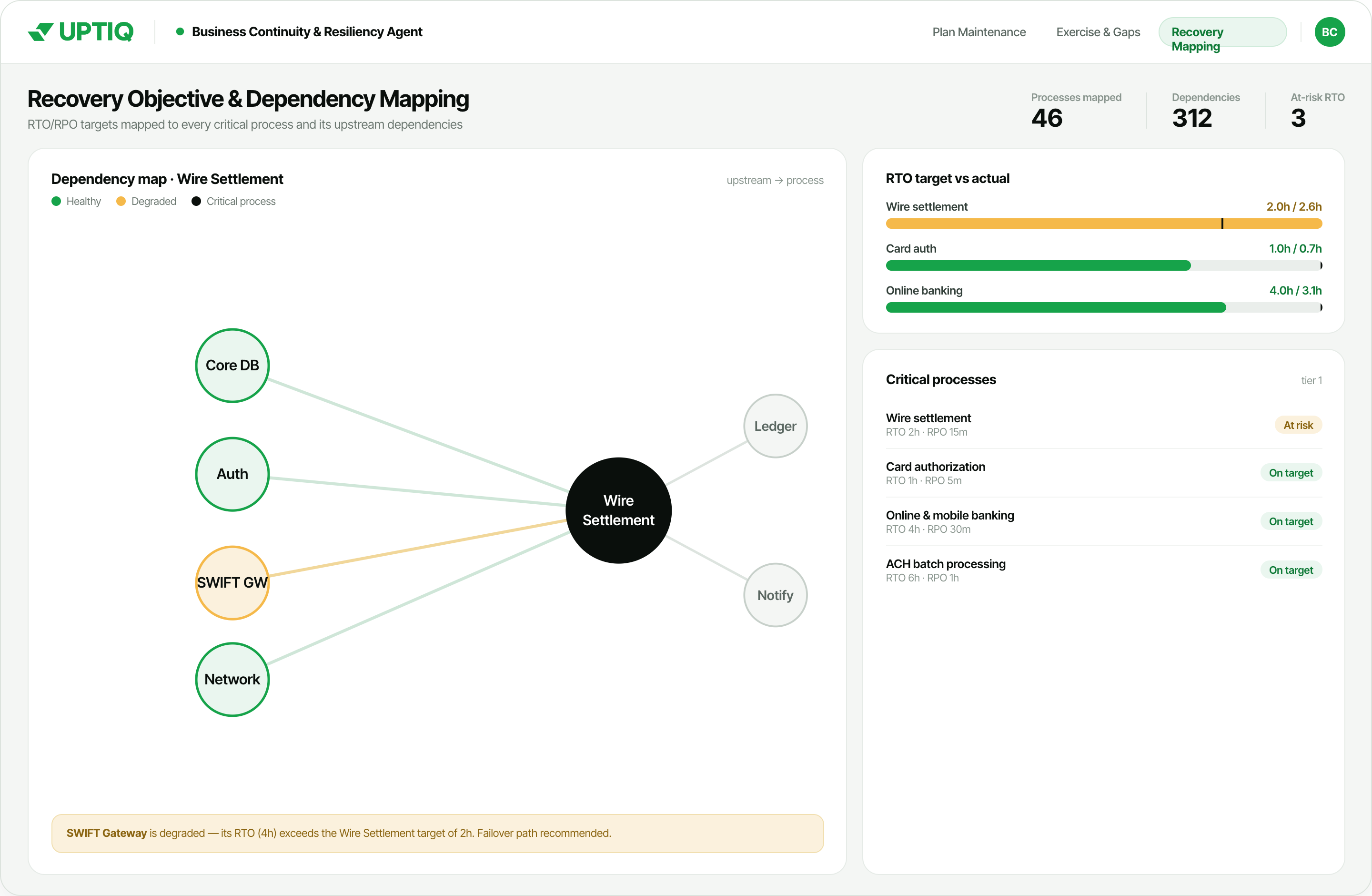
The agent ingests vendor dependency data, which critical functions depend on which vendors, which vendors are essential for regulatory reporting obligations, and which vendor failures would cascade into downstream system unavailability, and models failure scenarios where a vendor's outage creates sequential disruptions the current recovery sequence does not address. This fourth-party risk modeling is what most modern BCP gaps trace to: institutions have mapped their own system dependencies but have assumed vendor availability without testing what happens when a critical-path vendor is unavailable for 24 or 48 hours.
The output is a dependency-aware recovery sequence that identifies where the institution's stated RTO is not achievable under realistic failure conditions, and which dependencies need explicit BCP coverage, either through backup vendor arrangements, manual fallback procedures, or a revised RTO that reflects operational reality. These findings are surfaced as recommendations for business and risk owner review, not implemented automatically.
Most financial institutions are in production within five business days. Uptiq handles existing BCP document ingestion, critical function inventory configuration, exercise scenario calibration, and GRC platform integration setup. Because the agent works from existing plan documents and operational data rather than requiring new infrastructure or system connections on day one, deployment does not disrupt the institution's current BCP program or examination documentation cycle.
Institutions with mature BCP programs typically start by using the agent to validate and version-control their existing plans, then add exercise facilitation and dependency mapping in subsequent phases. Institutions building their BCP program from scratch use the agent's framework-aligned structure as the starting point for both plan content and exercise design.
Yes. The platform includes SOC 2 Type II compliance, encrypted data handling, role-based access controls, and comprehensive audit logging. Every plan version, every exercise record, and every gap register entry is retained with source traceability, supporting both internal governance reviews and regulatory examinations. BCP documents and operational data processed by the agent remain within the institution's configured data environment.
The agent's recommendation-only architecture means no plan changes are implemented, no exercise outcomes are recorded as completed, and no remediation commitments are logged without explicit approval by the designated business or risk owner. This preserves the human accountability structure that regulators expect to see in a BCP governance program, and that the agent itself is designed to make easier to sustain consistently over time.
Manual BCP document maintenance relies on someone noticing that a system was upgraded, a vendor was changed, or a team was restructured, and proactively updating the plan. That dependency on individual initiative is why BCP documents drift toward obsolescence between annual review cycles. The agent monitors for material operational changes continuously and surfaces update recommendations automatically, removing the initiative dependency that manual maintenance requires.
Standard GRC platforms are designed to store and track BCP documents and exercise records, they do not generate the structured exercise scenarios, dependency maps, or recovery sequence gap analyses that the agent produces. The agent functions as a BCP intelligence layer that works alongside a GRC platform rather than replacing it, producing the substantive analysis and structured outputs that translate into defensible examination evidence rather than just organized documentation storage.
Our team handles deployment end-to-end, from configuration to go-live. Most financial institutions are live within days, and not months.