QA loan files for policy compliance, independently re-assess credit quality and risk ratings, log exceptions with defensible documentation, and track remediation to closure, while keeping origination and review completely separate at every step.


Replace sample-based file reviews, inconsistently documented exception logs, and credit rating assessments that stop at origination with a structured credit QA workflow that covers more of the portfolio, maintains clear independence, and produces the exception documentation that examiners expect.


The Uptiq Loan Review & Credit QA Agent provides independent loan review by QA-reviewing files for policy compliance and documentation quality, re-assessing credit quality and risk ratings independently of the originating team, logging exceptions with defensible documentation, and tracking them through to resolution. The agent's independence is absolute: it reviews decisions made by others, applies rating methodologies it did not design, and escalates findings to a review officer who was not part of the original credit process. It never originates credits, overrides ratings, or modifies file documentation.
The result is a loan review program that covers more of the portfolio than sample-based manual review can reach, produces consistently documented exception registers, and maintains the structural independence that distinguishes genuine independent credit assurance from quality review conducted by the same team that originated the credit. For institutions subject to OCC, Federal Reserve, or FDIC examination of their credit review function, this structural independence and documentation consistency is the standard the examination is designed to verify.
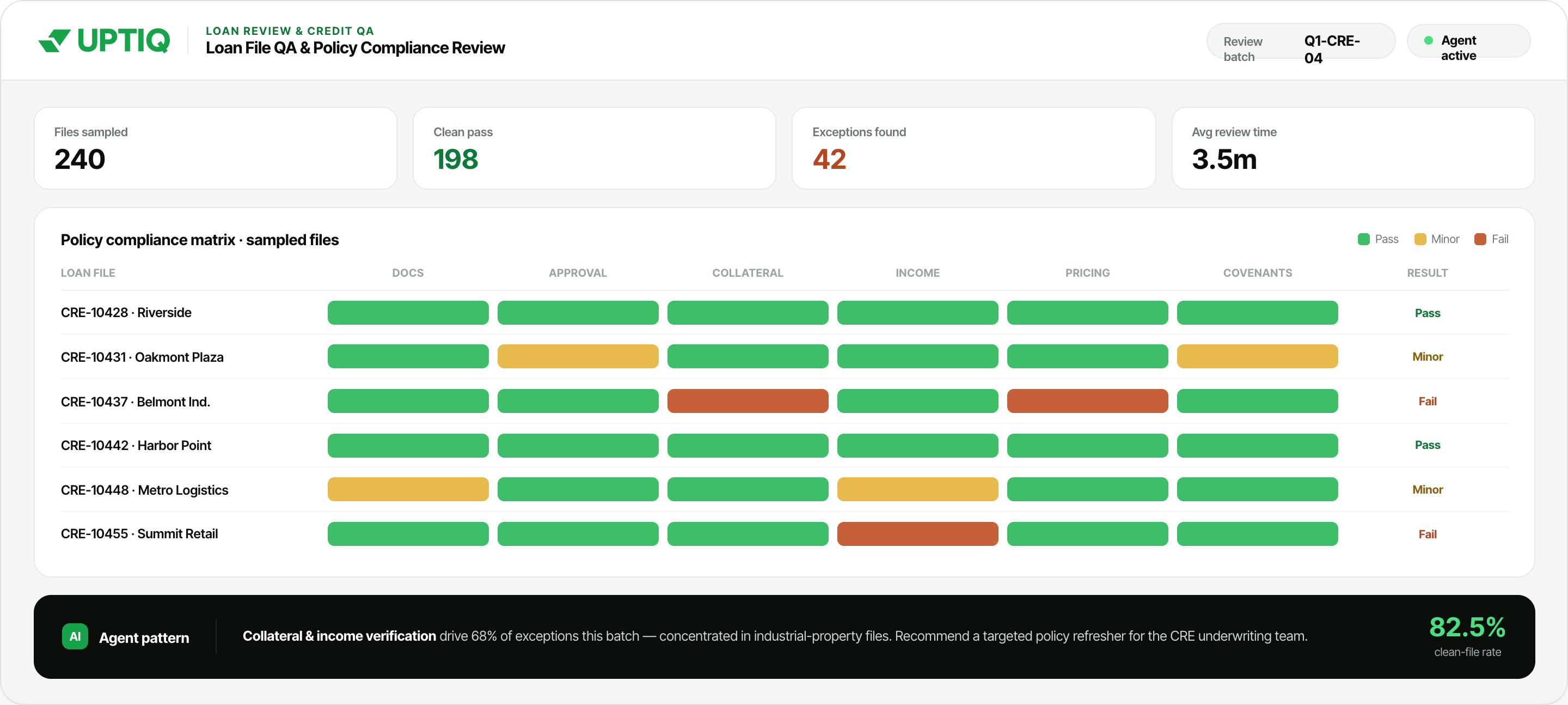
File QA applies a configurable policy compliance checklist to each reviewed loan file, checking: required document presence and completeness; key field population for the loan type; policy exception presence, and where exceptions are present, that they are documented with the required approval; consistency between the credit memo's analytical conclusions and the supporting financial data; and structural compliance with the credit approval process the institution's credit policy requires. Each checklist item produces a pass, finding, or flag result, with findings linked to the specific file element and policy provision involved.
The QA checklist is configured to the institution's current credit policy during deployment and updated when the policy changes, so the QA process always reflects the standards the originating team was supposed to follow rather than a fixed template that diverges from current policy over time. Policy updates and their checklist implications are coordinated with the Regulatory Change Management Agent and the Policy & Procedure Management Agent to ensure that QA criteria stay synchronized with both the written policy and the regulatory requirements the policy implements.
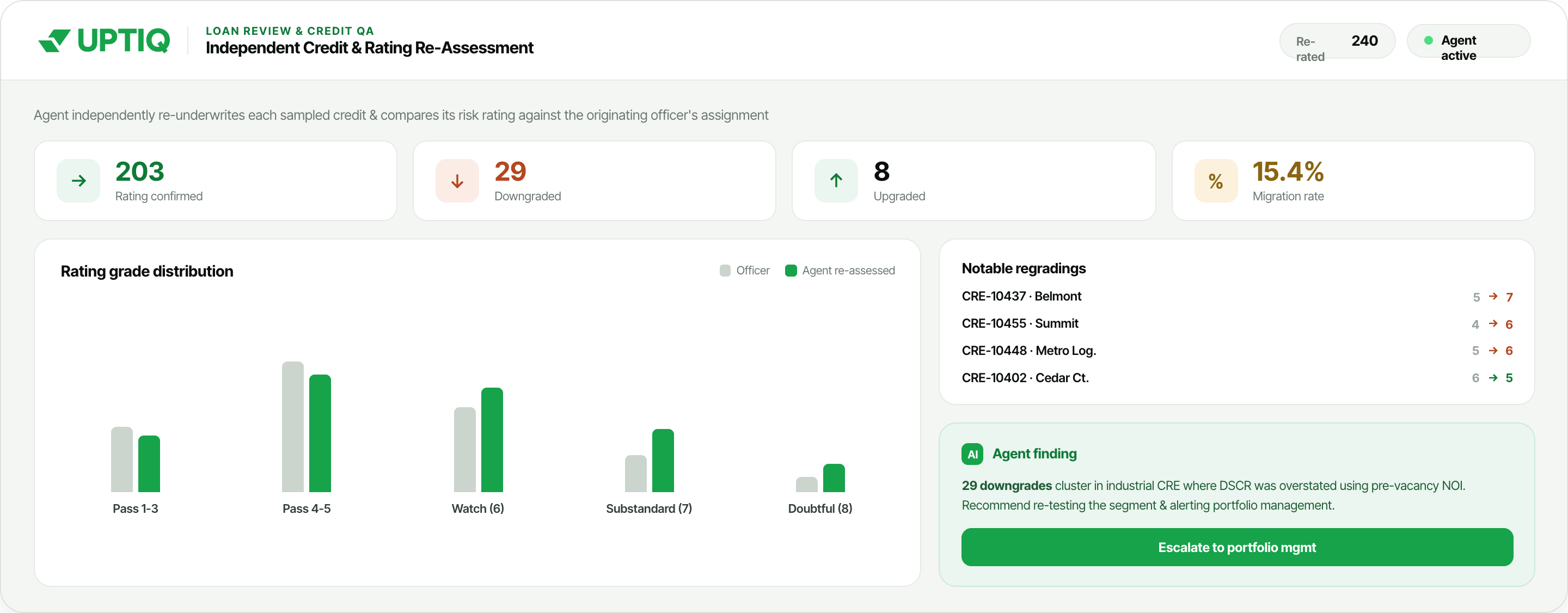
Rating re-assessment applies the institution's risk rating methodology to the information in the credit file — the same methodology the originating team was supposed to apply — and produces an independent rating conclusion. When the agent's rating conclusion differs from the assigned rating, the discrepancy is documented as a rating finding with the specific analytical basis for the difference — including which financial metrics, qualitative factors, or rating criteria drove the divergence — and escalated to the loan review officer for determination.
The loan review officer's determination — whether the original rating is confirmed, the independent assessment is accepted, or a different conclusion is reached — is recorded alongside the agent's finding, creating the two-opinion record that best-practice loan review programs and some regulatory frameworks require. The critical governance principle is that neither the agent nor any automated process makes a final rating determination: the human loan review officer holds that authority, and the agent's role is to ensure that every rating in the reviewed population faces independent challenge rather than only those in a manually selected sample.
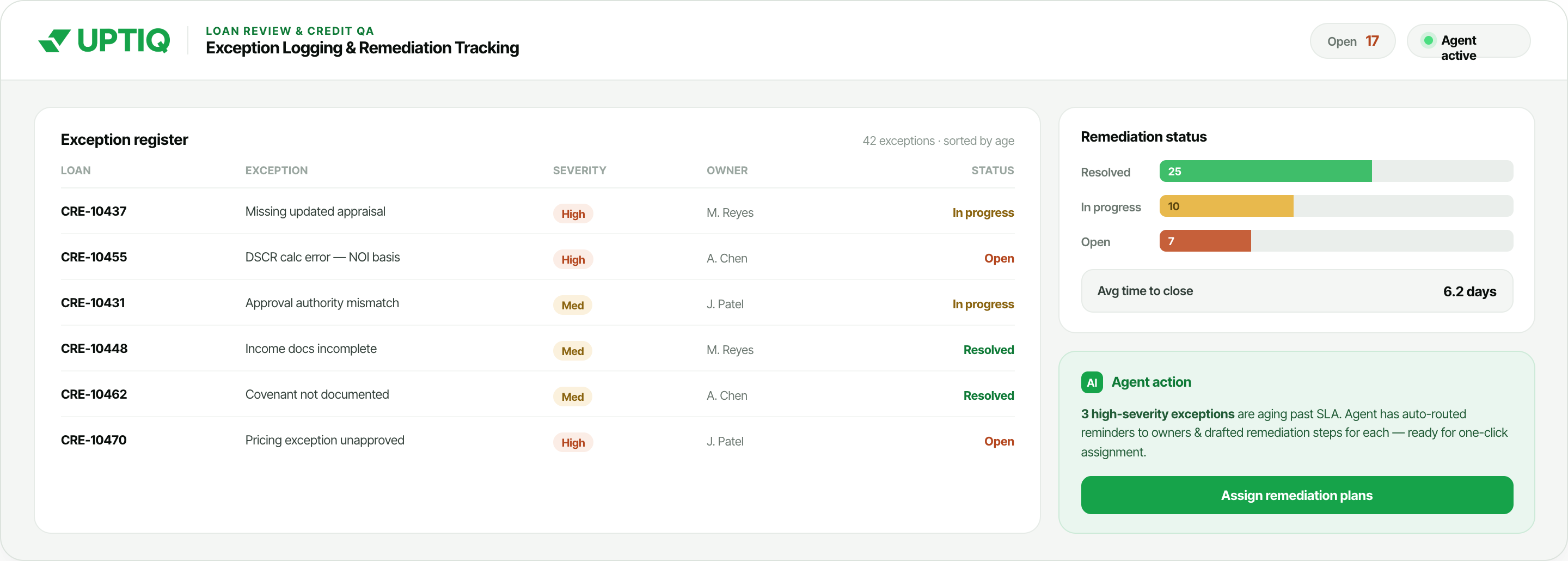
The exception register contains every identified exception documented with: the loan identifier, the exception type, the specific policy provision involved, the deficiency identified, the risk implication of the deficiency, the recommended remediation action, the responsible owner, and the status of remediation. For exceptions accepted rather than remediated, where the credit team determines that the exception does not require correction, the acceptance rationale and authorizing officer are recorded alongside the original finding.
The register is designed for examination review from the start: every entry is formatted to answer the questions an examiner will ask when reviewing the institution's loan review program, what was found, why it matters, who is responsible for addressing it, and how it was resolved. Institutions that produce exception registers in this format consistently receive better examination assessments of their loan review function than those that produce informal finding lists that require interpretation before their implications can be assessed.
Most institutions are running initial file QA and exception logging within a matter of weeks. Uptiq handles QA checklist configuration, rating methodology documentation, LOS and document management integration, and exception register setup during deployment. For institutions with an existing loan review program, the current exception inventory is migrated during deployment, so tracking begins from the actual current exception population rather than from zero.
Many institutions begin with loan file QA, which produces immediate exception documentation value and is easier to configure than rating re-assessment, which requires the institution's rating methodology to be fully documented and structured before the agent can apply it. Rating re-assessment is typically deployed in a second phase after the QA capability has been validated and the rating methodology documentation has been reviewed for the level of specificity the agent needs to apply it consistently.
Yes. The platform includes SOC 2 Type II compliance, encrypted data handling, role-based access controls that restrict loan file access and exception register content to authorized loan review and credit administration personnel, and comprehensive audit logging of every QA review, rating assessment, and exception logging action. Loan file data — which includes borrower financial information and credit decision documentation — is handled within the institution's configured data environment and is never shared outside the defined loan review workflow.
The agent's read-only access to loan origination and document management systems ensures that the independence between review and origination is maintained at the system level as well as the process level, the agent cannot modify a credit file, change a rating in the origination system, or alter a document, regardless of the findings it produces. This system-level independence protection is what makes the independence claim defensible to an examiner who asks how the institution ensures that its loan review function cannot be influenced by the originating teams whose work it is reviewing.
Self-review — where the credit team reviews files originated by its own members- lacks the independence that loan review is designed to provide. The purpose of independent credit review is to apply fresh analytical eyes and objective methodology to decisions made under the judgment and time pressure of the origination process; a team reviewing its own work is structurally less likely to identify the rating generosity, documentation shortcuts, and policy interpretation patterns that independent review exists to catch. The agent's complete structural separation from origination is what makes its reviews genuinely independent.
Sample-based manual review has a different limitation: coverage. A loan review program that reviews 15% of originated volume by definition leaves 85% of the portfolio without quality oversight for each review cycle. Exception patterns that are dispersed across the non-sampled population accumulate undetected until they reach a concentration level that shows up in the next sample, by which point the pattern may have been developing for multiple origination cycles. The agent's ability to cover a larger portion of the portfolio is what makes exception detection timely rather than retrospective.
Our team handles deployment end-to-end, from configuration to go-live. Most financial institutions are live within days, not months.