Monitor credit risk continuously across your portfolio, testing covenants, surveilling borrower financials, validating risk ratings, and supporting stress testing, so the credit committee knows where risk is trending between origination and the next annual review.


Replace annual review cycles that miss intra-period deterioration, manually assembled covenant test trackers, and stress test inputs compiled under deadline pressure with a continuous credit risk surveillance workflow that monitors every significant exposure between formal review dates.


The Uptiq Credit Risk Monitoring & Surveillance Agent monitors credit risk between origination and formal review, testing covenants against refreshed financials, surveilling the portfolio for deterioration signals, validating and challenging risk ratings against current observable conditions, and producing stress testing and reserve analysis inputs on demand. The agent recommends; it never decides. Credit rating changes, relationship management actions, and reserve conclusions remain with the credit officers and credit committee, who hold the authority and accountability for those determinations.
The result is a credit risk monitoring program that closes the gap between formal annual review dates, when the most significant credit deterioration actually occurs for many borrowers, and makes the credit team's view of portfolio risk genuinely current rather than a snapshot of conditions that may have materially changed since the last review. For institutions managing commercial and CRE portfolios with significant concentration risk or cyclical sector exposure, this continuous between-review monitoring is what allows the credit team to act on emerging risk while options are still available rather than after deterioration has advanced to the point of loss.
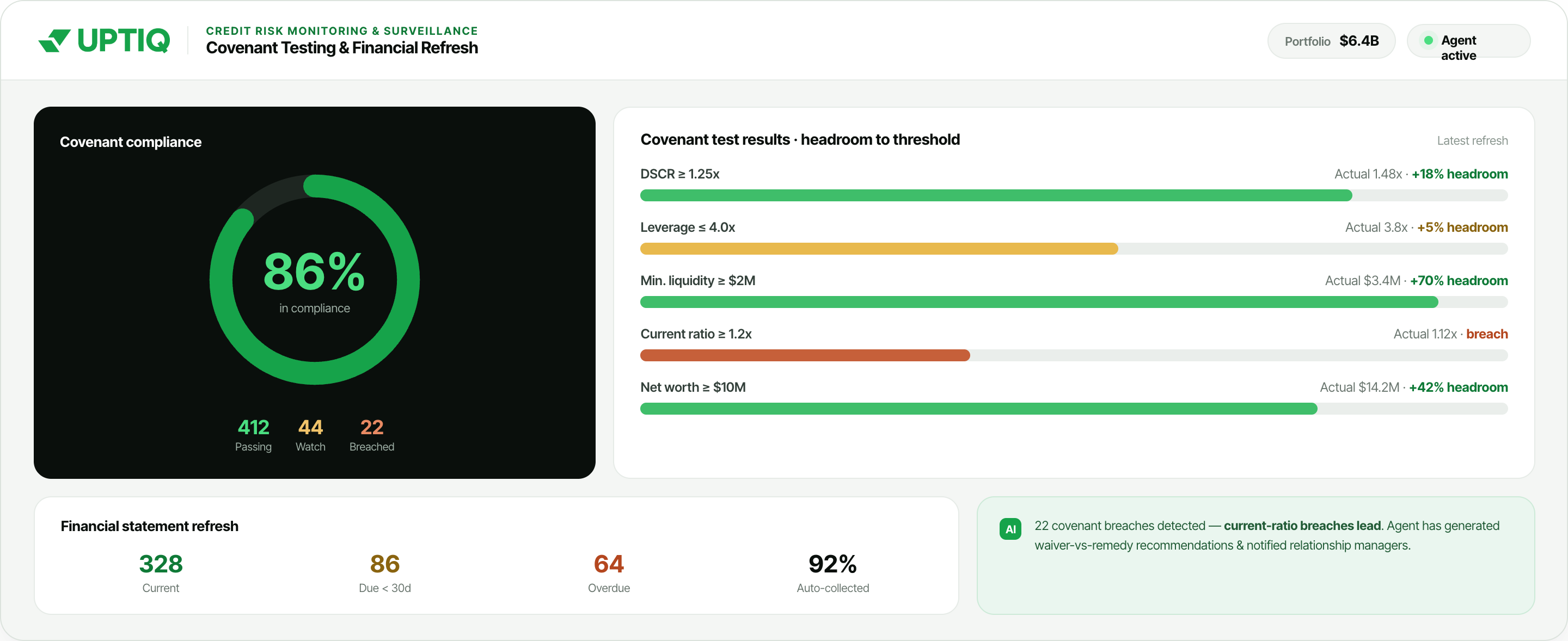
Covenant testing applies the specific financial covenant definitions from each loan agreement to the most recently available borrower financial data, annual audited statements, interim reviewed financials, tax returns, or borrower-submitted management accounts, and computes the metric values required to determine compliance. When a covenant test produces a result that is in breach or within a configurable proximity-to-threshold band, the finding is surfaced as a covenant alert for credit officer review and relationship management action.
Covenant alerts include the specific covenant tested, the computed metric value, the applicable threshold, the source financial data used for the computation, and the observation date, providing the credit officer with the complete context needed to assess whether the breach or proximity warrants immediate action, a covenant waiver process, or enhanced monitoring. The agent produces the test result and the context; the credit officer determines the appropriate relationship management response.
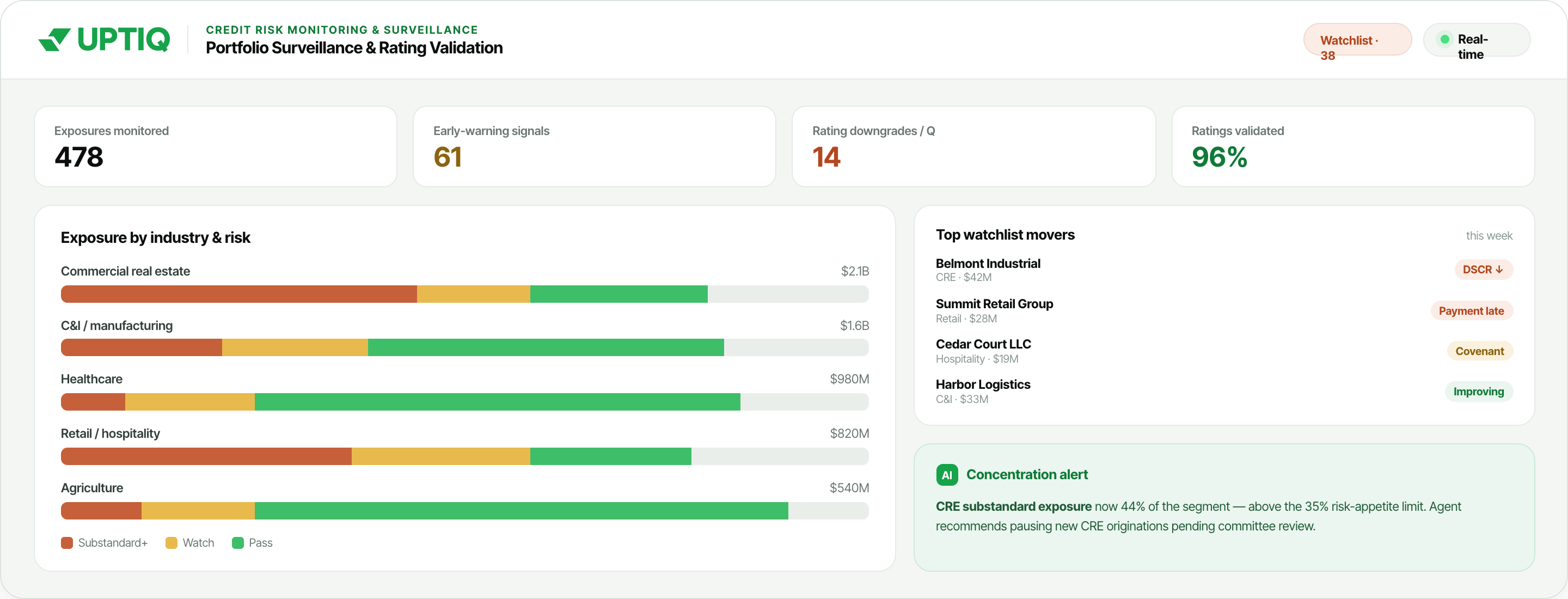
Rating validation applies the institution's risk rating methodology to the current observable data maintained in the surveillance dataset for each rated borrower, using the same financial metrics, qualitative factors, and rating criteria that the originating team was supposed to apply at origination. When the rating implied by current observable conditions differs materially from the assigned rating, the discrepancy is surfaced as a rating challenge recommendation for credit officer review.
Rating challenges are recommendations, not overrides: the assigned rating in the credit administration system is not changed by the agent, and the challenge finding is presented to the credit officer as an input to the formal rating review process rather than a unilateral determination. This architecture preserves the credit committee's authority over the institution's rated risk portfolio while ensuring that every significant exposure faces a rating challenge from current conditions rather than only at the annual review cycle, which is the gap that produces the rating cliff effect that supervisors and auditors consistently identify in commercial credit portfolios that review annually on a fixed schedule.
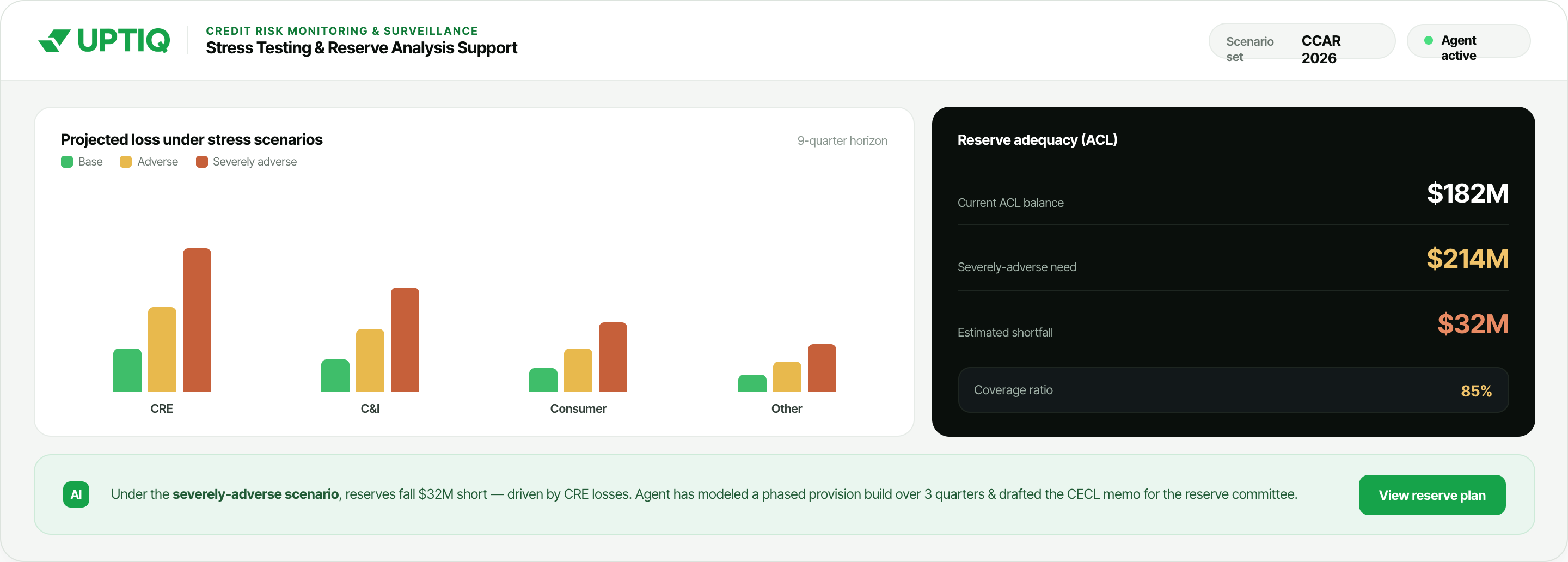
Stress testing support works by producing scenario-based outputs from the portfolio surveillance data the agent continuously maintains. For a given stress scenario, defined by the credit risk team in terms of macroeconomic or sector-specific adverse assumptions, the agent applies the scenario parameters to the current portfolio data to produce estimated loss rates, migration probabilities by risk rating grade, and borrower-level sensitivity indicators. These structured inputs are delivered to the credit risk team for use in the formal stress testing model rather than requiring manual data assembly from point-in-time snapshots.
CECL and ALLL reserve analysis support works similarly: the agent provides current portfolio segment data, loan type, risk rating distribution, weighted average remaining term, and recent historical loss experience, organized at the segment granularity that the institution's loss estimation methodology requires. This eliminates the manual data pull and segment reconciliation cycle that typically consumes significant credit team capacity immediately before each quarter-end reserve calculation deadline.
Most institutions are monitoring the portfolio and running initial covenant tests within a matter of weeks. Uptiq handles loan administration system integration, covenant schedule import, financial statement repository connection, and rating methodology configuration during deployment. Historical financial data and covenant records are loaded during deployment so the initial covenant testing cycle reflects the institution's actual outstanding exposure rather than starting from a clean state that requires multiple quarters of data accumulation before monitoring is meaningful.
Many institutions deploy covenant testing and deterioration surveillance first, which produce immediate risk management value with less methodology configuration than rating validation, and add formal rating challenge workflows and stress test support in a subsequent phase. The rating validation component requires the institution's rating methodology to be fully documented and structured at a level the agent can apply consistently, which is a pre-deployment activity that may require some preparation by the credit risk team before that phase begins.
Yes. The platform includes SOC 2 Type II compliance, encrypted data handling, role-based access controls that restrict credit surveillance data and rating challenge records to authorized credit risk and portfolio management personnel, and comprehensive audit logging of every covenant test run, surveillance signal, rating validation, and stress test input generation. Borrower financial data processed by the agent is handled within the institution's configured data environment and is never shared outside the defined credit risk monitoring workflow.
The agent's recommendation-only architecture ensures that no rating is changed, no covenant waiver is initiated, and no reserve conclusion is recorded without explicit human determination by the designated credit officer or credit committee. This human-decision preservation is consistent with the examiner's expectation that credit decisions carry named human accountability, automated analysis and recommendation do not satisfy the accountability requirement that the governing regulatory frameworks impose on credit risk management.
Annual credit review is a point-in-time process: it captures the borrower's condition at the review date and the risk rating and action plan that condition supports at that moment. What it cannot capture is what happens between the annual review date and the next one, the quarter where revenue declined materially, the sector shock that impaired collateral values, the covenant breach that was technically observed but not formally reported because the annual review was three months away. These intra-period developments are where actual credit losses originate, and annual review processes are structurally designed to miss them.
Periodic portfolio reporting captures aggregate portfolio statistics but does not test individual covenants, validate individual ratings against current conditions, or surface specific borrower deterioration signals for action. The agent combines the individual-borrower monitoring depth that annual review provides with the continuous frequency that periodic reporting provides , monitoring every significant exposure continuously rather than reviewing each one annually or reporting aggregate statistics periodically. The combination is what makes credit risk monitoring an active risk management function rather than a retrospective documentation process.
Our team handles deployment end-to-end, from configuration to go-live. Most financial institutions are live within days, not months.