Draft and update policies, map them to the regulations and risks they are meant to address, identify coverage gaps before examiners do, and manage attestation and distribution, keeping the institution's written control fabric as strong as the risks it governs.


Replace reactive policy updates, manual regulatory mapping exercises, and spreadsheet-tracked attestation cycles with a structured policy management workflow that keeps every written control current, mapped, gap-analyzed, and distributed to the people who need to attest to it.


The Uptiq Policy & Procedure Management Agent is an AI-powered solution that supports the full policy lifecycle, from drafting and revision through regulatory and risk mapping, gap analysis, attestation management, and distribution. The agent surfaces the regulatory requirements and risk-taxonomy context relevant to each policy, identifies where existing policies do not cover required obligations, and manages the attestation workflows that demonstrate the policies are known and applied by the staff responsible for implementing them.
The result is a policy library that stays genuinely current rather than drifting toward obsolescence between examination cycles, a coverage map that makes compliance gaps visible before examiners find them, and an attestation record that demonstrates real governance traction rather than a paper compliance exercise. By connecting the policy framework to the regulatory and risk landscape that surrounds it, the agent transforms policy management from a documentation function into an active control.
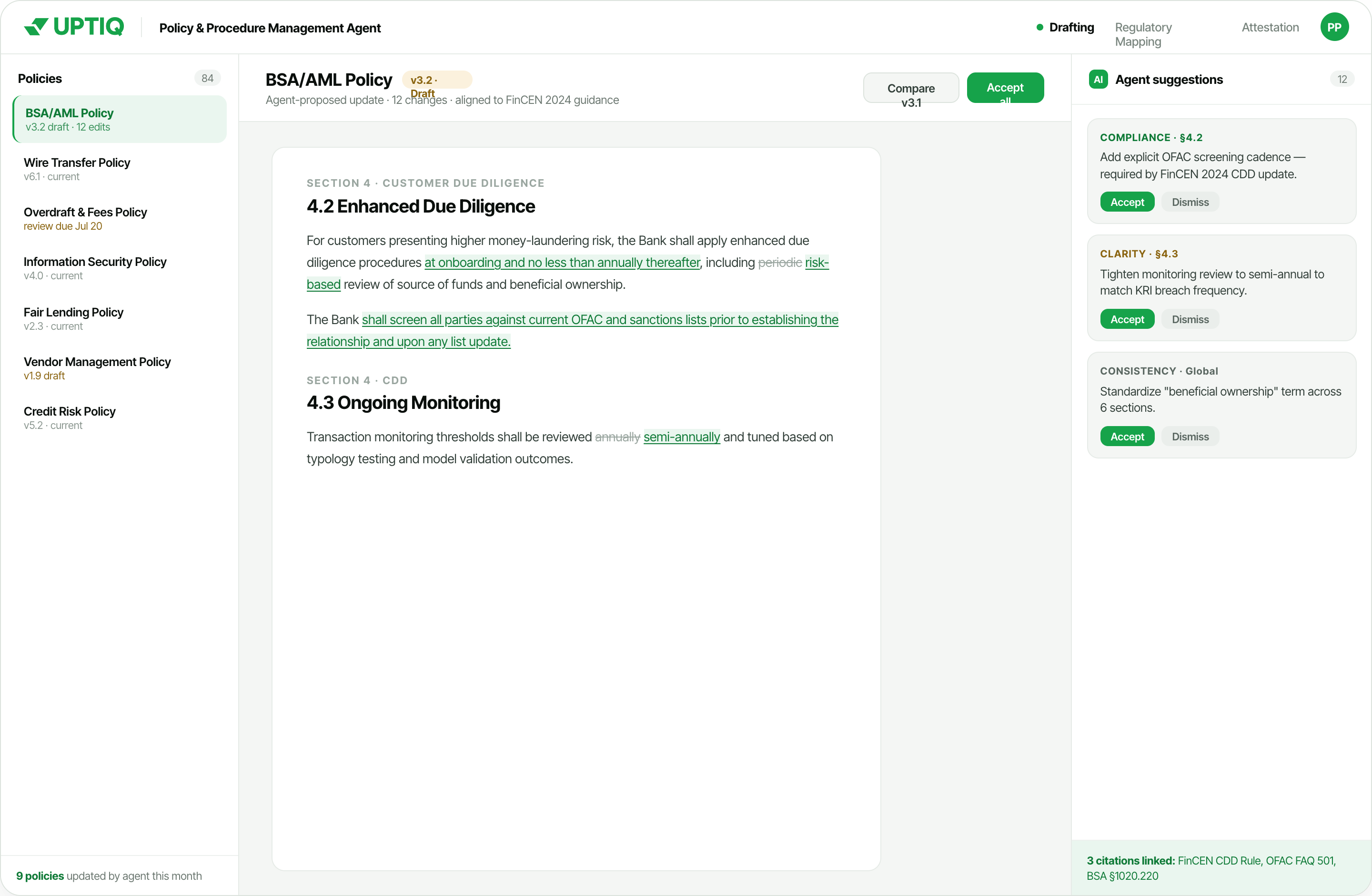
The agent supports policy drafting by surfacing, at the point of authoring, the specific regulatory requirements, risk-taxonomy items, and existing institutional policy language relevant to the topic being drafted or revised. Policy authors receive a structured starting context, relevant obligations, related policies, and any coverage gaps the new policy is intended to close, rather than beginning from a blank document without the cross-referencing that comprehensive policy writing requires.
During the review process, the agent routes draft content through the institution's configured approval workflow, maintains clear version control between the current approved policy and the pending revision, and retains the complete revision history with timestamps and author attribution. This version management is what makes policy documentation defensible during examinations; examiners reviewing a policy need to see not just the current version but the history of how it has changed in response to regulatory developments.
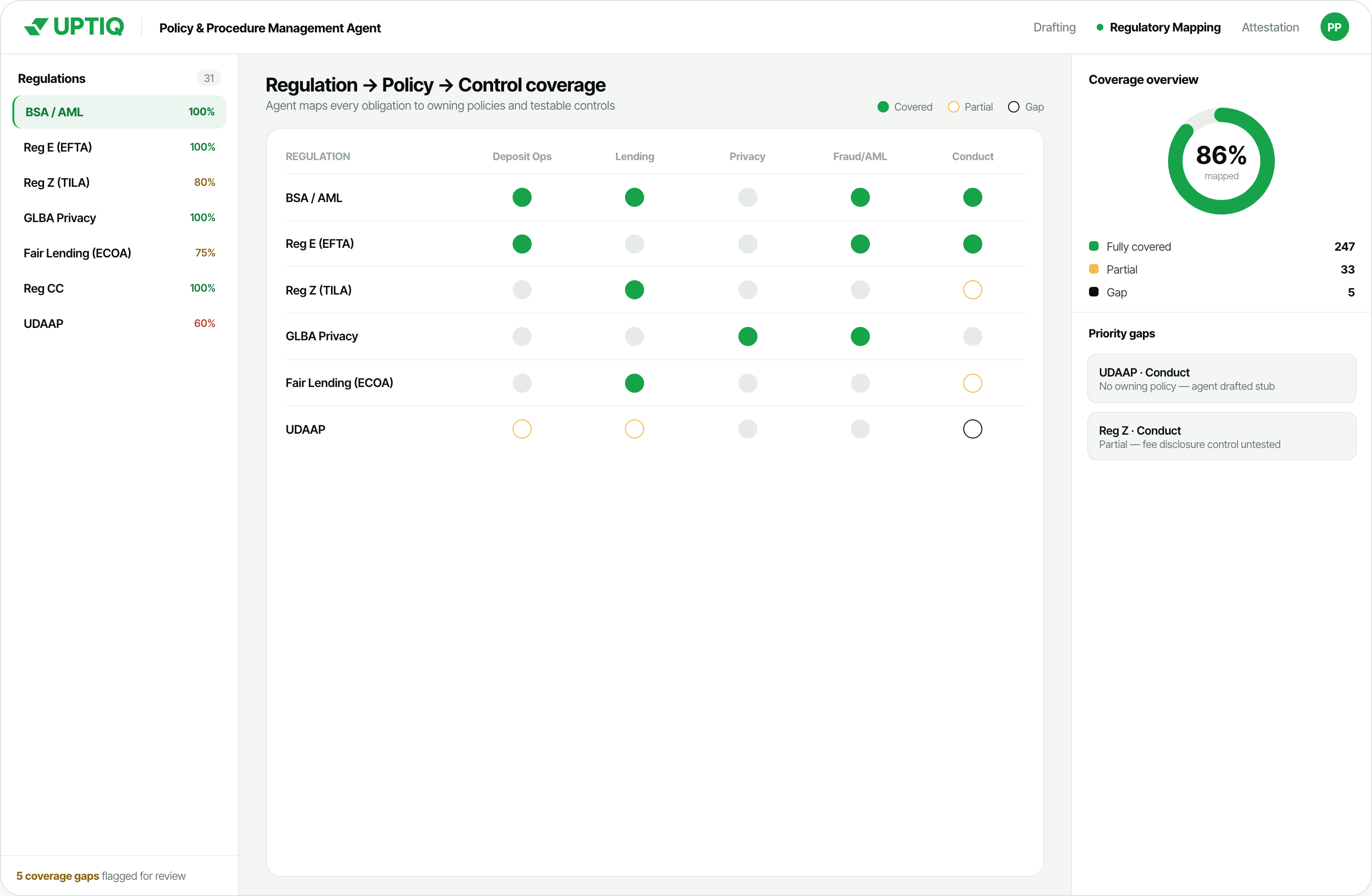
The regulatory and risk mapping function maintains a structured matrix that links each policy to the specific regulatory requirements it implements and the risk-taxonomy items it controls. This mapping is built during initial deployment from the institution's existing policy library and regulatory obligation inventory, and updated continuously as new policies are approved and as regulatory changes are ingested from the Regulatory Change Management Agent or configured regulatory monitoring sources.
The gap analysis runs against this matrix to identify two types of coverage gaps: regulatory requirements that have no corresponding policy coverage, and risk-taxonomy items assessed in the RCSA process that have no written control framework established by an existing policy. Both gap types are surfaced as recommendations for management review; the gap analysis does not create policies autonomously or designate existing policies as covering requirements they do not actually address.
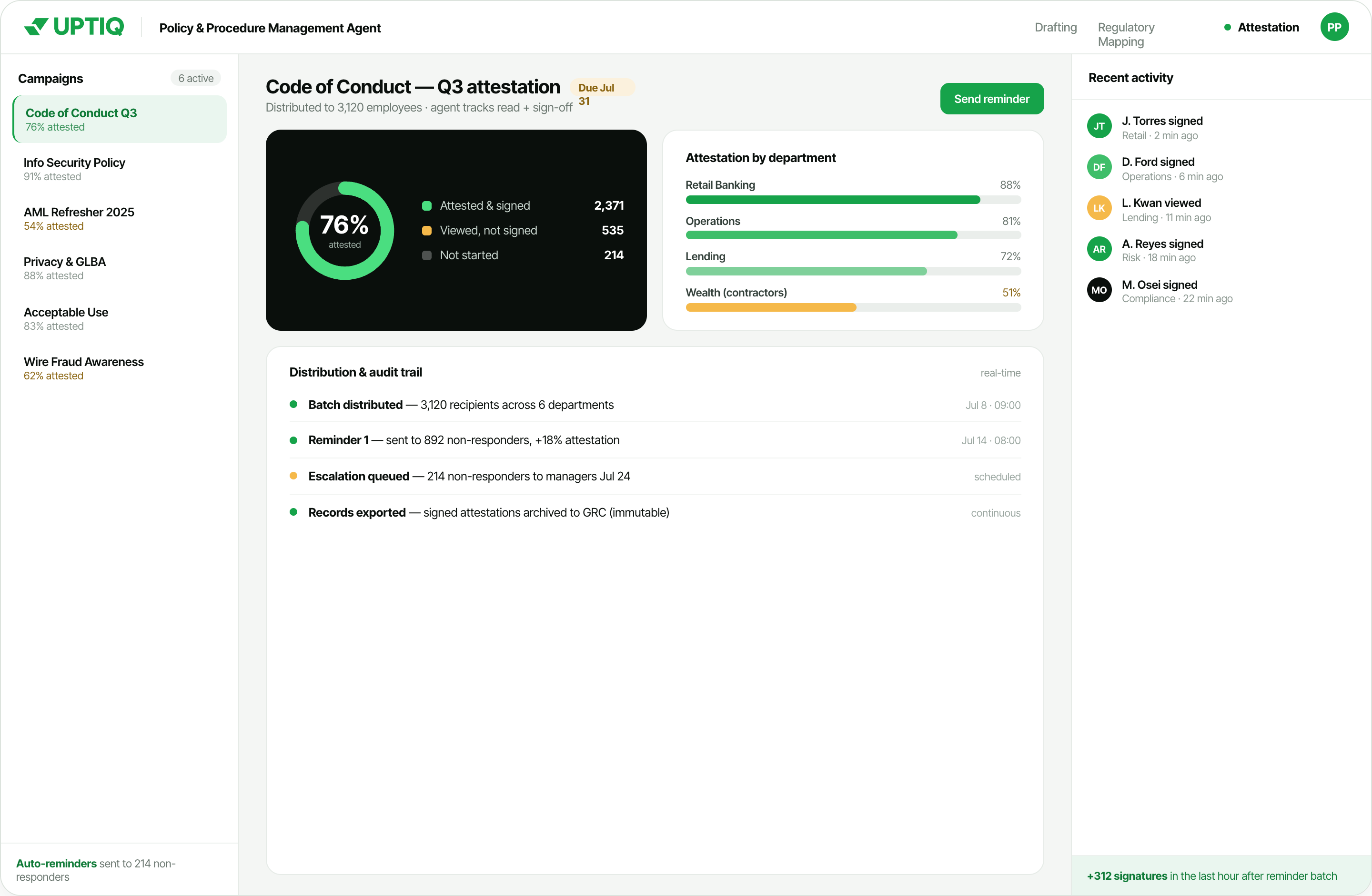
Attestation management begins when a policy is approved and enters active status. The agent identifies the staff populations required to attest to the policy based on the role, department, or function configurations established during deployment, distributes the policy through the institution's configured channels, and tracks completion against the required attestation deadline. Staff who have not completed their attestation before a configurable proximity threshold trigger an escalation notification to their manager or the designated compliance owner.
Every completed attestation is retained with the attesting employee's identifier, the timestamp, and the specific policy version attested to, so if a policy is updated mid-year and a new attestation cycle is required, the records clearly distinguish which employees attested to the pre-update version and which have completed the updated attestation. This version-linked attestation record is what examiners look for when they want to confirm that policy updates reached the staff responsible for implementing them.
Most institutions are live within a matter of weeks. Uptiq handles existing policy library ingestion, regulatory obligation mapping, attestation workflow configuration, and document management system integration during deployment. For institutions with an active policy library, existing policies are ingested, mapped to the regulatory and risk framework, and gap-analyzed during deployment, so the first output is a current state coverage map rather than a blank starting point that takes months to build.
Many institutions begin with the attestation management and distribution capabilities, which have the most immediate operational impact and require the least upfront configuration, then add regulatory and risk mapping and gap analysis once the team has validated the agent's policy library ingestion and version-control behavior. This sequencing keeps deployment fast and produces visible compliance benefits before the more analytically intensive capabilities are fully configured.
Yes. The platform includes SOC 2 Type II compliance, encrypted data handling, role-based access controls that restrict draft policy content and attestation records to authorized governance and compliance personnel, and comprehensive audit logging of every policy version, mapping change, and attestation event. Policy content and obligation mapping data processed by the agent remain within the institution's configured data environment.
The agent does not approve policies, finalize regulatory mappings, or close coverage gaps without explicit authorization from designated policy owners and compliance reviewers. This human-approval architecture preserves the governance accountability structure that regulators expect to see, where a named individual is responsible for each policy's content, coverage, and currency, while removing the manual effort that makes sustaining that accountability structure difficult at scale.
Document management systems store and version-control policy documents they do not draft policy content, map policies to regulatory obligations, identify coverage gaps, or manage attestation workflows tied to approval events. GRC policy modules typically offer workflow and storage capabilities but lack the regulatory intelligence layer that connects policy content to specific, current regulatory requirements and surfaces gap analysis in a form that is actionable for compliance teams rather than just visible in a matrix.
The agent functions as a policy intelligence layer on top of whatever document management or GRC infrastructure the institution already uses, adding the drafting support, obligation mapping, gap analysis, and attestation management capabilities that those systems were not built to provide. The institution keeps its existing document repository; the agent makes the policy library actively managed rather than passively stored.
Our team handles deployment end-to-end, from configuration to go-live. Most financial institutions are live within days, and not months.