Maintain a current inventory of every model and AI agent in your institution, support validation and independent challenge, monitor performance and drift, and flag governance gaps, including the AI agents making decisions on behalf of your teams right now.


Replace incomplete model inventories, periodic validation cycles that lag deployment timelines, and performance monitoring that only runs when someone remembers to check with a structured model governance workflow that keeps every model accounted for, validated, and continuously monitored.


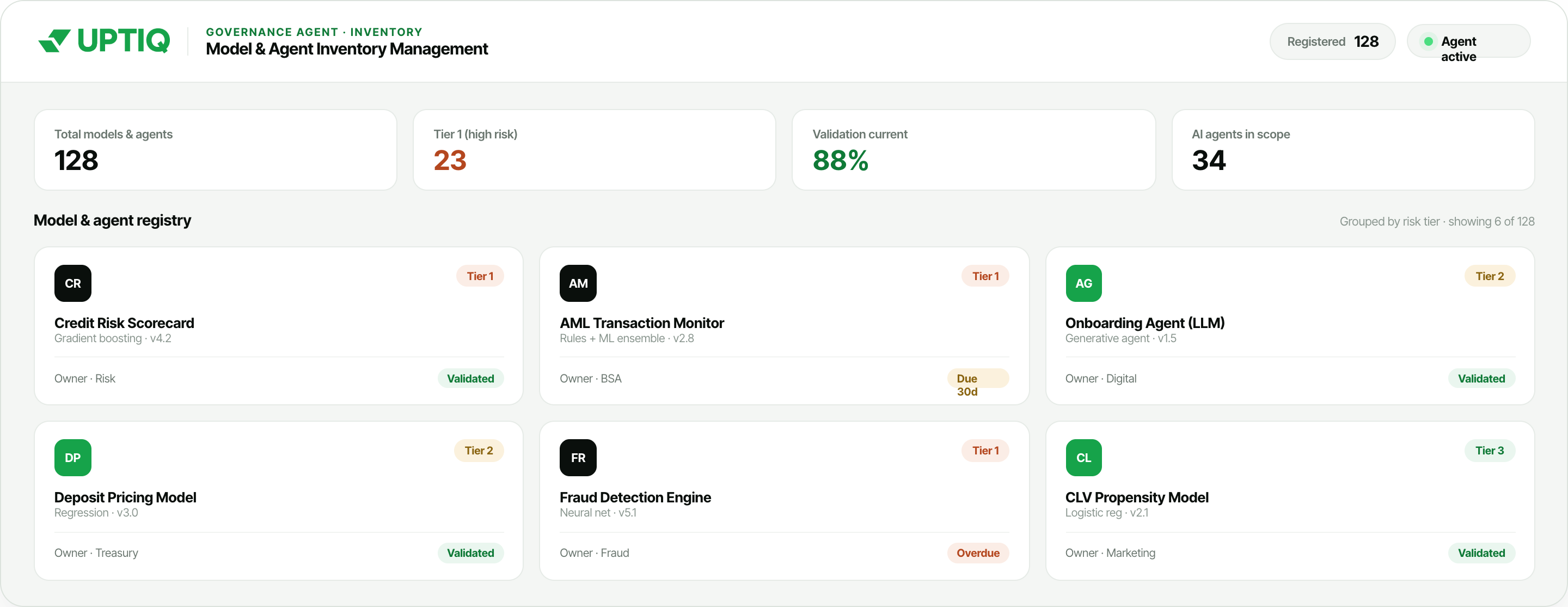
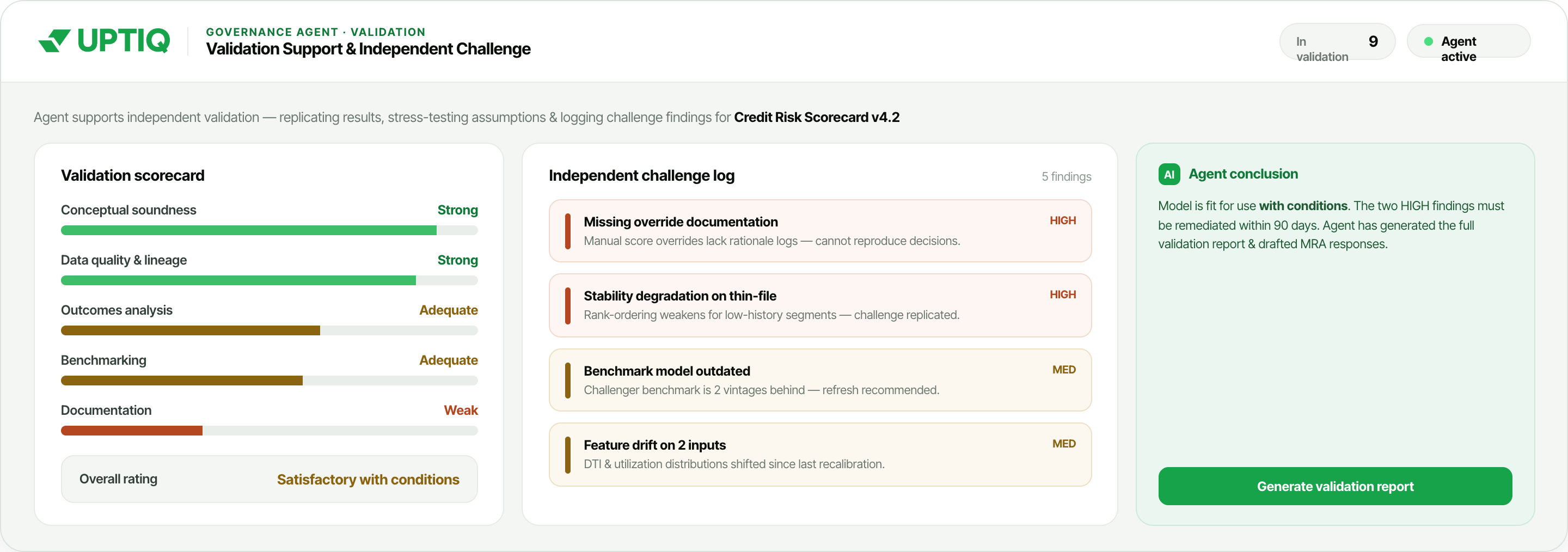
The Uptiq Model Risk Management Agent governs the institution's full model and AI agent portfolio, maintaining the inventory, supporting validation and independent challenge, monitoring performance and drift continuously, and flagging governance gaps when ungoverned models appear in decision paths. It governs the other AI agents in the Uptiq portfolio using the same framework it applies to every other model, because those agents are models with decision-path implications, and the governance standard applies regardless of where a model originates.
The result is a model risk management program that stays current with the institution's actual model population, supports validation with organized evidence rather than requiring teams to reconstruct documentation under review pressure, and detects performance problems before they affect the decisions the models drive. For institutions operating under the April 2026 interagency principles-based model risk management guidance, which replaced SR 11-7 and explicitly addressed AI and machine learning models, this comprehensive, continuous governance program is what the new framework was designed to require.
The agent applies the definition established by the interagency model risk management guidance: a model is any quantitative method, system, or approach that applies statistical, economic, financial, or mathematical theories, techniques, and assumptions to process input data into quantitative estimates. Under this definition, the institution's model inventory includes credit scoring and underwriting models, fraud detection algorithms, AML transaction monitoring systems, interest rate risk and liquidity models, prepayment and credit loss estimation models, and the AI agents operating in the institution's compliance, operations, and customer-facing programs.
The explicit inclusion of AI agents in the governance scope is what distinguishes a current model risk program from one written for the pre-AI generation of quantitative tools. The April 2026 interagency guidance updated the principles to address AI and machine learning models specifically, including the additional validation challenges that complex AI models present, the explainability requirements for AI-assisted adverse actions, and the ongoing monitoring obligations for models whose behavior can drift in ways that simpler statistical models cannot. The agent's governance framework reflects these updated requirements.
Ungoverned model detection works by comparing the models and AI agents observed in decision-path data flows against the registered entries in the model inventory. When a model or agent is producing outputs that feed into a credit, compliance, or operational decision without a corresponding governance record in the inventory, the discrepancy is flagged as a governance gap and escalated to the model risk officer for immediate assessment. The detection is continuous rather than periodic; ungoverned models are identified as they enter decision paths rather than at the next scheduled inventory review.
Shadow models, quantitative tools built and deployed by business units without going through the formal model development and validation process, are the most common source of governance gaps in financial institution model inventories. They typically begin as analytical tools, evolve into operational decision inputs, and reach the point of material decision influence without anyone having formally assessed their conceptual soundness or tracked their performance. Continuous detection is what catches this progression while the model is still in early deployment rather than after it has become embedded in a critical process.
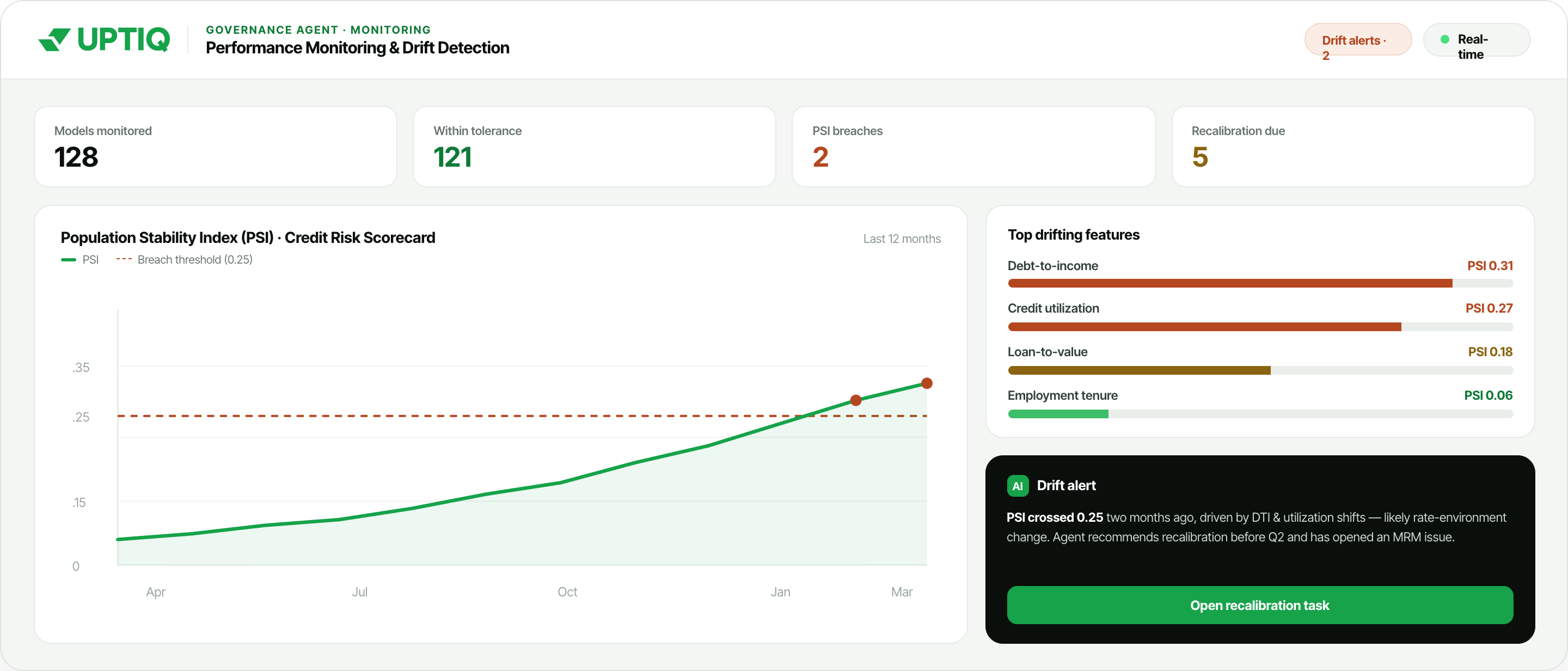
Performance monitoring tracks each model against the specific outcome metrics and stability indicators established during its most recent validation, discriminatory power for credit scoring models, detection rates and false positive rates for fraud models, and decision consistency and output distribution metrics for AI agents. Monitoring runs on the cadence configured for each model's risk tier: higher-risk or more recently deployed models are monitored more frequently than stable, lower-risk models with long validated performance records.
Drift detection watches for two distinct signal types: input distribution shift, where the population the model is scoring diverges from the population on which it was validated, and output drift, where the model's predictions or decisions are changing in ways not explained by corresponding changes in the input population. Both signal types indicate that the model's validated behavior assumptions may no longer hold, and both require a human governance response ranging from enhanced monitoring through expedited re-validation depending on the severity and nature of the drift observed.
Most institutions have a functional model inventory and initial monitoring in place within a matter of weeks. Uptiq handles model inventory initialization from existing documentation, performance monitoring data source configuration, and governance platform integration during deployment. For institutions with an existing model inventory, the current records are migrated and supplemented with the additional governance fields the agent requires, so the initial inventory reflects the institution's current model population rather than starting from scratch.
The initial inventory construction often reveals the shadow model problem directly: when the agent begins observing decision-path data flows and comparing them against the registered inventory, previously ungoverned models surface in the first monitoring cycle. Many institutions treat this initial gap discovery as a valuable governance exercise in itself; the inventory they thought they had is typically less complete than the inventory the agent's monitoring reveals.
Yes. The platform includes SOC 2 Type II compliance, encrypted data handling, role-based access controls that restrict model inventory and validation records to authorized model risk and governance personnel, and comprehensive audit logging of every inventory update, monitoring run, and governance escalation. Model development documentation and performance data processed by the agent are handled within the institution's configured data environment.
The agent's governance documentation output is aligned with the evidentiary standards that OCC, Federal Reserve, and FDIC examiners apply when reviewing model risk management programs under the current interagency guidance, including the documentation depth requirements for AI models that were introduced in the April 2026 principles-based update. Institutions whose model governance records satisfy these standards can walk into model-risk-focused examination components with documentation that addresses examiner questions before they are asked.
Model inventory spreadsheets are static snapshots that are only as current as the last manual update, they do not detect ungoverned models in decision paths, do not monitor model performance continuously, and do not support the validation process with organized evidence assembly. When an examiner asks for the model inventory, the institution produces the spreadsheet. When an examiner asks how the institution knows the inventory is complete and the models in it are performing as validated, the spreadsheet has nothing to offer.
GRC model risk modules improve on spreadsheets by providing structured workflow tracking and document storage, but they still depend on the institution to manually maintain the inventory and to manually review performance data rather than monitoring it continuously. The agent adds the capabilities that both approaches leave out: continuous decision-path monitoring to detect ungoverned models, automated performance and drift monitoring against validated baselines, and validation evidence assembly that compresses the preparation time that makes validation cycles slow. The result is a model governance program that is demonstrably active rather than documentarily complete but operationally passive.
Our team handles deployment end-to-end, from configuration to go-live. Most financial institutions are live within days, not months.