Support risk-based audit planning, execute testing with complete workpapers, document findings with source-linked evidence, and track remediation to closure, including independent assurance over the AI agents operating across your institution.


Replace time-consuming manual fieldwork, inconsistently documented workpapers, and finding registers that fall behind during busy periods with a structured audit workflow that accelerates testing, preserves evidence integrity, and tracks every finding from documentation through remediation.


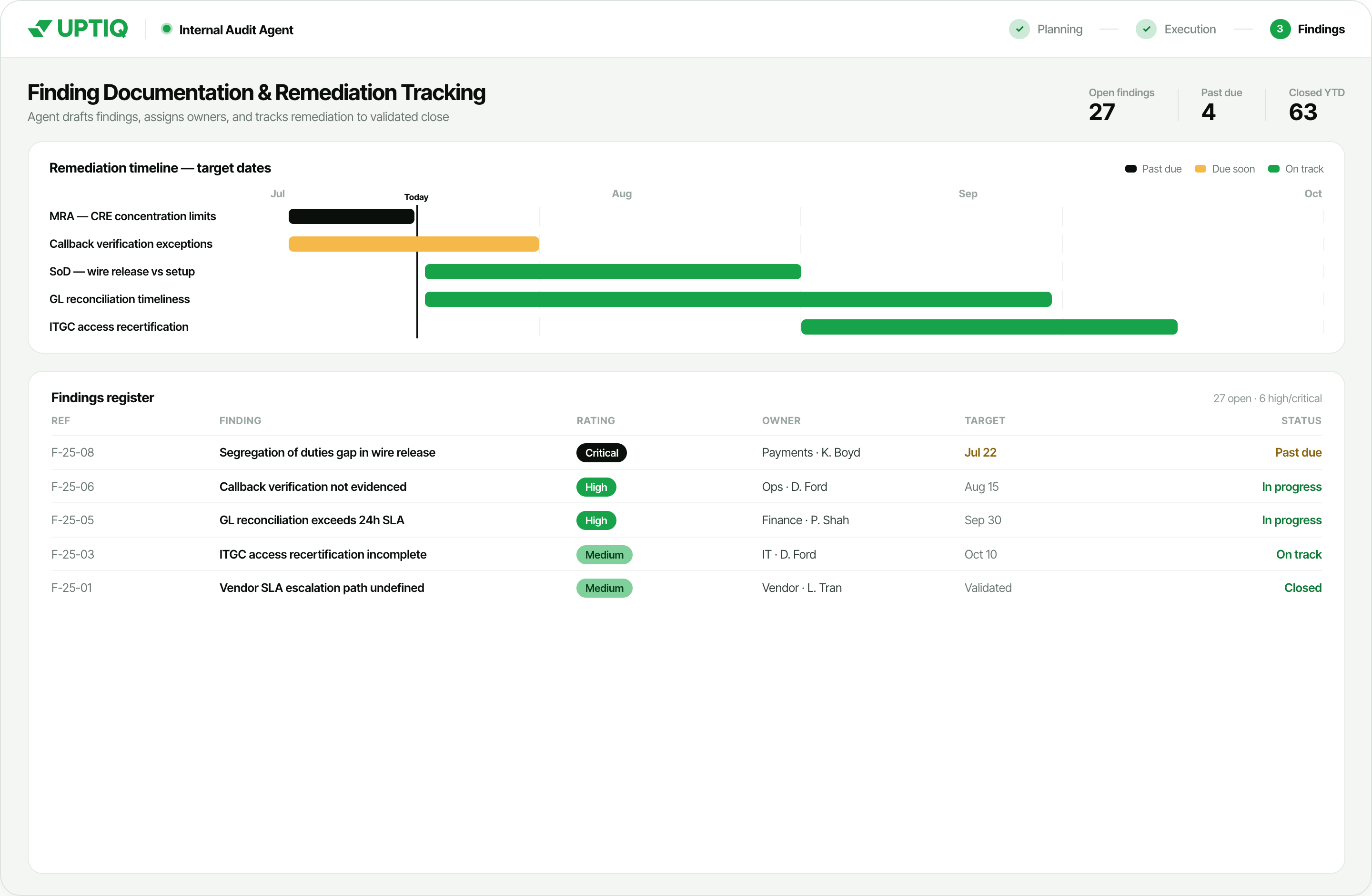
The Uptiq Internal Audit Agent is an AI-powered solution that supports the full internal audit lifecycle, from risk-based planning and scoping through test execution with complete workpapers, finding documentation, and remediation tracking to closure. The agent maintains strict independence from the processes it audits, supports rather than replaces the audit professional's judgment on findings and conclusions, and extends third-line assurance to the AI agents operating across the institution's compliance and risk program.
The result is an internal audit function that covers more ground in less time, produces workpapers with the evidence quality that supports examiner inspection, and maintains the independence that makes third-line assurance credible, without the administrative burden that currently consumes most of audit fieldwork before any actual judgment is exercised. For institutions deploying AI agents in their first and second lines, an Internal Audit Agent that can independently assess those tools is not optional infrastructure; it is what makes the overall AI governance program defensible.
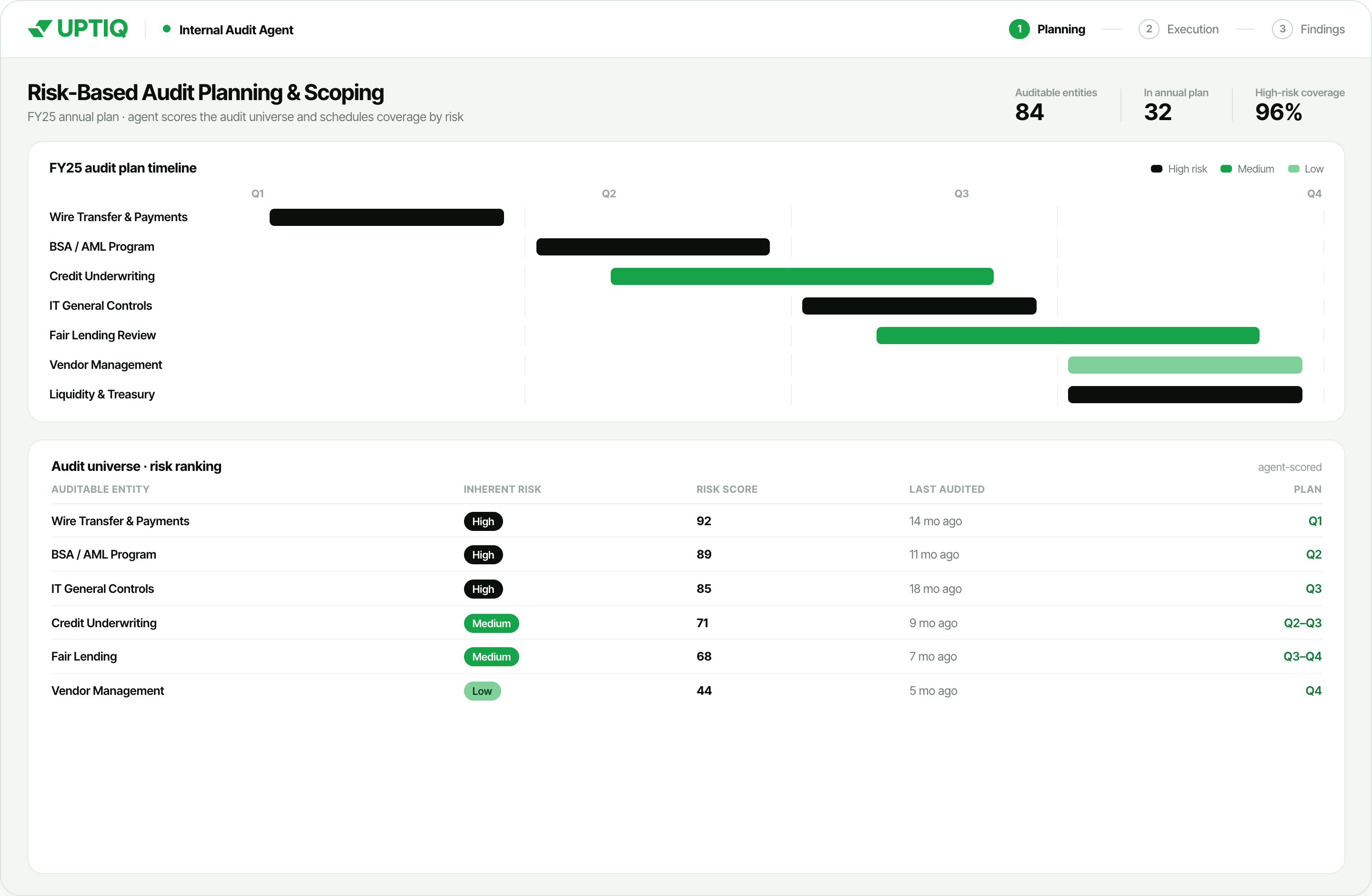
The agent supports risk-based audit planning by maintaining a living audit universe mapped to the institution's current risk inventory and drawing on RCSA results, operational loss event history, prior audit findings, and regulatory examination outcomes to identify where audit coverage should be concentrated in the upcoming period. When risk levels in a specific area have increased since the last audit, or when a control failure has been logged in the loss event system, the planning process reflects that information rather than working from a static annual schedule.
The structured scoping documentation produced by the planning process covers the audit objective, the specific risks and controls to be assessed, the evidence sources to be examined, and the testing approach, providing the level of pre-fieldwork planning that supports both efficient execution and clear Audit Committee communication before work begins. Planning documents are formatted for Audit Committee review and approval rather than internal working notes that require reformatting before governance use.
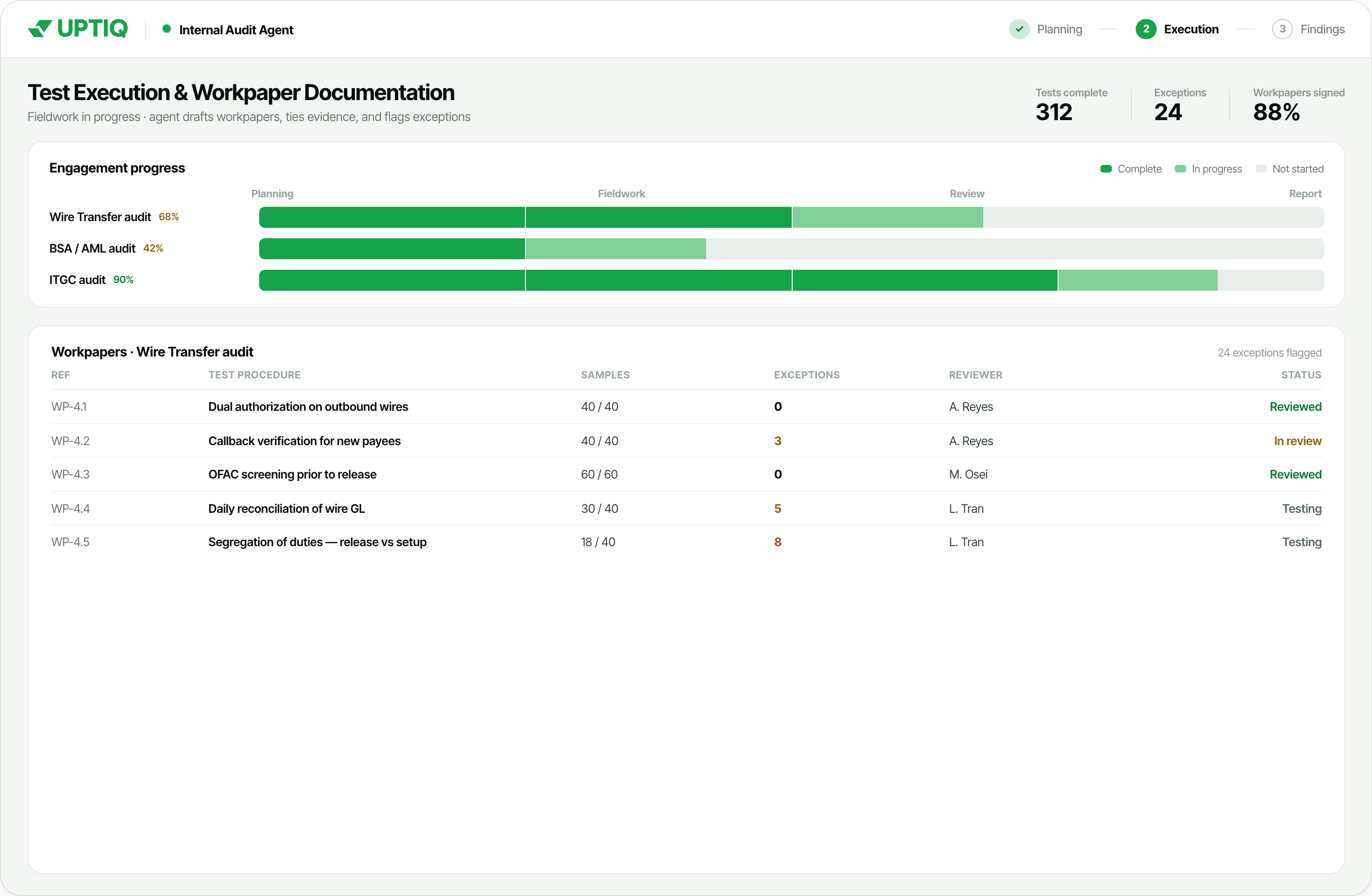
Each workpaper contains: the specific control being tested with its policy reference, the test objective, the testing approach applied, the evidence examined with source linkage to the original document or data extract, the exception criteria used to evaluate the evidence, the result of the test including any exceptions identified, the auditor's conclusion, and the audit supervisor's review notation. This structure satisfies both internal quality standards and the external inspection standards that OCC, Federal Reserve, and FDIC examiners apply when reviewing internal audit workpapers during examinations.
Source linkage is a non-negotiable component of every workpaper; conclusions that cannot be traced to specific, identifiable evidence do not satisfy the workpaper standards that support defensible findings. The agent maintains this linkage automatically, so workpapers are evidence-complete at the point of creation rather than requiring a separate documentation pass after testing concludes.
Independence is maintained through the agent's architectural separation from the processes and controls it evaluates. It does not modify policies, reset controls, change risk ratings, or approve transactions, it observes, tests, documents, and reports. Its access to operational systems is read-only for evidence collection purposes, and its outputs, findings, conclusions, and remediation recommendations go to audit management and the Audit Committee, not to the business units responsible for the processes being assessed.
For AI agent oversight specifically, the Internal Audit Agent reviews the operating behavior, output quality, and governance documentation of other Uptiq agents in the institution's portfolio, not their configuration or parameters. This is the same independence model that applies to human internal auditors reviewing automated systems: the auditor can examine how the system performs and whether its governance is adequate without having the ability to influence either.
Most internal audit functions are operational within a matter of weeks. Uptiq handles audit universe configuration, risk mapping setup, test program library initialization, and document management system integration during deployment. For institutions with an existing audit program, prior workpapers and open findings are loaded during deployment so the finding tracking capability is current from day one.
Many audit functions begin with workpaper documentation and finding tracking, the capabilities with the most immediate fieldwork efficiency impact, and add risk-based planning support and AI agent oversight in subsequent phases. This phased approach lets audit leadership validate the agent's workpaper quality through a parallel run period before it becomes the primary documentation method for external examination-quality work.
Yes. The platform includes SOC 2 Type II compliance, encrypted data handling, role-based access controls that restrict workpaper and finding content to authorized audit personnel, and comprehensive audit logging of every test execution and evidence collection action. The agent's read-only access to operational systems is scoped specifically to the evidence collection required by each audit engagement and does not extend to the operational functions those systems support.
Evidence integrity controls prevent workpaper content from being modified after the audit supervisor's review notation is recorded, preserving the evidentiary value of completed workpapers for examiner inspection and peer review. This immutability is what distinguishes workpapers with audit quality from working notes, and it is maintained by the platform architecture rather than requiring manual controls by audit staff.
Traditional audit management systems are designed for workflow tracking, they record that an audit was planned, started, and completed, and they store the workpaper files that audit staff created manually. They do not assist with test execution, do not build workpapers with source-linked evidence, do not extend coverage to AI agents operating in the institution's control environment, and do not accelerate fieldwork in a way that changes the ratio of judgment time to administrative time in an audit engagement.
Manual fieldwork processes have an additional problem: they are only as consistent as the individual auditor applying them, which creates the risk of inconsistent workpaper quality and coverage that peer review and external inspection regularly identify. The agent applies structured test programs consistently across engagements, maintains the same workpaper standards regardless of which team member is running the test, and produces examination-quality documentation as a natural output of the testing process rather than as a separate documentation effort that consumes time after fieldwork concludes.
Our team handles deployment end-to-end, from configuration to go-live. Most financial institutions are live within days, and not months.