Screen every payment and party against applicable watchlists in real time, resolve potential matches with the contextual detail adjudicators need, and prepare blocking and reporting documentation, with every clearing decision made by a human who can defend it.


Replace alert queues that grow faster than adjudicators can work, manual context assembly that delays match resolution, and blocking and reporting documentation prepared under deadline pressure with a structured screening workflow that screens in real time, resolves with context, and prepares every required action package.


The Uptiq Sanctions / OFAC Screening Agent screens every payment and party against applicable sanctions watchlists in real time before settlement, assembles contextual match resolution packages for adjudicator review, and prepares blocking and reporting documentation for confirmed match cases, presenting every action package for compliance officer authorization before submission. Every clearing decision is made by a designated human adjudicator; the agent screens and resolves, but it does not clear, block, or file autonomously.
The result is a sanctions screening program that operates at payment volume scale without sacrificing adjudication quality, clears false positives efficiently so adjudicator capacity is concentrated on actual match risk, and maintains the per-alert audit trail that OFAC and BSA/AML examinations look for when assessing the adequacy of the institution's sanctions compliance program. For institutions where payment volume growth has outpaced adjudicator capacity, the combination of real-time screening and automated context assembly is what allows the program to remain current with volume without proportional headcount growth.
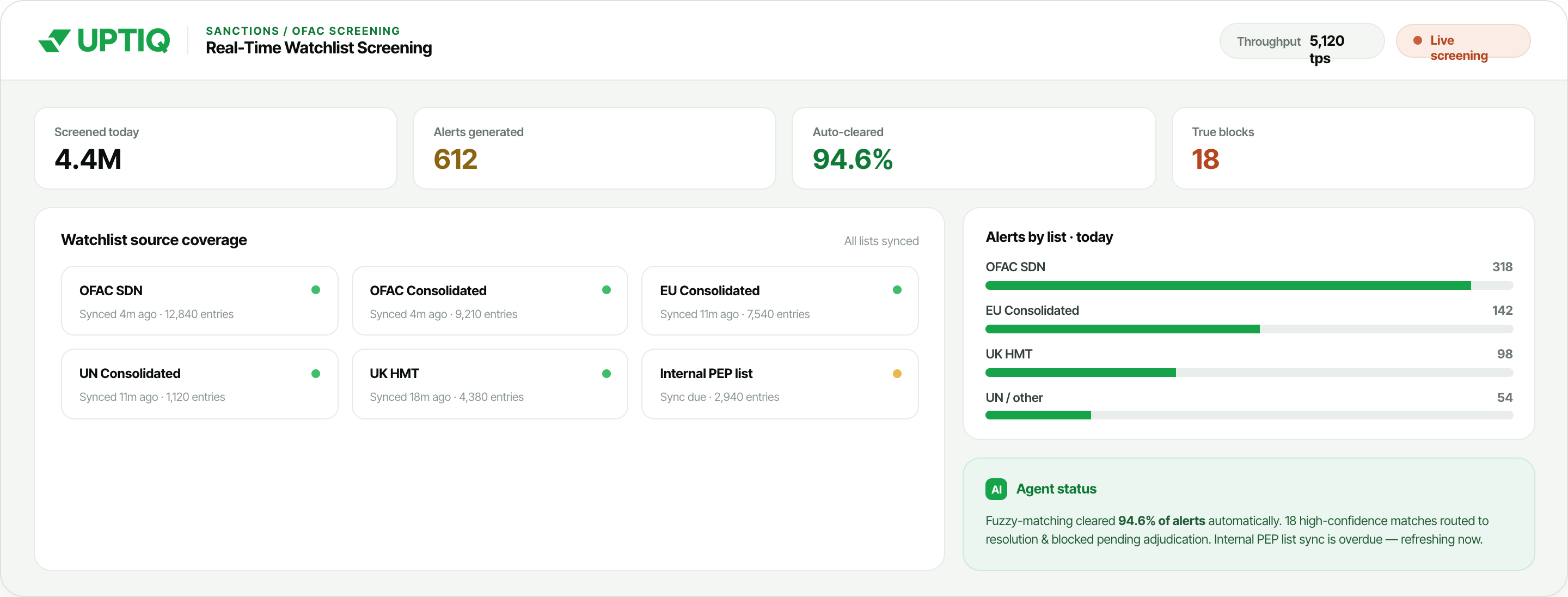
The agent screens against the full set of applicable sanctions watchlists configured for the institution's payment activity profile. Standard lists include: the OFAC Specially Designated Nationals and Blocked Persons (SDN) list, OFAC's sectoral sanctions programs including those targeting specific Russian, Iranian, and North Korean economic sectors, the HM Treasury Office of Financial Sanctions Implementation (OFSI) consolidated list for institutions with UK activity, the EU consolidated sanctions list, the UN Security Council consolidated list, and any institution-configured supplemental lists for counterparty risk or internal screening purposes. Watchlist updates are applied automatically as official list updates are published; the agent's screening always operates against the current published list rather than a cached version.
Ownership and control structure screening: identifying whether a payment party is owned or controlled at a 50% or greater threshold by an SDN-listed entity is applied to entity parties as a standard component of screening rather than as an enhanced procedure reserved for elevated-risk transactions. This comprehensive ownership screening is what satisfies the FinCEN and OFAC expectation that sanctions screening extends to beneficial ownership relationships rather than stopping at the named party in the transaction record.
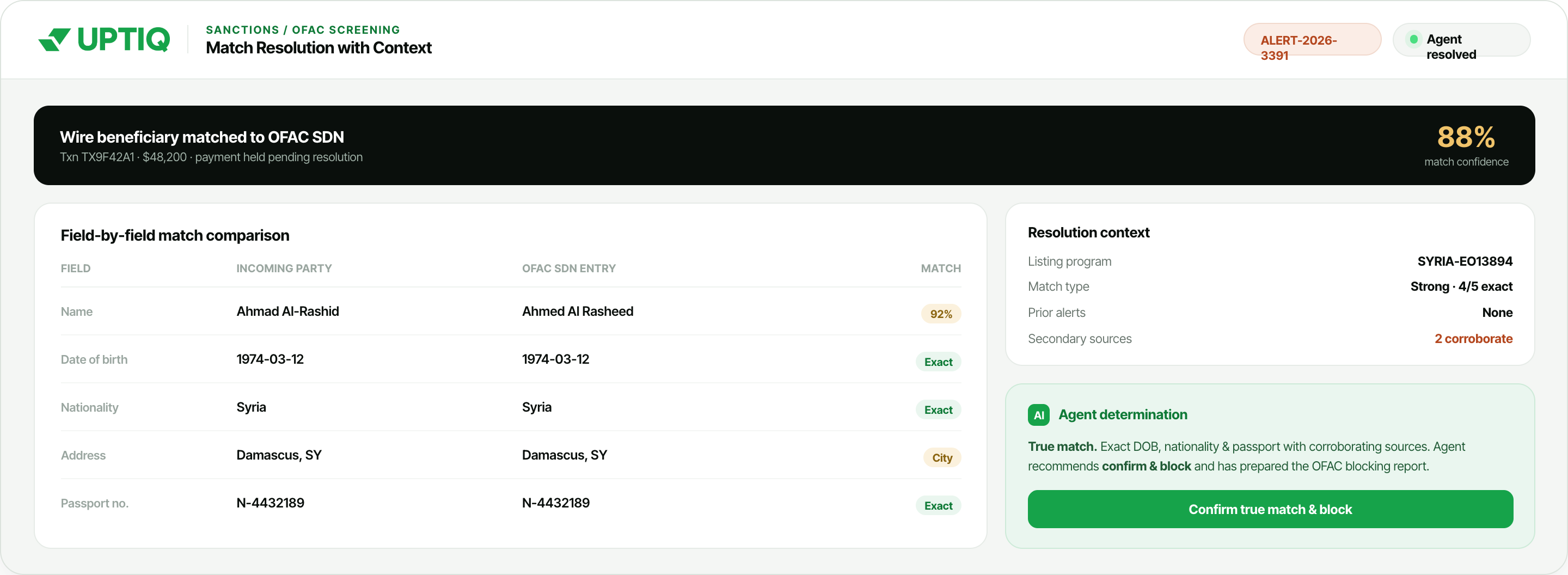
The match resolution package assembles, in a single structured document, the information an adjudicator needs to make a defensible determination on a potential match alert: the matched watchlist entry with the full SDN or list record, the specific matching basis, name similarity score, identifier match, address overlap, or ownership linkage, the transaction party's complete profile including known identifying information, the relationship history between the party and the institution, any prior screening alerts for this party and how they were resolved, and the available disambiguating information, date of birth, nationality, business registration, or other identifiers, that supports a true match or false positive determination.
The assembly is what changes adjudication from a research task to a judgment task. An experienced adjudicator manually gathering this context for each alert in a high-volume payment environment typically spends significantly more time on data collection than on the determination itself. When the context is assembled automatically, the adjudicator applies their judgment to the determination immediately, which is what allows high-volume programs to maintain the adjudication quality that examination requires without the adjudicator headcount that manual context assembly demands.
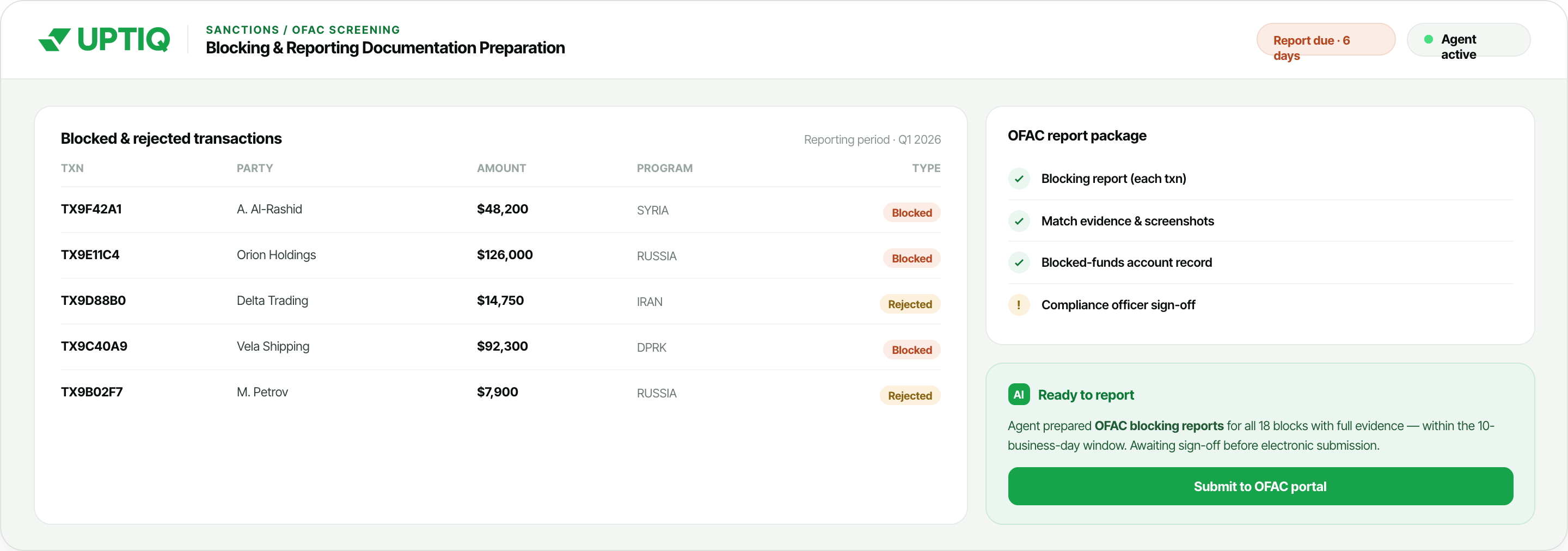
When a human adjudicator determines that a potential match constitutes a true match requiring blocking, the agent assembles the complete blocking and reporting documentation package: the blocked transaction record with the full transaction details, the matched SDN or list entry with the matching basis, the blocking action timestamp, the adjudicator's determination and rationale, and the OFAC reporting form populated with the required fields for the transaction type. The package is presented to the designated compliance officer for review and submission authorization. The report is not submitted to OFAC until the authorized compliance officer has reviewed the package and approved the submission.
Reporting deadline management is built into the blocking workflow: OFAC requires that blocked transactions be reported within ten business days of the blocking action, and the agent tracks the reporting deadline for each confirmed block from the moment the blocking determination is recorded, escalating to the compliance officer if the submission package has not been authorized before the deadline approaches. This deadline management is what prevents the reporting violations that frequently result not from failure to identify a true match but from failure to complete the reporting process within the required timeframe after the match is confirmed.
Most institutions are screening payments in real time within a matter of weeks. Uptiq handles payment system integration, watchlist source configuration, matching logic tuning, and adjudication workflow setup during deployment. Matching logic is calibrated during deployment to the institution's transaction population and party name conventions, tuning the false positive rate to a level that is manageable for the adjudication team without increasing the risk of true match misses, which is the fundamental tension that sanctions screening program calibration must resolve.
Many institutions begin by deploying the screening and match resolution capabilities against their highest-volume payment channels, then extend to additional channels in subsequent phases. For institutions replacing a legacy screening system, the deployment process includes a parallel run period during which both systems screen the same transactions, allowing the institution to validate that the agent's match detection rate is at least equivalent to the legacy system before the transition is completed.
Yes. The platform includes SOC 2 Type II compliance, encrypted data handling, role-based access controls that restrict screening results and match resolution packages to authorized BSA/AML and compliance personnel, and comprehensive audit logging of every screening event, match determination, and reporting action. Transaction and party data are handled within the institution's configured data environment, and the complete audit trail for each alert, from initial screening through adjudication to any blocking and reporting action, is retained for the examination periods required by applicable BSA and OFAC recordkeeping regulations.
The per-alert audit trail is designed to satisfy the specific evidentiary standard that OFAC applies when reviewing a sanctions compliance program: for every alert, the examination should be able to identify what was screened, which list was matched, what resolution context was reviewed, who made the clearing or blocking determination, when that determination was made, and what reporting action was taken. The agent's audit trail produces this record automatically as a byproduct of the normal screening workflow rather than requiring separate documentation assembly for examination preparation.
Legacy OFAC filters and rule-based screening systems apply name-matching algorithms to produce alerts and surface the raw match result — the name, the list entry, and a similarity score. They do not assemble the resolution context that adjudicators need to make defensible determinations; they do not apply ownership and control screening to entity parties at the FinCEN standard; they do not manage reporting deadlines for confirmed blocks, and they typically do not maintain the per-alert audit trail in the format that examination scrutiny requires. Alert handling after the initial match is left to the adjudication team to manage manually.
The agent replaces the manual steps that legacy systems leave for adjudicators with automated context assembly and structured workflows, but it does not replace the adjudicator's judgment, which remains the essential human element of a sanctions compliance program. The combination of comprehensive real-time screening, automated match resolution context, and managed reporting workflows is what allows an institution to operate a high-quality sanctions program at the payment volumes that modern institutions process, without either compromising adjudication quality by pressuring adjudicators to clear alerts faster or expanding the adjudication team proportionally with payment volume growth.
Our team handles deployment end-to-end, from configuration to go-live. Most financial institutions are live within days, not months.