Score every transaction in real time, investigate flagged cases with the full account context investigators need, detect fraud rings linking accounts across your portfolio, and prepare recovery and SAR pathways, while keeping every confirmed-fraud action with a human.


Replace reactive fraud review queues, manually assembled investigation case files, and isolated account-level analysis with a continuous fraud surveillance workflow that scores in real time, investigates with context, and connects the cross-account patterns that organized fraud rings depend on hiding.


The Uptiq Fraud Detection & Investigation Agent is an AI-powered solution that scores transactions for fraud risk in real time before settlement, assembles complete investigation case files for flagged transactions, detects cross-account fraud ring patterns through network and behavioral analysis, and surfaces recovery and SAR obligation indicators for human review. Every confirmed-fraud determination, every recovery action, and every SAR filing decision remains with the human investigators and compliance staff who carry the legal and operational accountability for those actions.
The result is a fraud program that catches more fraud before settlement by scoring in real time, closes investigations faster by assembling case context automatically, and surfaces organized fraud ring patterns that isolated account-level review structurally cannot detect. For institutions managing growing transaction volumes without proportional growth in investigator capacity, the combination of real-time scoring and automated case file assembly is what makes the fraud detection program scale without sacrificing the human judgment that fraud investigations require.
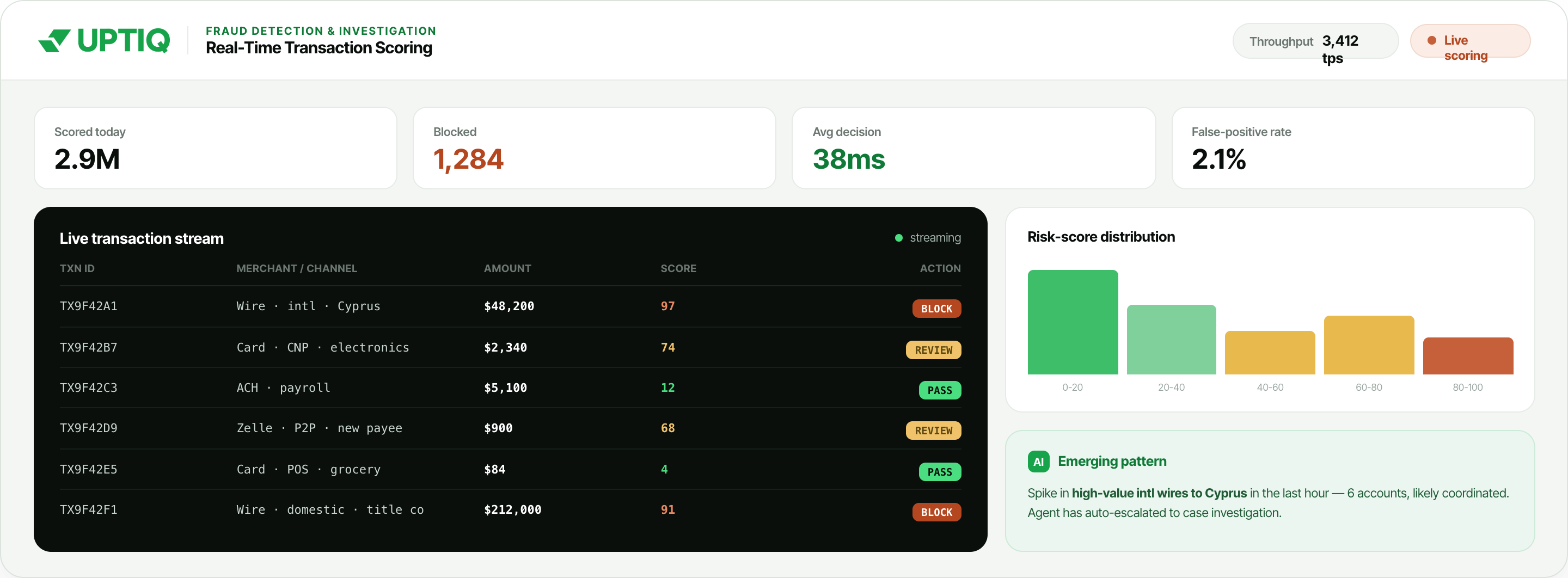
Real-time scoring evaluates each transaction against a multi-dimensional set of fraud indicators, transaction velocity and amount relative to the account's established behavioral baseline, device and IP reputation signals for digital transactions, payee or counterparty network risk, geographic anomalies, and pattern recognition signals drawn from the institution's fraud case history. The scoring model applies these indicators simultaneously to each transaction as it processes and returns a composite risk score with the specific signal drivers that contributed to it, before the transaction completes.
The signal driver detail is what makes the score actionable for investigator triage rather than simply a number to threshold against. An investigator receiving a high-score alert with "account velocity 8x 30-day baseline, payee first-appearance, device previously associated with fraud ring case #XXXX" can make a triage decision in seconds. An investigator receiving a score of 0.87 without signal context must reconstruct that information before the triage decision is possible, which is the manual step that pre-settlement intervention requires eliminating.
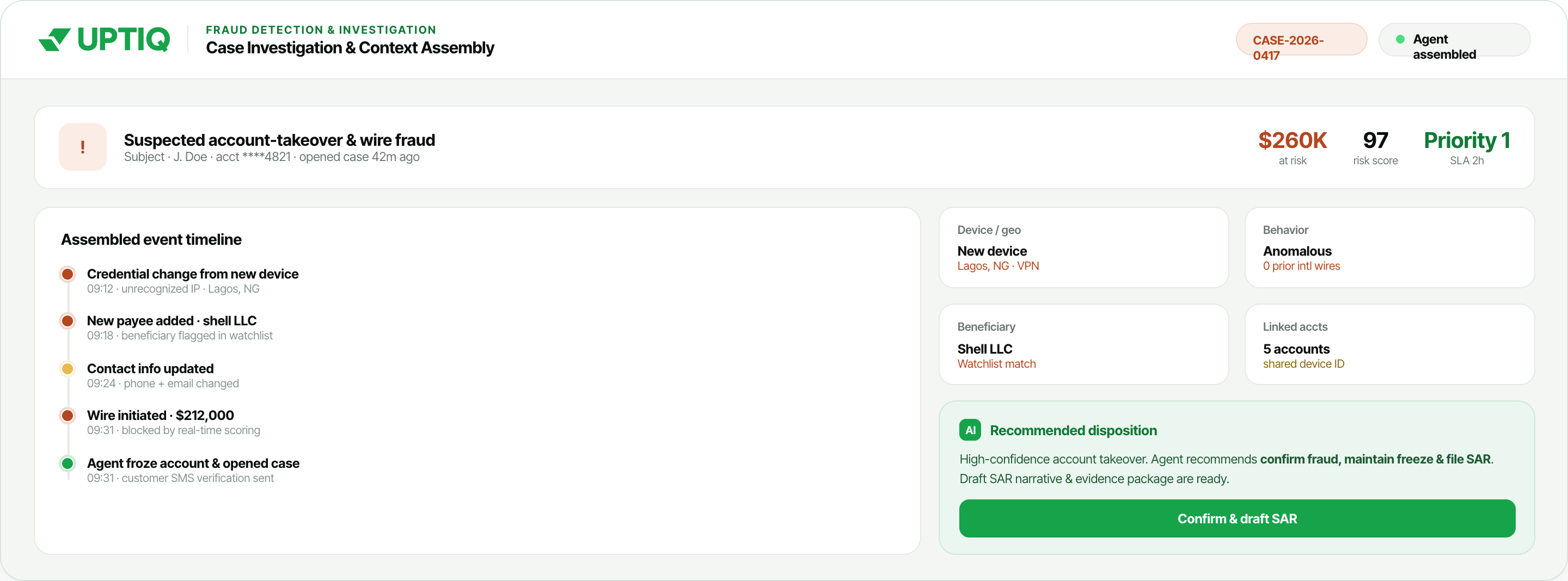
An assembled case file contains: the flagged transaction with full detail, the scoring rationale with each contributing signal, the account's complete transaction history for the relevant look-back period, behavioral baseline statistics for comparison, all prior fraud flags and investigation outcomes associated with the account, related account or entity linkages identified through network analysis, device and IP history for digital transactions, any external adverse signals associated with transaction parties, and the SAR obligation indicators relevant to the case pattern. The file is formatted for the investigator's review workflow, organized to support the disposition decision rather than as a data extract.
The assembly process is what compresses investigation time: an experienced fraud investigator manually gathering this context from multiple systems typically spends 20 to 40 minutes on data collection before the actual investigation analysis begins. When the case file is assembled automatically and delivered at alert time, that time is applied entirely to the analytical judgment that determines the disposition, which is the portion of the investigation that requires human expertise and cannot be automated.
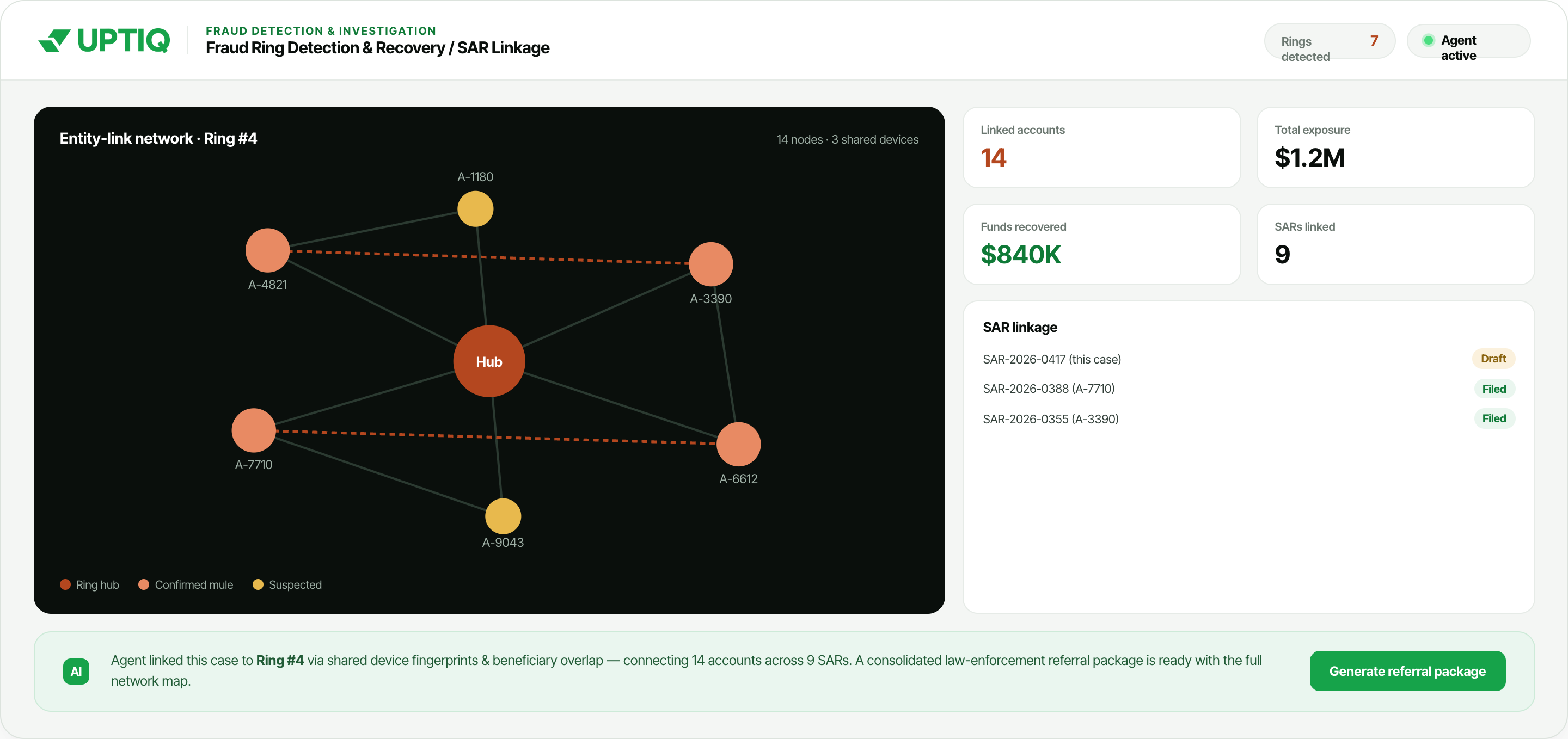
Fraud ring detection constructs a network graph of the relationships between accounts, devices, IP addresses, phone numbers, email addresses, payees, and other entity identifiers across the institution's full account population, and analyzes that network for the structural patterns that characterize organized fraud schemes: shared devices or credentials across multiple accounts, common funding or beneficiary relationships, coordinated transaction timing, and entity clustering around a common fraudulent payee or scheme operator. These patterns are invisible in account-level review because each account looks individually normal; they become visible only when the cross-account relationship layer is analyzed.
Ring detection findings are surfaced as structured case packages that identify the accounts involved, the linkage evidence connecting them, the estimated scheme pattern, and the recovery and SAR obligation indicators relevant to the detected ring type. Human investigators review the package and determine whether the pattern constitutes a confirmed fraud ring, which accounts for what actions to take, what recovery actions to pursue, and whether and how to file SARs. The agent identifies and connects the pattern; the investigators own every action that follows from it.
Most institutions are scoring transactions and receiving investigation case files within a matter of weeks. Uptiq manages transaction data integration, behavioral baseline configuration, scoring model calibration to the institution's fraud case history, and case management system integration during deployment. Initial scoring model calibration uses the institution's historical fraud case data, confirmed fraud, false positives, and known fraud ring cases to tune the signal weights to the institution's specific transaction population and fraud pattern profile.
Many institutions deploy real-time scoring and case file assembly first, which produce immediate investigator efficiency gains, and add fraud ring detection in a subsequent phase once the behavioral baseline is established from the current transaction population. Ring detection accuracy improves as the network graph builds depth from the live transaction stream, so phasing the deployment allows the ring detection capability to reach its full effectiveness before it becomes the primary output the investigation team relies on.
Yes. The platform includes SOC 2 Type II compliance, encrypted data handling, role-based access controls that restrict fraud scores, case files, and ring detection findings to authorized fraud and financial crimes personnel, and comprehensive audit logging of every scoring event, case file assembly, and ring detection finding. Transaction data and investigation records are handled within the institution's configured data environment and retained for the periods required by applicable BSA and SAR recordkeeping obligations.
The agent's human-action architecture ensures that fraud scores, case files, and ring detection findings are inputs to investigator judgment, not automated dispositions. No account is restricted, no transaction is blocked, no SAR is filed, and no recovery action is initiated by the agent. This architecture is consistent with the BSA/AML examination expectation that fraud and SAR determination decisions are made by human investigators with the authority and expertise to assess the evidence, not automated by systems that apply threshold rules without contextual judgment.
Transaction monitoring systems apply rule sets, typically velocity limits, amount thresholds, and country lists — that produce alerts when a transaction triggers a configured rule. They are designed for BSA/AML compliance monitoring rather than fraud detection; they do not assemble investigation case files, and they do not detect cross-account fraud ring patterns because their analysis is account-scoped. Rule-based fraud platforms improve on transaction monitoring by applying more sophisticated scoring, but they still typically deliver an alert without the assembled case context that makes the investigation efficient, and most are not designed for the network-level analysis that fraud ring detection requires.
The agent combines real-time behavioral scoring, automatic case file assembly, and cross-account fraud ring detection in a single workflow that is designed for the full fraud investigation lifecycle, from detection through case preparation to recovery and SAR linkage. The combination is what changes the investigator's experience from receiving alerts that require extensive manual follow-up to receiving investigation-ready case packages that allow disposition decisions to be made at the point of triage.
Our team handles deployment end-to-end, from configuration to go-live. Most financial institutions are live within days, not months.